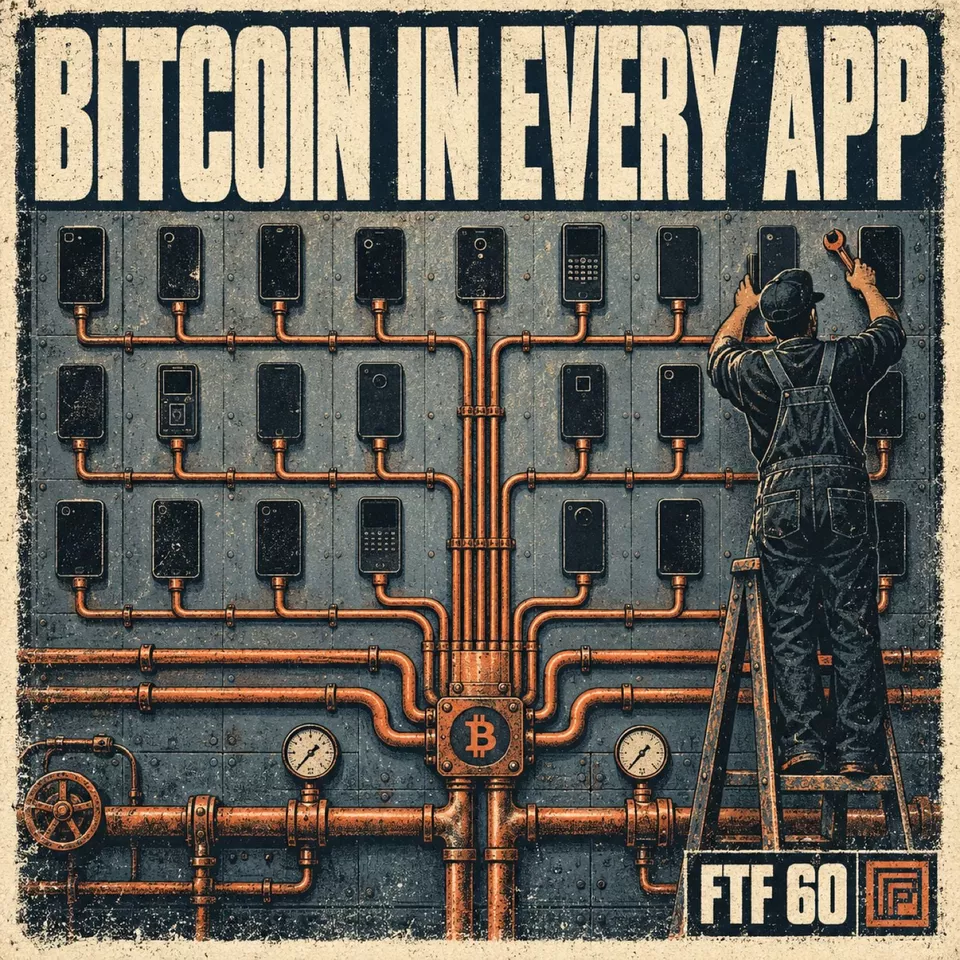
Bitcoin in Every App
Discussed in this episode
Boost this Episode
Send sats directly to the creators. Value for Value.
Plus 1% to Podcast Index, 1% to Boost Bot.
Show Notes
A weekly live show covering all things Freedom Tech with Max, Q and Seth.
This week we're joined by Roy from Breez to talk about how the nodeless SDK has evolved, moving from Liquid to Spark after Boltz suspended swaps in August citing AI-assisted attacks, and why Breez picked Spark over Ark: Roy says payments need a near-perfect Lightning operator and that liquidity, not the ledger design, is the real bottleneck.
We get into what Breez takes on as a Spark operator, the closed-source nature of Lightspark's SSP versus the open-source SSP Breez has now released, and why Spark's confidential transactions and oblivious send are still on the roadmap rather than shipped. Roy is blunt that Lightning was never a privacy tool, that around nine nodes handle 80-90% of network volume, and that Spark's privacy model is comparable to an LSP rather than something better.
We also cover the stablecoin features (Stable Balance, instant on-chain deposits via zero-conf), the Glow reference wallet, and how AI coding tools have cut SDK integration times from weeks to days, including partners going from API key to production in under 24 hours. Links: Breez SDK (Spark) docs, Spark FAQ, Cake case study, Radar case study.
HELP GET SAMOURAI A PARDON
- SIGN THE PETITION ----> https://www.change.org/p/stand-up-for-freedom-pardon-the-innocent-coders-jailed-for-building-privacy-tools
- DONATE TO THE FAMILIES w/ USD ----> https://www.givesendgo.com/billandkeonne
- DONATE TO THE FAMILIES w/ BTC ----> https://pay.zaprite.com/pl_JpxtkLv95T
- SUPPORT ON SOCIAL MEDIA ---> https://billandkeonne.org/
TO DONATE TO ROMAN'S DEFENSE FUND: https://freeromanstorm.com/donate
VALUE FOR VALUE
Thanks for listening you Ungovernable lot, we appreciate your continued support and hope you enjoy the shows.
You can support this episode using your time, talent or treasure.
TIME:
- create fountain clips for the show
- create a meetup
- help boost the signal on social media
TALENT:
- create ungovernable misfit inspired art, animation or music
- design or implement some software that can make the podcast better
- use whatever talents you have to make a contribution to the show!
TREASURE:
- BOOST IT OR STREAM SATS on the Podcasting 2.0 apps @ https://podcastapps.com
- DONATE via Monero @ https://xmrchat.com/ungovernable
- BUY SOME STICKERS @ https://ungovernable.network/shop/
FOUNDATION
https://foundation.xyz/ungovernable
Foundation builds Bitcoin-centric tools that empower you to reclaim your digital sovereignty.
As a sovereign computing company, Foundation is the antithesis of today’s tech conglomerates. Returning to cypherpunk principles, they build open source technology that “can’t be evil”.
Thank you Foundation Devices for sponsoring the show!
Use code: Ungovernable for $10 off of your purchase
CAKE WALLET
Cake Wallet is an open-source, non-custodial wallet available on Android, iOS, macOS, and Linux.
Features:
- Built-in Exchange: Swap easily between Bitcoin and Monero.
- User-Friendly: Simple interface for all users.
Monero Users:
- Batch Transactions: Send multiple payments at once.
- Faster Syncing: Optimized syncing via specified restore heights
- Proxy Support: Enhance privacy with proxy node options.
Bitcoin Users:
- Coin Control: Manage your transactions effectively.
- Silent Payments: Static bitcoin addresses
- Batch Transactions: Streamline your payment process.
Thank you Cake Wallet for sponsoring the show!
MYNYMBOX
Your go-to for anonymous server hosting solutions, featuring: virtual private & dedicated servers, domain registration and DNS parking. We don't require any of your personal information, and you can purchase using Bitcoin, Lightning, Monero and many other cryptos.
Explore benefits such as No KYC, complete privacy & security, and human support.
(00:00:00) Welcome to Freedom Tech Friday
(00:02:45) Roy Joins Us
(00:05:04) Eight Years of Breeze
(00:14:19) From Lightning Limits to Liquid
(00:18:09) The AI Attack Wave
(00:24:07) Why Spark Won
(00:31:22) Don't Put Your Life Savings on Layer Two
(00:37:41) Life as a Spark Operator
(00:39:17) Breeze Builds Its Own SSP
(00:43:14) Lightning Was Never Private
(00:49:36) Bitcoin in Every App
(01:00:28) See You Next Friday!
Hello, and welcome back to Freedom Tech Friday, a weekly live and interactive show hosted on the ungovernable network.
Each week, we go live for one hour every Friday at 9AM eastern and 2PM UK time, but you can, of course, catch up later across the feed. On Freedom Tech Friday, we like to cover the latest news and trends for anything relating to Freedom Technologies.
That could be anything from Bitcoin or Monero, encrypted messengers, privacy tools, and everything in between. Essentially, if there is a news item tool or topic that can help you take back some control in today's digital Panopticon,
then we want to talk about it. My name's Q and A, and I'm head of customer experience at Foundation. And as always, I'm joined by my good friend Max, the head honcho of the ungovernable network. But this week, not Seth, who is yet again jet setting around the world.
I don't actually know where in the world he is, but he's at a conference somewhere. Probably Nashville. Probably Nashville, yeah. Tops before from the last show with Nathan Day comes from Late Stage Huddle who sent 6,006 stats
and asked the question, what happened to reading questions from Twitter or Nosda during the show or is it only live boosts? We do have irregular question shows now but because we try and keep these shows down to one hour, we more than... More often than not don't have time to take any random questions. But for those people
boosting live or getting in the live comments and asking questions relevant to our topic or guest, of course, we will do our best to answer them. But thank you for your support, Lazy Stage Hubble.
Without further ado, Max, how are you doing? Very good, mate. Killed off all the giant centipedes now, so no longer being attacked. Just me and the frogs. Very happy and excited to dig in today.
Good. Good stuff. Well, as I say, we are set less this week, but we've got somebody who's more than capable of filling his boots with us this week. We have Roy from from the Breeze team. How's it going, Roy?
Doing great. Doing great. How are you guys? I'm all good. I'm all good. I'm not jet setting like Seth, although I do have a couple of conferences coming up next month. You've on your travels much lately?
Not really. I'd say, like, with regards to kinda the beacon circle, I tone it down this year. I'm doing less conferences. Although the week after next, I'm in Lugano Nice. And the and the plan before. So it's gonna be an entire week. It's gonna be cool there.
Yeah. I've seen, ironically from Seth, some photos of Lugano when he went there last year, and it looks like an absolutely beautiful scenery for for a Bitcoin conference. Have you been before? Both.
Yeah. I've been several times in the plan before and many times in Lugano because there's, like, a proof of work hub there, Bitcoin space, with with people from... With Giacomo and people from Blockstream, and my good friend Marco from ArcLabs has an office there in Lugano. So I've been there in August to visit them. Yeah.
Very nice. Very jealous that you're you're getting to go out there. Lugano is beautiful. Heaven in the summer could be hellish in the winter, so we'll see. Yeah. Not so easy to get around, I can imagine, when there's snow everywhere.
It's not really snowy, but it can definitely rain cats and dogs as you pretty say. Nice. Nice. Alright. Well, there there may be a a small handful of people listening to this that live
in a cave and don't listen to podcasts very often. So for the benefit of those people, why don't we start at the very bottom and just get a brief catch up on you and what Breeze is so that we can set the scene for for today's conversation?
Definitely. So I started Breeze It's about to say. Eight and a half years ago in in an attempt to help Bitcoin transform from a medium of exchange to a store of value. That was early twenty eighteen. And for the OGs out there that you remember, the the the Bitcoin Cash versus
the BlockSize wars, it was kind of the aftermath of the BlockSize war with the inception of the Lightning I saw an opportunity kind of to... Yeah. I I was a Bitcoiner since 2013, but in in early twenty eighteen, I saw an opportunity kind of to put my effort, my professional capabilities into Bitcoin and help Bitcoin kind of evolve from
digital gold to a real world currency. And that was because of Lightning Network. Lightning Network kind of was the the technological evolution that I thought would work building on, and that's how I start kind of my journey, my professional journey in the Bitcoin space.
It's been a long journey, really a roller coaster with... I I knew it would take a lot a lot of time to to help Bitcoin evolve, and... But, I didn't expect so much, so much, things to happen, throughout the journey.
Maybe you you... There are folks that even use kind of the first... So we we went to market with Breeze with the Lightning Wallet. We were the first company to run a fully fully featured Lightning node inside a mobile device.
So we were able kind of to run LMD inside the mobile device, and then we came up with this concept of an LSP, a Lightning service provider that helps you with the user experience of opening channels and and and not needing to search for peers to connect, having inbound liquidity. So when you onboard to a wallet, you immediately
can receive funds.
And and from that, we've done stuff with other models, like having the node on the cloud with GreenLight, with the GreenLight project from Blockstream. We dabbled in liquid,
and now we're kind of focused on on on on Spark, and we're not really a wallet company anymore. We're an SDK. SDK... The Breeze SDK, the Breeze software development kit is our primary product where we help companies, services, developers integrate instant Bitcoin into their solutions.
So that's kind of in a in a nutshell. Yeah. You... It's it's almost as if you can read my my show notes because you just kind of glossed over all of the stuff that I'm... I wanna ask more questions about, so that's perfect info.
We can discuss four hours for every little bit of what I just said. Yeah. Absolutely. So... First off, I can't believe it's been eight years. Holy crap. Doesn't time fly when you're when you're having fun with it going cheese.
Yep. Breeze was my first noncustodial lightning wallet. I was, you know, it was... My apologies. And... Yeah. But, you know, there there... There's a famous Reid Hoffman saying that if you're not embarrassed by your first product, you probably were too late to market. So kind of that's that's our philosophy, basically, to try early,
to get market feedback, to iterate, and to use the best technology at the time. So... Yeah. Absolutely. And I'm glad you said that. I mean, Bon in the chat has just said Breeze was a game changer. It worked, Roy, and I couldn't agree more. For its time, like, it felt like I was living in the year 3000.
It was it was such a great wallet. And
what what were some of the things as as the the the wallet itself kind of matured? What were the kind of stumbling blocks that you came over that have made... You know, have influenced the decisions that you've mentioned where you've switched to Liquid and then moved on to Spark, and now you focus more on the SDK?
Like, what was the the the kind of... What was that journey like? Mhmm. I I think when we first launched and we came out with the Breeze mobile with the OG app, we kind of brought you... A new model to to the market where you didn't need...
You you had a fully featured Lightning node, but but we also kind of help you
onboard really quickly by kind of inventing this concept of a lightning service provider that opens a channel to the end user and connect them to the network. That's the kind of the the concept we brought to market, and that's why a lot of people back in the day felt like it was magic.
Back at the time, there was Eclair. That was kind of the first iteration of Phoenix or what is known today as Phoenix. And there was the Zap wallet from Jack Mallers. And there... I think there was, like, an Anthem wallet that everyone used where you had an old device, but you kind of were stuck there.
Okay. Where... What should I do after I have a Lightning node? No one really knew. And we kind of improved
that and and kind of brought this LST concept to market a concept that still people use. Like, Phoenix is an LST today and Zeus has an LST today, and everyone that wants to connect end users to Lightning using... Is using kind of the LSP concept.
But we operated and we had many thousands of active users and tens of thousands of users for the Brisk mobile. We operated a very large LSP. And I, after a year or two of operating that, I saw that, it has it has a a really... Even with splicing and with advanced liquidity management,
there is a cap to how many users you can you can onboard from an economical standpoint. Because operating Lightning as a last mile solutions for end user from an economical standpoint, it it simply doesn't scale.
It come... It came to a point where we came out with another concept to the market, which back in the day, we called it an open LSP, where we onboarded more liquidity providers in help... To help us onboard more users to the Lightning Network.
And once I out... Started outsourcing liquidity and started connecting outside providers to onboard users, then I lost control over the quality of the product because running a Lightning node, making sure you have a very high success rate of payment is is is still was back in the day. It was very much an art. And without
an excellent team that is dedicated to it, it's... It was kind of practically impossible. So I couldn't kind of outsource liquidity, the yield that was that was generated to these LSPs from
the lightning activity wasn't enough. So the economical model of lightning... I cannot realize that the economical model of Lightning... Because Lightning wasn't still, like, infrequent payments isn't enough. You need a high frequency channels to make it economical for for LSPs.
It does happen with with larger... If you onboard a merchant that is frequently sending and receiving lightning, it can happen. But for the most part, for the 80, 90% of the users, they simply don't generate enough activity in order to make it economically justifiable.
So then I had to kind of...
We had to take a step back and think about, okay, where we're going from here because we kind of hit the limit of Lightning, like, of kind of providing nodes to end users. Is that what pushed the change to liquid?
And Yes. Was that something that then ran alongside an LSP, or was it replacing... Was it a switch, of course? We deprecated the old g solution just in the past year. So we have been running kind of the Breeze LSP for a long, long time until we kind of deprecated it. Liquid was always...
So so what's... What is, like, the... Conceptually, liquid means you have a wallet...
You have another wallet, and you're... In order to kind of to do Lightning payments, you need to do swaps, atomic swaps from the wallet that you have to to to the Lightning Network or from the Lightning Network.
Liquid for for me was always a stop gap solution because it's not it's not a really Bitcoin wallet. When you run a liquid wallet, you run... You you really hold a pegged BTC, lick... An LBTC.
You don't have a unitary exit and and so... But the concept of kind of having swap, which which was already proven kind of by Moon, those who were using kind of the Moon Wallet, m u u m, know that the the concept really works with Bitcoin on chain. So Moon is a Bitcoin on chain wallet that you could could have interrupt
with lightning through atomic swaps provided by Moon. The problem is that this model doesn't scale when when when there's, like, a mempool conjunction and the fees are high, then the entire model breaks.
Liquid doesn't have that problem because the fees are are because there's no activity... There wasn't activity on Liquid before we brought kind of the Lightning people to Liquid. Activity was very low. The the the the blockchain time is one minute Mhmm. On the clock. Like, every minute, there's a block that's being mined.
But I was eyeing kind of the sparks and arcs of the world while we're working on the on the liquid solution. And so Yeah. Once once those kind of matured, we we we move to to spark. And so were you affected by the shutdown of Boltz and the hack on Liquid, or had you already
sidestepped it? I was... Yeah. Eighty eighty, 90% of our partners were already on Spark. So we started the the the transition to Spark six months before the liquid hack, urging existing liquid for customers to migrate to to Spark.
The liquid... Both shutting down and the liquid hack was kind of the the final nail in the coffin that kind of urge the the the the remaining 10% to to move to Spark. So I was affected, but mildly affected because
I can't say I envisioned it, but the fact that it's not, like, it's not like a true b t c solution was always something that were were... Was troubling me. So that's why it kinda... We started the shift early on.
Yeah. And that's why we weren't as affected as other solutions in the market. What was that feeling like, you know, running what you run with all of the crazy hacks and stuff? It seems to me as an... As a nontechnical person that the last six months has been crazy.
Like, is it felt... Me and Q have been chatting every single week. We've done a show or two for, I don't know what, Q, the last five years or something together, and it's never been as crazy as it has been. Crazy. Crazy. Yeah.
It feels, well, I'm I feel that I was very proud of the team. The team, I think, performed really well during during this time. I think we were able to make right decisions prior
to the wave of attacks that kind of made us
made... Put us in a better position
in the market. And... But it's still challenging, by the way. I think, I think... First, a shout out to Bolt. I think Bolt is one of the most capable teams and just a great people, like a great great...
Like, Michael and Kilian are are close friends of mine, and I don't think there is a more capable team in the Bitcoin space. The fact that they got hacked is a red flag to every every team, every Bitcoin team that is managing a hot wallet and and and funds.
Because if bots couldn't sustain the attack, it means something had... Has dramatically changed, in the ecosystem. And I think something has dramatically changed in the ecosystem because there's an inherent asymmetrical position between the attackers and the... Those that are being attacked.
Small teams, has to protect themselves from, from AI generated attacks, but these AI generated attacks are funded by serious, teams that are be... There are serious teams, governments that are behind these attacks.
And these teams are very well funded, and and and they're using a lot of resources, a lot of tokens, and a lot of money in order to plan these attacks. There were a lot of reported attacks, but there were a lot of... There are a lot of unreported attacks.
And things are still crazy. Like, people are still trying to attack Bitcoin project because Bitcoin is the low hanging fruit here. It's open source. It's about money. There's a lot of projects that are dealing with hot wallets. Like, it's it's it's an easy attack vector.
We might... I think we might kind of starting to see consolidation in the market, like small teams leaning on bigger teams in order to mitigate these attacks. Like, the Bitcoin Red Team is an example of that, meaning there's, like, a coalition of resources that help protect the smaller projects.
And... But, also, I think we'll see consolidation in the infrastructure. I don't think small teams will be able to sustain their infrastructure themselves, but we we we will see a convergence in the market in order to kind of to be shielded from these types of attacks. And I think what we're seeing now is just the first wave of attacks.
Now the the the first wave is is by kind of analyzing the code and and finding exploits in the code, but there's... There are many more types of attacks that are are... That can happen,
multidimensional attacks. It's not just of... Because of the code, it's also how the system is ran. You can DDoS very easily, and you can exploit through DDoS. You can do a lot of social engineering as well. So I think, like, what we're seeing right now, we we need to brace ourselves and be prepared for what comes next.
Yeah. It definitely feels like we're we're in a brave new world that seems to be changing literally day by day at the moment. So, yeah, I I echo all of all the thoughts you... That you just said and just hope and pray that people are are attacking themselves and using introspection
before somebody else does it for them and and steals all that shit. In terms of the fuzzing, there's a lot of... I think Bitcoin is also kind of... The fact that Bitcoin Core did... Was very well tested
was because of the capable people that work on Bitcoin. I think we were... You can say blessed, but it's not blessed. Like, it's it's it's because of their skills. So
shout out to the Bitcoin core team that is taking a lot of crap for many people out there, but they're angels, really. Agreed. Yeah. There's a lot to be said for slow, steady, and careful development. I completely agree there.
Going back to to the kind of Breeze journey, we we got as far as Liquids, and then obviously you've now moved across to to Spark. What was it about Spark and the trade offs that come with it that made it the the next natural step for you that maybe, you know, what... How did it fill the void that Liquid couldn't?
So From a user experience standpoint,
the the the transactions were faster because you didn't need to wait for a liquid block to complete in order to complete the transaction. So it it... Spark for those... For the the the folks that are listening and are are not familiar with Spark, Spark is is a type of a federated state chain, meaning there are operators
that are coordinator... Coordinating signature switching within a transaction offline in order to facilitate offline Bitcoin transactions. So we're talking about Bitcoin transactions. Every Spark transaction is a Bitcoin transaction, and we're talking about real Bitcoin and not pegged Bitcoin. So it's it's real BTC that is transferring.
That means that you also have real unitary exit. You can exit Spark without the permission of the operator or without coordinating anything with anyone. So that was from a kind of a first principle standpoint. I think that was something that drew me immediately into Spark. Secondly, I like the simplicity
of the of the state chain model. I think there are, of course, it's not a trustless solution. You are trusting the the the Spark operators, but the one of n security model where you need at least one honest operator in order to to
to be okay with Spark. And the fact that we are now running an operator, I think that's something that made me very comfortable in kind of onboarding partners to Spark. As... And and so from a user experience standpoint, I think it's like it's it's it's super fast transactions.
It's the unitary exit. It's the fact that you can receive offline. Because of the Spark model, you can receive offline a Lightning transaction. That's a game changer. And I I have to say, people aren't familiar with Lightspar, but I went to see Lightspar.
I saw... I met with the Lightspar team. I met with the people. I saw how they operate, and I was very, very impressed by their execution. Think a lot of... There's a lot of naivety in the Bitcoin ecosystem.
People think it's about
just the code or or or or the software itself. But if you are running a startup or if you're part of a start up startup, you know that execution is is is the game changer. And the and the and the team at Light Spark is executing.
Like, it's the... Maybe the best... May... They may be the best executors in the Bitcoin ecosystem, And I was very impressed with the the... Their way of execution, which was different
to other partners that I've worked with in the Bitcoin ecosystem. And I worked with many, and some some of them are really big names in the Bitcoin ecosystem, but they don't know how to operate a service.
And Lightspark, because they're coming from this Silicon Valley mentality, they're very seasoned in running software companies. I immediately find... Found a lot of synergy with the way they operate because I also come kind of... I I come from enterprise software background, and I always was kind of...
I I I didn't feel well seeing how companies are operating in the Bitcoin ecosystem. And with Light Spark, I felt different. So so it's the Light Spark way of execution, and it's all the kind of the properties that the Spark federated stage and brings with it.
The way that you've kind of just talked about Spark there, it it seems as though it is almost like the perfect solution. If you were to play devil's advocate to your own kind of justification
there, what are some of the things when people interacting with Spark or the Spark system or or a Spark wallet that they should also kind of be aware of? There's nothing perfect in software, and there's nothing perfect...
On chain isn't perfect, but it's the... It's kind of the best manifestation of a perfect software we have. When we say offline and off chain and we're talking about layer two, I think everyone should understand we're talking about trade offs. Like, there's always a mix of trade offs when we talk about a layer two.
And and and and so so perfect is not a part of my jargon and shouldn't be part of anyone's jargon that is kind of building a layer two. We need to minimize the trust but acknowledge that there is trust.
So let's play devil advocate on on on on Spark. You are trusting Spark, meaning your funds can be... The the Spark operator, if they collude with the previous owner, they can steal your funds.
You need all the Spark operators to collude together with the previous owner, but, again, I'll be the devil advocate.
The previous owner can be Spark themselves because there's an SSP component to Spark. So for example, if you're receiving a Lightning transaction, you're basically swapping a Lightning transaction in exchange for Spark Leafs. These Spark Leafs are given to you by a a Spark user called an SSD, a Spark service provider,
and the SSD can collude with the Spark operators in order to steal these leaves. So you need at least one honest operator to stop this, this from happening. And so this is something that is kind of built into the state chain model and people should be aware of. So it's not Yeah. Perfect in that in that regard. Secondly,
there is a... With a privacy... Sorry, Max. You wanted to say something? Yeah. No. I was just gonna sort of butt in with a, again, a nontechnical view of these things is that, to me at least, this whole liquid hack makes me think that sometimes the obvious attacks, like you're running through there,
are maybe not the only attacks. Like, you could look at Liquid or or someone like me would look at Liquid and say, oh, well, that's pretty safe because they've got this federation and, you know, it would need collusion and need this and need that. And then there's a complete sideswipe
of something that no one saw coming. So my view on all of this stuff... And and maybe it's No one saw coming or so or or... Yeah. No. I I... It's it's it's super fair, and it goes... It's very aligned to what I said about execution.
Because if the the the the Liquid Federation was to execute on on on higher standard, this attack would have been prevented. Because the core principles of Liquid should have prevented this attack from happening, but allowing a a a hot wallet takeouts to be done by a Liquid Federation member,
and people knew about it. Well Mhmm. I didn't know about it, and I was a federation member. But other federation member knew about it and didn't do anything about it. That's kind of the execution issues that I'm talking about.
Yeah. And and because of things like that, I I think I view anything that is hot and anything that's on Lightning, I just view it as I use this for spending, and I only put what I'm comfortable losing on there. And, like, maybe
maybe more technical people would be more comfortable, but I just kind of... Whatever the solution is, whether it's ARC or Spark or Liquid or whatever, like you say, nothing's perfect, and so it works very well, it seems.
And we saw that there are hardware wallets that aren't perfect, and that we can have a multisig solution on chain that aren't perfect. Yeah. Yeah. Yeah. It's it's complicated. Like, I don't have a very clear answer, but definitely, I would second your advice. Don't put your life savings on layer two.
Yeah. Yeah. Yeah. But, again, it doesn't mean that we don't need to do everything that we can in order to improve the trust model and to improve the security models on every avenue. And we've done that with Spark as well. Like, I don't know if you guys remember, but when Spark first launched, every transaction was public. And
and we we kind of worked with the Spark team to make it more private, at least private for... From an outside standpoint because, again, to Q's question about playing a devil advocate, the Spark operators do see the internal transactions.
So it's kind of... It's the same... I I see the the Spark model from a privacy standpoint very com... Comparable to an LSP model where the LSP is is executing the Lightning transaction like the Phoenix model. So I think the privacy model is very comparable to what Phoenix is offering.
There's a lot of justified criticism about Spark, but most of the criticism that I see is complete complete and and bullshit. And so
I think there's a lot of the... A lot of not invented here mentality in in Bitcoin. I think if the, like... If if Spark would have kind of
grew within the lightning... Without... Within the lightning... The Bitcoin ecosystem, I think people would have treated it differently. People are very suspicious about Lightspark as a team. Everyone is is a communist when it comes to Silicon Valley companies in the Bitcoin ecosystem suddenly.
So the free market isn't isn't isn't positive when it comes to to to to other parties, but I see it completely different. I think they brought a level of professionalism to the Bitcoin ecosystem that we haven't seen before.
And I think it's kind of inspired entire ecosystem to work on other solution. I think ARC would have been... Would've would've... Would not have been in the same place that it is now without Spark as well.
So I think there's a lot of positive, but but I but I... Yes. There's a there's a lot more improvement that can be done. By the way, there's a lot of things in Spark that people don't know that is possible, and we're kind of trying to to to to simplify it. We still don't have... We have a wallet called Glo that
is using our SDK. That's kind of our our our reference application for people wanting to implement Spark. We still don't have unitary exit in Glo because we're not happy with the user experience. I hope next week, we'll release unitary exit within Glo so people could see how easy it is to, you know, truly exit.
But there are a lot of other stuff that you can do in Spark, but people are on... Unaware. One of those things is, like, anchoring your state to an on chain transaction, like, similarly to an out of run transaction in an ARC.
It is feasible to do that in Spark, but people aren't aware that is feasible. So there's a lot of stuff that already exist without further improvement, which we're pushing for as well, like confidential transactions and other other improvements.
Yeah. Very cool. I'm looking forward to those those improvements. You mentioned earlier that Breeze is a Spark operator. I'm curious to know what that's been like and how it differs to to being an LSP.
It's very... Like, it's it's it's very different because an operator... The only thing that an... The Spark operator does, it's not an SSP. The SSP is the component in Spark. So there's a Spark entity, an SE, that is comprised of multiple Spark operators, SOs, and they interact with an entity called an SSP in order to,
to facilitate lightning transactions. So an LSP is comparable to an SSP, actually, because it means you need to run the Lightning node, connect to different nodes in the network, manage liquidity, make sure you have 99 dot 99% of the success rate, and that's the heavy lifting when it comes to Lightning.
A Spark operator, the only thing that it does, it's basically validating the Spark transactions and signing transactions. So it's like a... The equivalent of a validator in the Ethereum ecosystem or in the...
Or in or in Zcash or other technologies. Like, it's it's it's a very simple and non demanding work from an operator. I see. I I think I've seen a You just I think I've seen a comment from you somewhere that's... Where you've mentioned that LightSparks SSP is is closed source and that Breeze may or may not be building its own.
What... What's the status of of that and what drew... Drove you to to kind of build your own, presumably the the closed source nature of, I'm guessing? Yes. So the the reason the LightSpark's SSP is closed source because, to be honest, there's no point in open sourcing it because it's using a LightSpark API.
So even if it was open source, like, no one would be able to use it. And people kind of think that if it was open source, they could have replaced the Lightspark SSP and to work with the existing Spark, and that's not true as well. Like, in order to use an SSP within Spark,
you need the Spark operator to sign off on the SSP, and no one would sign off of of an arbitrary third party SSP. So open source doesn't mean that it's not permissionless. People that want to run their own Spark today can use... We released an an open source SSP last week. So we have our own SSP that we've built
and open sourced it, and people are welcome to use it. But we are using it in the... Because we wanted kind of to to to to dabble with advanced features, but also to have a a Rectest environment, an end to end Rectus environment for for for Spark,
for our partners as well. That's why we kind of created our own open source SSP. It doesn't mean that we're running an SSP as part of our solution, but it enables other to use it in the context. So so if someone wants to run their own Spark today, they can. But there's nothing limiting them from running their own SE, Spark entity.
Mhmm. And would it be fair to say that if somebody did that, then it would be two kind of siloed networks that couldn't speak directly to one another, although assuming you would have, like, a... You could have a lightning bridge to get from one network to the other, so to speak. Exact... Exactly.
Exactly. You would need a lightning bridge or a spark to spark bridge. Like... But, yes, it's a siloed network exactly like a different arc. Like, it's comparable to second and arcade, for example. It's two different arcs.
Even if you... Someone would run the same code base of bark, the the implementation from second, they are not... They're... They are not interoperable. You need a bridge, a bark to bark bridge, or or just use the the the... What I call lightning as a common language to bridge between this this implementation.
But to answer your question, yes. If someone would have run-in another Spark today, it would be another Spark that is not inherently interoperable with the existing Spark. They need to bridge between them, but the bridging is easy because Lightning is built into both.
And it's also super easy to do Spark to Spark atom swaps as well. Because in Spark, you have HTLCs inside Spark transactions. So you can do atomic swaps between Spark to Spark without going through Lightning. So it can be very cheap as well to bridge between two Sparks.
There was some things that people aren't really aware of or things that can be done. Mhmm. You mentioned confidential transactions. I was wondering That's that's not available yet. It's something that we're working with the Spark team to to... You know, at... Confidential is a... Is in the road map, basically, but it's not it's not...
Doesn't exist today. It's not currently possible, but but it could be. And Yeah. So it just had me wondering, like, privacy on Lightning in this ecosystem and second layer stuff as a general view. Like, how do you see that developing over the coming years? Because What Privacy. Think there's a lot of
Mhmm. I I think people are selling Lightning first as a privacy solution, and it's not. So I think people should be very cautious about a lot. We see also with the latest hacks. Blink posted their their their report yesterday,
I think, about the the the hacks, and we see a lot of hackers as well trying to launder money through the Lightning Network. Lightning is not a good privacy solution. It's very concentrated.
There are basically nine nodes in the network that are processing 80, 90% of the transactions. So if the if the network is controlled by such a small number of nodes, and you don't need me kind of to say that just, like, you use your favorite LLM to to to scan the Lightning Network, and you'll see
you see kind of the... How the network kind of concentrates into a very, very short list of nodes. If someone get a hold of these nodes, they can know a lot about the the flow of funds.
Oh, I need to say that louder for the idiots in the back. I can't tell you how long I've I've been arguing with people in all of our groups where they say that Lightning is better than Whirlpool and better than Monero, and it's great. Like, listen. I'm not No. That is... It's it's simply rude. Stupid.
Yeah. I... Well, for me, I I never thought about I never thought about Liquid as a as a as a as a good privacy tool, and I'm not coming from that. Like, I I I think I'm... What I'm trying to do at Breeze is to build a solution from... For mainstream...
For the mainstream audience that don't really care about privacy. Let's be honest. It was more a tool for me to promote Bitcoin as a medium of change. If I was a privacy concerned person, I wouldn't have used Lightning, period.
Like, there's no there's no doubt about it. And I'm Yeah. I'm saying that as someone that operated a large node in the network, and I'm saying that because I I I did the the... I did the math, and and I ran the tests. And you can see that most of the flow is concentrated on a very few nodes, and you don't want that. Like, it's
it's very different than... It's a it's it's a very obvious and spoke model, and it's very different than pure peer to peer transactions. Yeah. Yeah. Agreed. I mean, the the advice from anyone who I took seriously in in privacy world was always whirlpool and then open a channel afterwards.
And I'm just... What I'm really wondering is is there something on the road map, or are there clever ideas that that you and others have to help protect people who are using Lightning? Because if we if we look at...
You know, if Lightning is gonna be the thing that helps
people use their Bitcoin, then it is important that people can protect their privacy, with the real world wrench attacks and the real world stuff that's going on as we see just constantly growing. So just wondered if, like, there's anything you can share that you're thinking about.
I don't think you can disassociate the improvements... The on chain improvements from Lightning because every enhancements and improvement that is applicable to to on chain transactions, page owns, and whatnot will be applicable to Lightning as well.
Because as you said, like, that's kind of the the basis of Lightning. It's opening a channel. It's basically performing an on chain transaction. So I think that's that's something that that is good, and there's a lot of improvements on chain privacy related that people are working on.
I think in the context of Lightning specifically, Lightning is evolving. Again, it's like no... People are not really using it as the last mile solution. They are using ARC and Spark a lot more in order kind of to hold the funds and and then do atomic swaps in and out of Lightning.
That's in itself
a a improvement. I think there are two things about Spark specifically that could enhance that. One is the ability of end users to execute the Lightning transactions themselves, meaning sending an encrypted onion message to the SSP, and the SSP won't be aware of the payment destination.
This is on the road map something that we're working with the with the with the Spark team to enable,
what we call oblivious sense. So the SSP will be oblivion to the destination and won't be aware of destination. I think that's that's kind of a low hanging fruit that I'm trying kind of to push towards.
And then there's the the the more challenging enhancement, which is confidential transactions within within within Spar. That's much more challenging, much more demanding, but I think we're gonna get there too.
Some stuff. I wanna spend the last ten minutes talking about arguably what you guys focus on the most nowadays, which is the the Breeze SDK. I wanna talk about like what what features does it enable?
How do how do people start to interact with it? I mean, the obvious answer now is that they talk to their clunker for that one. Exactly. When you say people, like, what do you mean people? Like, percent of my conversation...
My day to day conversations are are with machines. So... Likewise. Likewise. Who who have you been working with? You know, there's some big names, Primal, Cakewallet, Radar, Bitbox. Just walk us through some of the relationships that you've had, what the SDK has enabled, those type of companies and stuff like that.
Yep. So I think we're seeing tremendous growth with our SDK.
We're... In the last four months, we we... We've meet... We've witnessed the 100% growth month over month in the volume that we process, and that's kind of very exciting to see. We have many verticals that are using our SDK in different manners.
So crypto wallets, obviously, that's one very popular vertical. And we we have swaps and bridges that are using the SDK just in to facilitate instant Bitcoin transactions, meaning to bring lightning capabilities to their swaps.
So we have Exolix, and we have Garden, and we have more in the pipeline. Basically, any service that has on chain Bitcoin could use our SDK in order to make faster Bitcoin transactions. And not just through likely, by the way, because because we have a new feature, which is instant deposits.
Basically, it's the resurrection of Zeroconf. So Spark now supports a Zeroconf... On chain, Zeroconf transaction. They they take the risk. They assess the risk. They take the risk and credit you with Sparkleaves when you deposit from on chain.
And, of course, not in all cases, but if it passes their screening, you can be credited immediately in exchange for a higher fee. So every broker exchange breach provider that wants to facilitate faster Bitcoin transaction either through Zerocoin or through Lightning is
a is a good prospect for our SDK, and we see a lot of those in our in our partner list. Crypto wallet, as I said, but what what I'm mostly excited is about is about these new applications that are using Bitcoin. It's not wallets. It's just, like, regular mainstream applications that are being built with Bitcoin
as a medium of exchange built into them because we make it so easy for them to use Bitcoin as a medium of exchange. So there's a bunch of of applications like that. You're running, and you're being rewarded with Bitcoin.
You you have stuff like Zap Cooking, cooking applications that are using Bitcoin. You have Indie Hub, which is you you watch indie movies, and you stream stats to the creators while watching them movies.
So there's a there's a long tail of applications that are kind of real application, normie application with Bitcoin built into them as a currency, and radar is a great example of that as well. Like a like a signal like messaging app with Bitcoin as a money built into that experience.
I think that's the future of Bitcoin. Where Bitcoin really flourish is as a global permissionless value transfer instrument where anyone can send anyone funds globally at any time, that's the real power of Bitcoin, and that's what I'm most excited about.
Some... I think some of the case studies that you've got on the Breeze website are fantastic examples of this. And I wanted to to know, like, obviously, no two integrations are the same. But generally speaking, like, how fast can can a development team
get Bitcoin payments or a bit... You know, use the SDK in their app? Like, it it... Are we talking, like, months here, or is it... Can it now be done in a matter of days with, obviously, with the help of some clients?
Minutes. Like, we... We're seeing one shots, like, Fable integrations. We're seeing people going to production in in a matter of days. Exolix went to production in two days. So... And and that's kind of a high processing bridge provider. Like, we're not talking about a small
small app with a with a low volume here. So AI is a game changer in that. Yes. You can have a single prompt, one shot integration of the Bridge SDK.
So worst case, hours, days. It's no longer weeks. It used to be weeks, and we're very proud that... I remember, like, six months ago, we were, like, excited that it takes... That we had partners taking the apps to production in a matter of weeks. Now it's like, we're not so excited anymore, because, because the AI
and and and specifically with the cloud code change the entire programming scheme, and and we're seeing people going to production in a matter of days. It's it's always easy now to do the the the coding.
I think product product wise, product management, product finesse is something that takes sometimes, but but it should take time. Meaning, I think I think AI is not doing a very good job in product management still, and it requires a few iteration.
And I'm happy with some of the integrations that we have. I'm not happy with with others, but it's it's not it's not that kind of the software engineering that is blocking it from being better or something that we can do in our SDK. It's just like product people. Like, we need better product people. Mhmm. Yeah. Definitely.
I... We're almost at time, but I wanna read this quote from your website that's... It's one of the case studies. It's for a a project that I know many of the privacy focused people listening to this will be familiar with, Freedomia.
And the quote is Freedomia rebuilt Bitcoin deposits with the Breeze SDK. They requested an API key at 10PM and were live in production by 9PM the next day. That's just mind blowing to me that that, you know, you can iterate so fast. Also also, we're not talking about the small customer here.
Freelamer is processing... Yeah. Yeah. Yeah. I I wasn't aware even of of this specific case study. Shout out to Danny who does our case studies and marketing. Yeah. That's that's just mind blowing and and hopefully will entice more people to to jump on this bandwagon. One final question I have just really quickly.
Do you have to be kind of white listed to use the Breeze SDK or can somebody just go and self serve it? What does that look like? I I I missed the the question. I missed the word there like you were... Yeah. So if if I was a wallet builder and I wanted to integrate the Breeze SDK,
do I need to get permission from you guys to do that or can I just go and do it all myself? So we do have an API key that is being sent automatically. Either the LLM can request it or you can request it via forms, but we don't screen it. We just immediately send an API key. And the reason we we use an API key is to be able to attribute
the traffic to you as a partner. Yeah. Because, we give you as a partner a partner portal where you can see the volume that you're, driving. And in the next quarter, actually, this quarter already, we should have a feature that allows you to charge additional fees on on the transactions that you're facilitating.
So for that, we need some kind of instrument to be able to associate the the traffic that you generate to you. But it's automatic. Okay. There's nothing that we... So, technically, it's permission, but, effectively, we don't we don't screen. And if you don't want to use our API key,
you can just run the Breeze SDK services yourself and... Because everything is open source. Beautiful. Awesome. Alright. Before I wrap this up, where do you wanna send people who are interested to to get their hands dirty with all this awesome stuff?
Breeze.technologywithoutane,breez.technology.our website. And I'm everywhere. Like, I'm on Twitter or on on... Sorry. On X. We have a group in Telegram, Breeze SDK. Like, people feel free to reach out to me directly.
And if I can help in any way, I'll be happy to. Fantastic. And and whilst you're there, by the way, guys, if you're on the Breeze website, head to the blog because Roy has written some of my favorite all time Bitcoin articles. So definitely check those out. There's some fantastic stuff in there.
Alright. Max, thank you very much for stopping by. As always, Roy, it's been a real pleasure. Thank you for always being at the cutting edge and for building awesome tools. It's been... Thank you. Thank you for having me. Yep. No. We really appreciate it.
We definitely wanna get you on at some point in the future because I'm sure by the time we we next speak again, you'll have built several of the tools as well. So looking forward to diving in again.
Thank you, guys. Thank you, everybody, for joining the live chat, asking you questions, and just supporting the show. We will be back with the exact same time next week, and I hope you all have a wonderful weekend.
Thank you for listening to Freedom Tech Friday. To everyone who boosted, asked questions, and participated in the show, we appreciate you all. Make sure to join us next week on Friday at 9AM EST and 2PM London.
Thanks to Seth, Max, and Q for keeping it ungovernable. And thank you to Cakeballet Foundation and my Nim Box for keeping the Ungovernable Misfits going. Make sure to check out ungovernable.network to see q and his clankers web design skills.
Listen to the other shows in the feed. Stay up to date and stay ungovernable.
Use the tools. Live free.
Privacy is a human fight.
Join the discussion.
Share the ungovernable network with friends and family who value freedom.
We love you all. Stay ungovernable.
Machine transcript; expect the odd mishearing. Click a passage to play from there.