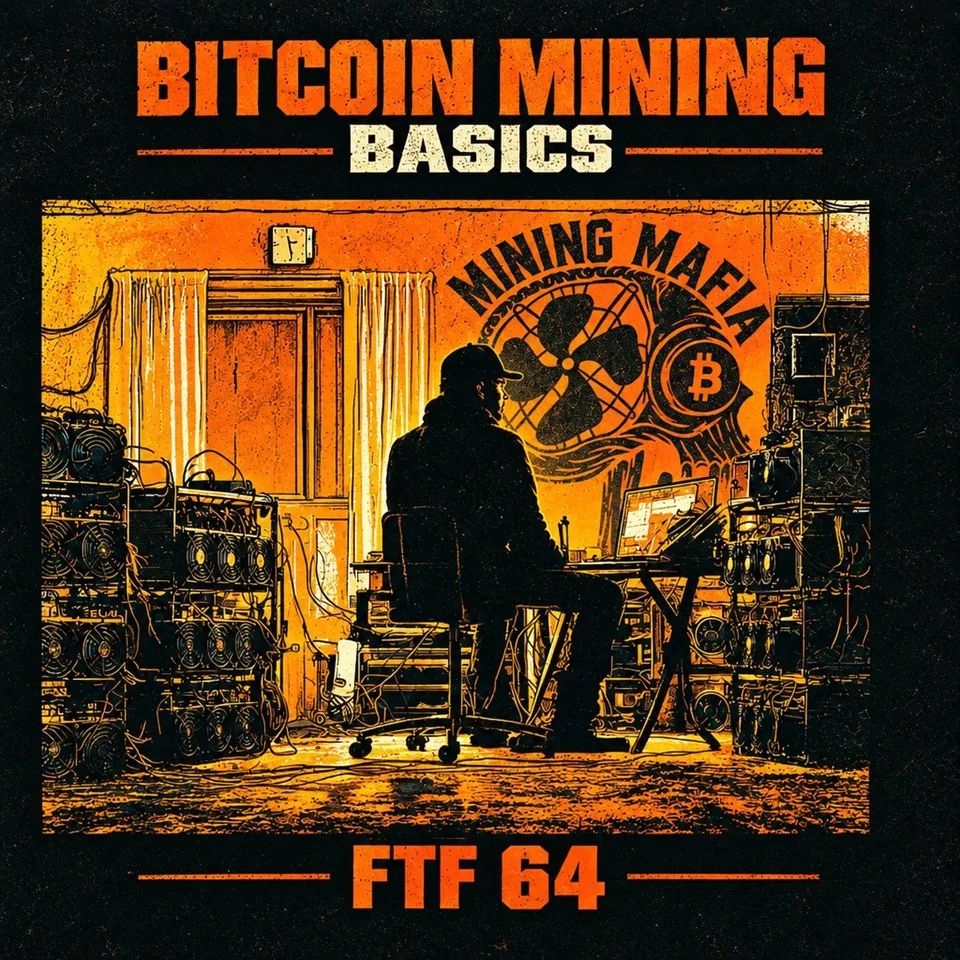
Bitcoin Mining Basics with Jon
Discussed in this episode
Boost this Episode
Boost from here and it goes to the show. Boost from a podcast app and it splits like this:
Plus 1% to Podcast Index, 1% to Boost Bot.
Show Notes
Jon, the Mining Master and fellow Ungovernable, returns for a plain-English guide to Bitcoin mining basics. He covers what the machines are actually doing, how a block gets built and why difficulty adjusts, the difference between pool and solo mining, how payouts and hash price work, and how to check whether your electricity costs leave you any margin. Jon also shares where he thinks mining is headed as data centers move in, and how to monitor your machines once they’re running.
HELP GET SAMOURAI A PARDON
- SIGN THE PETITION ----> https://www.change.org/p/stand-up-for-freedom-pardon-the-innocent-coders-jailed-for-building-privacy-tools
- DONATE TO THE FAMILIES w/ USD ----> https://www.givesendgo.com/billandkeonne
- DONATE TO THE FAMILIES w/ BTC ----> https://pay.zaprite.com/pl_JpxtkLv95T
- SUPPORT ON SOCIAL MEDIA ---> https://billandkeonne.org/
FOUNDATION
https://foundation.xyz/ungovernable
Foundation builds Bitcoin-centric tools that empower you to reclaim your digital sovereignty.
As a sovereign computing company, Foundation is the antithesis of today’s tech conglomerates. Returning to cypherpunk principles, they build open source technology that “can’t be evil”.
Thank you Foundation Devices for sponsoring the show!
Use code: Ungovernable for $10 off of your purchase
CAKE WALLET
Cake Wallet is an open-source, non-custodial wallet available on Android, iOS, macOS, and Linux.
Features:
- Built-in Exchange: Swap easily between Bitcoin and Monero.
- User-Friendly: Simple interface for all users.
Monero Users:
- Batch Transactions: Send multiple payments at once.
- Faster Syncing: Optimized syncing via specified restore heights
- Proxy Support: Enhance privacy with proxy node options.
Bitcoin Users:
- Coin Control: Manage your transactions effectively.
- Silent Payments: Static bitcoin addresses
- Batch Transactions: Streamline your payment process.
Thank you Cake Wallet for sponsoring the show!
MYNYMBOX
Your go-to for anonymous server hosting solutions, featuring: virtual private & dedicated servers, domain registration and DNS parking. We don't require any of your personal information, and you can purchase using Bitcoin, Lightning, Monero and many other cryptos.
Explore benefits such as No KYC, complete privacy & security, and human support.
VALUE FOR VALUE
Thanks for listening you Ungovernable Misfits, we appreciate your continued support and hope you enjoy the shows.
You can support this episode using your time, talent or treasure.
TIME:
- create fountain clips for the show
- create a meetup
- help boost the signal on social media
TALENT:
- create ungovernable misfit inspired art, animation or music
- design or implement some software that can make the podcast better
- use whatever talents you have to make a contribution to the show!
TREASURE:
- BOOST IT OR STREAM SATS on the Podcasting 2.0 apps @ https://podcastapps.com
- DONATE via Monero @ https://xmrchat.com/ungovernable
- BUY SOME STICKERS @ https://ungovernable.network/shop/
(00:00:00) INTRO
(00:01:10) Welcome Jon, The Mining Master
(00:02:09) A First Gas Well Customer
(00:06:51) What the Machine Is Actually Doing
(00:14:05) Blocks, Halvings & the Nonce
(00:26:54) Block Templates & Difficulty
(00:34:04) Pools vs Solo Mining
(00:44:15) Payouts & Hash Price
(00:51:22) Power, Profitability & Breakeven
(00:57:39) Where Is Mining Headed?
(01:01:30) Monitoring Your Miners
(01:06:25) See You Next Week!
Welcome back to Freedom Tech Friday, a live and interactive show taking place every Friday at 9AM eastern ish, unless the time changes, and 2PM UK ish when it suits across the ungovernable network. Oh, I'm hearing myself in the phone.
Each week, we dig into the latest in Freedom Tech, including Bitcoin, Monero, encrypted messengers, privacy tools, and everything in between. Essentially, if there's a news item, tool, or topic that can help you take back some control in today's digital panopticon, then we want to talk about it.
This show and the topics we cover are powered by freedom.tech, a daily news desk that uses AI to monitor hundreds of sources so we can continue to bring you the signal every week. We are not joined by q and a or Seth this week, which is probably why we're still showing two episodes in Flag Theory with Pavel Luptak
all over the socials even though I have changed it. I have no idea why. But today, we are actually joined by everyone's favorite dad, John, the mining master. Hello, my son. Hello, my son. Hello, my children.
Hello, dad. Yeah. You you can definitely notice that there's a sharp drop off in quality from, from q running everything to you. And that's that's just the way you are. And that's Oh, yeah. Yeah.
It's shoddy. It's it's it's quite it's quite shoddy. I don't understand why it's still showing the same fucking thing. I have to say, Q had the same problem once before. I've changed it. Like,
I sent you the restream thing, the link. It shows you the correct name and all that. It's just, for some reason, Twitter doesn't fucking update. I have no idea why. These these things are to be expected when you are at the helm, and everybody's gotten used to it.
So, we're not covering Flag Theory. What are we covering today, mate? We're covering mining basics. And the the the reason that I want to cover mining basics is I may have my first customer for, running a natural gas Bitcoin mine for someone else that they're going to pay me. Oh. Yeah.
Yeah. So I I had a conversation with this. Pay you with real with real real cash money. I mean, he could pay me a Bitcoin if if he wants to. Wow. We'll we'll have to figure out the details of that. It's it's not official yet. I'm just, in an advisory role. We're going to go, give him a tour of my my gas well, Bitcoin mine.
And, after that, we're gonna go to his gas site, and and, I'm a do a flow and pressure test on there and and see how healthy the well is and, do some preliminary planning for this guy to put a, genset on his, natural gas well that he's got no other no other way to deliver to market than to mine right there. So,
in my conversation with him, he's he's very green. You know, I'd mentioned the podcast, and, he's like, oh, I'd like to listen and and learn about Bitcoin. And I thought, boy, you're gonna have to pour through a lot of shows and a lot of, I don't know, very inside baseball stuff in order to get information
out of there. Yeah. A lot of inside jokes. And, you you know, I thought we did a great job with the bite sized Bitcoin stuff. And, perhaps this can just be a really long bite sized Bitcoin to explain mining to, not to, like, your mom or or my mom,
even though my mom probably knows more about mining than than most people. You you think? John's mom? I think your mom probably knows more more about mining than I do, John's mom. You know you've got quite a bad connection for a telephone man.
Well, there's, like, you know, there's there's not much I can do here. What... What's wrong with the connection? Delay? Glitchy, delayed, not quite that clear. Are you on WeeFee? No. I'm on, my cell phone because I'm Okay.
Yeah. Do the best thing. We have. Do I? I go. But, yeah, John's mom. Yeah. I think there's just a bit of a delay. I love you, John's mom, and you know a lot about mining. I would have had her on, but she was busy with other things. So
I think that's a good idea. We can cover the basics. I've forgotten sort of half the basics in such a long time since we recorded and did some mining mafia stuff, so it'd be good. Alright. So this... I've kind of organized this in a way where
you are already familiar with Bitcoin. So we're not we're not going to go over any of those kind of things. Our our audience members are... They're quite astute in the the basics of Bitcoin, but we're going to go over mining basics, what the machines are actually doing, how a block is created, their their power usage,
how much machines cost. We'll go over something called profitability, which is important for a miner, believe it or not, to remain profitable. Okay. Yes. Yes. That's right. Unless you are independently wealthy, you're probably going to want to...
This to be financially viable for you. Easier said than done in this industry. Yeah. There's a lot of people that want to contribute, for altruistic reasons to, Bitcoin mining, but but we want you to make money.
So let's start with this, and and good morning, Silas, and good morning, Andrew Lund. Where where is Bond? Good morning. Where is our friend Bond? Well, he probably he's probably saying I fucking know about flag theory now, boys.
We need to do a third one in a row. This is your third your third opportunity. Well, he he might... Yeah. He might he might join us later. Hi. Hi, friend Bon, anyway. My friend, Bon. Clem Fandango. Hello. Good morning. You, sir. Hello. So so the the regulars are are, you know, drifting in.
So let's talk first about... And I hope you don't mind how I've prepared this show because I know sometimes this this gets on your nerves. But I've but I've written things, and I'm going to read them, and then we'll talk about each subject. And then if you have any questions, and then we'll move on. Is that okay with you?
It's fine with me. It does annoy me slightly, but I I can deal with it. Alright. So what what is the machine actually doing? Now what what is a Bitcoin miner? Early on in Bitcoin, the miner was pretty much your computer, and you had a node there on your computer and you created your own blocks and your own submissions.
And then as mining going on, we we created the application specific integrated circuit chip called the ASIC. And modern miners are now industrial machines that are made up of hundreds of these ASICs in one unit.
So these individual ASICs are the ones doing the compute. So an ASIC is, like I said, an application specific integrated circuit, and it's built only to run the SHA two fifty six double hash function on a 80 byte block header.
They do not process transactions. Some of these newer miners can run little games on them and such, but that's not what the IC, the integrated circuit chip does. They simply receive work from a node, either on your pools node or if you're solo mining, you're using
someone else's node to solo mine, perhaps like CK pool, or you have your own node implementation that that gives your miner work to do. Like I said, you can still point to your own node if you want, but most people don't.
The minor constructs or receives a candidate block header that varies the nonce. That's a word that you like to say, a nonce, and an extra nonce field. So each attempt produces a completely different two fifty six bit hash. It's searching for any hash whose numerical value is less than or equal to the current network target.
The target is set to the entire network finds one valid block roughly every ten minutes. But that doesn't mean it is every ten minutes you can have bang, bang, bang, three blocks in a row, or you can go forty minutes with, out of block. You can go, like, 75 like I did yesterday waiting fucking around. That's alright. It... It'll it'll go.
Yeah. Your your transaction will go. So the the current iteration of air cooled units, and I've I've stuck this only to air cooled because the the hydro stuff can get a little little bit more complicated.
So most people's entry into Bitcoin mining and ASICs is going to be an air cooled unit. Three generations ago, it was about 100 terahash per second, and now we're up to about the two thirties terahash per second.
And that's that's how many guesses the the machine is actually throwing at the network to try to to be the one that constructs the next block and enters the transactions onto the blockchain.
So it's just just throwing numbers out there. And any questions, Max? Alright. Well, I'm not sure that Sorry, mate. I was just trying to see if... No. I'm here. I'm here. I was just trying to see if I could do anything about the connection on my side, but I think it is yours. I just... I keep not hearing you.
Okay. Can somebody from the audience let us know if you're hearing me okay?
Well, they're not listening. They just came in to say hi. Hopefully, they're all grabbing their phones right now. You sound you sound perfect, John. You sound amazing. It's Max's connection that is dog shit. It very well could be. Tested mine. I can't... It looks fine. But, anyway, it
very well could be. It very well could be. No questions on that, mate. John's connection is bad. You. Mhmm. Mhmm. Yeah. Thank you. Yeah. Well, I I wonder what I should do here.
But it sounds like there's not a lot you can do. There's not a lot you can do about it, is there? Let let me try putting my phone outside. Can you sort of stand on one leg nearer? I'll be back.
So... Okay. That's fine.
It's not fine, Peter. We cannot hear this man.
Climb up higher on Apple. I've I've put my phone outside of the van. Is this any better?
It is. It it currently is. Yeah. Okay. Well, hopefully, this isn't a giant shit show. It's good. No. It won't be. We'll be fine. Okay. Per... Perhaps we can, you know, re... Rerecord this someday with, like, official slides and everything. This could be where we point people when they want to learn about mining.
It could well be. You you do sound better now, so we we might be alright. Okay. So next, are there any questions about what the machine itself is doing as far as, throwing guesses out out to the network? Not from me. Anyone in the chat have any questions?
Okay. We're we're going to move on then. So hash rate. So hash rate is basically the the number of these guesses in... It's measured in terahash currently, which is 10 to the twelfth. So they're they're gonna fall in the 100 to two fifty range. Some of the hydro units are, a little bit faster.
And the network as a whole is measured in... No questions. If we didn't hear anything John said. Yeah. I guess so. I guess so. That Hey. If you don't hear what I say, you might have difficulty asking questions. Yeah.
Microphone issues are a turn off. I'm sorry, lady. I I actually don't have any microphone issues. I I brought my microphone. I I bring this janky setup with me when I have to record on the road.
So I'm I'm sorry, everybody. John. John. Mhmm. Mhmm. John. Yes. Microphone issues are a turn off. Okay. Alright. It's not his mic. Alright. So your your hash rate is going to be limited by the the number of machines that you run, the type of machines that you run.
The only variable that you're going to have in your hash rate, you know, your local hash rate may differ from your your network hash rate or your pool hash rate. If your pool is rejecting some of your submissions, you've got some kind of firmware issue, you've got network latency,
those things will affect your your overall hash rate. But it... It's pretty much determined by the the quality of the machine itself, the generation of the of the chip itself as to how many guesses that that it can make... It could submit to the network.
You're alright with that one? Yep. Makes sense to me. Okay. Happy with that, mate. Alright. Good. Now blocks. What what is an actual block? We we have a whole series explaining what a block is, and it's very interesting if if you like. Okay. Good question here, Andrew Lund.
Can old miners be repurposed for any sort of AI interface? Maybe repurpose the RAM. So no, not really. The bulk the bulk of a miner itself, is the the ASIC chips themselves. So that they're purpose built to pretty much only do that that one function.
Once a machine has exceeded its usefulness, it's no longer profitable to run. The energy costs are far outweigh the the amount of Bitcoin that you would be able to mine. Your best bet at that point is to probably recycle the machine or just wait for some crazy event in Bitcoin to happen.
And perhaps some of these, for instance, the s nineteens, the the m thirties will be profitable again like the s nines were at at one time? I want to sit on your s nine. Yes. You can. I I still have a few left that are, sentimental to me.
Of course. Feel free to come over and sit on my s nine. So the... What makes up these machines is you have an aluminum case. You have, aluminum heat sinks, And, basically, you you take the case apart. You take... You pop the heat sinks off, and you can recycle those heat sinks. So I I took probably 20 machines, like s nineteens, and,
took them to the scrap yard after I decased them and everything, and I got about $450 in scrap. So that's that's not bad. That's something. They're a lot more valuable than the machines. The heat sinks? I said a lot more valuable than the machines. A lot of these things are worth absolutely nothing at the moment.
They are. So you you can you can get on on MegaMiner. So if you're looking for used machines, please contact Megaminer Nick or Megaminer Alex. I think they have s nineteens for, like, a $100 now.
I remember paying, like, 5 or $6,000 for s 19. In 2021 The good old guys. I know guys that spent almost $10,000 on machines. So, yeah, you have to be very careful, and and we'll talk about this more as as we proceed.
You have to be very careful about what machines you you get if you're just getting into this. Get something small. Get one of the home purpose built miners either from Megaminer or alteratech.io.
Some of the Canin Avalon or Canin Avalon Nano whatever home heater stuff, get a Bidax. If you just wanna practice Nanos three's? Nanos three. Yeah. If you just want to practice addressing something or or or seeing what it's like to to mine, just go simple, go cheap.
Don't don't spend any money yet until you really understand this stuff. Good morning, mister Crown in the chat. I like your new Ashigaru stuff. Anyone who missed that, go and check it out. It's very cool.
Hi, Crown. Hi, buddy. I I miss you, buddy.
Alright. So am I am I still sounding okay? There's there's a lot of pauses usually in IR. You sound good? Yeah. It's... No. It's just because there's there's a delay, so I'm trying not to just talk over you. It's...
Yeah. Just... I'm waiting a few seconds just so I don't talk over the top. Alright. Well, that wouldn't be any different than a normal podcast. That's not true. You're you're you're very gracious and generous.
Thank you, mate. Alright. So what so what is this block? So what... Once we... If if we guess the correct number, if your your pool guesses the correct number, it it creates the block, the candidate block with all of the transactions in there.
So a Bitcoin block consists of an 80 byte header plus the list of transactions. The header contains version number, the hash of the previous block, the Merkle root of transactions. Remember all this stuff from our what makes a Bitcoin block series, a timestamp, the n bits, difficulty encoding, and the nonce.
The nonce is always last. The nonce. When when we do these shows. The first transaction in the coin base which creates the new bitcoins, that's the subsidy and the the collected fees from the other transactions in the block.
So, nope, we won't get into that... To the having, but transactions have been abysmal transaction fees. So you you can't really, at this point, expect too much in transaction fees. It's mostly going to be the, block subsidy.
All the transaction IDs are hashed together in a Merkle tree, so the root can be committed in the header. Once a valid proof of work is found, the full block is broadcast
nodes, which are, you know, the miners are like the players and the nodes are like the referees. I I think that's one of my favorite analogies in this. The nodes validate the header proof and the transactions.
They append it to the chain. The block weight is limited. We don't have... We're not big blockers in Bitcoin. Effectively, a few megabytes, which is why not every pending transaction makes it into that block, but they pretty much do.
It's not just delay. John's audio also cuts out occasionally. Sometimes it's just for a split second, other times a bit longer. It happens very randomly. Well, thank you, Crown. We are going to charge on, and, this is this is the nature of of me trying to...
I don't know.
A van recording. Yeah. Yeah. Exactly. I'm I'm not at home, so, I'm pretty limited to, what I can do now. Sorry. Sorry, everybody. It's okay. Look. We forgive you. We appreciate you. Okay. Cool.
It was either this or not have a show this this Friday. Yeah. Exactly. We didn't wanna let you guys down. We did not. Okay. So this is this is one of our favorite things to say from back in the day is the the halving.
The halving of issued Bitcoin, which we, have always called the Hal Finning. Yeah. That's that's the way it has to be said. The Hal Finning. The Hal Finning. So the Hal Finning, roughly every two two hundred thousand, 210,000 blocks.
Alright, lads. Isn't it ironic that Bitcoin is about miners finding a nonce? I was just thinking this. And the cantillionaires running our fiat money system are nonces finding miners. Damn.
That's that's really good. Very good. That's that's the... One of the best comments we've ever had. Yeah. We'll we'll have to, some... Somebody ripped that out and and retweet it. That's genius.
Save that.
Okay. So the half inning, roughly every 210,000 blocks about every four years, the block subsidy is cut in half. The most recent half inning was April 2024, which drops a subsidy from $2.6.25 Bitcoin to 3.125 Bitcoin per block.
The next half inning is expected around April 2028 and will cut the subsidy from 3.125 to 1.5625 Bitcoin per block. The Coinbase transaction still collects transaction fees on top of whatever the current subsidy is.
So the total minor revenue per block is subsidy plus fees. But like I said, fees are pretty low at this point, so you're pretty much just getting the subsidy. The Hal Finning is hard coded in the protocol and is the mechanism that enforces Bitcoin's fixed supply schedule.
For miners, it means the Bitcoin denominated reward supply drops 50%, while hash rate and difficulty usually take time to adjust, which is why the hash price often compresses around these events until price or fees catch up. I can tell you from experience that's a that's a difficult time
when you're... You experience a halving event and Bitcoin price doesn't go up immediately. It's it's a little bit of an adjustment period. So as a miner, you have to get ready for for those half inning events and save up a little bit of your money to keep on running. Mhmm.
Okay. I I have given you ample time to reply, and you have not replied, Max. So I will continue on with what a nonce is. Nonces are running our world today. And agenda 2030 is is well on its way to being realized by 2030.
So you have to prepare accordingly. Now as far as Bitcoin is concerned, the nonce is a 32 bit field in the block header. Incrementing it by one changes the input to the hash function and therefore produces an entirely different output.
There are only about 4,300,000 possible nonce values, which a modern ASIC can exhaust in a fraction of a second. To keep search... Searching beyond that, the miners vary the extra nonce field inside the Coinbase transaction.
This expands the search base without requiring a completely new block template from the pool or the node. The ASIC's job is simply to cycle through these values as fast as possible until one of the resulting hashes meets the target. So you you can actually do this on paper yourself.
Adjust the nonce, put it in your hash function, hash it out on paper, and mail it into your local Bitcoin blockchain and and see if you see if you got it right. It'll probably take you about five or ten minutes to do those calculations if you're a cryptographer.
Five or ten minutes per calculation. Yeah. And and your machine is doing it trillion... Trillions trillions of guesses. Yeah. But if we were to be without electricity, we we could somehow do these hash functions by hand.
Some of us could. Alright. So who who wins that block? Okay. So the first miner or pool,
but it's really, really a minor. That's probably the best. I shouldn't have written it like written it like that. The first miner or pool to produce a header hash that is numerically less than or equal to the current target is allowed to broadcast that block.
Other nodes accept it if the proof of work is valid and the transactions check out. That miner or the pool representing many miners receives the Coinbase reward. Current subsidy, like I said, is 3.125 Bitcoin after the twenty twenty four Hal Finning event,
plus all transaction fees in the block. If two valid blocks are found at nearly the same time, the network temporarily has a fork, The chain that accumulates the most work afterward wins, and the other block becomes orphan. Winning is prob... Probabilistic.
Say that for me, Max. Probabilistic. Probabilistic. Yay. It only improves the odds. It does not guarantee the next block. Any any questions so far, Maximilien von Bittenstein? No questions from me, mate. Anyone in the chat have any questions?
I wanna get one back to one to Andrew Lund again. What about mining blocks on Testnet? Yeah. That's something you're interested in? I don't know. What... What's the overall hash rate on Testnet? I had...
I don't know. I I don't know. But they did... Like, people were actually paying money for them at one point, weren't they? Yeah. That was on the, like, the old testnet. I I actually had in my possession many thousands of testnet coins at one point. Wow. What a flex. I felt really rich.
Yeah. When you look at your wallet and you're like, oh. They're actually worth fuck all. And then I gave them away. Andrew Lund, I I will go into the, solo mining pros and cons later on in this.
I see that you have a big axe that you picked up, and, we will go over, solo mining versus pool mining and the advantages and disadvantages of that. So block template.
When using an ASIC, the miner does not build the block from scratch. Pool software or a local Bitcoin node assembles the block template. It selects transactions from the mem pool. So when you initiate a Bitcoin transaction,
it just doesn't go into a block. Like Max was saying, he waited seventy five minutes the other day for a transaction to to go into a block. It goes into the mem pool, and it kind of waits to be selected by the miners to be put into a candidate block.
And, once the... He... The... That miner has has won the block, then he will record the transactions. And most miners are waiting their transactions based on what has the highest transaction fees in there.
Right now, it's it's not an issue, but there are times within Bitcoin where where it is an issue that you have to up your transaction fees if you want to make sure that that transaction goes into a block. That's that's more max and queue kind of stuff to explain.
Remember those times where it's like cost proper real money to make a transaction? Like, there's been little blips where it's like, no. It's gonna be, like, $50 to make a transaction, and then, like, now it's, like, a penny.
It's just, nothing. It's just, like, no transaction fees. Yeah. The the... To me, the most interesting time to look at transaction fees is is to go back into a a Block Explorer and look at the 2017 bull run where people are like, I don't know if I'm ever going to get another opportunity to sell this Bitcoin again,
so I don't give a fuck what the transaction fees are. Yeah. I just want to oh, I just wanna cash out. Yeah. There was some crazy fees there. So the... In in in that block template, it it builds a Merkle trees. It fills in the previous block hash and other header fields and reserve space in the coin base for the extra knots.
This template is sent to the ASIC by the stratum protocol in pooled mining. The machine's only remaining task is to vary the nonce and extra nonce until the double SHA two fifty six of the header falls below the target where the valid share or block is found, it is submitted back upstream.
Difficulty, difficulty, and difficulty adjustment. I'm a tell you the basics of hashing with ASICs, Bitcoin mining statistics. Check it out. I wish I had I wish I had that loaded up. I could search for it somewhere, but we're we're we're already having enough technical issues. I don't wanna be Yeah. Touching this computer.
I will add it. Okay. So the the the difficulty adjustment Relax. Yeah, buddy. Thank you. Thank you very much. Difficulty is a human readable number that represents how hard the current target is. The target itself is encoded in the n bits field of the header.
Every 2,016 blocks, roughly every two weeks, the network looks at the actual time those blocks took to come in. If they arrived faster than the ten minutes, on average, difficulty arises.
If slower, it falls. The adjustment is calculated so the next epoch should again average ten minute blocks. Raising difficulty means each unit of hash rate earns a smaller fraction of the total rewards.
This is the mechanism that keeps block times stable as more or less mining hardware comes online. It is also why older, less efficient machines eventually become unprofitable even if they still function.
So the overall network hash rate affects difficulty, and recently, because of suppressed hash price, network difficulty has been kind of steady, and network overall hash rate has been kind of steady. Good or bad. That's what it is. At least you know what your numbers are gonna be every month. So when is currently the next half inning
roughly? Oh, the next half inning is April 2028. Currently. Yeah. Heating a greenhouse, from infinity divided by 21,000,000. Yes. Of course, heat reuse is something on ungovernable, we have spoken about at length. I, I currently heat my home and have been for, Jesus Christ, eight eight, nine years, with with Bitcoin mining.
That's that's... Yeah. What a retard. Did you say Jesus Christ because it's been so long? Yes. I just thought I'd be rich by now. Yeah. Me too, mate. Me too. Drying wood, making jerky, what other uses of minor heat, Heating a greenhouse. Yeah. Bert DeGroote was doing that, wasn't he? He was doing heating greenhouses.
He sure was. Yeah. I think at that time, he probably had, like, six or eight s nineteens where he would he just mounted them, like, up high in in the greenhouse, and and they were blowing around.
So each each one of these these industrial ASICs are about, let's just say, 3,000 to 3,500 watts. So that's that's direct heat. If if you can capture that heat and deliver it somewhere else, then, yeah, it's it's just heat. Now some of the hydro units, my friend Travis Bittkull has just
like, I builds all kinds of cool stuff. If if you wanna if you want a good follow for heat reuse, Travis Bittkull is is your guy. He just built a Bitcoin water heater, off of a hydro unit that kind of, like, charges the water inside of of the the water heater and, and cycles it through and and,
ups his hash rate and lowers his hash rate, therefore, ups and lowers the amount of heat that the machine produces. And, he heats a hot water heater with it. It's in his it's in his uncle's house, and, his uncle is... And, his lady are are taking showers with, Bitcoin mining mining heated water. Nice.
That's a good quality shower. Oh, you'd feel good. Yeah. Travis Bickle. That's... We've we've recorded with him twice over the years. He's he's an amazing miner Yeah. And just an overall really, really good guy.
Came to my house last week. Oh, how nice is that? Yeah. He was he was working a couple hours away, and I had another one of our our Bitcoin friends over the house, and he's like, oh, I'm I'm coming over. I gave him a tour of the gas well,
and he was amazed. And he's like, wow. How do you do all this stuff? You're so smart and hardworking and good looking. And I said, I know, Travis, but you are too. And that made him feel good about himself. Yeah. You're both great guys and modest. Yes. That's that's definitely my best quality.
There are so many to count, but that probably is your best. Yeah. Yeah. I'd say so. My mommy would say so. Love you, John's mom. Okay, Andrew Lund. So now we're gonna go over pools and solo mining.
So a mining pool lets many small or medium hash rate contributors act as one large miner. Participants submit shares, hashes that meet or lower that meet a lower difficulty set by the pool as proof they are working. The pool combines everyone's hash weight, finds a block more regularly,
and pays members proportionally to the shares they submitted. Common payout methods include PPS, FPPS, PPLNS. Each handles variance and fees differently. Typical pool fees run point five to 2%. 2% is probably your your more average.
The stratum protocol carries the work and the results. Pool mining converts a high variance jackpot into steady, predictable revenue stream, which is why almost all non industrial miners use one.
Popular pools include... These are the these are the three that that we've always spoken about on the show. First one is Ocean. I think they've they've made a little bit of a turnaround lately.
LingCoin, LingCoin mining, a long time sponsor of our mining shows on on Governable. That's the, the little pool that could. I'm still mining with LingCoin and probably always will be because I am faithful. That's the kind of of person I am. And You are. Brains is is is Faithful to Mehdi. Yes. The fridge. I am faithful to Mehdi.
He's he's a good friend, and I just really couldn't imagine pointing my miners anywhere else. I would I would feel like I I cheated on somebody. I can see that. I do wanna give a shout out though to Ocean. We have shout on them a lot over the years. I mean, you can go back where it's just been a And right brain of shit.
Yeah. Absolutely. But credit where it's due, they've just given a million sats to the free samurai lottery to get it kicked off, donated to that. So I just want to say thank you for doing that. You've been very gay in the past, but that is cool. Yeah. They're they're turning it around, and and that's why I I put them on my list because,
I'm making nice with people now. Aw. That's sweet. Yeah. So Ocean uses its Tide system that's transparent index of distinct extended shares for scoring and payout. LinQueen and Brains both use FPPS full paper share. LinQueen additionally emphasizes an audible version of FPPS so miners can verify earnings against public data.
And also, let's not forget, the only mining pool at this point or... And definitely the first to use BIP 47 payouts, which is very important to me. It takes its clothes off. Not relevant, but it's body.
Also, I'm I'm monitoring it. I I think I have another section in here on monitoring your miners. Body McBodface is a telegram enabled robot that,
gives you updates on your mind and and texts you if something goes down, and, he's become a good friend. Good friend of the show. Good friend to Max and I. He has. I I miss that guy. I miss Body as well. I miss the old show. I'm I'm... I miss it a lot. Oh, well. That's what it was. Mhmm. It's it's it's in the can.
It's gonna be there forever. It is what it is. Is there a way to manage a distributed network of miners remotely from my laptop home assistant, Tailscale brains? Can I point a distributed network of miners to one remote pool?
Yeah. There's a number of Huxley. Yes. I I don't know exactly because if if you're doing minor management stuff, you need, like, a... An on-site agent to be able to log in to all of the miners.
But I can say that and maybe some of the other guys that mess with that kind of stuff would would be better to answer that. I'm I'm kind of like a a farm management kind of guy. So you've got like farm god.
You have... Oh, jeez. What's that guy's name? A foreman foreman mining. Linkcoin has its own, minor management software. Brains has its own minor management. George Foreman? Yes. George Foreman.
You can, put Asics on the grill actually, and, it's slanted. So the fat from the burger drains out, and, the Asics chips heat up. Good way to use the heat. That's right. George Foreman Grill. So, yeah, that... That's a that's a good question on a decentralized way. I'd I'd actually don't have an answer for you on that, Huxley.
Maybe I'll I'll research it and get back to you on that one. But your your pool software, you know, has all of your machines there. So if if you've got machines in in multiple different locations and they're all pointed to your same pool address, then then you can see on the pool dashboard,
you know, what machines are there. But as far as managing them all remotely like that,
jeez, you probably can. I think you're just gonna need an agent in each location.
That's a tough one. Sorry. Don't have a good answer for you on that one. I like it when there's mining questions that you're not sure on. Yeah. Because it's it's not the way I run my stuff. You know, if you if you want full control of of all of your miners, that's that's a little bit different.
If you just wanna check their status, well, it's gonna be on your pool dashboard. That's fine. Alright. That that is fine. Solo mining. Alright. So solo mining is mining you run or connect to on your own full node. You request block templates directly and submit any valid blocks yourself.
Or you can use... And this... I don't have this in here. You can use somebody else's node as well. For instance, CK pool. There are some pool operators, and I have suggested LingQoin do this at one time, is to run a specific node just for the solo miners.
You know, it it it just takes away you having to run your own node, but you can certainly mine to your own node. We had a a node implementation a long time ago. Who helped us do that? Urban, wasn't it?
Was it Urban? Yes, it was Urban. I'm running up against my Dunbar number. But but we we built one. We built one ourselves and I was doing solo mining Sundays off of that node and it was lots of fun.
So certainly you can you can use your own node or you can use someone else's node. You receive the entire coin based reward if you find a block, but you receive nothing otherwise. With small hash rate, the probability of finding a block is extremely low. Expected time between blocks can be months or years.
There's no pool fee, but the variance is total. So the mining is practical mainly for operators with very large hash rate or for those who treat it as a pure lottery. Most people who start solo eventually move to a pool for cash flow reasons, and and that depends on your runway
if you want to solo mine. Listen. If if you just have a small machine at home and you can afford the the electricity, then go ahead and solo mine. If you're rich and you have a decent sized mining farm, go ahead and solo mine if if that's something that that you're interested in.
For myself, that's that's not something I could ever pull off at my gas well. My my costs are too high. I don't have enough money in the bank. I don't have enough hash rate to reliably hit a block,
even though that would that would be exciting. Maybe if I hit the lottery someday or or get rich, I'll just be some kind of cool solo mining guy. For instance, if you have one to two petahash at current difficulty...
Now that's, like, the current difficulty. There's there's no way for me to project this out. You could expect to hit a block once every two years. With two to four petahash, you can expect to hit a block once a year. And if you have four to eight petahash,
you can expect to hit a block about every six months. Now not not to talk about, you know, hash rate and what I got and what you got, but but I am in the hit it every six months or less range with with my overall hash rate.
But I don't have the runway to to pay my bills at the gas well. And that's that's really not how I I run mine as a business. So I need reliable income. I need reliable Bitcoin coming in. It's also expect to hit within.
It's not hit within. It's expect to hit within. So it could be years. It it most certainly it most certainly could be years. Yeah. I mean, you you could hit two blocks your first day. Yeah. You'd have to calculate it as worst case scenario. You'd be like, you know, can I survive for five years?
Mhmm. And if I can't, then the same way sending a transaction is like, is this gonna get confirmed, and how long is the block gonna be? It could be two minutes. It could be one minute, or it could be two hours. And so you need to have a serious runway, or you have to have
some sort of off grid setup where you've got free energy because you buy a waterfall or some sort of thing where there's no, like, costs outside of your initial outlay, and then it's just like a a waiting game. But outside of that, it's just you you can't you can't run that as a business that way. It's not reasonable.
It... It's not reasonable at at medium scale, in my opinion. Also, there's there's other things that... So say, for instance, everybody always asks me, what's what's your cost to mine? And I say, well, in a in a good month, it's, it's pretty minimal.
And then, I'll blow up an engine and have to spend, you know, $6 on a new engine and putting it in. What if you have some kind of accident where you have a a bunch of machines go down? You you know what I mean? So now that that month, you got a $10 in in new machines that that you gotta put in a a unit. There's just a lot of variables.
And unless you're really lucky or you have a lot of money most of the time on a medium scale with operating costs, that solo mining isn't your best shot. But for instance, Huxley's in here saying, yeah, I'm thinking of solo mining. I've got a bid axe in one spot, an s nine in another spot.
You know, that's the the the minor management thing. I'm not a networking guy, but you can definitely run your own node at home and have those two different units pointing pointed to that node. You just need... Would need the right networking.
And as far as monitoring, you can... Yeah. I don't know. Once again, that's that's that's beyond my my abilities, you know, kind of a dirt under the fingernails kinda guy. You are dirty. Yes. Quite dirty.
Alright. Payouts. Once the pool accounts for your shares, it credits Bitcoin to the wallet or accounts you configured. Payouts are automatic based on the minimum threshold as reached or a fixed schedule daily.
Or for instance, if you are mining on a, a PPS pool or or tides like Ocean is, when they hit a block, that's that's when you get paid out based on your hash rate contribution. So if you like steady daily, you know, weekly, whatever your your minimum threshold is, I use an FPPS pool myself.
But, the the variability of not knowing when your pool hits a block is actually kind of fun because you, you know, you see, oh, great. You know, back in the day with brains when when they had a different payout scheme, it was very exciting when they hit a block. So
in the end, you're probably gonna make about the same amount of money depending on luck, depending on the pool. But over a long enough time, every... Everything should probably even out. The pool's fee is deducted before the credit Coinbase rewards themselves mature after 100 confirmations,
but most pools pay for their own balance. So you do not wait. The worker name you set, often your Bitcoin address or your account name plus the worker identifier. So how how I organize my workers, I do I do use LinkCoin Agent. You can use FarmGod. You can use Foreman Mining,
you know, to to have a a nice clean dashboard and and to keep track of all of your your ins and outs and and your budgeting and and your money and and and such. But when you set up your miner, you're setting up a worker name. So what I like to do is, like, mine is, like, gen one, slot twelve. Those those are all my worker names.
So even without going into, into my agent, in... Into my miner management software, I can just look at the pool dashboard and know what what miner's hash rate is. I can assume a lot of things based on the hash rate. Oh, it went down by a third. That means the hash board is down.
You can discern a lot just from the the general miner, the pool dashboard if you've named your miners properly and are and are organized in that way. Hash price, this is what miners that run as a business, they care a lot about this number, especially if you need to sell throughout the month in order to cover your your operating costs.
Hash price is the expected dollar denominated revenue for one petahash per second of hash rate for one day. It's derived from the current block subsidy plus average fees, the number of blocks per day, the Bitcoin price, and the total network hash rate. When Bitcoin's price rises or fees spike,
hash price rises. When difficulty increase, hash price falls. It's the single most watched profitability metric because it already folds together price, fees, network competition. Miners compare their power costs against the prevailing hash price to decide whether a given machine is worth running.
As of November 2026, hash price is running... Fuck. $30 per petahash per day, around $33 per petahash per day is is probably the the number that sticks in my head for me. I I really wish we were about $45 per pet ash per day.
That would make me that would make me feel a lot better. That's just a personal thing. So a common approach depending on your runway, depending on your operating costs and such, the approach really
should be to huddle as much Bitcoin as you possibly can instead of selling daily or weekly or selling as soon as you get your payout, which is what happens to me. I don't mean to pitch. Sorry. Under that strategy, you pay less attention to the short term hash price swings because you're not converting to dollars every day.
You can sell when the price spikes. You can you can hold on for that halving event. And, you know, a few months after that, we're expected to have, you know, these these bulls and bears. So you're you're you're playing the market there. You're a little bit more in control
the more Bitcoin that you're able to huddle from your mining rewards, which brings us to our next order of business, hash value. Now hash value is how much Bitcoin that you're getting from your your rewards in petahash per day.
And so if if you're a real hardcore Bitcoiner and, you don't care about dollars, then you're looking at 43,000 sats per petahash per day. Jeez, Max. I gotta look into our old shows what what the hash value was when we first started our mining show. Yeah. It's very different to that.
Was that the downfall of the show where it was just starting to get so depressing, and it was just the the mining statistics looking shitty
was what we would say every single episode. Oh, yeah. I'd I'd come up with a new word for every episodes, the how shitty hash hash price and hash value were. Was was that the end of the show? I I don't know. I think dire.
Abysmal. Atrocious. Why did we stop the old show? Just time, probably for the most part. And, mining didn't feel fun because it was a lot of bid act stuff. It was a lot of, block template and and, you know, everybody's using using the same ant pool pool and pool family stuff.
I don't know. It it just didn't... The the environment didn't seem as fun anymore. And as much as we tried to inject fun into all of it all of it, everyone was just so fucking miserable. Andrew has asked, what's the best way to suggest a topic slash guest for the upcoming Freedom Tech Friday show?
Ask it here, mate. Ask me now, and then I'll, try and remember Oh, yeah. Right. Try and remember.
Well, okay. John's here. He'll remember. Q will probably scan through all the notes. It will remember, and its AI agents will remember. It'll be it'll be in the transcript, so they'll they'll be scouring all over that, all these little agents.
Alright. We we better let Q know. That... That's really, really what it comes down. It gotta get in his computer brain. I'll just read it, and then and then you can do next bit. Spacesprotocol.org.
Don't know what it is. Queues, clankers will look into it. We'll, we'll let you know, mate. Alright, Andrew. Spacesprotocol.org. Spacesprotocol.org. Spacesprotocol.org. Don't know what it is, but, hopefully, it gets in our brain, maybe we at least plugged it.
So for your your power setup, I'm just doing on grid power setup for for home mining kind of deal or or small small scale mining. These ASICs are going to run at 240 volts, so you have to size your breakers appropriately.
At 240 volts at 6,500 watts, you're probably looking at a a 20 amp breaker because each machine is going to use about 3,000 to 3,600 watts at two forty. Like I said, that's a 20 amp breaker.
So you're going to need a special plug. You're going to have to know what plug that that your machine is is going to use. I think we even have a, like, an episode on plugs at at one point. But if if you talk to a a reputable reputable miner dealer like Altair Tech dot I o or Nick and Alex at Megaminer,
they'll be able to advise you appropriately on what kind of plug. The energy usage on these machines, it is significant. So they're running at about 3,500 watts, twenty four hours. That uses 85 kilowatts per day. So the manufacturers published both wattage and efficiency in joules, which I think is the more important number.
Joules per terahash. That's how much power you're using in order to make those those computational guesses. So lower joules per terahash means less electricity per unit of hash rate. Real world draw varies with ambient temps and firmware settings, but it's it's kind of about the same. So if if you're like me,
you know, a 50 kilowatt generator is is going to consume for me about 12 MCF a day of gas. So my my numbers are a little bit different because I don't price my stuff in in kilowatt hours.
Well, I probably should have put this in a different energy usage. Let's see where I have this here. Profitability and breakeven prices. I'm just going to skip to that part. So profitability, that's your daily revenue, is approximately your effective hash rate multiplied by the current hash price.
Subtract power cost, pool fees, and then the operating expenses that get net. For me, it's fucking oil. Lots of freaking oil that I use.
Hardware decisions rest on three numbers. Your capital cost per terahash, dollars per terahash. That's very important when deciding which machine you wanna buy. Energy efficiency, that's joules per terahash, and your actual power price.
Air cooled pricing, for instance, s 21 pro, 234 terahash, 15 jewels per terahash. That's roughly about 1,800 to $2,400, which I think is is not a bad price. Used s 21 pros. So I checked Nick and Alex at Megaminer. I always check their list to see if if they get any good deals on used units.
Go ahead and visit them. They are very good guys. So I'm just gonna pause here for a second. Your your minor dealer is is very important to you. I hope Max isn't breaking too much shit without me. Actually, I'm the one that's the problem on this recording. Here he is. No.
No. We both are. Yeah. We're both we're both a problem. Are, mate. I fucked up the name. You fucked up the audio quality. Q is just relaxing in, in Amsterdam at the moment, I believe. Yes. This is what happens when you Smoking a massive fat suit.
So your your miner dealer is very important. There are lots of people out there. You can get a miner on on eBay if you want to. You just find some guy that tried this out and and wanted to sell it. You have no idea if that machine works or anything. You have to be careful in these eBay deals.
Nick and Alex, Avril at Alteratech dot I o, Chris @Alteratech.io. These these are good guys that that I know personally. So I highly recommend them if you want a minor. Go to them. That's that's it. I'm I'm done with that. Agreed. Chill.
Alert.
The What's Minor m 60 is around $2,000. The m 70 is about $3,800. And older s 19 or s 19 j pro units are about a $100, $200 or so. I swear to God, I saw in Nick and Alex's thing that they were $89, but I think it was like an MOQ of we gotta take the whole lot.
And who knows how many of them work? At low dollars per terahash machine looks attractive on capital, but a high joules per terahash machine burns more electricity and reaches breakeven only at very cheap power on stranded or nearly free gas.
Christ. And hell, this is so silly to even say this nearly free gas. There's no such thing because, again, I have a generator that runs stuff. But anyway, the penalty shrinks so older hardware can remain viable longer, which that's my current strategy.
Always run the calculation against specific dollars per kilowatt hours or MCF if you're on natural gas that you'll actually pay for current s 21 machine. Once again, 234 terahash at $33 per petahash per day. Daily gross is about $7.72 and clearly negative around $7 negative $7.40
a day. If you're mining on The United States residential average of 18¢ per kilowatt hour at current hash price, the approximate break even electricity rate for an s 21 pro class unit is around 9¢.
So don't even bother unless you're at 9¢, and you really should be much, much cheaper. Older, higher Jules Verterash machines like the s 19 series breakeven close to about 5 to 7¢. Here are some examples of break even prices.
For 15 jewels per terahash machine, your break even is 9¢. For a 20 jewels per terahash machine, your break even is 7¢. And for a 29 per terra hash machine, that's like the JPROs, you are a breakeven price of 4.5¢.
So good luck good luck with that, guys. You're you're not gonna get those prices. Alright, Max. Anything... I have two more items to cover. Any any questions that you may have up until this point?
No. I don't have any questions, but we do in the chat. Do you think we'll see a day when demand for mining hardware outstrips, or do you think these days are behind us? The supply of ASICs, blah blah blah blah blah. I think, basically, do you do you see a outstripped supply of available ASICs? Demand outstripping supply of ASICs.
I don't know. Like, do you think you see another crazy scramble again? I I don't personally, but I don't know. Maybe that's wrong. Yeah. So so I I have some thoughts on this, of course.
My friend Alex from Mega Miner Mega Miner Alex, He he he often says... Yes. He he often says the same thing. Like, you know, because a lot of the big manufacturers have slowed down on on their production,
you know, or they're not releasing them. They're just going, oh, yeah, Bitmain, we made the s 23. We made a few of them. We're just gonna keep them. We're just gonna mine them. We're we're we're not we're not putting them out to market.
It is hard to get the foundry space in order to make chips. And if we don't have robust and growing, mining sector, then why even bother putting these machines out? So then you have a bull run, and,
you know, you you could... This this could be some kind of rare item that you can't really get anymore because they're they're not making as much as as they used to. So there's a theory in that. And also, there's the there's the theory of plugs, plug space.
This is what's happening in the Bitcoin mining industry. So so a buddy of mine who who has a extremely large mine, and he's, you know, he's he's now pitching this... His capacity to to data center folks.
And the phone calls that he gets from these people are are what we and, you know, a bunch of my friends call the the crypto bro kind of guy. And we said, don't crypto bro me with this crypto bro bullshit.
And so for now, these crypto bros who who were Bitcoin miner guys are now trying to shop data center sites. So I think a lot of these Bitcoin miners would much rather go the the data center model, take their capacity, take their infrastructure, and and shop it around and say, hey. You know, we're we're down here in ERCOT, and,
you know, we're participating demand response, and our our all in price is around 3¢, 4¢. Well, you know, whatever the fuck. And that's what they're they're shopping around. So there there could be... If this data center boom is actually a data center boom, that's... There's stupid money there right now.
There is not stupid money in Bitcoin mining. If you've paid attention to any of these profitability numbers, it's not there. The the stupid money is not there. A lot of the people that that go with x's and o's and and black and white and spreadsheet,
you know, like myself, we're figuring out how the fuck is all of this hash rate still on the network. It isn't Iran. It isn't all Bhutan. It isn't all these these nation states that have free power.
There are still a lot of publicly traded companies that are contributing a significant amount of hash rate, and when are they going to pivot over to the data center model when they come in with all of their stupid money?
When when are they gonna say, oh, well, we've we've had one company and we dissolved it and we got rid of it, and we started another company and they're playing this depreciation game and they're playing this tax game. When is that going to run out?
And miners who are just dealing with black and white are the only ones left on the network. I I don't know, but that's that's kinda where I see things going. Yeah. Not unreasonable. So there's there's two things that I want to go over before we wrap things up, and that's that's basic monitoring.
So, Huxley, this kinda goes to your question before, and I do have a section for this. Your question was just very specific. You watch it... You watch your your your miners in in two places, the pool dashboard and the miner itself.
And then, you know, your dashboard is... You also have your your farm gods, your foremans, your your LingQoin agents that, you know, have have additional data in there. The pool only shows the accepted hash rate, the rejected or stale shares, and earnings over short or longer window commonly,
hourly or daily. A rising reject rate often indicates network late and see or an overload in the pool service or some kind of hardware problem. On the machine's web interface or API, you can check the chipboard temperatures, fan speeds, power consumptions, any hash board errors,
sudden drops in hash rate, climbing temperatures, that... That's all gonna be on the firmware itself of the miner. A lot of people use aftermarket firmware, like, Vanish or or Brains, for instance, and you get a little bit more more usability there because you you can use power scaling
to go up and down. You can have individual tune on on the chips themselves. So I myself have often run aftermarket firmware, but sometimes that's more... Or LuxOS. That's a lot more headache. So it... It's kind of up to you. I mean, I I I have
a number of machines that are still just the stock firmware, and sometimes they end up being the most stable machines that I have. So that's that's definitely something to consider and play around with if you wanna go aftermarket firmware or, stick with whatever the the provider gives you.
And lastly, how do you log in to these, machines? So for most ASICs, they obtain an I... IP address via via DHCP. You locate it with a network IP scan or a management agent, so that's that's another thing that you can do with some of these these foreign management
is, like, batch your pool addresses, you know, so you don't have to log in to these things individually because, you know, four or five machines, it's fine. But once once you get up, you know, to a 100 machines, it becomes a giant fucking pain in the ass. So that's that's when you wanna use the the pool management software.
So in in the... In your browser, you can just type in the IP address that that has been assigned to the individual miner, log in with the factory default. Usually, it's root root or admin admin or admin root, you know. But usually, it's it's it's root root.
Inside the confirmation page, you enter one or more stratum URLs supplied by your pool plus a a worker. If you're doing solo mining on your own node, that information is going to be different. I don't remember it off the top of my head.
Man, I wish Urban Hacker still had that stuff up on his website. It would probably be pretty helpful since now we're talking about solo mining on your own node. But anyway, inside the configuration page, you add the stratum
URL supplied by your pool plus a worker name. And like I said, you want those... That worker name to be something that you can easily understand. You know? For instance, like I said, mine is gen 1, slot 12, gen 3, slot 4, you know, something like that.
And, the password, usually, you don't have to put in the password. You save the settings. It restarts the miner, and it it it connects to the pool. So usually within a couple minutes, you you can check the the pool's software
and see that that miner on there on the dashboard. If you have something like Ocean, they're they're kinda just like a a a web URL, so you can look for your wallet address. That's gonna denote if your machine is submitting shares.
And that's that's all I have. Do do you think I've covered the basics of hashing with ASICs? I think you've covered it. I... There's always room to do more shows and and cover this again, but I think we've we've got it nailed there. Don't think there's anything else to cover.
I'll be back with q on Monday covering just misery. Anything else from you, mate? I don't I don't have much else. I I don't wanted to, extend all these delays and mess things up. But, yeah. No. I I don't have anything else. I I love all you guys.
I love I love talking to you, Max, and I love the ungovernables. And, you know, things are tough, and and there's a lot of challenges with with AI attacks and and whatnot, but just, like, stick together, everybody. Don't be so don't be so, excited to to to stomp on and and kill the next guy because, they wanna kill us.
Yeah. So let's stick together. That is true. That is true. What was that nonce comment? Where was that nonce comment? I wanna read that again before we finish. Here we go. Alright, lads. Isn't it ironic that Bitcoin is about miners finding a nonce and the cantillionaires running our fiat monetary system are nonces finding miners?
And that's why we do what we do so that we can get these nonsense out of our lives. So, yeah, let's stick together and let's stay ungovernable. Ciao.
Thank you for listening to Freedom Tech Friday. To everyone who boosted, asked questions, and participated in the show, we appreciate you all. Make sure to join us next week on Friday at 9AM EST and 2PM London.
Thanks to Seth, Max, and Q for keeping it ungovernable. And thank you to Cakeballet Foundation and my Nim Box for keeping the ungovernable misfits going. Make sure to check out ungovernable.network to see q and his clankers web design skills.
Listen to the other shows in the feed. Stay up to date and stay ungovernable.
Use the tools. Live free.
Privacy is a human fight.
Join the discussion.
Share the ungovernable network with friends and family who value freedom.
We love you all. Stay Ungovernable.
Machine transcript; expect the odd mishearing. Click a passage to play from there.