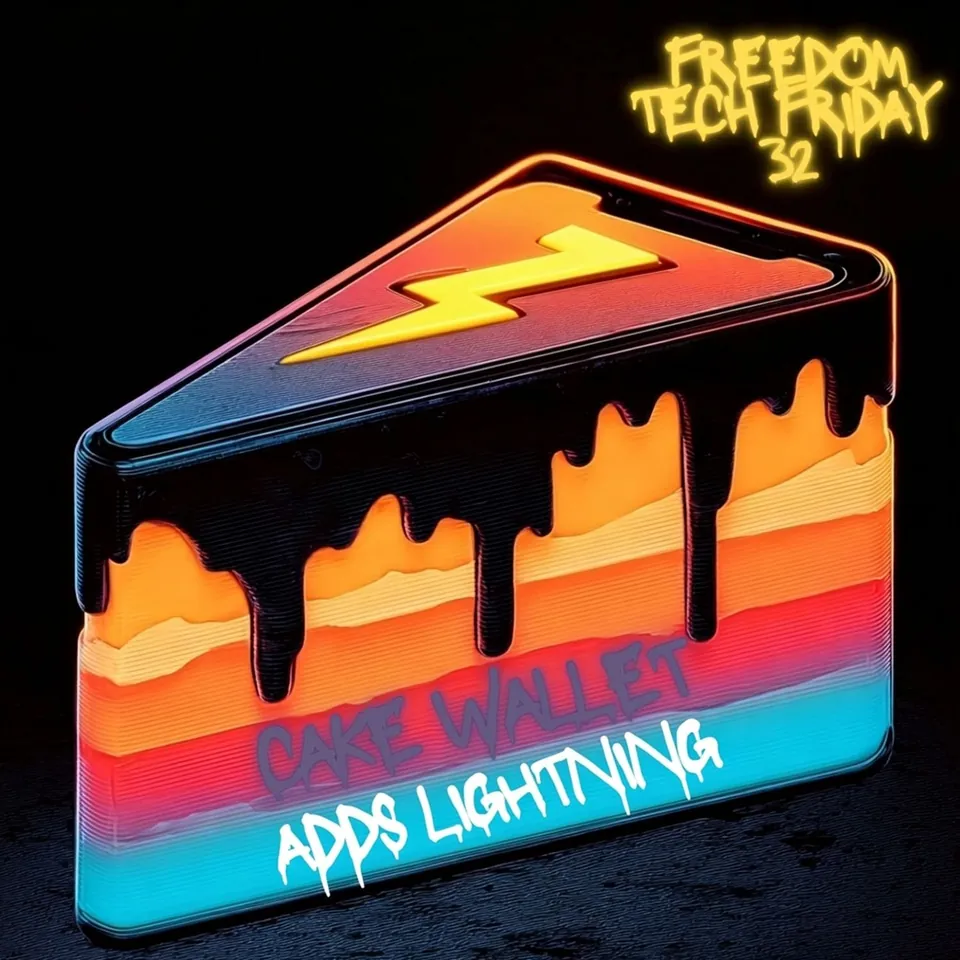
Cake Adds Lightning ⚡
Discussed in this episode
Boost this Episode
Boost from here and it goes to the show. Boost from a podcast app and it splits like this:
Plus 1% to Podcast Index, 1% to Boost Bot.
Show Notes
A weekly live show covering all things Freedom Tech with Max, Q and Seth.
Lightning Journey: https://blog.cakewallet.com/our-lightning-journey/
Lightning in Cake: https://blog.cakewallet.com/lightning-is-finally-here/
Spark Discussion: https://serve.podhome.fm/episodepage/ugmf/layer-two-who-freedom-tech-friday-18
HELP GET SAMOURAI A PARDON
- SIGN THE PETITION ----> https://www.change.org/p/stand-up-for-freedom-pardon-the-innocent-coders-jailed-for-building-privacy-tools
- DONATE TO THE FAMILIES w/ USD ----> https://www.givesendgo.com/billandkeonne
- DONATE TO THE FAMILIES w/ BTC ----> https://pay.zaprite.com/pl_JpxtkLv95T
- SUPPORT ON SOCIAL MEDIA ---> https://billandkeonne.org/
TO DONATE TO ROMAN'S DEFENSE FUND: https://freeromanstorm.com/donate
VALUE FOR VALUE
Thanks for listening you Ungovernable Misfits, we appreciate your continued support and hope you enjoy the shows.
You can support this episode using your time, talent or treasure.
TIME:
- create fountain clips for the show
- create a meetup
- help boost the signal on social media
TALENT:
- create ungovernable misfit inspired art, animation or music
- design or implement some software that can make the podcast better
- use whatever talents you have to make a contribution to the show!
TREASURE:
- BOOST IT OR STREAM SATS on the Podcasting 2.0 apps @ https://podcastapps.com
- DONATE via Monero @ https://xmrchat.com/ungovernable
- BUY SOME STICKERS @ https://ungovernable.network/shop/
FOUNDATION
https://foundation.xyz/ungovernable
Foundation builds Bitcoin-centric tools that empower you to reclaim your digital sovereignty.
As a sovereign computing company, Foundation is the antithesis of today’s tech conglomerates. Returning to cypherpunk principles, they build open source technology that “can’t be evil”.
Thank you Foundation Devices for sponsoring the show!
Use code: Ungovernable for $10 off of your purchase
CAKE WALLET
Cake Wallet is an open-source, non-custodial wallet available on Android, iOS, macOS, and Linux.
Features:
- Built-in Exchange: Swap easily between Bitcoin and Monero.
- User-Friendly: Simple interface for all users.
Monero Users:
- Batch Transactions: Send multiple payments at once.
- Faster Syncing: Optimized syncing via specified restore heights
- Proxy Support: Enhance privacy with proxy node options.
Bitcoin Users:
- Coin Control: Manage your transactions effectively.
- Silent Payments: Static bitcoin addresses
- Batch Transactions: Streamline your payment process.
Thank you Cake Wallet for sponsoring the show!
MYNYMBOX
Your go-to for anonymous server hosting solutions, featuring: virtual private & dedicated servers, domain registration and DNS parking. We don't require any of your personal information, and you can purchase using Bitcoin, Lightning, Monero and many other cryptos.
Explore benefits such as No KYC, complete privacy & security, and human support.
Hello, and welcome back to FreeInTech Friday, a weekly live and interactive show hosted on the ungovernable misfits podcast feeds. We go live for one hour every Friday at 9AM eastern or 2PM UK time, but you can also catch up later on the podcast feed.
On Freedom Tech Friday, we like to cover the latest news, trends, and topics for anything relating to Freedom Technologies. This could be anything from Bitcoin or Monero, encrypted messengers, privacy tools, and everything in between.
Essentially, if there's a news item, tool, or topic that can help you take back some control in today's digital Panopticon, then we wanna talk about it. My name is Q and A and I'm head of customer experience at Foundation where we build Bitcoin focused sovereignty tools.
And as always, I am joined by my good friends, Matt, the head honcho of the Ungovernable Hire, and Seth who is COO at K Wallet.
Freedom Tech Friday is a live and interactive show, and you can help steer the conversation by commenting live, pre submitting your questions or topics on socials, boosting the show via podcasting two point o apps, sending in tips, or just sharing the show with your friends.
Top support for the last show comes from late stage Huddl who sent 6,006 sats and just said phoenixed. He's trying to turn that into a verb, which I'm all about. But we did also have a a sizable XMR chat come through from Ape who sent 0.015 XMR and said that he really enjoyed the show and he hasn't used Phoenix d UI
when it sorry. He used Phoenix d when it first came out in the command line, but he hasn't revisited it since then. And Miguel's dashboard sounds like a great project. Yeah. I agree. Really a big fan of the the design behind that one. It was a fun show. Ape and Lately's Day Shuttle, thank you both for your support.
Well, without further ado, we've a big one today. Mark, Seth, how's it going? Very well, mate. I'm very excited. We finally know where Seth slithered off to. He's he's been building. I thought he'd been chilling on the beach with a margarita, but, actually, he's been building. This is exciting.
One day. One day. When, when Open Claw replaces everything that I do, I can just sit on a beach with a margarita, and it'll do my podcasts. Do my my marketing, my telegram chats. It'll just be our agents interacting with each other. The future.
So we all just have our own little bot. We'll all just chill. Let's go scuba diving or something, and they can just run the shows. This is the evolution of a universal basic income, I think. Just the the agents will do it all for us. We'll live happily ever after.
I'm doing pretty well, you? I'm doing well. Doing well. I we're doing a lot of vibe coding this week. It feels like that could be some topic for some some future shows. But, yeah, my my sleep has taken a significant hit, if I'm being honest. So it's
all good fun. It's all good fun. It's yeah. I'm enjoying the process. But, yeah, it's good. It's good. As always, we're on a we're on a tight time scale, so I'm gonna push us along. Unless you've been living
under a rock or not listening to any of the ungovernable shows, if you haven't, shame on you. Then you will probably be well aware about today's topic and it's been a long time coming. Cakewallet has just shipped lightning support.
They haven't kind of bolted on a custodial lightning service, thankfully. This is proper self custodial lightning built on a new layer two called Spark using the Breeze SDK under the hood.
I'm gonna dive us right into it. The first thing I'm keen to know before we kind of go into any technicals around why what Spark is and Seth doing demos and things like that.
Seth, for for a wallet like Cake that does pretty much everything under the sun and speaks to all different services and allows you to do wonderful different things with hardware wallets and
debit cards and things like that. Talk to us about the reason that Lightning has took this long because it seems like an obvious fit and for it to only have taken place in 2026. I'm keen to understand why that is.
Yeah. It's a it's a great question. A lot of what I've been kind of, like, writing about and thinking about this week is is that journey because it has not been as straightforward as I think many many of our users would have liked or I would have liked. I wish I had been a little bit more straightforward.
But, I mean, it really comes down to the fact that doing self custodial Lightning in a way that has a good user experience that the average new person to crypto can use and can use well is just it has been almost impossible.
Roy actually had a Roy from Breeze actually had a really good quote in a an article he made this week on on this idea that basically was we weren't
we weren't able to do what we wanted with just a change of or a change in the solution, like, just a slight tweak to the way that we did self custodial lightning, something like green light, which we had explored at CakeWallet where you you have Blockstream run a Lightning node for you in the cloud, but you keep your signing keys local.
You keep self custody. In theory, the node in the cloud is always online and fixes a lot of the problems with Lightning. But that slight change in the solution just wasn't good enough. And when I first joined Cakewallet back in 2024,
it was literally the first week we were testing out the beta. They had just released the beta right before I joined Lightning using that green light approach. And it just it just wasn't good enough, and that's not that wasn't Breeze's fault. That's just that the the solution and specifically just the the requirement to
handle channels, handle liquidity, make sure that you're online when you need to be, make sure that the channels that you have are going to the right places so you can properly route payments, and you're not having to pay exorbitant fees because you're taking a weird roundabout, path there.
All of those things just were too much to deal with and just made it untenable to fit what we wanted at Cake. Like, we we could have done something like other fantastic wallets have done, like Zeus, where they go really hardcore and they do either node on a phone with an LSP and use the LSP to get channels to to a good
hub that you could then route payments through, or where you can run your own Lightning node on a a start nine or whatever, and then manage your own channels and do all that. But that just it wasn't really the audience we're aiming for here.
And there are already good solutions like Zeus that do that. We didn't want to just recreate that. But we wanted to have something that felt pretty much as easy to use as Bitcoin on chain, as Monero, as Ethereum, whatever you're already comfortable with using, but gives you the benefits of Lightning.
So that's where Spark was a a really good fit and ended up being we needed a change of the solution that was going to be used. Like, we couldn't just tweak the model that was already there, but we needed something new.
And I think Spark and Arc, alternatively, that wasn't the approach we went with, but we've talked about that a good bit on the show, was the the change of the solution that was necessary to make really good user experience with self custodial Lightning possible.
Awesome. Yeah. Appreciate the, the backstory there. And I I wasn't actually aware that you were so close to to shipping that. That's interesting to hear. I bet, yeah, Vic wasn't very happy about that, that you came in and, tore up the playbook.
Keep mentioning that to the end of the day, didn't we? Yeah. I I did. I like, the ball's on him to let me join and just kill something that they've been working on for a long time. Like, that was that was a lot of trust,
and that that's not easy to do. I think that was something that kinda really earned my respect that he was willing to listen to a a hard decision very early on on something that we wanted to ship even before then. I mean, they've been working on that for a long time.
But I think with the success of this release, it's been really clear that we needed that pivot, and this has been a good solution for us. Yeah. Well, in my personal experience, I've I've been fortunate enough to get hold of some of the beta bills, and, yeah, it it it works exceptionally well. I was astounded as to to how easy the
sorry. How well done the implementation was and how easy, you know, Spark makes in. We're we're gonna demo that in a little bit. But to kind of set the scene, I I mentioned earlier that the lightning integration in cake is powered by something called Spark.
I'm sure some of the listeners listeners have at least heard of it, but Spark was launched back in late twenty twenty four, I think, by a company called Lightspark.
It's a bitcoin layer two built on state chain technology, and that's about where my expertise ends, hence why we've got Seth here to talk about it. So, Seth, let let's take him on a journey.
What what is Spark at a high level? We don't need to go too deep because we're we're we're tight on time, but, like, how how is this working at a high level? How is it enabling fast cheap payments like native light Lightning does, but in a way that kind of seemingly removes all of the trade offs.
Yeah. I'll definitely keep it really brief. I will say we have a Freedom Tech Friday that we did a while ago where we talked about Spark versus Arc, and I gave a much more detailed explanation of how both work.
I also have a Citadel Dispatch where me and Matt went really deep on Spark and Arc as well. So those are two, if, like, longer form podcasts, if you really wanna better understand the tech here.
But the the TLDR is that Spark was launched in late twenty twenty four and essentially extends the state chain idea that Reuben Somson came up with, in 2019, long time before that, which basically is the idea that instead of signing over
an output on Bitcoin's chain to someone else and having to send it, like, send that signature through a block, which is what your transaction is. It's a signature to to to move ownership of those funds. You have to pay on chain fees. You have to take a block space, all of those things.
A way to work around that is that instead off chain, you can use a combination of things, which is a a state chain operator, like the the entity that helps to keep track of who owns what outputs, and then let the sender, the receiver, and that state chain operator work together
to send transactions. And the way they do that is nothing moves on chain, but when Alice wants to send a transaction to Bob, they use their key. The spark chain the Spark or state chain operator uses their key, and they're able to transfer ownership over to Bob. Bob and the Spark chain operator, then change the lock, for example,
to only support now Bob and the SparkChain operator's keys. And ownership is transferred, but nothing actually had to move on chain. Behind the scenes, the only other thing that happens is that a new presigned transaction is made by Bob so that if he needs to, he can exit on chain trustlessly.
He doesn't need the SparkChain operator. He doesn't need Alice. He can move those funds on chain any anytime he wants after a time lock expires. And so this basically means that you can move Bitcoin between users
essentially instantly as fast as it it takes to sign a multisig transaction, specifically using Frost here, which is milliseconds. You can move funds with no on chain fees and no on chain footprint.
And then you can exit anytime you want using that presigned transaction if necessary. Normally, that would not be necessary, but it's just a fallback to make sure that
if the SparkChain operator and Alice collude and they try to double spend those funds, you can exit on chain before them because your time lock will be shorter than theirs will be.
Or if the SparkChain operator just goes offline and ceases to exist, you could still get your money back. But that's the t l d r of how the the Spark side of it works. The Lightning side is really easy. It's just like the LSP model that we're used to,
and it's very similar to the the liquid, quote, unquote, Lightning approach, where right now, if you use something like Aqua Wallet or Bull Bitcoin and you use Lightning, you're actually using liquid. You're giving up custody to the liquid custodian, but then you're swapping those LBTC atomically
with a Lightning service provider to make the payment for you or to receive a payment for you, they swap that, HTLC into LBTC and give it to you. Same thing happens here. It's just an atomic swap, which ensures that when you go to make that payment, either it succeeds or you get your your money back on Spark.
There's no way for the the Lightning service provider to to rug pull you at all. But, yeah, it's the combination of those essentially instant free transfers because you're just signing something over off chain to a new entity
and pairing it with someone who's going to run Lightning at scale, manage channels. They're gonna do all that for you, which we're already used to in the Lightning space. Gives you a really seamless native feeling Lightning user experience, but it also lets you do things like free Spark to Spark transfers,
lets you do things like tokens on Spark, which are gonna become pretty common for stablecoin specifically. And in the future, we'll let you do more advanced privacy things on Spark, which is something we'll be pushing for.
Awesome. Where does come into all of this? Are are they like, can they be seen as, like, a a middleman? Like, what's their role in all of this?
No. So not a not a middleman. Essentially, Breeze has done is they have taken the the Spark APIs, and they've packaged them into a much more easy to use SDK that makes it easier for developers like us at K Wallet to actually implement Spark and Lightning.
And Breeze also does a lot of work to add all of the, like, extra bits that you need when using Lightning. An example of that is l n URL. So, the @cape.cache
usernames that we have in Lightning, those are using l n URL under the hood. Breeze are the ones actually handling handling the l n URLs l l n god. So many so many l's. L n URL side of things.
They also have built in things like support for sending to Vault 12. They'll be adding on receive to Vault 12 support. They really help it to make to to be a one size fits all solution for Lightning that uses Spark under the hood rather than Spark itself, which is just a much more simple Spark centric
approach. So they make the dev experience for us really easy, but they're not a middleman. They have no they're not a Spark operator, nothing like that. They just help to make it easy for people to actually implement Spark based Lightning into their apps.
Nice. Okay. Cool. Privacy, obviously, a big one for for k Qualys specifically. With this Spark implementation, what what should the users be aware of? Who sees what? Yeah. Walk us through that.
Yes. There's a lot of misconceptions about Spark privacy because the first wallet that really launched with Spark was Wallet of Satoshi, but they did it really poorly in two main ways. One, they exposed the user's Spark address to everyone who paid them. So in the Bolt eleven invoice, you actually get them all to Satoshi. They encoded
the Spark address, which on its face seems fine, but there were two problems with that. One, right now in Spark, you can't rotate Spark addresses. The reason is because you can't currently spend from multiple Spark addresses at once. So Spark addresses are static for now. That will change very soon.
But for now, you can't rotate Spark addresses. So all transfers are going to the same Spark address. They also allowed the Spark operators to publish all of the transactions of all of the Sudoshi users to a Block Explorer.
Now remember that Spark is not a blockchain. It's not a public thing where anyone can join a node in and see all the transactions. It's something where only the Spark operators actually have visibility into transactions,
but they had chosen to publish a Block Explorer because they wanted people to be able to see transactions to be more comfortable with it. Obviously, I don't love that. I would prefer they just didn't publish anything. But the main differences in cake are that, a, we don't expose your Spark address in your Bolt 11 invoices intentionally
so that no one can see that and look it up. But b, we also opt out of that publishing of transactions to the the Spark Block Explorer. So the, like, the really easy way to explain Spark privacy is essentially you have VPN style privacy
when it comes to your transactions. The Spark operators themselves can see your transactions and the details of those transactions,
but they don't publish them to the world. And as long as they don't publish them to the world, no outside observer can see those transactions. So you shouldn't think of it as a a perfect privacy solution. It definitely is not.
But it's much better than the default on chain, And it's really similar, sometimes better than the the LSP model that we're used to. I think something a lot of people don't understand is using something like Phoenix Wallet.
You reveal everything about your payments to Phoenix, the person you're sending to when you're receiving unless Bulk 12 is used, but that's pretty rare right now.
And so they get all that visibility. Right now, again, you're trusting Phoenix when you're using Phoenix not to reveal that info. It's very similar in the the case of Spark here. So VPN style privacy,
better privacy will be coming. But right now, we're doing everything that's possible at the present day with Spark to make it, I think, good enough for right now, especially when it comes to Bitcoin.
But yeah.
Awesome. Max, you got anything to to come in with here before I move forward? Not really other than as you're mentioning, like, with Phoenix, a lot of well, all of your information is revealed. It's good to see that this is gonna be a step towards some more privacy because,
as you said, about the users who are using Cake are gonna want something that just works because that's what they used to. Cake wallet just works. So anyone who's using Phoenix also experiences this.
I was just wondering between the two wallets as someone who heavily relies on Phoenix currently for a lot of my spending from my phone outside of ungovernable, what what are the, like, changes that I'll see outside of, like, the improved privacy? Is there anything that's
worse? Is there outside of, obviously, what we're gonna say that's better, is there any sort of negative trade offs that we should make people aware of? Yeah. Really, the only two trade offs versus something like Phoenix.
The first one is that we don't have Bolt 12 support for receiving yet in Cakewallet. That's because Sure. Spark itself doesn't have Bolt 12 at the moment. Breeze are building that out. So as soon as that's available, we will have that.
So if you're a heavy Bolt 12 user or you rely on that for donations or something, unfortunately, you you won't be able to use Cake Wallet for that specific use case right now. But you can use the slightly worse alternative, which is l n u r l, which is that cake dot cache usernames.
And those those work well. They're just not as decentralized and not as privacy preserving as Bolt 12. So, obviously, we will have Bolt 12 as soon as that is possible, within Spark. The only other one, and it's I can't necessarily say it's worse, but it's different, are the trust assumptions.
So something I should have made more clear when I was explaining Spark is the the only risk to loss of funds is a very niche case, which is if you have funds in Spark, someone sends you let's say Alice sends you a thousand sats.
If Alice and every Spark operator so there are multiple Spark operators within the Spark entity. I believe there's three right now with a fourth being added very shortly. If all of those Spark operators and Alice all collude, they work together, and they don't delete their key share when they transfer funds to you,
they can work together to double spend those funds. And because the Spark operator is the one responsible for preventing double spends, if they're colluding with them, then they can double spend funds.
The the main caveat, though, is if they do that, you can still exit on chain. You have that pre sent transaction with a lower time lock, so you can still exit on chain to ensure that you get those funds regardless.
So you Yeah. Go ahead. Just just thinking through what you're just saying there. So it's not that they can actually steal the funds. It's that they can try to, but you can exit on chain. But for smaller amounts that you might be using for lightning, a like thousand sats or whatever, then that becomes potentially not possible because
of, like, fees potentially going up in the future. You start to get to a point where it's kind of, like, almost not worth it or not possible,
But it's pretty neat. Like, that that would be
I would say it's pretty unlikely that that's gonna happen, but Yeah. Not necessarily. And you have to think of the incentives too because, like, let's say all the Spark operators and Alice, the sender collude to steal a thousand sats.
They're also destroying their reputation, and no one's ever going to use their Spark instance again, and all of their business that they built is gone. So they're not gonna do that for a regular amount. They're not gonna do that for a $100 in your wallet.
If they were to do that, they're gonna do that for a very large sum and somehow hope to hide it, but they can't hide it because you can cryptographically prove that they've tried to double spend funds.
So it's the the incentives are really against that happening, but it is something that people should understand can happen. The flip side, though, and what a lot of people don't understand is that using Lightning is not trustless either, especially in the way that we do it today. So for instance, Phoenix.
There are multiple ways that Phoenix could steal user funds. They don't because, again, their business relies on that. But Yeah. When you first receive funds in Phoenix, those funds are actually not yours until the just in time channel that gets opened for you is confirmed, and those could be stolen at any time.
So if someone sends you a thousand dollars and that's your first transaction in Phoenix or they have to splice in, those funds could be moved by Phoenix at any time until that transaction confirms to to open or to splice into the chain. Same thing with, Phoenix publishing, an incorrect channel state.
If they do that and you don't come online in time, your your money is gone. They can they can publish a false channel state because you don't you're not running a watchtower. You're not running your own always online node.
There are risks to Lightning as well the way we use it. And I think something that's been a little bit confusing for people is they think that, like, true Lightning is trustless and that Spark has trust issues, or that it's maybe trust minimized, maybe worse.
But I would actually argue that the Lightning Lightning, the way that we all use it today versus Spark is actually a very similar trust minimized model.
Yeah. That's cool. That answers all my questions on that, mate. That's cool. Alright. I wanna keep enough time to do a a proper demo here. But the final question and the most common criticism or feedback I've seen since this has come out is
why not ARC? Why why choose Spark? Because on the surface of it, to some people, it seems more trusted. I know I'm working a fine line here between taking this way too technical, but try and keep it as high level as you can, Seth, as to what the rationale behind
the decision to go with Spark versus Arc. Because, again, the way I see it, they seem to offer the same sort of functionality, like channel less lightning, if you for want of a better term.
So walk us through that decision. Yeah. I will do my best to keep it really brief. I I have covered this in previous ones. So, again, if people want to dive more deeply, maybe we can link to those. But
the the short answer is ARC is really, really amazing. I'm absolutely not saying that ARC is a bad solution or anything like that. I really love it. I think for me, ARC, in many ways, is a a more extensible type of tool where it's it's it's not built
just for payments, but it's built to do a lot more than that. Whereas Spark is, I think, built built very specifically, very pragmatically to solve the payments plus tokens use case, whereas Arc can do a lot more. We we see this with ArcadeOS, with the ways those guys are building out a lot more kind of advanced kind of,
not EVM style, but, like, DeFi kind of things onto Bitcoin that would be harder to do on chain. And the the main downside to me when you're looking at Arc versus Spark is that to achieve the same to achieve any better trust properties in ARC than Spark
is very difficult on mobile. And it's getting better. There there have been really good breakthroughs like HARC, and these names are gonna are gonna kill me. But HARC by the, the second BTC guys, the guys at second, they're doing fantastic work building their own Arc implementation, and they've come up with some good ways to
to minimize trust even further than something like Spark, but without the headaches that we initially thought were were necessary in Arc. But it ultimately comes down to to get the same user experience in ARC as you have in Spark,
you're going to have essentially the exact same trust model. And, actually, you're gonna have a worse trust model. The reason I say that is that if you're not actually finalizing a transaction within ARC, if you're not joining around making the transaction with other people and getting a new VTXO,
you're actually solely trusting the ARC operator. They can move funds unilaterally at that point. They don't need there's no there's not multiple Spark operators that have to work together. It's one ARC entity that can move funds. So there's not even a distribution of trust there.
So in in many ways, the trust model is actually worse unless you are getting finality and getting a new VTXO every time you receive funds. But the problem is that's expensive to do,
and it's time consuming, and it's not great on mobile because you're having to sign transactions at the right time within a round to make that happen. It's not as bad as CoinJoin. CoinJoin is much more complex,
on mobile, and we've all we've all done that. So we know how that can be painful, but can also sometimes work. Arc would be easier than that, but there's just a lot of different trade offs. And I I think that for our use case, which specifically we needed payments plus tokens and Lightning on Bitcoin
in a very straightforward way, Spark was a better cleaner fit that's built a little bit more pragmatically for that use case than I think Arc is. But Arc is really exciting for a lot more functionality that we'll see in the future, and it's definitely something we're gonna be keeping an eye on.
Perfect. Perfect. You you walked the the tightrope perfectly there. Hats off. Alright. Let let's show them, shall we? Let's I'm gonna switch over to to your phone screen share and, you know, take us take us through it. So let's see see what it's like in practice. There we go. Look at that.
It's working. A live demo. Will it actually work? So I will I'll I'll quickly run through just some of the new UI as well. But for those who haven't seen yet, this is cake wallet version six.
So we rolled out 6.o.o earlier this week, 6.o.1 with a bunch of fixes and improvements. It's going live today and will be fully rolled out to everybody probably by the end of today, maybe tomorrow.
But we have completely overhauled the UI from scratch. So there's gonna be a lot of new stuff here. Everything is going to look very different. But this is this is live production cake wallet running right now. One caveat,
it won't look this blurry on your phone. Frame rate will be better on your phone too. I'm doing the the iPhone screen mirroring. So it's gonna be a little jankier than you're used to actually on your device. I promise that it's much smoother than this in person.
But overall, you'll notice when we when we're in a Bitcoin wallet, a lot of things have changed. So, obviously, we have this balance card now, which we'll use these cards for accounts once we add Bitcoin accounts, which will be coming very soon. That'll be really exciting. Your transaction history is now just directly under,
your balance card. You don't have to go to a different tab or find that to be able to see all of your transactions. And the the beautiful thing is every Bitcoin wallet is now a Lightning wallet, thanks to Spark. We've got this toggle up top. Anytime you want to, you can switch between on chain and Lightning at a tap.
And the Lightning side, like we talked about, is accomplished via Spark. Another really nice part of this is that we can use that same 12 word seed phrase to generate your Spark wallet, so you don't need to create another wallet to actually accomplish this. Obviously, you can if you want. It's totally up to you.
But for most people now, you can have one Bitcoin wallet
for Onchain and Lightning, and soon you'll be able to have all of your Bitcoin accounts as well within that one wallet, which makes it really straightforward to do things like move funds in and out of Lightning. Because I know something we've all done is you you go to a conference or something, you spend
you spend most of your Lightning balance, you need to top it up. Traditionally, that's required you to do, like, two or more apps to actually make that transfer and make that happen, but now you can really, really easily move funds into Lightning at a tap from, your existing on chain hot wallet.
So the other main thing that's changed, and I'm gonna go back to my theme now, but this is the default theme for Cakewallet now, but, there are some really nice new themes. So I'm gonna roll with my classic Monero orange dark bows theme. Birthday cake one. That's nice. I'm just gonna say it hasn't made a a sneaky return, has it?
It it will. It will, for those who love it. Vic, I'm I'm talking to you. Those, one person. Uh-huh. No. It it will make a return, but no. Not yet. We we started with the the better ones first.
So a a TLDR here, again, very straightforward. If you want to move funds into Lightning from your on chain wallet, you can use deposit or move them out of Spark into your on chain wallet. You can use withdrawal.
That's gonna change a little bit in upcoming update just to make it a little clear because I think things are a little confusing with send and receive. But outside of that, really straightforward. Obviously, you still have the ability to swap.
One thing that has been really nice with Lightning that I just hadn't even thought about is that swaps into other things like Monero from Lightning are almost instant. Like, I've swapped from Lightning to Monero in,
like, thirty seconds. By the time I actually go over to my Monero wallet and check it, I've already I'm receiving the Monero. It's ridiculously fast because you don't have to wait for confirmations on the Bitcoin side.
It's a it's a really beautiful thing. Outside of that, we'll go ahead and show actually using it. So I already have some sets in another another phone that I'm using here to send some in. So I'll hit receive.
You can see our cake.cache usernames here. So I've set a custom one here.
If you get into your Bitcoin wallet and you don't have a custom one set, you'll be prompted to do it when you create a new Bitcoin wallet. But for those who already have a wallet, you can always change it by going into the settings, going into your Lightning username,
and then you can change this to whatever you want. Obviously, I wanna keep this one, so I'm not gonna change that. I'm gonna hit receive. Anybody who wants to donate can send me some money, feel free to.
And then I'm going to send a few sets over. I can hear Max scrambling for his phone as he goes and says, update. Cash.
So I'm just sending it on the other phone. I just hit swipe to send on the other phone, and already it does. Nice. I mean, if you're used to Lightning, obviously, that's not too shocking.
The nice thing here too is that if you're sending to another Cakeweller user, since you're just routing to the same LSP, it's gonna be even faster. So it's it's absolutely instant.
But if you're sending to someone else in the Lightning network, obviously, depending on how long it takes to route that payment, it could take one or two seconds. But super fast. Sorry to cut you off. Is cake cake to cake over Lightning? Is that completely free from fees?
It's not free from fees. So we we made the conscious decision to not do Spark to Spark transfers yet because we can't rotate addresses even though, yes, we're not publishing transactions to the Block Explorer so no one can see it externally.
I don't love that we can't transfer or we can't rotate Spark addresses yet. And to make those cake to cake transfers use Spark, we would have to encode that into the invoice that we pass, which would then reveal that to the world. And I just I don't love that since you can't rotate those addresses.
So the plan is to add Spark to Spark transfers for all the cake to cake users or cake to wall of Satoshi, as soon as we can rotate addresses, which should be very soon. So you will pay fees, but they're they're quite low right now. They're I can find the link to the fees, but they're they're cheaper than Phoenix
right now. And when we do Spark to Spark, those will be absolutely free. So a a little bit of a downside right now to provide somewhat better privacy for a little bit higher fees right now, but we will do Spark to Spark in the future.
What's the cost for someone who sends Bitcoin and wants to swap into Lightning? Like, for example, to compared to using what's the thing that everybody uses? My brain's just gone dead. Bolt bolt Bolt. Bolt swap. Yeah.
So the the beautiful thing here is that it's actually completely fee less. So if you're sending on chain into your Lightning balance, what you're actually doing is your,
I wanna say bridging. That's not the right word. You're swapping on chain Bitcoin into Spark trustlessly. All you pay is the on chain fee. You're not paying any fee to actually get that balance into your your Lightning wallet because it's actually ending up in Spark. You're not having to do a Lightning transaction
or a submarine swap to make that happen. So it's it's actually free outside of the on chain fees that you pay to send the transaction. Interesting. Okay. Yeah. Yeah. So that is an advantage. The same thing if you're going like, if you're used to using Phoenix for that,
when you pay on chain. I can't remember if they charge a fee when you pay on chain or if it's just the on chain fees for splicing. But for many other wallets, you are gonna do that kind of bolt swap, and you'll have to pay the the fees for bolts. And bolts are awesome. I'm telling them, absolutely
saying they're bad or anything. Like, I love Bolts, and I've used them very heavily for years. But the nice thing with Spark is you can natively go in between Spark and Bitcoin trustlessly,
and all you're paying are the the Bitcoin on chain fees. So you're never having to pay any fee based on the amount or anything like that, which is definitely an advantage to to be able to bridge back and forth.
Nice. Yeah. So the other thing that I will do here, I will just show you how to send. Again, like, this is really rudimentary. There's not a ton to tell you here, but I'll go and show you how the keep that cache names work. So I've got a test wallet here.
Oops. It automatically pulled the l n URLs behind the scenes for that. I'll just choose to send in a thousand sets. I don't wanna show this. Two seconds. Sorry.
Do you happen to change the scene? Not for privacy. Yeah. I'm gonna change the scene for just two seconds because I don't wanna kill the screen share. There you go. Yeah. 11000.
Me when you're ready. Talking about live. I'm ready. Let's roll. Thank you. There you go. Yeah. I had to use my my real wallet plus my, test wallet, so I'm I'm not gonna tell everybody my PIN there.
So here we go to send. Another thing that I just absolutely love about this new UI is this send confirmation dialogue is so much better than the old one. So much better. Nice little swipe to send. You're off to the races.
One thing that will change too, you'll see there's just this, like, temporary
bottom sheet that popped up there. What we're going to do next is you're gonna be able to add the note there, or you're going to be able to save the contact or just continue. So it's gonna be a little bit of a simplification in our flow, but make it really easy for you to still add notes to transactions for you to have locally.
Yeah. I mean, I've I've already got those sets in my wallet. I had them before I before I said that. Super fast, super easy. This is between two k wallet instances. You can do it between Phoenix, any Lightning supported wallet. It's not something where you're limited to this. So super straightforward, easy to use,
and paired with on chain very easily. Also, obviously, we have broad hardware wallet support, so you can connect your cold card, your foundation passport, whatever directly in the cake wallet, and you can send from that wallet directly into Lightning,
add a tap, no copy, no, typing addresses, no copying and pasting. Just choose the right wallet and send them in and get your sets into Lightning directly even from cold storage. So
really straightforward. Again, the goal here is that there's not much for me to show you. Like, I don't I don't need to show you, here's where you click to open a channel, or here's where you click to select how much inbound liquidity you want to lease, or here's what you do when your channel force closes. Yep.
It's like, you don't need to worry about any of that. It just works behind the scenes, and it it feels almost like you're using on chain Bitcoin, but on chain Bitcoin, that confirms instantly.
And it's, yeah, it's really kind of the the dream that Lightning has promised, and it's a great pairing between Spark, which makes those transfers really easy, and Lightning, which is the the connective tissue throughout the Bitcoin space that lets us tie all of these these things together.
If someone's building a wallet using Arc, you'll be able to pay them. Someone's building a wallet using pure Lightning, you'll be able to pay them. It doesn't matter. You'll be able to make those payments,
and every person can choose what trust model they love. They can choose what user experience they love and and roll with that from simplest to most hardcore.
Fantastic. Yeah. You guys have done a really great job here, both with the UI and and obviously the the Lightning integration. It's I like the analogy of it feels like spending on chain, which is, you know, technically true.
But you're getting all the benefits of of being able and interoperable with the with the Lightning Network with without any of the the channel management. So, yeah, hats off to to kick team cake up. This is excellent stuff. The redesign is also beautiful.
The simplicity like, this is where I put this in the hands of friends and family and boomers and people who I just would never bother with previously. I would feel comfortable doing this, and they'd like there's not anything they can play with to fuck up here. Like, it's it's even me proof. It's really, really nice. So yeah.
Yeah. Hats off. Hopefully, we start seeing people move across from Wallet, Satoshi, and all these other things and start to put this in other people's hands because, as you said, there are some trade offs here as with everything. But to me, from my level of understanding, they seem pretty fucking reasonable.
Unless you're putting, you know, ridiculous amounts of money on here, I wouldn't have any concerns. Yeah. And I think, like, the the goal has always been for me to to get two types of users. One is to finally get Lightning not 95% custodial.
Vast majority of Lightning usage, we see this in charts all the time, is coming from custodial wallets. I think we can finally change that. We even I mean, you mentioned Wallet Satoshi. The really cool thing with Wallet of Satoshi is that you can use it non custodial
non custodially now, thanks to Spark. So they they re released in The US because they were able to do self custodial Lightning via Spark. I I really like the vision is all of those Bitcoiners who have just given up on Lightning being too much of a pain in the ass can come back now
and not have to sacrifice custody and have a a greatly trust minimized solution that gives them the user experience that feels just like custodial lightning. Like, the user experience here is just as good. There's there's essentially no downsides compared to that, and you're getting custody of your own Bitcoin.
So I I wanna win that user group. But I think for me, the much bigger and much more important one is all of the people who have been just scared off by the complexity of Lightning or haven't had a reason to use it yet, if their first experience using Lightning is this,
like, no longer do we need to onboard them either to the custodial wallets. Like, I see here so many people who when they they show someone Bitcoin, they show someone Lightning.
They're showing them a custodial wallet, and that's what they're onboarding them to because they're too scared of the user experience of Lightning scaring that person off. We don't do that anymore, and I'm really excited that lot of people's first taste of lightning will be self custodial
via Spark and Cake wallet, and it'll be something that makes them feel like, I can actually do this. Like, if you can say 12 words, you can use lightning now. And that is a massive paradigm shift from what we've had You've just got one. For the last eight years.
You've just got one. A proper boomer here, expatriotic. I might finally open a Bitcoin wallet and cake now. Bang. You just got one. We're doing it. We're doing it. That that and that that is the that is the big other group. We have so many Bitcoiners who are using Cake Wallet already, but who have
not been able to completely migrate over because they still need light. So that's a a huge fit here too, is you can now you can use Cake Wallet for your silent payments, your PayJoin, for your cold wallets, for your hot wallet, and you can use Lightning. You don't need the
you don't need the complexity of multiple apps on your phone anymore, which I I think is a a huge one.
You you might have touched on it briefly at the start of the the in the demo, excuse me, but just to to pad it out and make it sure it's clear. If if you're already a Cakewallet user, do you have to take any action here to have a Lightning Wallet, or will it just be there when you update?
So if you are an existing Cake Wallet user and you already have a Bitcoin Wallet, once you update, your Bitcoin Wallet becomes a Lightning Wallet. You don't have to do anything extra. The toggle will be there waiting for you. You'll just you'll you'll launch into your Lightning or into your on chain wallet like this.
You'll see the toggle, and you'll have obviously an empty Lightning wallet that you can move funds into. One thing that we are adding in the
next release is the ability to disable Lightning. I know there's there's probably some people out there who you don't want to use Lightning even if it's easy. You just want to use on chain, and you don't want to be annoyed by a really beautiful toggle up in front of you on your screen. So you want to disable that.
We will let you do that. But every Bitcoin wallet, because there's no there's no added complexity there, we just automatically create a Lightning wallet to pair with it. So you have both out of touch. So really straightforward. Yeah.
If you already have a wallet, but obviously, if you create a new Bitcoin wallet, you'll also obviously have Lightning enabled. And the nice thing when you create a new Bitcoin wallet,
is that you'll go through that flow that lets you choose that username. But like I mentioned, if you if you're already a cake user, you already have a Bitcoin wallet, you wanna just start using Lightning in there, you can change your username at any time by just going into settings, going into Lightning username.
It'll show you a random one that we've generated for you that'll work, and then you can change it to whatever you want it to be custom from there. So really straightforward for you to still get all the the best stuff without creating a new wallet.
And stating the obvious here, but no additional backups. Like, I don't need a separate set of 12 words for my Lightning wallet. Right? Nope. Yeah. No no need for a separate backup. No need for the, like, metadata backup that you're used to from Phoenix or something like that, because you don't have to keep channel state somewhere.
You don't have to trust channel straight the channel state with your your channel partner or anything like that. Just those 12 words, you can restore everything. Because under the hood, it's just Spark transactions.
So you can even recover all of that history and balance directly without having any extra backup stuff. So nope. Just one one seed, 12 words, all your wallets, all your cryptocurrencies too.
Nice. Nice. Alright. I'm gonna keep your screen on. I'm I'm gonna roll into the to the questions now. We'll keep your screen share on just in case of stuff that we can visually answer. First one comes from Vibrant in the live chat that said, does this support the Huddl invoices and things that are needed for RoboSATs?
So I haven't tested this yet, but I have been told that it does work. It's already supported HAL invoices for a while on the sending side, and now supports them on the receiving side as well as of a recent update on the Breeze SDK, which we do have. So it should work. But if you do try it, please let me know.
If it doesn't work or if it does, actually, because I I really wanna know for sure. I I do normally use RoboSATs, but I haven't used it in a little while. So I haven't actually tested it here.
So let me know what what happens there. Cool. We've also got a follow-up from Vibrant that's saying that v six is marked as a prerelease on on GitHub, so it hasn't updated yet. Is that accurate? Or does he just need to command shift r?
It so it is still marked as prerelease. I'm just gonna double check with my dev lead real quick after we get off that it's ready to go, but 6DotODotOne's already rolling. No. I'm just gonna do it right now. Forget that. I'm gonna make 6DotODot1 the latest release, because that has all the fixes that six dot o dot o did not. So
I did it live. Six dot o dot one, you'll see now in Obtanium or anything else that you're using to to pull from GitHub releases there. There you go. Vibrant. It was worth coming along, wasn't it?
I'm gonna intentionally ask this one first. It's a pre submitted question from Katgoper. Nice name. So Seth, can you demo the channel management options and what happens in the situation to force close?
And question, is it possible to swap LN to Shiptcoins and vice versa within the wallet? Okay.
So the nice thing that we talked about, there there is no channel management. You don't need to worry about that. There's no forced closes. You don't have to there's nowhere to see your liquidity because you don't have to worry about that. Something I didn't mention and another beautiful part of the approach, you can just
open a brand new Bitcoin wallet, click on lightning toggle, hit receive,
someone can pay you, and you get all of it minus whatever the no. You get all of it because the sender pays the fees. You don't have to wait for a channel open. You don't have to deal with a a large amount of fees being taken from that first transaction to pay for opening a channel.
You don't have to figure out inbound liquidity before someone can pay you. It just works. So that that part of it, you don't have to worry about. There is no UI around that because there there is no channel management, which I think will sound a little, like, weird and scary if you've been a hardcore, like, Lightning user for a long time.
But once you actually get used to it and understand how this works, it's man, it's it's a it's a thing of beauty. As for the swaps, yeah, I mentioned it a little bit earlier, but, man, swaps, especially from lightning to other things, are just insanely enjoyable because I can I can swap
sets directly into Monero or whatever cryptocurrency I want, stablecoins, etcetera, and it takes literally seconds? We have two partners now with a third coming soon that directly support Lightning payments, but they're doing it via Spark two. So once we enable Spark to Spark transfers, you'll have a completely fee less transfer
to swap to them. Obviously, you'll pay the swap fee itself, but you won't have pay any transaction fees. And that swap, like, Lightning to Monero, like I said, literally thirty, thirty five seconds, you have the Monero confirming in your Monero wallet,
after sending that payment. That's one of the beautiful things of Lightning. You can swap from other things into Lightning as well, but, obviously, then you're dependent on the confirmations of whatever you're sending. So if you're sending on Bitcoin yeah.
With because of what you said earlier about, you know, going from Bitcoin to Lightning, there isn't any fee or any cost associated with that within cake. Would it mean then that if you're doing any swaps, it would just make sense to always swap into Lightning before doing a swap to Monero?
Or would there be any because it would just be faster. Would there be any drawback to doing that privacy wise or any other drawback that maybe I'm missing?
I mean See what I'm getting at? Yeah. I hadn't really thought about it, but
I think just generally, it would be better. I mean, if you're making a swap from on chain anyways, you're you're publishing that transaction on chain. The swap provider obviously sees it, and everyone who looks at the chain sees it, but they don't know where it's being swapped to.
The same thing is true if you're swapping using Spark over Lightning is you're making that Lightning payment. Spark knows where the transaction is going over Lightning, but, obviously, they don't know what's happening with it after that as well, and that transaction isn't broadcast publicly.
So, yeah, I would I would think I mean, you're gonna get the best user experience if you swap into into Lightning, like, deposit your Bitcoin here. This that's what this will do is you hit deposit. You choose however much you wanna deposit.
It's gonna go ahead and try to pull it from your current hot wallet that you have. I'm not gonna do that because I don't actually wanna transfer it anyways. But you'd only have to copy paste addresses, and you'd have your balance in Lightning, and then you you're able to make that that swap.
The only caveat would be that you'll have limited providers available. Now two of our top three providers already have Lightning supported, so it's not gonna be a problem for, like, 99% of swaps. But you will have a little bit less price competition and maybe a little bit less support for, like, niche chains or tokens, potentially,
but that's gonna be pretty unlikely too. I think you're you're gonna be covered. Okay. Nice. Okay. We've got a couple of Zaps come through on the livestream. Nosygang sent 204, and BTC Wrestle sent 5,000 sats along with a question.
Will the 12 words give you access to your funds in another wallet?
So they would give you access to your funds in another Spark wallet. You couldn't, like, take that 12 word seed and restore it in Phoenix and see your balance because, remember, your balance is actually in Spark. It's not in, quote, unquote, Lightning. It's it's it's on the Spark state chain.
So you would need to restore it in another wallet that supports Spark. Right now, that's gonna be Wallet of Satoshi. Soon, that will be Breezes app that I cannot remember the name of off the top of my head.
But there's going to be more and more Spark wallets in the space, so you will be able to restore there with that. But, yeah, not you can take it to just any Lightning wallet and get your balance back, because your your balance is not in Lightning channels. Even that
transferring seeds between Lightning wallets is not always something that works anyways.
But, yeah, you'll you'll need to do it into a Spark wallet, but it could be any Spark wallet. And, obviously, the beauty of Cake Wallet, we're free and open source. If you've been Cake Wallet, then if we disappear tomorrow, the app still exists. You can still restore and move your funds from there.
Makes sense. Question from Sean, who's asking what's the main differences between CakeSpark implementation and other ones like Wallet Satoshi. I think you might have answered this at the top of the show, but if you got anything else to add, let me know. If not, we can move on.
Yeah. No. I think I I answered it mostly. The the biggest difference is just the difference in implementation where we have better privacy than they do right now. I'm hoping they make the same changes that we did and they improve privacy for their users because I I want everyone to have the best privacy even if it potentially,
costs us users. I don't I don't care that much about about acquiring users to want them to have worse privacy on something like Qualitative Satoshi. So hopefully, they'll fix that, but it's really just that privacy issue right now.
Awesome. Okay. Jordan is asking if there is Keysight support. He's asking for a podcasting friend. Again, this is not something I tested, but that's a good, that's a good question. Maybe maybe I can try it. I'm trying to think of what a good place to test that is. I don't do the podcasting2.o
stuff myself because I don't listen to Bitcoin podcasts. Sorry, guys. Boost, there's a great a great show, Uncouple of Misfits. If you jump on there, just send a couple of Boosts or Never listen to that one. I'll have to check it out.
Yeah. Nice easy one for you. B jackal on Twitter is asking, can I use the Lightning Wall to receive Bitcoin from another app such as Cash App Lightning and payment, will it go thought? I think it means through.
Short answer is yes. Yep. Yep. Beautiful thing here, complete Lightning interoperability. So anyone can pay you. The the one caveat I'll say is because it's Lightning and Lightning is a Bitcoin thing, there are a thousand different standards for the way an address or invoice works.
So some wallets won't support Lightning addresses that we have. So like that, cake.cache, some wallets won't support that properly even though they should because it's a Bitcoin standard.
So if they don't support it, what you'll need to do is just go to receive,
set an amount. So, like, if you want to receive I know this only does BTC right now. It's also something we're gonna fit we're gonna fix. But let's say I wanna receive that much Bitcoin. I set the amount. You see the QR code here changed to something that's much more dense. This has the full Bolt 11 invoice now.
So if I copy that and I paste that into any Lightning Wallet, that will for sure work. The other thing that will generally work is if you hit receive, this QR code is not just this text, but it's actually the LN URL
that this resolves to. So many wallets will work scanning the QR code even if they don't support Lightning addresses directly.
But that's not a cake problem. That's just other wallets not probably supporting all the standards in Lightning. But I also understand because there's a million standards in Lightning in there, and there shouldn't be. But generally, everything would just work when you wanna receive.
Nice. Okay. Question from Johnny Iverson. He says, what steps would you recommend that Spark take in order to give users privacy from them in the future?
So by far, the most important, there are two changes that one that is going to happen soon, which is blinded amounts for Spark transfers. So when you make a transfer within Spark, they'll use the same kind of technology that Monero uses to hide the amounts.
But because Spark themselves are part of that transaction, like, they're they're a cosigner to those transactions, they will see the amounts, but no one else will except the sender and receiver.
So that will be a better improvement where even if someone were to see the transaction somehow, like it was published to a Block Explorer or you used Wallet Satoshi and it was published, they wouldn't see the amounts of transactions.
But the bigger change and one that I will continue to push Spark heavily for and have been pushing them for months is to do blind signing. So it's it's something that is very possible within the state chain framework that Spark is built around, and it's something that was done by MercuryLayer, which was the last,
the last real approach to state chains that was a really cool approach, where thus the operator of the state chain can actually sign those transactions securely without being able to see what is in the transaction.
That would give, like, almost a narrow level privacy to users because even the Spark operator would not see the sender or the receiver or the amount. And the only person that would see it, obviously, is the the receiver because they're they're getting either side of the transaction.
So that would be a massive, massive improvement, and it's definitely doable. So I will be pressuring them. If you have any contacts that can put pressure on them or you wanna you wanna mention them on Twitter and say, hey. I love Spark and Cake Wallet, but I would really love to have better privacy through blind signing.
Definitely do that. We'll keep the pressure on, and try to get that in place because that would be a massive step forward and give this even better privacy than the vast majority of Lightning wallets.
We'll clip this up queue and pressure them. There you go. Another one from BTC Wrestle, this one pre submitted. Is it accurate to describe Spark as self custody? No shade. He's genuinely curious. It seems like Spark is u is regulatory arbitrage to keep wallet devs away from being considered money transmitters
and just shifting the risk to Spark. So I I know there's some debate about the semantics here. I had a a back and forth Matt Carollo on on Twitter, because he's he's always a bit hardcore about this kind of thing.
I think that the term self custodial or noncustodial do apply to Spark. The reason I say that is because only you can move funds unilaterally, and the the only way that someone else can move funds is a very niche way. I think if we're going to call Lightning, where we
have a channel, but we're not on online all the time, we don't have a watchtower, we don't run-in on start nine or something, if we're gonna call that self custodial, like using Phoenix, for instance.
If you consider that self custodial, I think you have to consider Spark self custodial. If you want to change the the definition and we start calling all of those things trustodial or something,
Maybe. But it's really confusing to users because I I think in the vast majority of cases and even in the worst case, Spark will be self custodial and is not offloading custody to another entity. Just because another entity could could attack you to try to steal funds does not mean that the system itself is custodial.
And I think that's the big difference here. So I think it it should be considered self custodial or noncustodial. Either term is fine with me. And then when we have time, obviously, we should explain that one, trust assumption
to users who are interested. Obviously, that's what I did here. That's what we do in our blogs. That's what I will continue to do in presentations, etcetera. But when we're just looking for a simple catch all term that works, I really think self custodial or noncustodial are fitting.
The one little thing I'll add I know we're running up on time here. It's the the reason why Spark is self custodial, I think you can be really transparent, is because of the regulatory environment.
LightSpark probably would have been totally fine with doing a custodial system if they could get away with it. But because the regulatory environment is what it is right now and self cuss self custody is the bar where you can do a lot more. You can build much more interesting things.
They built it because of regulatory reasons. I really don't they're not super cyberpunk, so that's okay, I think, because the technology is fantastic. But it's not about, like, wallet devs themselves. It's about Spark wanted something that they could build freely and know that they would be
as safe as possible as you can be in this regulatory environment, and self custody is a is a a nonnegotiable there. And they built something that I really do think is self custodial. Awesome. Great insights.
Great update. I'm very, impressed with it all. So hats off once again to to everybody at team cake and for you, obviously, driving the ship alongside Vic. It's very, very impressive. Looking forward to to using it day in, day out. We are at time.
These hours always fly by. I do have a hard stop, unfortunately.
So thank you to everybody for getting involved. As always, see all the usual suspects in the live chat and on Twitter and on Oster. So thank you all for stopping by, supporting the show, submitting your questions. Thank you to Seth for the in-depth demo and sharing his knowledge.
And as always, we will be back at the same time next week. Hope you all have a good weekend. Stay ungovernable.
Thank you for listening to Freedom Tech Friday. To everyone who boosted, asked questions, and participated in the show, We appreciate you all. Make sure to join us next week on Friday at 9AM EST and 2PM London.
Thanks to Seth, Max, and q for keeping it ungovernable. And thank you to Cake Wallet, Foundation, and my Nim Box for keeping the ungovernable misfits going. Make sure to check out ungovernablemisfits.com to see mister Crown's incredible skills and artwork.
Listen to the other shows in the feed to hear Kareem's world class editing skills. Thanks to expatriotic for keeping us up to date with Boost's XMR chats and sending in topics. John, great name and great guy, never change and never stop keeping us up to date with mining news or
continuing to grow the mesh to Dell. Finally, a big thanks to the unsung hero, our Canadian overlord Jordan, for trying to keep the ungovernable in check and for the endless work he puts in behind the scenes.
We love you all. Stay ungovernable.
Machine transcript; expect the odd mishearing. Click a passage to play from there.