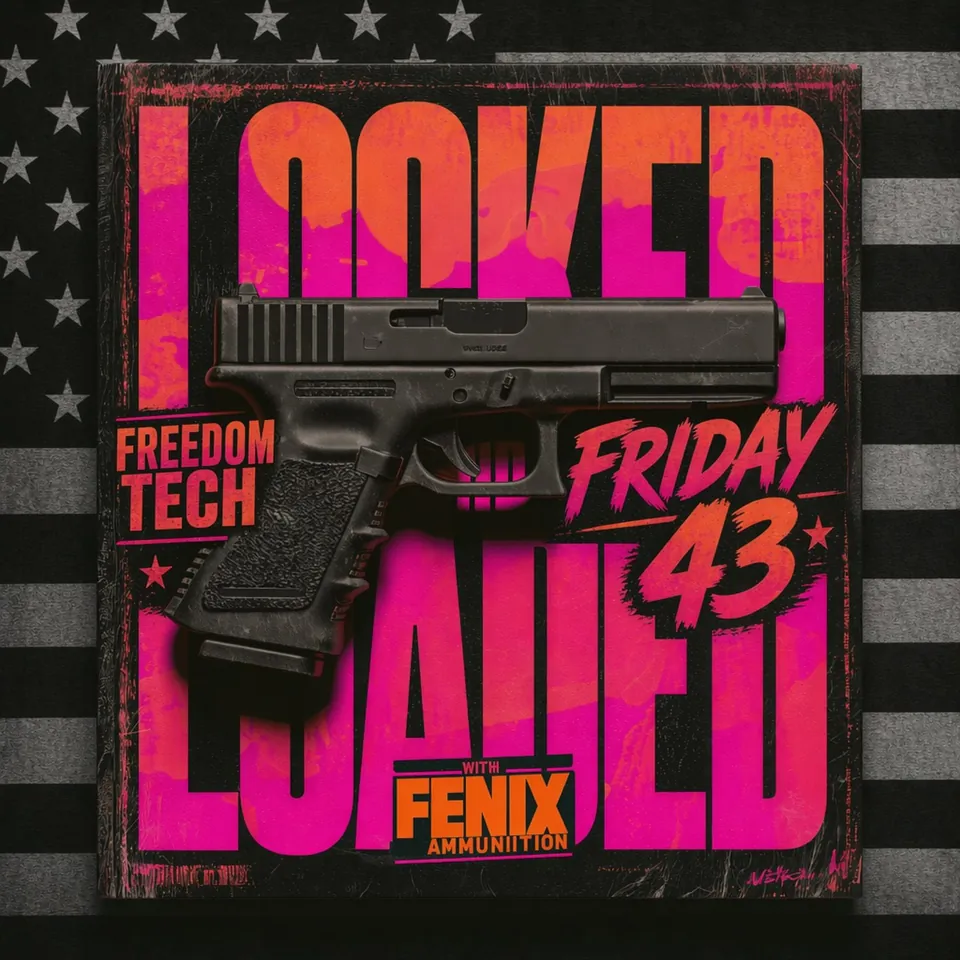
Locked & Loaded with Fenix Ammunition
Discussed in this episode
Boost this Episode
Send sats directly to the creators. Value for Value.
Plus 1% to Podcast Index, 1% to Boost Bot.
Show Notes
A weekly live show covering all things Freedom Tech with Max, Q and Seth.
GO TO https://nano-gpt.com for more information
HELP GET SAMOURAI A PARDON
- SIGN THE PETITION ----> https://www.change.org/p/stand-up-for-freedom-pardon-the-innocent-coders-jailed-for-building-privacy-tools
- DONATE TO THE FAMILIES ----> https://www.givesendgo.com/billandkeonne
- SUPPORT ON SOCIAL MEDIA ---> https://billandkeonne.org/
TO DONATE TO ROMAN'S DEFENSE FUND: https://freeromanstorm.com/donate
VALUE FOR VALUE
Thanks for listening you Ungovernable Misfits, we appreciate your continued support and hope you enjoy the shows.
You can support this episode using your time, talent or treasure.
TIME:
- create fountain clips for the show
- create a meetup
- help boost the signal on social media
TALENT:
- create ungovernable misfit inspired art, animation or music
- design or implement some software that can make the podcast better
- use whatever talents you have to make a contribution to the show!
TREASURE:
- BOOST IT OR STREAM SATS on the Podcasting 2.0 apps @ https://podcastapps.com
- DONATE via Monero @ https://xmrchat.com/ungovernable
- BUY SOME STICKERS @ https://ungovernable.network/shop/
FOUNDATION
https://foundation.xyz/ungovernable
Foundation builds Bitcoin-centric tools that empower you to reclaim your digital sovereignty.
As a sovereign computing company, Foundation is the antithesis of today’s tech conglomerates. Returning to cypherpunk principles, they build open source technology that “can’t be evil”.
Thank you Foundation Devices for sponsoring the show!
Use code: Ungovernable for $10 off of your purchase
CAKE WALLET
Cake Wallet is an open-source, non-custodial wallet available on Android, iOS, macOS, and Linux.
Features:
- Built-in Exchange: Swap easily between Bitcoin and Monero.
- User-Friendly: Simple interface for all users.
Monero Users:
- Batch Transactions: Send multiple payments at once.
- Faster Syncing: Optimized syncing via specified restore heights
- Proxy Support: Enhance privacy with proxy node options.
Bitcoin Users:
- Coin Control: Manage your transactions effectively.
- Silent Payments: Static bitcoin addresses
- Batch Transactions: Streamline your payment process.
Thank you Cake Wallet for sponsoring the show!
MYNYMBOX
Your go-to for anonymous server hosting solutions, featuring: virtual private & dedicated servers, domain registration and DNS parking. We don't require any of your personal information, and you can purchase using Bitcoin, Lightning, Monero and many other cryptos.
Explore benefits such as No KYC, complete privacy & security, and human support.
Hello, and welcome to Freedom Tech Friday, a weekly live and interactive show hosted on the ungovernable feeds. The live for one hour every Friday at 9AM eastern and 2PM UK time, but you can, of course, catch up later on the Ungovernable Misfits podcast feed.
On Freedom Tech Friday, we like to cover the latest news and trends for anything relating to Freedom Technologies. That could be anything from Bitcoin or Monero, encrypted messages, privacy tools, and everything in between.
Essentially, if there's a news item, tool, or topic that can help you take back some control in today's digital Panopticon, then we wanna talk about it. My name's Q, and I'm head of customer experience at Foundation where we build Bitcoin focused sovereignty tools.
And as always, I am joined by my good friends Max, the head honcho of the Ungovernable Empire, and Seth, who is COO over at Cake Wallet. Freedom Tech Friday is a live and interactive show, and you can help steer the conversation by commenting live, pre submitting your questions or topics on socials,
boosting the show via podcasting two point o app, or just sharing the show with your friends. Top support for last week's show with Zach Herbert comes from late stage Huddl who sent in 6,006
sats and said, I'm not sure what to say about this in this boost, but it's a great episode with lots of info. I need an AI breakdown of all products suggested in this episode. Keep up the good work, Max, even if Q and Seth bailed on you.
Well, band are back together for for one week only this week. We're all together. So thank you for your support, late stage, Huddl. Without further ado, I will bring in Justin, our guest, in just a second. But Max and Seth, how are you how are you doing?
I am I'm doing good. I'm doing good. I'm doing this podcast from a a random Airbnb in Norway after finishing Oslo Freedom Forum this week. So excuse any bad audio, no video, leaving Justin in the in the dust here by himself, the only real face. So sorry about that, but I'm doing well. I'm doing well. Really quick. How was it, Seth?
Man, I mean, it's always the highlight of my year, most HR events, but also Freedom Forum, just that unique combination of I feel like a lot of the cream of the crop in terms of who's building FreedomTech in the space, not just Bitcoiners, which I really enjoy. There's a lot of people building other
other FreedomTech out there, and then getting to to hear stories about people fighting real battles, like, lot a lot harder than the ones that at least I'm fighting.
A good reminder of how how blessed we are, how privileged we are, but also how much of a responsibility we have to not just build this stuff and talk about it, but really really live live what we talk about,
use this stuff day to day, and and make it easier for real people who are on the front lines. A lot of good design stuff specifically this week was a big focus for me of trying to figure out what what makes these things more useful for people who are actually fighting for human freedom right now. So, yeah, always an an absolute bass.
We'll definitely post a little bit more in a in a post later this week, but don't miss it if you ever get a chance to go, those who are listening. Awesome. Yeah. Was said I couldn't make it this year. But, Max, how about you? You doing well?
Yeah. Very well, mate. Excited for today. Excited to pick Justin's right. Some proper Freedom Tech.
Nothing other to report. I'm just glad to have you two back. Good. Well, like I say, for one week only, I'm unfortunately not with us again next week. So holiday. And You're back on your own. You're back on your own. Anyway Alright, mate. Ladies and gents, we've got a good one for you today. Today's guest is,
I guess, you could say is the epitome of proof of work. The Fenics ammunition build something that you can actually hold in your hand. They're based in Michigan Michigan. Excuse me. My UK isms. They're a they're a manufacturer making all American ammunition.
Every component sourced and built in The USA, no overseas powder, no overseas primers. But, obviously, that's not the only reason that we're getting them on this show. Fenics is one of the good guys when it comes to FreedomTech.
They accept Bitcoin, and they don't do it the lazy way. They run their own BTC pay server, self hosted, open source. After apparently deliberately walking away from the custodial options like Coinbase, and we're gonna dive into that.
They, tell their customers to self custody on their website, and, they understand exactly why financial privacy matters better than anybody else that we've probably had on this show.
Come for the ammo. Stay for the attitude, as they say. We're gonna get into all of it, the story, the Bitcoin, the privacy, and the brand that isn't afraid to say what it thinks, which is my personal favorite aspect of it. So let's bring them in. We've got Justin on board. Welcome to the show, Justin. How's it going?
It's going great, man. Thanks for thanks for having me. That was that was a great intro. The the one thing that you that you got is it's come for the ammo, stay for the means. It is attitude, of course, but, you know, this is I'm a I'm a early stage millennial, so we we speak in memes.
Nice. Yeah. Well, they're they're plentiful in the Bitcoin ecosystem, so you definitely fit them all there. Before we we kind of get into the Bitcoin and freedom side of things, I wanna start with the company itself because this story is kind of, you know, one of the main parts why we wanted you on. Fenix is bringing ammunition,
manufacturing back to The USA, building every component right there on US soil, which I'm sure was a deliberate choice and, again, I'm sure is an increasingly rare choice these days. So tell us how it all started.
Yeah. So started in 2016. And at that time, I was actually working for an insurance company doing various things for the manufacturing industry, product liability, risk assessment, etcetera.
And I had wanted to move out of that into some kind of manufacturing. I watched what they did every day and, you know, how proud of the things that they were building they were. And so I I wanted I I've always known that I wanted to do more of that. I'm more of a physical hands on guy.
So as much as I enjoyed, you know, paperwork and insurance and legal contracts, I wanted to get away from that. And so at the time, my younger brother was working for a small ammo company local to us, you know, just because, obviously, you guys are from The UK. You know, this was in the end end of the Obama era of politics when
everybody was a 100% sure that Hillary Clinton was gonna get elected. And so there was a big push for people, you know, looking to buy guns for the first time or just as many as they could because they figured things were gonna get banned right away. So there was a pretty big market for guns and ammunition generally.
And I you know, he approached me in at one point and said, hey. You know, the guy who owns his business, he he actually just passed away, and his family doesn't really want to do anything with it. It was kind of a hobby business for him.
And so he said, I think we can restart this in our in our own way. What do you think? And I said, okay. You know, I'll handle all the finance and administration and marketing side of things.
You you know how to build the product. And I'm also, you know, sort of an amateur engineer, and so we can probably figure out some better ways to do things. Let's do it. And that's how we got started right before the twenty sixteen election.
And then, of course, you know, that didn't go the way that everybody thought it was going to. And that was actually a big killer for the gun industry for a number of years. Demand dropped pretty sharply, and we had to make a lot of adjustments.
And that's kind of what led us into the niches that we really focus on today, things like competitive shooting, and then getting further into the the discovery of, okay. Well, you know, what does all this really mean?
We spent all a ton of time at gun shows talking to gun owners and, you know, hearing their side of of things and starting to understand, okay. Well, these these guys have have this side of the freedom equation figured out pretty well, but, there's a lot of things that they're missing.
And, you know, it it tended to be kind of an older crowd that wasn't maybe as hip to the latest things going on. And, you know, I I personally had heard about Bitcoin, you know, almost when it was invented. I had been thinking about it for years.
And as time went on, you know, one of the things that we had issues with was, okay. We need to accept credit cards. How does that work? And that led me down the rabbit hole of trying to figure out how to work with credit card processors and trying to understand why we are a restricted industry despite
something that's constitutionally protected here. And so, you know, as somebody who's always trying to figure out a better way to do things or a con you know, contrarian way to do things, I might say, that kinda led me into, alright. Well, let's try to figure out how to get Bitcoin
incorporated into the business because this just seems obvious. These two are basically the same thing from a, you know, I I don't know, a a not a morals and ethics standpoint, but just conceptually, they're they're very similar.
So let's figure out a way to get these two communities together as best we can, and this is another niche that we can get into. Nobody else is accepting Bitcoin. Everybody's kind of waiting to see what will happen with that.
And, you know, that was sort of during 02/1819 era. And, then we got into COVID here. That was actually pretty good for us. To be honest, there was a lot of demand here in The US for ammo. People were real nervous about things.
And what it really did was you know, open up people's eyes to just how quickly things can get restricted and shut down. And so that that really then propelled us more into the world of Bitcoin where we you start looking at, okay. The you know, all these things can be turned off remotely
by the government if they want to. It's great if you have an AR, but if they turn off all your banking, you know, what does that leave you with? Basically, no other options than to use it. And, you really don't wanna have to do that. So how do we start exploring this freedom world and not being so heavily concentrated in only one topic
where, we miss out on opportunities, to expand that in other ways. Yeah. I love that you I feel like you've gone a step further than a a lot of people in the gun space have.
And maybe just for a little context for those not in The US, I think, our our gun culture is a a bit unique. Maybe not totally unique. There are other countries out there that are are pretty, gun friendly, but I don't think anywhere is quite like The US.
So, like, a little context, and, Justin, you definitely fill in more too because you're you're even more of gun guy than I am. But in The US, there's basically, like, three reasons why people are interested in guns, and they're extraordinarily common. One is just for fun.
There's a lot of just people enjoy shooting at the range, target target shooting, shooting, like, sporting clays with shotguns. It's just an enjoyable pastime here and has for has been for hundreds of years.
There's also hunting, which is very common in much of the South, rural America. People hunt both for fun, but also legitimately for for feeding their families. And then there the third one, and maybe the one that that you focus on a little bit more and that aligns a little bit more with the Bitcoin side of things too, is is the idea that
we in America once used guns to overthrow a tyrant and to to start a new country to to change the way that things were. And the idea is we need to make sure that we have the ability to do that again. Obviously, the goal is not that we have to use guns to overthrow a tyrannical government. That would be a worst case scenario.
But there's something about having the ability to to check government, but also just to defend our families personally from a robber, from kidnapping, whatever that may be. That is a very big movement and part of the culture in The US to be able to to use guns for self defense.
And I know a lot of times, like, people looking in from the outside only see the bad sides of gun ownership or normally illegal gun ownership when they're used in crimes, that sort of thing. But there is a a a deep a deeply rooted culture of
gun ownership in The US in very positive ways. I don't know if anything else jumps in jumps out at you, Justin, there, but I figured that was probably good to set the scene for those who are listening who are not from The US and maybe don't understand kinda where this would be coming from.
Yeah. I'll I'll expand on that even a little bit. You know, I personally, I I'm not former military. I I'm not a former police officer. My parents were not in the military. They were not police officers.
So I I actually grew up really without having guns. You know, my parents are fairly conservative, you know, they didn't really want me to have, like, toy guns, and they wanted me to, you know, have a have a nice
calm upbringing, I guess you could say. But, you know, I played with toy guns at my friend's house and and had fun doing that type of stuff. But it it really hit me. You know? So I I've actually never been hunting.
People find that surprising considering what I do for a living. I just don't have time for it as a as a hobby as much as I'd like to. What got me into guns
was when I got my I was working for the insurance company that I worked for, and I spent a lot of time in Downtown Detroit in the worst areas you could possibly imagine, and that's because that's where the manufacturing companies were.
And at the time, I was dating my ex wife very seriously. We were living together. And I thought, if there was ever a situation where something happened to me and I couldn't protect her for whatever reason, I I would never be able to live with that.
And, you know, again, myself, personally, I I was a a collegiate wrestler for a division one program. I'm a black belt in Brazilian jiu jitsu. I've been grappling since I was 12 years old, so I have, you know, almost thirty years of experience fighting people,
whether simulated or not. And the one thing that you learn when you do that is there's always somebody bigger. There's always somebody faster. There's always somebody stronger. There's always somebody who knows a little bit more than you do.
And at the end of the day, in in a real life scenario where there's no rules and, you know, you can't just tap out and surrender and shake hands at the end,
you have to be ready to do anything to stay alive. And if you're getting beat up by two two hundred and forty pound guys and you're a hundred and seventy pounds, you're probably gonna die.
And so you need to have a gun. That's the conclusion that I, came to. And like I said, that was at, you know, the age of 21, 22. I got my concealed pistol license, and that's really the reason I had it. You know? If somebody comes in here and tries to hurt me or my wife, I'm gonna kill them. And that's just the end of it. To me, that's
the essence of the propagation of the species and human survival is at the end of the day, you have to be alive. And as men, particularly, we are, whether we like it or not, charged with society sort of charges us with the responsibility
of protecting people who are weaker than us or who need it. And, you know, that's maybe a little bit different today, I think, for the negative, and we can see the consequences of that. But we need to get back to that, and part of that is having the tools that you need in order to be able to accomplish that task.
Yeah. And I think the maybe tying it back into Bitcoin too, something that has always stood out to me is a a a gun for self defense is a a great equalizer. It's an asymmetrical tool for defense, and that even as a small person who isn't a black belt in jujitsu,
who's well trained and has spent the time on a, on a gun range and has practiced
could defend themselves against someone who does have greater tools or greater wisdom and then greater learning in terms of, like, hand to hand combat or who has a knife or who knows what could happen. It's a great thing that gives you an asymmetrical advantage.
And I think in many ways, Bitcoin is the same thing for us. But on the financial side, where you can have an an outsized increase in the power you have to to determine your future, your sovereignty through Bitcoin in a financial sense. And those two things mesh so well together, and I think, fit along a lot of the same lines.
Yeah. I I agree completely. You know, for me, that that's one of the one of the things that that hit me early on learning about Bitcoin and the wallets and how all this stuff works. It it was cool to me that, okay. So you're telling me that all I have to remember is, you know, 12 or 24 words in a in a pattern.
And as long as I memorize those and I have those buried in my head and I don't have it written down anywhere where somebody can find it, you know, you'd literally have to torture me to death in order for me to give those up.
And so that hit home because, of course, people in the gun world are always saying, you know, from my cold dead hands, you're gonna have to kill me to take my gun away from me. And that's
kind of the way that I saw it. Bitcoin is like a digital gun in a sense. You know? You you you'd have you'll you and in that case, if you kill me, you're not gonna get it at all. You know? If you kill me, you can take the AR 15 off my body and go use it for whatever you want. But if I don't give up those
my passkey and you kill me, then that's gone forever. So fuck you. And I kinda like the idea of being able to do that. As a gun owner, that's at least for me and my sort of ex you know, maybe extreme corner of of that world, being able to say no is a a really good feeling and especially when you're able to say it to the government.
Yeah. It's quite rare that you can say no and quite rare that you can have these type of protections. And those two things, like, going back to the home invasion scenarios,
as a father, the biggest fear I have and the thing that keeps me up more than anything is, like, what happens if someone breaks in and tries to hurt my children or my partner? Like, that's the biggest fear.
And no matter how much, if you're in The UK or parts of Europe, no matter how strong you are, how tough you think you are, even if you're trained,
if there's multiple people or they're armed or with all the will in the world, there's not a lot you can do other than get your phone and call the police who are probably gonna do fuck all and arrest you anyway because of the meme you've put out. And that is a a very bad situation to be in. That I don't understand
anyone can have even as someone from The UK, I can't understand how anyone could have a problem with someone having a firearm in their own home to protect their own family, that seems like a right that any human should have and has done has had going back forever and ever and ever.
Like you say, with Bitcoin, it's the same thing. It's, well, no matter how bad things get, I can still feed my family because someone will accept Bitcoin even if they wanna shut me off, and that's pretty powerful.
Yeah. I think it's you know, with things evolve over time. So money has evolved over time from whatever, you know, wampum and and rocks up to silver and gold coins to paper money, and now we have basically the digitization of money.
And, you know, unfortunately, there's no way to, like, digitize an AR 15 sort of, but, you know, that's kind of where we're getting into the topic of three d printing and and, you know, the proliferation of being able to make your own firearms.
And to me, that is the is the evolution that actually makes it much similar to Bitcoin in the sense that, you know, Bitcoin, the idea is self custody. So I don't have to rely on a bank, and we have, you know, ways to get around having to rely on any one entity to process transactions,
you know, with mining and things like that. But in the gun world, as free as we are, you know, unfortunately, most of the time, you still have to get your gun from a dealer who is subject to a government license,
and and what have you. So three d printing comes around and is getting better over time, of course, and allowing us to do more things. And so now that's sort of the self custody side of it. Well, I I if I can't get a gun from a dealer for whatever reason, my state doesn't allow it or the ATF is shutting down all the stores in my area,
the the politicians are trying to drive the gun stores out. Well, now I can basically just make my own and, you know, self custody my gun in the same way that I would you know, like, in a in a moderate in in the in the gun world sense, buying your gun from a gun store is kind of like having your Bitcoin on Coinbase.
Not not not exactly. The gun store can't come and take your gun back exactly. But It's like buying from Coinbase. They have paperwork that shows that you bought it and they have your address.
And if the ATF or some other government agency decided to put the screws to them and force them to give that information up, they probably will. And so, same kind of idea. You know, your your bank will sell you out
to any government agency who wants to know how you're spending your money or they wanna garnish your wages or whatever. You know? They will turn free reign of your bank account over to them. No problem.
And so the same issue exists in a slightly different sense, but close enough that what's good is that when you start to talk to people in the gun world about Bitcoin things,
you find that it makes sense to them very quickly. And I found the same on the other side. I attended the Guns and Bitcoin conference, which is actually where I met Seth, back in 2022. And I really enjoyed it because I was in a room full of people who weren't like, some of them were gun owners for sure and gun enthusiasts,
that kind of thing, but not obviously to the same degree that I was. And so I I had all this stuff that I was eager to share, and it was it was great to see how quickly they understood it and recognized it and could see the parallels.
And, similarly, I picked up a lot of things from those guys that I hadn't really considered. And so I I I couldn't have had a better time. I I found that it was a a great fusion of the people with more or less the same line of thinking just in two different worlds.
Yeah. That's that's that's awesome. I didn't actually know you've been to to Guns and Bitcoin. I'm jealous about that one. I'm curious about the the marriage of of
Fenix and and Bitcoin. Was it kind of something kind of organic that you discovered it and thought, you know, this is obviously a great marriage for the business? Or was there a specific point in time that you have problems with the legacy financial system? Like, walk us through how that came about.
Yeah. So there was never any instance where we got, you know, shut down by a credit card company or anything like that. But when we were getting started, you know, I'm setting up the website and I'm, you know, I'm doing all this stuff on my own. We don't have, you know, a web developer or an IT guy.
This is all just stuff that I had to figure out from scratch. We just didn't have the budget for it, frankly. And so I'm looking into the credit card processors, trying to find who has the best rate, all these things. And you start going through their terms of service, and you're like, okay. Why am I in the same category as
selling drugs and pornography and, you know, gambling and all this shit? Like, what what's the problem? And they just said, well, you're a high risk industry so you're going to pay more than everybody else. And there's probably only two or three companies that you're going to be able to work with.
And so right away, I you know, in the back of my brain, being like that side of a financial guy, I had it had already planted the seed of, man, somebody needs to figure out a better way. And I know that's unlikely because this whole system is controlled by these gigantic
credit card companies, and you you have to have their blessing to do anything. So, you know, how do we get around that? You know? And at the gun shows, not
everybody, but a significant number of people wanna pay cash. And as we started to move away from doing gun shows more into the online and retail world, that kind of disappeared where, you know, we really can't have people sending us checks and money orders for
orders that they placed online. It just doesn't really doesn't really work that way. So, you know, Bitcoin, like I said, I had already been thinking about that. You know, back when I bought my house in 2010, I remember, you know, then what Bitcoin was, what, 2012,
I I remember doing something around my house and thinking, man, I I could set up a miner down in my basement here, and it's nice and cool down there. It would actually function better, but, you know, I'm busy, so maybe I'll think about that later.
I probably should have thought about that at the time a little bit more seriously in retrospect. But, so I you know, I'm trying to think of the exact I actually okay. I do remember. When when we were when I was setting up the website and it was giving me the different options for payment, I somehow stumbled upon a way to accept
alternative payments, that you could basically set up a little portal for. And I said, okay, well, what can we do with that? Well, I mean, we could try to accept Bitcoin and Shopify had some built in way to do that with Coinbase originally. So that's kinda how we got started
at just as a way to accept it. I I just thought it would be cool to be the only gun company that accepts Bitcoin. Seemed natural to me being that here we have all these customers that wanna pay cash and they wanna be a little bit more anonymous.
Bitcoin seems to be getting, more popular. And so let's try to be an early adopter. Let's be a a fringe, you know, company that's gonna take a step and and, be the first, maybe not the first, but the you know, one of the first ones to accept it.
And then as I said, you know, I went to the Guns in Bitcoin conference. So we, you know, we we had been accepting Bitcoin for about three years at that point, three, four years maybe.
And when I got there, then I discovered this whole other world. I mean, I knew about self custody and things like that, but I really hadn't put the work into figuring out how easy it could be for a business to do it.
But when I left there, that's the first thing I did was, alright. I gotta figure out how to I gotta host my own node. I gotta host my own server. I gotta use a payment service or a, you know, software that is not tied to KYC, and this totally makes sense. And so it's it's it's definitely evolved over time for sure.
That's awesome. And and to the point at which you're obviously comfortable with sharing, like, what's the the uptake been over the years on on your customers actually using Bitcoin as a method of payment?
You know, it varies quite a bit. I would say, initially, we would get maybe one a month, two a month, something like that. And and, you know, that was one of the things that maybe start taking it much more seriously is,
leading up to COVID, you know, we were just kind of collecting Bitcoin, and it wasn't really a significant amount of money. So it just kinda sat there. You know, I I accounted for it when I had to, but it was sort of like a rainy day fund, I guess.
And then COVID happened and, course, you know, Bitcoin took a big drop. And oddly enough, it seems like when Bitcoin drops, that's when everybody wants to use it. And I guess that's fine. It's great for us because we're getting it at, you know, a low price and then eventually it appreciates. And so,
we collected a bunch of Bitcoin payments at the beginning of COVID for the first, I don't know, four or five months when it was down significantly. And then by the end of that year, it had gone back up, you know, to where it was, if not higher, if I remember. And so I I recall logging in to the account where our Bitcoin was held.
And, you know, I thought there might be, I don't know, 10 or $15,000 in there or something like that. And it was, like, 4 times that. And I thought, holy shit. You know, how did I lose track of of that much money?
You know, there's no way. Like, we're not that kind of business. You know? I don't lose $60. Like, that's not that's not how this works. And I just realized that most of it was from appreciation.
And I thought, alright. I I really do need to take this more seriously. I need to pay attention to it. This is not just a a payment source, but it's also kind of a business investment, and there's some real opportunities here. So
let's let's start exploring this further and, you know, trying to incorporate that a bit more into our marketing. You know, we were getting people interested in the Samurai wallet and and their technology at the time. Again, guys that I met at the Guns in Bitcoin conference and just right away knew that these are the kind of guys that,
you know, I I would love to hang out with. Like, they have the same mentality. They're doing stuff that I don't even I can't even conceptualize how to do from a technical side. But if we went out and had a beer, we would be saying the exact same things.
So, yeah, I I I does that yeah. Does that answer your question? Yeah. I think that answers it. I'd be interested to know,
as a percentage, if you're comfortable to talk about it, like, how much are people using Bitcoin? How much of your customer base are Bitcoiners and actually spending and using it? Is it stable, or is it It's hard to say. It it's increased now. I I I think we do a couple transactions a week now with Bitcoin.
You know, let's say we do four or five a week on average, you know, may maybe one a day, maybe one every other day. Sometimes when we, you know, hit some particular part of Twitter that gets into the the Bitcoin world a bit more than we usually do, we'll we'll get a couple in one day.
But overall percentage, it's still very, very small. I mean, you know, out of a 100 transactions, it might be, say, two to four. So, you know, maybe maybe two to 4% at most,
which, you know, I don't really know what that's like compared to other businesses and retailers because, really, there just aren't that many companies that accept it. So I'd be curious to know if that's greater than the average or less than the average. I suspect it's a bit greater than the average, but I I don't know. Yeah.
Yeah. It's normally quite small. Zach's in the comments from Foundation saying he uses you for all his ammo. I love these guys. Only place I buy ammo from. So you know, it's probably it's probably him four times a week just buying cases.
Yeah. And I have a foundation wallet, so thank you guys. You guys have great products, and I've I've had that for a couple of years now. So yeah. Nice. Very nice.
Yeah. I think one thing that I I sorry. Go on. Go Just just real quick. I know, like, something that was was awesome to see with y'all. I think it was around the time of Guns and Bitcoin that y'all were exploring switching from Coinbase Commerce to to BTCPay because I think we chatted quite a bit about that Yeah.
About that then, which was was fun of that idea of, like, not only can you accept Bitcoin, but you can accept it in the way that provides the most privacy and the most freedom. Like, that's one of the the hard things, I think, because a lot of people think,
oh, I just accept Bitcoin, and I get all the benefits from it. But just, like, obviously, people listen to the show know, like, the there's there's a lot of issues if you do trust a third party custodian, and you end up in the same kind of privacy and censorship
place that you you you would be in with credit cards if you're doing it through something like that. So that's been an awesome transition. I'm kinda curious just, like, from a
an experience perspective, how has it been for you running BTC Pay server for this? I mean, like, you said you're not getting a ton of orders through it, but enough to make it worthwhile clearly. Like, what's that that experience been for you as as a team? You're not you're not an IT company.
Like, that's not your normal your normal bread and butter. I mean, I'm just kinda curious, like, what that experience has been like. I'd say it's pretty good. Setting it up the first time wasn't hard. I had to make some changes, of course, when we went to our our at first, I was hosting it on
a different server, then we got our own. And so that that was, you know, a little bit difficult, but, you know, I I'm a like I said, I'm sort of an amateur engineer. I mean, I was building computers back I mean, I had a computer in my house when I was, like, nine years old. My dad's an electrical engineer.
He had a VAX, you know, computer that's the size of your fridge, around the time I was born. And so we were always kind of a technical family.
So I like that challenge of, okay. Well, now I'm gonna, like, buy this hardware and put it together. The software side is the part that I don't like. I I guess I'm just not that type of a creative. I'm I'm more of a physical world type guy.
So it was a it was a little bit you know, it took some figuring out, but it's mostly just following the steps. And once it's set up, it's pretty good. I mean, we we very rarely have issues.
I suspect most of the issues we have are because we use Shopify as our ecommerce platform, and I just haven't been motivated to move away from that until I have a really good reason. And I think it would probably function better
on some other ecommerce platforms, but it works okay for now. Every so often, we'll have somebody that doesn't get the QR code to pop up at checkout. And so they'll send us an email, and we just send them a direct invoice from BTCPay, and that always works.
So, you know, on on the rare occasion where we where we have a problem, it's it doesn't take all that long for me to manually, you know, process the transaction on on my side. So, you know, if I was trying to do that a 100 times a day, maybe I would be motivated to look for a a different solution outside of Shopify.
You know, I I don't think it's really a problem with BTCPay at all. I think they're having to kind of shoehorn their functionality into a box that doesn't really want you to fuck with the box. You know? They they kinda Shopify sorta has their
ecosystem set up, and there's you have a lot of freedom in some aspects of the website and then almost zero in other aspects like the checkout page and some of the payment processing things.
So I I would say it works it works better now for sure. The initial setup, I I think, was a little bit more difficult, but now it it seems to work better. So I'm I'm happy with it for sure.
Yeah. Just on that, you might see on screen now, Zach and I are working on a an update to the Shopify eBay plugin because we've been eating that dog food as well and had a similar sort of experience where it's a little bit janky. So the
joys of open source software, we're we're gonna see if we can we can improve them. Obviously, happy to share that with you guys as well as and when it's ready, see if it will improve your practices as well. Yeah. You know, I like open source. I like the idea of it, but I know that that comes with the challenge of it. Open
source things are almost never as polished, and that's that's really where I see the hesitation for a lot of people getting into Bitcoin who are in the sort of normie world or they they have one toe in the water is they it's it's just seems it's it's hard for them to find a software or a combination of software and hardware devices
that have a great user interface and make them feel as if they're using something,
you know, professionally designed as opposed to, like, a bunch of hackers that figured out a way to move money across the world with ones and zeros. And, like, I like that because it sounds cool as shit. But, you know, for your average person, I think it's a little tough.
But it's getting better. I I think over the last few years, it's gotten it's better than where I was in 2022. That's for sure.
Yeah. You've written previously around, like, banks and card networks tracking firearm and ammo purchases. Could you kind of paint that picture in a bit of more of a detailed way as to how kind of real that surveillance is today? Do you have any, like,
anecdotes or stories about customers that you've interact ed with that have really felt the the brunt of in in recent years? Well, that's been it's been a topic of discussion for for many years. And for now, it seems that they've been able to weigh their ability to do that.
But, yeah, the credit card companies, they they always want you know, the the problem is everybody always wants more information. And so if I look at it from the perspective of a credit card company, if I if I know the individual items that somebody's purchasing with their credit card as opposed to just the
total dollar amount from, you know, Walmart or Target or something like that, that information is useful to me as a business for marketing. You know? I mean, that's just what thing that's just what companies do now. They scrape your data. They figure out how to sell you more stuff, and so there's value in that data.
So I think there are probably some people approaching it innocently from the perspective of, well, we just want more data for the company to be able to, you know, sell better products or whatever.
And then there's the nefarious aspect of, okay. Well, now we can actually monitor what people are doing. And you have people in the government who would say, okay. Well, this is great because now we can use it to track things like financial fraud or theft.
And then you have other people in other areas of the government or in in society, generally, people who are very anti gun who say, well, okay. This is perfect. Now we can see, you know, who's buying guns and how much ammo you're buying, and then that's a way for us to start putting some restrictions on how many you can buy
in a given month or or something like that. And so there was a big concern about that when, we had, you know, Biden as the president here for those four years because they had a pretty good control over the congress.
And, you know, it seemed like they were really pushing the credit card companies in that direction, and those companies tend to be left liberal leaning anyway. So they they didn't end up they ended up getting a lot of backlash for it, and the credit card, companies seem to have backed off on it.
Although I don't really know that I trust them. You know? If they say if if they think that they can do it and the government says, well, no. You can't do it because x y z. I'm not convinced that they aren't doing it anyway somewhere in the background and just not reporting it or simply, you know, collecting it to see how it works.
And, yeah, I I I'm not confident that it's gonna get any better. Let's put it that way. I think as time goes on, that will that will inevitably only get worse. You've got to assume necessarily at the same way with Bitcoin.
If you're buying from an exchange and you're giving all your personal information, even if that information isn't used against you today, it probably will at some point. And with Bitcoin and with ammunition and firearms, you've often got those for worst case scenarios.
If your government turns against you, your banks turn you off, things go bad in society, you you have those things as protections. If there's a record and a trace of who has what and where, that puts you at risk if you're stockpiling either Bitcoin or ammunition or firearms or whatever.
If they have your name and address, well, how how helpful are you? How much of a good militia can you have? Or how much can you look after your family and the people around you if military can just roll up and, you know, outgun you? That that seems like it would be,
just as just the same way we would advise here, don't buy on an exchange and buy peer to peer and use things like Whirlpool, you know, think about your privacy, don't leak that information.
I think it's clear that people should be doing the same with, guns and ammunition if possible. Yeah. I I that that's a a weird there is is a dichotomy there because, you know, I would say when I first got into this world having been just a gun consumer, I
tended to think in the same way that now I think is sort of like boomer gun cringe, things like, you know, I lost all my guns in a boating accident. And I'm like, yeah, that was funny for a little while. It was cute to say.
But then as I, I suppose, became more radicalized or I would say more affirmed in my opinions, I realized, well, okay, what's the fucking point of
you're gonna pretend like you don't have any guns? You know, the government's gonna ask you if you have guns and just you're gonna lie and say that you lost them in a boating accident. Like, my answer would be, fuck. Yeah. I got guns. You wanna see them? Like, I got a whole shit ton.
And if you think you're gonna take them away, you're gonna be seeing them right up close and and in person in a way that you're not gonna like. So, you know, I think Bitcoin is kind of the same way in that I I'd like know, there there's the the the secretive aspect of it. You know, it's very private. You can do what you want.
At the same time, I think it's I don't I don't think the long term strategy of hiding is is ever a good one. And so at some point, you have to just say, yeah. We have this money system that you guys can't fuck with, and we've created a whole system that will
allow us to get away from banks and not allow us to be controlled by this government. What are you gonna do about it? I'd love to get to that point with Bitcoin. And that's kind of where me I I personally am and us as a company are
in the world of guns. You know? That's one of the things that we say on Twitter all the time, often right to you know, replying to politicians here in The United States
who say that they're gonna take this away or that away. I just reply, well, I've got 20 of those. What the fuck are you gonna do about it? Like, who are you you're gonna come and get it? You know,
Patty Sue? I doubt it. You're gonna send a bunch of guys to come get it. And as soon as a couple of those guys meet some resistance, they're all gonna quit, and then you're gonna have nobody.
So if that's the way that you want things to go, then we're we're ready. You know? Say the word. And, of course, that's, you know, antagonistic and instigatory and probably, you know,
is not great in terms of me being put on government lists and things like that. But, I mean, if we're all on the government list, then it doesn't matter. Right? It's the list is too long anyway. So that's kinda my approach.
You're just getting on extra lists, new lists, maximalizing maximizing those lists there. I'm list I'm list maxing. The a list. Yeah.
I think, like I I think a lot of times for, like, self custody for the individual who's not trying to
be an influencer or use, like, social media as a platform, I kinda think of it a little bit maybe closer to concealed carry when it comes to guns. Sure. Sure. Where it's like, I keep it private so that I can use it when necessary, but no one comes comes to take it from me because they know that I have it.
And where I'm more worried about the the random guy on the street who would see me open carrying and say, hey. I could use a gun. And so he he takes it from me because he knows it's there, where I can use it better for self defense or better to defend my family
if I do keep it quiet and private until the moment arrives. But definitely different, like, use cases. I mean, I think similarly to to how I've approached the privacy space. Like, I'm not showing my face here because no one would wanna see see the setup I have here, but I do show my face, and I go on video podcasts
even though I am a, like, a I'm a privacy guy because I think there's a lot of value in people seeing that regular people actually value privacy and actually want to build good tools and actually want to educate people about why this stuff matters. And there is some some loss to that in terms of
probably me being on more lists as well, just like you, Justin, of, you're going out and about and saying things that people don't want you to say, but you're doing it to to hopefully get a better benefit long term. So I definitely
definitely echo that sentiment. I did have one question for you. You mentioned this very briefly at the the beginning of the the pod, but that you had, like you're you're going gun shows. You're having these conversations with gun owner gun owners and seeing that they
they have maybe the physical defense side down, but they're missing out on the fact that that's just one part of the kind of freedom tech stack that a person needs to holistically defend their family or holistically defend their sovereignty generally.
What's the, like, the the feeling or reception like towards Bitcoin in those kind of circles that you you are having conversations with? Is that kind of a relatively common thing? Is it something most people are dismissive of? I'm kinda curious, like, if that seems like something they're open to or if it just seems just totally
not even on their radar. It it's definitely changed as time is I would say if you if I if you put me back in, you know, 02/1718 when we were at, you know, gun shows at some, you know, state fair grounds someplace, probably none of them would you know, it's very generational. Let's put it that way. The gunshot crowd's pretty boomer.
And so, you know, my dad's an electrical engineer, and I talk to him about Bitcoin all the time. And he knows about it, but it's just not his thing. You know? So most of those people, I think, are just an old dog that really isn't very bothered to learn new tricks. I'm hopeful for them,
but they seem to believe that, you know, cash is king. And, well, if I don't have cash, then I've got these gold bars so I have that. And, yeah, that makes sense. That always made sense to me. You wanna have multiple ways to barter and deal with things.
But how do you send a gold bar to somebody on the other side of the country or the world or something like that? So I think some of them are a little too caught up in the one thing. They're spending 80% of their time in the gun world and 20% of their time,
you know, buying emergency food and and having, you know, gold and things like that as a periphery. So I think Bitcoin is just a little bit too far. All those are, like, real things. You know, I I think in the in the gun world, in the in the world of, you know, I hate to say conservative because
I don't wanna exclude, you know, anybody in the gun world that's not conservative, but it just tends to be much more, that way. And those people, they want they want to see their stuff. You know? Like, you wanna have your stuff piled in your bunkers that you can count everything and you have this many of this and this many of that.
Even for me, Bitcoin, that was I remember the first time sending Bitcoin, and it was not an insignificant amount of money to me at least. It was probably a few thousand bucks. And I had that, like, you know, heart flutter, like, asshole puckering moment where you're like, you hit send and you're like, oh, fuck. I hope this works.
But how do I know? You know? It's just like numbers floating around in cyberspace. And so but I guess it's the same thing as putting a dollar into a vending machine and hitting the number and expecting your drink to come out. You know? We no nobody really
has any worry about that anymore or or, you know, sending an ACH payment from their bank. Nobody's concerned about that. But I think there are a lot of people in the in the gun community and the freedom community generally, prepper community who, like a common thing that I'll hear from people is, well, what
if all the electricity goes out? What are you going to do with your Bitcoin then? And my answer is typically, okay. Well, what are you going to do with your gold bars then? Like, the the power's out. So, you know, explain to me how this is any worse of a problem. I mean, you you're talking about a literal end of the world scenario
where your average suburban neighborhood is gonna look like a zombieland apocalypse within three, four days, I don't think that gold bars are really gonna save you in in that instance. They might, but you're probably more likely to be bartering with somebody for food and water or a pack of cigarettes
than, you know, you can't eat a gold bar. So nobody's really gonna be all that concerned about it. And eventually, the electricity will come back on, you know, ideally, and we'll be able to resume normal society.
But I, you know, I I just don't I'm not saying to put all of your eggs in one basket or the other, but to say that you're not gonna put any eggs in the Bitcoin basket because electricity to me seems seems silly.
So but I've had a lot of those conversations. And I'd say most of the time, I feel like I'm edging people at least a few percentage points toward doing more of their own self discovery and figuring some of these things out on their own and having it make sense to them.
And and like I said, I think as I think as technology improves in the gun industry generally and we have more people involved you know, there's a lot of people involved in the technical aspects of three d printing and CAD design and
all that type of stuff. And so you are starting to get more, technically competent people into the gun space who are competent in things like, you know, software and hardware. And so that's great because that will then proliferate into other areas of bringing that kind of freedom technology
into the space and just more people will be around it and we'll just absorb it through, you know, osmosis, more or less. Yeah. I mean, I see something really similar, I feel like, in the in the Bitcoin space where it's that idea of, like, I'll just I'll stack all the Bitcoin I can.
The world will end, and somehow I'll just keep the Bitcoin and be able to use it to build a citadel, and no one will try to take it from me. And I I don't the I think the the through line there is a little lost a lot of the time because they they view it just like gun owners where it's like,
the only thing I need is guns or maybe guns and gold or whatever the the other preference is. And Bitcoiners often do the same thing where they're they're not considering the physical
realm where, like, how are you going to actually defend the ownership of Bitcoin that you have? And, obviously, each each situation is different. Maybe you maybe you actually have no need for that.
But for most people, you do need a physical protection at the same time as your financial protection, which Bitcoin can bring, or your digital protection as just taking taking privacy seriously can bring. So those things do do mesh better when they're they're joined together and you have a kind of a full freedom tech stack.
I know not everyone can do that. Sorry, UK. But at least at least some of us can. Some of us can. Yeah. If you have the opportunity to, of course. Like you said, you know, adding to your stack,
that that is a big problem in both the gun and the Bitcoin world. You know, I again, at the Guns in Bitcoin conference, I I thought to myself, there's a lot of guys here that have some really nice equipment and a bunch of stuff and, you know, a place to hide out in the mountains, but they don't got any guns. And so,
you know, whoever shows up there first is gonna be a big problem for them. So if we can get them more into the realm of physical security, they can teach us more about digital security, and then we'll have more of a cohesive effort. I mean, I you know, I had even thought about,
you know, some of the other industries that are, you know, targeted by banks and credit card companies, you know, let let's say OnlyFans.
Okay. Well, you know, they have the same problem that we have in a way. You know, they the banks don't wanna work with them. And so, you know, even if I even if I don't agree morally with the things they're doing, if that ends up with Bitcoin becoming more popular because they have to find a workaround
to be able to do what they do without the banks, well, that's a benefit to me because whatever they invent to do that, I will in turn be able to use in my world. And I don't have to endorse what they do necessarily, but I can benefit from the advancements that they make.
And so, there's a lot of, you know, seemingly un the marijuana industry, same way. You know, they they legalized it here in Michigan a few years ago, but they can't really have bank accounts. And it's cash only.
You know, they can't accept credit cards. So they have the same problems that we have and more or less for the same reason because the government has said that you're not allowed to have this or do that, and that's the end of it. And now you gotta figure out a way around it. So there's I I enjoy finding,
you know, the 20%. I'm a I'm a big, like, eighty twenty Pareto kinda guy. You know? I'm a I'm a I'm a generalist. I like to be a a mass generalist, not an individual specialist, if I can be.
And so if we can find the 20% in common between industries that may have nothing in common other than that small 20%, you know, we can we can leverage that quite a bit. So I I've been very happy to to meet all the Bitcoin people that I have and just people in the crypto world generally
because they've they've taught me a lot of things that I may may have already known in deep in the back of my head, but never really understood it the way that they explained it. And that's been beneficial for us, you know, in what we do.
We're we're coming up to a time that the time has absolutely flown past. I had a couple of things that as we were going through,
I I wondered. So I'll close out with the Yes. And I've got plenty of time, so you let me know. It's it's it's my cohost, unfortunately. They Oh, got it. No problem. Away at the end. So the the two things I was wondering as we're going through this, one is from what I understand, everything that you do manufacturing wise is US based.
And from what I understand, that's quite rare. So it's why is there a is there a ethical reason, or is it a practical reason? And the second one, which I'm sure Seth has been itching to ask, as a freedom lover, any thoughts about accepting Monero?
I was waiting for him to ask that. Well, so on the on the first topic I'm sorry. Can you repeat the question again? I'm sorry. So so the two questions are, is is it an ethical or a practical reason for you to manufacture in The US?
I would say primarily ethical, although from a technical side, it it actually can be. So the firearms world is regulated by ITAR, which, you know, also regulates a lot of other things that it's not supposed to in the tech world.
But, you know, we really can't work with foreign suppliers that you would typically want to work with, say, as a manufacturing company trying to chase the lowest price. You know, we we can't buy anything from China. So that's just right off the bat. ITAR won't allow it. Couldn't even do it if I wanted to.
But then, you know, having worked in around manufacturing for ten years prior to then being in my own manufacturing company for the last ten years, you know, I was around a lot of people here in The US whose businesses
got completely wiped out because of moving things to Chinese manufacturing offshore and the auto industry and aerospace and you name it. So I really wanted to be a US company and to make sure that what we were doing is is all US based as as much as possible.
Luckily, there's enough suppliers here that that's not super difficult. There are a couple of parts of our industry that are very, very tightly controlled just due to the capital cost. So that is tough to deal with at times.
But and then in terms of product quality, I just you know, we we we we have looked at products from other countries and we have over the years at times, you know, during COVID, we couldn't really get much of anything. So, you know, we did get primers from a foreign company for a couple of months
And there's just a notable quality difference. You know, I don't really know other way to say it. So you see what works well and you see what runs I mean, in our world, you know, we're making hundreds of thousands of pieces per week.
So every one of those pieces is its own experiment. And so after you run 200,000 or something and you're like, man, this shit just sucks. It just doesn't fucking work. They can tell me all they want about their quality standards, but I'm looking at 200,000 of them and 5% of them are bad. That's just completely unacceptable.
Some of it's that, just learned experience. Yeah, I would say from like a moral I was obviously born here in The US. I've actually never traveled outside the country aside from Canada, believe it or not.
And not because I wouldn't or don't want to particularly, but I love it here and I I think it's important for our country. We are we are basically the only country that has a very well established civilian firearms community, and I wanna make sure that we keep that. And, unfortunately, most of the most of the big companies here in The US,
they make their money through government contracts and police department contracts and things of that nature. And they're they're happy to eat the cherry on top of the sundae, which is the consumer market.
But, you know, we are a 100% consumer market company. We have no government contracts at all. We have no police contracts. In fact, we will not sell directly to police departments. We'll sell to individual officers, you know, who wanna buy stuff from us, but we don't we don't do any government orders at all.
And we may be the only company in the entire firearms industry who operates that way or or at least intends to operate that way. And so I think it's important for us
to hold the ideals of not just making you know, we're a family owned business. We make everything here, but we also because we're not large enough to make all of those individual parts on our own, we wanna work with companies here in The US
that make them well and that we can establish a good relationship with, come out and see their facility, talk to them about making upgrades or advancements in their quality based on the things that we see, and it just makes sense.
Know
plenty of people in this industry that have equipment that they've bought from a foreign country that doesn't work. They pay a lot of money for it, and it's sitting in the corner of their shop collecting dust because they don't have anybody here to fix it. And I just never really wanted to be in that situation.
And then on the Monero side, yeah, I mean, I've thought about it. It it I I I don't think it's all that difficult from a technical standpoint. However, you know, from an accounting and and sort of just business perspective, there's always so much time I have to manage, so many things. And so I I think we will probably expand into Monero.
I would say when I initially looked into it, you know, you have to understand me being new to the not new, but sort of a neophyte in the crypto world, at least at the very beginning.
You're everybody's telling you that this coin is the best and this one has the best privacy and this is the one that's gonna dominate all and this is the one that's gonna rise out of the ashes.
And so, you know, over time, you're just like, okay. Maybe I'll wait a little bit and see see if any of that stuff actually happens and then kind of make my decisions from there. But, obviously, Monero's got staying power. And so, yeah, I I do think that we would expand into that. We we we took Ethereum for a little while
and then got away from it. So, yeah, I think it'd be a a good idea to expand into at least one other coin, and Monero definitely would would be the one to pick. You can do it via BTCPay server. So if you ever need any help with that, let me know. But you've already got you've already got 95 percent of the setup down. Yeah. Yeah.
Alright. Well, this has been an excellent conversation. Justin, just before I close this out, just let everybody listening and watching know where they can go and support your business. Yeah.
We are at phoenixammo.com or phoenixammunition.com. Either way, they both go to the same place. We ship to every state that we're legally allowed to here in The United States. And you live here, you you probably know which states those are.
If you have any questions about that, you can go to our website. And then you can also find us on Twitter, Phoenix Ammunition. That's our only social media. It's, it's a fun time. We talk a lot of shit, about everybody. You know, the the gun industry, the anti gunners, good politicians, bad politicians.
You know, we, everybody's catching bullets, pardon the pun. We have a lot of fun there. And, you know, yeah, we we love we love hearing from our customers and our fans. And probably most often, we enjoy hearing from our detractors the most.
So, yeah, that's where you can find us. Yeah. Definitely worth a follow on on Twitter. One of my favorite accounts. Alright. Well, this has been great. Thank you again for joining us, Justin. It's been wonderful to get to get to meet you.
Thank you everybody for stopping by, posting your comments. Some funny comments come through in the live chat. I saw Justin chuckling along before, and that you know who you are. And we will be or some of us will be back at the exact same time next week. Thank you very much for joining us, guys, and hope you have a great weekend.
Thanks, guys. Thank you for listening to Freedom Tech Friday. To everyone who boosted, asked questions, and participated in the show, we appreciate you all. Make sure to join us next week on Friday at 9AM EST and 2PM London.
Thanks to Seth, Max, and Q for keeping it ungovernable. And thank you to Cake Wallet, Foundation, and my Nim Box for keeping the ungovernable misfits going. Make sure to check out ungovernablemisfits.com to see mister Crown's incredible skills and artwork.
Listen to the other shows in the feed to hear Kareem's world class editing skills. Thanks to expatriotic for keeping us up to date with Boost's XMR chats and sending in topics. John, great name and great guy, never change and never stop keeping us up to date with mining news or
continuing to grow the mesh to Dell. Finally, a big thanks to the unsung hero, our Canadian overlord Jordan, for trying to keep the ungovernable in check and for the endless work he puts in behind the scenes.
We love you all. Stay ungovernable.
Machine transcript; expect the odd mishearing. Click a passage to play from there.