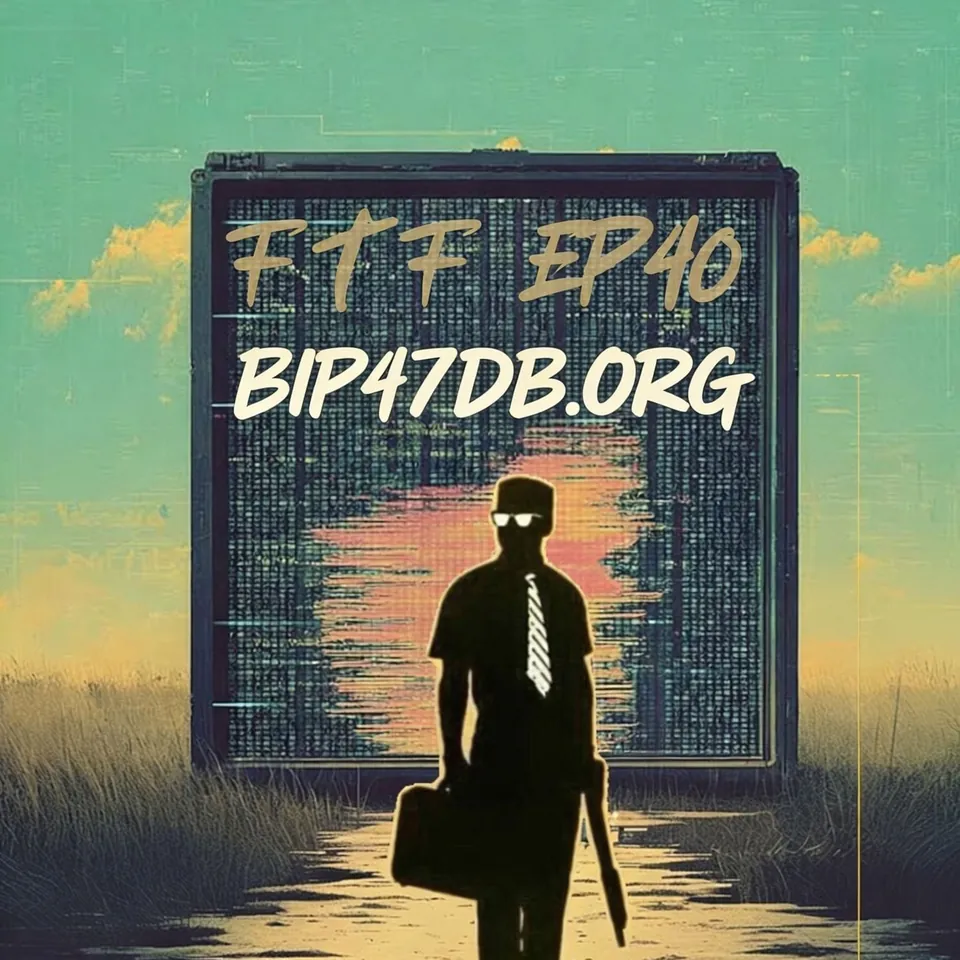
Max Tannahill Reveals BIP47DB.ORG
Discussed in this episode
Boost this Episode
Send sats directly to the creators. Value for Value.
Plus 1% to Podcast Index, 1% to Boost Bot.
Show Notes
A weekly live show covering all things Freedom Tech with Max, Q and Seth.
GO TO https://BIP47DB.ORG for more information
HELP GET SAMOURAI A PARDON
- SIGN THE PETITION ----> https://www.change.org/p/stand-up-for-freedom-pardon-the-innocent-coders-jailed-for-building-privacy-tools
- DONATE TO THE FAMILIES w/ USD ----> https://www.givesendgo.com/billandkeonne
- DONATE TO THE FAMILIES w/ BTC ----> https://pay.zaprite.com/pl_JpxtkLv95T
- SUPPORT ON SOCIAL MEDIA ---> https://billandkeonne.org/
TO DONATE TO ROMAN'S DEFENSE FUND: https://freeromanstorm.com/donate
VALUE FOR VALUE
Thanks for listening you Ungovernable Misfits, we appreciate your continued support and hope you enjoy the shows.
You can support this episode using your time, talent or treasure.
TIME:
- create fountain clips for the show
- create a meetup
- help boost the signal on social media
TALENT:
- create ungovernable misfit inspired art, animation or music
- design or implement some software that can make the podcast better
- use whatever talents you have to make a contribution to the show!
TREASURE:
- BOOST IT OR STREAM SATS on the Podcasting 2.0 apps @ https://podcastapps.com
- DONATE via Monero @ https://xmrchat.com/ungovernable
- BUY SOME STICKERS @ https://ungovernable.network/shop/
FOUNDATION
https://foundation.xyz/ungovernable
Foundation builds Bitcoin-centric tools that empower you to reclaim your digital sovereignty.
As a sovereign computing company, Foundation is the antithesis of today’s tech conglomerates. Returning to cypherpunk principles, they build open source technology that “can’t be evil”.
Thank you Foundation Devices for sponsoring the show!
Use code: Ungovernable for $10 off of your purchase
CAKE WALLET
Cake Wallet is an open-source, non-custodial wallet available on Android, iOS, macOS, and Linux.
Features:
- Built-in Exchange: Swap easily between Bitcoin and Monero.
- User-Friendly: Simple interface for all users.
Monero Users:
- Batch Transactions: Send multiple payments at once.
- Faster Syncing: Optimized syncing via specified restore heights
- Proxy Support: Enhance privacy with proxy node options.
Bitcoin Users:
- Coin Control: Manage your transactions effectively.
- Silent Payments: Static bitcoin addresses
- Batch Transactions: Streamline your payment process.
Thank you Cake Wallet for sponsoring the show!
MYNYMBOX
Your go-to for anonymous server hosting solutions, featuring: virtual private & dedicated servers, domain registration and DNS parking. We don't require any of your personal information, and you can purchase using Bitcoin, Lightning, Monero and many other cryptos.
Explore benefits such as No KYC, complete privacy & security, and human support.
Hello, and welcome back to Freedom Tech Friday, a weekly live and interactive show hosted on the ungovernable misfits feeds. We go live for one hour every Friday at 9AM eastern and 2PM UK time, but you can, of course, catch up later on the podcast feed.
On Freedom Tech Friday, we like to cover the latest news, trends, and topics for anything relating to Freedom Technologies. That could be anything from Bitcoin or Monero, encrypted messengers, privacy tools, and everything in between.
Essentially, if there's a news item tool or topic that can help you take back some control in today's digital Panopticon, then we wanna talk about it.
My name's q and a, I'm head of customer experience at Foundation where we build Bitcoin focused sovereignty tools. And as always, I am joined by my good friend Max if he ever figures out his technical issues,
and Seth who is COO over at K Qualit. FinTech Friday is a live and interactive show, and you can help steer the conversation by commenting live, pre submitting your questions on socials, boosting the show via podcasting two point o apps, sending in your tips, or just sharing the show with your friends and family.
Top support from the last show come from none other than Late Stage Huddl, who sent in 6,006 sats and said, great conversation. I still have a three d printer and a similar experience. Kids and I printed all sorts of little stuff and it was fun, then we just stopped and time keeps slipping by.
But recently, one of the kids asked why we hadn't printed anything lately and I didn't have an answer. But then she didn't know what she wanted to print anyway, so maybe it's time to find something.
Yeah. I definitely had the same sort of experience and got burnt out pretty quickly. But thank you for your support, late stage Huddl. Always nice to see you in the boost list. Alright. Without further ado, well, just you, Seth, for now before I bring on our guest. How's it going, mate?
It is going. I'm here. We have the apparently more technical Max joining us today, so excited about that. Yeah. The one that's able to to click a link. Uh-huh. And count to 47, I think. So Yes. Yeah. Should be a should be a good one. I'm doing pretty doing pretty well. So just to spell it out, Max ungovernable Max is trying to get in,
and he's banging his head across the keyboard to figure out why he can't join the restream. So he may or may not join us at some point during the next hour, but I'm sure we'll we'll survive without him if even if he can't.
So today, we have a special guest joining us, also called Max. Max Tannehill is a longtime Bitcoiner in the trenches privacy user and and see behind a project that we're gonna be digging into today called Bit 47 DB.
Before we get into the project, we're gonna go back quite a number of years now because bit 47 is one of those proposals or projects or tools that's been quietly carrying the privacy torch for Bitcoin since, and I can't believe I'm saying this, 2015.
And most people still don't really understand what it is or why it matters. It's an elegant idea. It's been around for a decade, and yet the infrastructure that made it usable has been on a wild ride, particularly in recent years.
I'm sure we all know what happened there. So, Max, yeah, welcome to the show. Looking forward to diving in. How are you doing, pal? Yeah. Good. And thanks both of you for having me. Good to good to get a chance to chat. I just sent Seth earlier. Feels like a long, long time since we spoke. In fact, it might have actually been
when probably Seth is doing a podcast and all that. But, yeah, no. I'm really excited to talk about it. I do worry, though, that if if the other Max is known as ungovernable Max, maybe I'll just be governable Max for everyone else in the show. The governs Max.
Here he is. The timing has arrived. Yeah. I've had to log in from my phone because my laptop's fucked. Let's see. Yeah. It what there must be a maybe it's the have you got, like, a screen protector and a shelf for your phone that stops the static electricity from your fingers interfering with the electronics unlike the laptop?
I don't know what it is, mate, but I'm I'm here. I'm here. The the special needs Max has arrived.
Oh, fantastic. Welcome to Max. How are doing, mate? Are you alright? Yeah. Good. Other than the mild panic, I was I thought I was all ready and got myself sorted with a coffee and all, like, set up and then just couldn't fucking connect to this Restream thing no matter what I try. So here we are.
More flustered, but happy to have Max on again. Good. Yeah. Me too. Me too. Alright. Before we we dive, like, head first into bit47db.org. I wanna take the audience back and set the scene with bit 47 and pay NIMs because it, you know, it it lays it paves the way for what we're gonna talk about later.
So I wanna set the foundation for anybody who hasn't gone down this rabbit hole. Bit 47 was proposed way back in 2015, which in Bitcoin years is basically forever.
Max, take us back there a little bit and, you know, I'm curious to hear, like, what was the state of Bitcoin privacy back then? Because clearly, there was there was an impetus for, you know, justice Ranvier, if I'm saying that Yeah.
That was it. So, I mean, my kind of time in Bitcoin, I I I think I'd literally just bought my first Bitcoin in 2015 for the princely sum of £200, which I then sold two weeks later for 205, making a mean profit. So,
you know, when people like Ranvier were on the mailing list doing stuff like this, I was so ignorant. I had no idea about any of this. So I don't know a huge amount of kind of except from obviously looking back in, you know, through mailing list entries and kind of comments in social media back then,
but I wasn't even around really in 2015 or 2016 to pay much attention. But what I was kind of aware of was after it being discussed and had been kinda heavily criticized by some core developers for various reasons is that it was starting to be implemented already by 2017 in actually a few wallets.
I was already interested in 2017 about that. I there's actually probably find, like, an early tweet for me asking Samurai Wallet at the time, like, how do these addresses compare to stealth addresses?
And so there there was more than just kind of one type of implementation of this kind of thing even back then. Like, you know, I mean, obviously, now there's talk about stuff like silent payments. But back then, there were even the concept of Bitcoin stealth addresses that were server side, and this was a slightly different
implementation. And back then, I was still trying to really get my my head around it and understand. But at but at least in 2017, Samurai had released their integration of bit 47 into into Samurai wallet.
There was another wallet called billion app, which you can find, like, think it's still a medium blog that they had, and they integrated it for Bitcoin Cash. They had, like, a multi coin wallet, bit even Litecoin and Bitcoin. So you could use a bit 47
foot with with that wallet. And they even had, a a thing where you could, like, message each other, like, do encrypted messaging and share and share, like, codes. I think it was through Bluetooth or something like that. And what was kinda cool back then is they were an iOS as well as an Android wallet. So already even in, like, 2017,
like, there were kind of there was more than a one or two wallets doing it. I think there was someone else as well. That's it. There was also Stash, I think it was called. No. Yeah. I think it was Stash, but it was an old cipher punk had been involved in that. A guy called Steve Sheer,
they'd implemented bit 47. They were doing a fundraiser. Again, like, there's quite a few wallets actually looking at technology, and and I'm sure kind of obviously your listeners know. There's just a way effectively a way to pay to someone else without having to, like, run a server, generate, you know, addresses,
do something interactive with providing an address each time. And so it was pretty cool. And I think, you know, I remember t dev, Bill, you know, saying it very well back then. It was very kind of understandable to me. It was like for them a very important part of just the general privacy stack on its own.
It, you know, it did a little bit. But what it was, it was something that would stop anyone's kind of ability to to have that kind of first look at where a transaction was going. And, you know, if you look at some of the chats back on social media then,
there was another wallet that was looking at that was going to do CoinJoin and famously never did. Mycelium, I think, wallet that was. And Samurai kinda said at the time, hey. We'll do bit 47.
You do the coin joins. And, you know, there was that kind of idea that there was so much kinda, you know, work to do in the Bitcoin space. There was plenty of room for everyone to do, and, you know, everyone was gonna take a bit of a chunk there.
So, yeah, it was it was gonna stop this kind of idea of you posting an address, it being a point of surveillance and observation for any any kind of hostile actor.
And it was just a first step really before you then try to, like, say, obfuscate your transaction anyway or do anything else private. So it was just, you know, back in 2017, it was pretty interesting and and already being deployed back then.
Yeah. I think which is one more quick thing to add to. Like, another critical piece that this solves is just, like, simple donations. Even for those who don't necessarily want privacy, that was something that was always such a pain in the butt. If you want any privacy and be able to receive donations,
you you would have to use some sort of stealth address. So bit 47 was by far the earliest solution to solve that where you could just put that that payment code or later, as I'm sure we'll talk about that, that pay NIM, and you someone could pay you, multiple people could pay you, and no one would be able to connect those transactions
on chain without you having to run a server, which that was such a such a vital improvement over having to run a BTCPay server or run something online that could generate new new addresses every time or do the normal, which was just reusing the same address over and over again, which was a nightmare.
Yeah. And and and, yeah, it's really interesting point. I remember I remember being quite keen on a wallet that was actually had been built. I don't know if this guy's still in the space now.
I think name was Tim, or I wanna say Lee. I can't remember. So but he did a wallet called ArcBit, and it was such a kind of great wallet available on iOS and Android. He was next blockchain.infodev, I think it was. And it was a real kind of,
you know, toolkit of a wallet. Like, kind of, you know, if you look at something like BlueWallet now with all the functions that has, ArcBit definitely was like an early version of BlueWallet, but, like, super early, and that had stealth addresses. And so you could kinda send from one to another, and it wasn't bit 47.
But I think even back then, right, like, there you're already trying to work out, like, what wallet is gonna give you something that's gonna have that network effect, and, you know, you can send to someone else and all that.
And, certainly, the, you know, the other one that we I forgot to mention was Dark Wallet, and I'm pretty sure that was the kind of the Cody is it Cody Wilson? Yeah. In American Key. Like, that yeah. Again, it's a web wallet that would have been a server backing. I'm pretty sure that had, like, arch bit style
stealth addresses and didn't do bit 47. And all of that stuff just faded out because the wallets faded. So, you know, I I don't know much about that tech, but it's kind of interesting. I think this will come to another point probably discussed later
is that a lot of this tech, even if you've got a preference for certain tech, a lot of it's gonna depend on, you know, how popular the wallets are and where they're maintained and where else in the ecosystem is used. And I think that dictates a lot of what gets the adoption.
Yeah. Definitely. So, I mean, all of this that we're talking about now for for those that are new, like, completely predates
BTC pay server where people, like Yeah. Take it completely for for granted that, oh, yeah. You you just have a server that I just run on my umbrella node or something like that, and it just handles all this sort of stuff for me.
Over ten years ago, people were solving this with on chain solutions. So it was like, when you look back now, was well ahead of its times for for for lack of a better term. But it wasn't kind of all sunshine and roses, I guess. Like, bit 47 gives you, like, a payment code, which obviously you could represent in a in a QR code,
which was helpful. But what did let's, like, move forward into the pay names and and what Samurai built on top of that as a kind of UX layer. Yeah. So
so I think, again, like you said something earlier here, which is no one really knows the full story or kind of everything here, and it's actually quite a lot of tech. And I don't even think it's that technical always to understand, although, obviously, you can dive into cryptography.
There's actually a lot of what I would kinda call a user flow and, like, UX and an operational and recovery issues that kinda come with bit 47. And so Samurai and I'll come back to that. The Samurai created a thing called a payment server. And, like, obviously, these bit 47 payment codes, they're even longer
and more rat you know, and more unwieldy than than regular Bitcoin addresses. So it's kinda hard if you pay someone to, like, know that what you're paying for hasn't been spoofed or something like that. And so they built a payment server. There was an original one that wasn't called pay names. It was it was called paymentcode.io.
And I remember having an old bit 47 address there, and that was very much like you put your real name or your your pseudonym if you wanted. So I had, like, Max Tannehill, like payment.co paymentcode.io/maxtannehill,
and that showed me my code. And then I think I would I think I could put my, like, Twitter handle or some maybe I don't think there's a GitHub. I can't remember. I wouldn't have had one back then. But, anyway and then very quickly, like, within months, I think, Samurai scrapped that, moved forward with paintings, which was
like an autumn like a somewhat kind of geo well, there's a kind of an automatic generation of a still like a pseudonymous kind of name that came from the like a code. So it still wasn't like, you know, like something you could, like, domain squat or register yourself, but you'd get something like, you know,
like I'm trying to think of, you know, black coat 53 or something like that. And you'd and the other cool thing is they integrate the thing called robo hashes, which obviously, if anyone's looking at the screen now, they can look at q and a's profile pic, and that was that was a robohash. And, you know, it's an open source implementation,
and you could and do that. And I think pretty much everyone understood that I think, you know, there were some people that didn't like the trade offs of that, but I think most people understood that it was pretty similar to, like, if you've had MIT server,
you ever use that with getting public PGP keys. It's all very well having, you know, a PGP key, but it's kinda handy to have, a server that you can download from with your email client. You can share that. And really, like, the payment directory was a a friendly way with some trust trade offs of of,
you know, giving it, like, an identifiable avatar and an easier to remember name in order to kinda handle these clumsy large payment codes. I think the thing that was less clear to other people was something that I became particularly aware of at the beginning of this year, and I'd I'd suppose I started becoming aware of it when
when the Ashigaru project came into being there. But the the pain himself was doing a little more than just providing user friendly identities. It was actually acting as a bit of a crutch for recovery.
It wasn't absolutely, like, mandatory. Like, it's not like you couldn't use bit 47 codes without it, but it did a lot of kind of work to make it easier. And specifically on that, like, when you do connect with someone and exchange payment codes, everyone's very aware of, like,
you know, doing these notification transactions with an op return
that kind of embed some data in the blockchain. But if you ever try and, like, recover your wallet with just your 12 words or your 24 words and a passphrase or something like that, you can't actually easily discover those connection transactions that you make to someone else. You can only discover the ones that are made to you.
And so if you're gonna actually kinda do payment channels again, you've not saved that metadata in a wallet, then you're gonna have to make those transactions again. And whilst that kinda sounds like, okay. I could just go and do it. In some cases, you're not necessarily gonna be aware of the connections that you've made.
So that's kinda high level summary, but it is something I kinda wanna highlight because the, you know, the pain in database was definitely doing some extra work that, you know, I don't think really got an awful lot of attention,
you know, by Samurai wallet users, necessarily Sparrow wallet users. But I think would have become more apparent to anyone that tried to use something like, say, BlueWallet, which didn't integrate the payment server and therefore kind of, you know, suffered when it came to recovery flows.
And, yeah, that's a a good summary. Excellent. That's something that you you don't hear talked about a lot. So, obviously, this was a a kind of centralized service on top of the bit 47 layer, I guess, that provided some benefits that you've just outlined.
Obviously, when all of the Samurai stuff went down in 2024 Yeah. Obviously,
that server got taken down with the rest of the stuff. So where did that leave wallet users? It obviously, it didn't there was no funds at risk there, but, like, what type of hold did that leave for for Samurai Wallet or, yeah, Samurai Wallet user and, I guess, Spyro as well? Yes. If you kinda cast your mind back, like, to 2024,
obviously, like, Whirlpool went straight down. Surprisingly, I think for a few people, oxt.me went down, and certain services went down. But Samurai had clearly, like, had quite a lot of infrastructure spread in different servers, and the server never went down.
Well, sorry. Sorry. Never. Not in the immediate aftermath of the arrests. And so, you know, when I was kinda doing, like, the research for this bit 47 DB, I was obviously, like, looking at Ashigaru's site and their blog post on, like, the painting directory.
And it's actually kind of, like, interesting is because what they did is that, like, they obviously had wanted to recreate the painting directory. But, like, it's a central place. You can't contact the team anymore.
Like, you know, they had a problem. So they scraped, like, the pain in directory as it was. And then it would appear that they then actually also purchased or somehow got hold of the domain name that Samurai had after registering their own. And so from what I can see happen, like, at some point, Samurai's
server went down. In fact, I I think I recall in the Telegram group that the domain expired before the server. So a lot of people felt like, you know, when they opened, like, their wallet,
it didn't sync with the payment server anymore. But, actually, like, you could actually still access the server if you, like, did a scan for, like, an IP address or something. But in any case, like, the Ashigarro team, by getting hold of that domain name and reaching it to the new one that they hosted,
could basically mean that anyone that had, like, an old samurai wallet would actually kinda have their, you know, their paintings work pretty much in exactly the same way except the conventions around because it was a fresh server around the avatars and the and the names changed.
But in that time, like, I think there was some
like, I wouldn't say funds were at risk, but there were some kind of, you know, potential dangers there. So, like, number one, like, I mean, obviously, as I mentioned earlier, there was recovery issues. If you're trying to recover your wallet and you and let's say Samurai's infrastructure had disappeared,
you might have struggled to kind of scan and find funds if you did, like, a full wallet recovery with only your words and not any of the other metadata. And I think, like, the other thing as well is, like, if it had been if that domain had been taken by, like, a malicious entity,
you know, they could have put other images through or or something like that.
You You hear me? Yeah. My connection just Yeah. We've got you. Yeah. So I think there was kind of some risk there. And from what I can see, like, I think the Ashigaru team have, like, mitigated some of that risk now. I know that the wallet doesn't go through, like, clear net domains anymore. It only goes through Onion,
so that shouldn't be possible to kind of hijack in the same way if something like happened that to the Ashigaru team. But, obviously, like, at least from my perspective,
you still got this kind of fundamental problem that you have got a centralized server. Yes. You expect to have a centralized server at the Ashigaru team proved anyone can spin one up and do it. But there is that kind of thing of, like, a real hassle of, like, you know, 17 and a half thousand payment codes or whatever. If they go missing,
it really hits the network effect if they were to all be gone, and then you're gonna require wallet users to kind of reconnect to a new payment server and set that data up. So I think it was a a pretty close call
there for the for the ecosystem generally. And if the Ashikauri team hadn't done that, I think we would have seen a a much more, you know, like, loss of adoption of bit 47, and people could have turned away from it. And I, you know, I was concerned about that beginning of this year, and it's something I'd actually had.
It occurred to me two or three years ago, but I didn't really have the technical chops then to do anything about it. A quick question about that. You you've mentioned that recovery can be a little bit more difficult if you don't have this this way to see prior payment notifications.
What what do you actually lose, like, if you can't do that? I think I thought in my understanding, you just wouldn't know where you had sent those funds, but you wouldn't lose the ability to spend your own funds. But I'm Yeah. Maybe I'm misunderstanding it. No. You're absolutely right.
So that's a it's a it's a nuance, but it's kind of important. So, like, there's a it's again, it's possibly an edge. You could describe it as an edge case. But because in you know, at the end of day, like, whatever protocol you have, even if bit 47 was a perfect protocol, what if implementation still vary?
So, yeah, you're right. Like, you can you can see anyone that's made a connection to you and paid to you. But if you've paid to someone else, you might think, well, that doesn't matter because you're just paying someone else. Right?
The trouble is though is is that as I kinda highlight in, like, the the in the the kind of the white paper I did, samurai and and still even that in Ashigaru, although the team did it when they emailed me that they said they would try and resolve this in their kind you know, as a as a matter of priority.
When you make a payment on bit 47, in Samurai Ashugaru particularly, you can do a refund, and it doesn't prompt you to make a connection payment back. So if you paid someone
and, again, like, the UX suggests it's just for a refund. Right? But you could always just kinda go, well, that person's connected with me. I'm gonna use the refund payment to make a payment back. And it was kind of a bit more pronounced in Sparrow where a few months after, like, bit 47 have been integrated.
If you were like and this is where it gets confusing. If you're following the bit 47 payment, you could just put in the bit 47 code and make a payment to someone, and it wouldn't force a connection. And then when I was doing this research, I realized that if I, like, copied and pasted a bit 47 code,
like, Craig could fix one of these bugs, but another one remained. And, you know, you had, like you know, you could just in a bit 47 code and start paying. So you've kinda got a few years, right, of these wallets that have allowed transactions to kind of occur without
without that that kind of aspect of the flow need up. So it's kinda quite it's niche. It's small. But, like, I realized when I was doing this, it's like, wow. I can you know, we're always gonna go to design a bit, but I think I can solve for that potentially. I'll put a building block in there for other wallets to build off.
But, also, like, the original reason I started off wasn't to handle these kind of slightly obscure recovery scenarios. It was actually just to kind of build something that's somewhat like anyone could build another painting directory of just because I think the actual painting directories are such an important aspect of making bit 47
usable.
I actually wasn't aware of that. So yeah. So It's it's it's a funny one. I haven't looked at Stack Wallet at all the way that I don't even think you can do connections on that. So it's kinda like a bit outstanding for me to look into it. And BlueWallet, like, you know, when they announced that they were gonna do bit 47 integration,
like, they said, we're not gonna do pay NIMs. And I think that was part of the reason, you know, maybe there's design decision in the product team there. They didn't wanna be too tied with Samurai infrastructure.
Maybe it was because they wanted to limit the scope for that particular build, but it's kind of really awkward because they you know, when you don't look up, like, the PayNIM server, even for the payments, like, that you get, for example, if someone else, like, pays you, you've actually not got, like
yeah. You can look up, like, bit 47 codes, but you've got, like, nothing to, like, look up. So even when there is a payment server,
like, the recovery is, like, pretty awkward if you do, like, a kind of yeah. You don't get all your connections back and you find they're missing. So I know Jordan had been working on, like, some BlueWallet stuff and tying it into the payment server.
And when I was testing that, I was just putting in an old wallet that I'd used before and was, like, shocked at, like, hang on. Why am I missing connections and things like that? And it was because, basically, there was no pane of directory lookup.
So it's, you know, it's this is the challenge here is, like, you know, even when you've got, like, a a protocol, like, not everyone, like, you know, follows specs, and you've got edge cases. And it's just tough to get, like, multiple independent open source projects aligning around standards.
You know? And you can have all the bits you want. You can have, you know, all things. But at the end of the day, like, you are relying on independent teams to do this. Yeah. And and you can see why people would or or teams and projects would gravitate towards centralized
solutions to this. You know, we've seen Samurai do it, and then we've seen Ashigari pick up the mantle and do something similar, albeit with some some minor tweaks. But we've also seen, you know, the potential impact of said centralization, you know, into back in 2024, which brings us nicely towards your project, bit 47 d b.
So give us the give us the, I guess, the elevator pitch to start us off. Like, what was the impetus? What does it solve? I think it's probably fairly obvious by now, but Yeah. Dive in. Yeah. So
it originally started, like, actually I was actually saying this to kinda Gabriel, so I wouldn't kind of label the point too much. But I think around 2023, I'd suggest in a private group chat, like a testing group with the Samurai guys
just because I didn't really wanna distract it on the public thing. But I kinda said, like, oh, I've seen this new Ordinal stuff coming out. And, like, as soon as the Ordinal's thing came out, I was really, really interested in it and very quickly disappointed when everyone started creating, you know, shitcoin tokens
and just found it really boring. But, like, whenever when I heard of Ordinance, I was like, wow. Like, you know, banned books. We can get those on the blockchain. You know, we can get data that people care about. And, of course, you know, it it it's clear that people care about data that doesn't really align with my interest.
So it's pretty disappointing with how things turned out. But I was, like, fascinated by the the kind of the guts behind it, the way,
you know, Casey had built this thing. He designed something. He hadn't required permission, and he'd kind of built something that other people could outside of, like, core consensus build something themselves. And back then, I kinda came up with a really, really unsophisticated idea.
And I think I said it was to, like, to and and Samurai. It was like, you know, what about, like, we just, like, store a CSV of payment codes? Because I'd realized there was, like, this recovery issue when I'd done some testing on Samurai.
And, like, I got an interested response, but some others in the group were like, you know, are you trying to ask these guys to, you know, write ordinals, you know, transactions and take a cost on them? And, like, the whole thing fizzled out. And, obviously, I wasn't really expecting it to. It was just an idea.
But, like, it's kind of always been in the back of my mind to do that. And then fast forward a couple of years and, you know, a few things that kind of, you know, jumped out at me. Like, number one was these b r c 20 tokens that got done, and I remember seeing, like, a tweet, I think it was from Ricardo Spagni, aka Fluffy Pony.
And he was just laughing at, like, what a shitty protocol this b r c 20 thing was because it was, like, completely, like, clear text, noncompressed,
non efficient data put on the chain. And I remember kind of thinking, oh, I had no idea. That's interesting. Okay. I didn't know, you know, the I mean, obviously, I knew that you could compress data, but I didn't actually know there are all these efficient methods that people were doing.
And so, like, you know, when I kind of was playing around with, like, you know, AI tools, I was like, okay. Could you, you know, could you you know, I'm thinking of writing, you know, bit 47 data on chain as a kind of immutable directory of codes.
Can you give me some suggestions as to, like, how I could compress this and how I could, like, make it readable? And then that's really how the whole genesis of it came in. I compared it initially to the b r c 20.
Yeah. One of the lucky things here, I suppose, is I've got, like, a lot of good friends in the space. So, you know, it wasn't like just some kind of I I wasn't worried that I'd kind of fall off on some hallucinating journey with AI.
I'd you know, I I I kind of wrote this white paper up. You know, got some kind of help from Claude and Gemini or whatever, and you know, did some stuff. And then, like, put out some people that I respected, and then I got thing you know, feedback like, you know, maybe change the signature kind of thing here.
This kind of part of the database seems a bit redundant. I'm not sure about that. Other comments like I think one was a pretty blunt one. Like, why are you comparing it to b r c 20? That's retarded.
Compare it to Roon's data. But, like, you know, it went through a few things. And then, like, I've been doing this all on, like, a a document PDF and sharing it around to people. I I valued their opinion. I And was like, well, actually, if I really want, like, feedback and I wanna send it out there,
I'll stick it on GitHub and make it, like, a readable blog post kind of thing. And if it's on GitHub, people can, like, put in pull requests or they can make comments. And, yeah, that happened. I mean, obviously, it got a bit of attention.
I had Casey raise an issue around, like, the design that was around kind of potentially blowing up indexes without the right kind of protections. I had a fella called Mighty Mercurian who really went through it and challenged the
I you know, I had some ambiguity on the on the signing that I did and all that. And so I just kinda got the spec a lot tighter over a few weeks, basically, from feedback. And yeah. And
at that point, by the time I got, like, a spec pretty kind of knuckled down, I was like, ah, I think now I've got a spec. I can probably build, like, a tool to do this. It doesn't need to just be something that, you know, is exist in theory.
So, yeah, I wanna jump in and maybe take us a step back actually because you mentioned about, oh, well, I wanna write the data to the chain
To an outsider or or to to somebody less technical, I guess, you could make the argument that, wait, didn't that already happen with generic bit 47 and writing op returns? Like, what what's the differentiator?
Like, what what's bit 47 DB doing differently to to what was the status quo back then? So, actually, interestingly enough, if my understanding is correct, there's, like, no actual bit 47 codes that are really, like, visible on chain even though they're written in op return.
So when you actually make a connection, you embed your public key in someone else's in an op return, but encrypted with their public key. And so they kind of you know, I've described it before. It's a bit like,
you know, going to someone's locked mailbox and dropping a business card in and saying, you know, you could you know, I'm, you know, I'm now gonna send you money or something like that. And then if they wanna do the same, they drop a business card into your, like, locked mailbox, and you do that. And, like, that's all fine until,
you know, you you until until you discover you've actually gotta work out which mailboxes you've posted your business card in even though you can see all the business cards in your mailbox.
And because of these these these addresses, these payment codes aren't on chain codes, you know, they don't actually they can't exist on chain or in the consensus. So what this does is it's a very kind of simple table, but it's like an append only database.
And when you write these codes in, you can actually, like, extract,
like, the notification addresses from them. So you don't even need, like, a large table that says, like, you know, this is the date it went in. This is the payment code. This is the corresponding notification address. You can actually just read that payment code, extrapolate the notification address,
and then you can say, like, you know, if you've decoded all this data or your wallet's done it or your index has done it, you can now, like, take a a lit you know, a scan through a database that you build on well, this which is effectively already been built and then go, oh, well,
I can see all these notification addresses I've extracted from these payment codes. Now I'm gonna look and see, have I made any notification payments to any of these addresses? And so you can pretty quickly now, like, you know, just as fast as as querying, like, an a payment server, you can now kinda query the blockchain
and just, you know, get a whole kind of the entire payment list and work out who you might have had payments to and from, if that explains it. Yeah. It certainly does. So what does the new this this new style kind of enable from a user experience perspective? Like, how does it improve it? Is it faster? Is it is it just better recovery?
Like, what's the the main benefits? So, yeah, so the so I think the first thing is is that from a user basis at the moment, absolutely nothing changes, but there is the potential for things to change if wallet developers build these things in. What this started with originally was, like, let's say the Ashigaru team disappear.
We someone could, like you know, and let's say we don't get two or three months to to kinda crawl their database for codes. You know, how would someone build up another pain in the server now?
And so with the way it is now, you could just you know, my original intention was someone could just use, like, the command line interface, grab these inscriptions
on ordinals that contain the payment codes, decode them, and go, right. Cool. I've got, you know, 17 and a half thousand or whatever pay names. Sorry. Bit 47 codes. I'm now gonna build a new database. That was the original intention.
I think, though, now, though, is, like, now I've actually written codes on Testnet and played around with it. I think there's some interesting things that could be built further. So, like, number one, someone like BlueWallet, they don't interact with the paying server at all.
Potentially, BlueWallet could use their electrome indexer that scans regular addresses for the wallet and actually just scan the canonical address, which is like this reused address that all these inscriptions get sent to, and just kind of scan that address, get the witness data, decode it, and build up like a local database of 20,000.
And therefore, you wouldn't need to integrate with the PayNIM server because you could integrate with it on chain. So that's one thing that could be done. I think the other thing this is a bit more theoretical, but you could potentially do away with the notification transaction entirely.
Because with the notification transaction, you're saying to another person, hey. This is my payment code. I'm now paying you. But if you've got your payment codes embedded as an inscription, you know, bulk inscription with everyone else's, then potentially someone could just have their, you know, their indexer, take the payment codes,
render addresses on the kind of the derivation path between those payment codes, and then kinda similar to silent payments, look out for every new block that comes and go, hey. Is there a payment that is made to me here? And you could potentially do away with the the notification transaction.
But, again, like, it's gonna depend on whether wallet developers want to build that. A third one, I'm not so convinced of this, but I certainly wouldn't dismiss it because the person that suggested it, Laurent MT, said to me, this is very interesting. He said, you could actually even start decentralizing the database.
And I was like, well, I don't see how. You know? This is just about bit 47 codes. How does that help? And he's like, well, once you've written bit 47 codes on chain, they go in an order. And therefore, you could potentially say
you build up another database or something and say, you know, this is the bit 47 code that corresponds with this particular painting. So, you know, this could be a building block for other things where, you know, at least from my perspective, the was always meant to be a centralized trade off in a way of handling bit 47,
you know, in an easier way. But, like, maybe and, you know, I don't have the answers on this yet, but maybe there is a chance that what we've actually traditionally had in the form of a payment server with an image and a name as well as a a payment code, could that could that be decentralized?
There's actually a possibility to do that. Obviously, more complex, but there is potential there. Max, I, didn't hear, like, the last fifteen minutes having loads of technical issues here. But just from what you were saying there, is there any downside to doing it this way other than, like, maybe fees and costs and stuff? Like,
it seems like it would be better to have this decentralized because it's quite an attackable thing otherwise. And like you were saying earlier, if people are using something and then have issues with recovery and other things like that, it's gonna stop the adoption.
So is there, like, a downside to doing all of this other than sort of squawkers on Twitter? So I would actually say so I think well, yes. So think we can all safely dismiss the score, I'm not concerned about that. There's obviously a cost downside or an impact.
That doesn't even really bother me because, fundamentally, we're we're writing data on chain. And when you look at, like, how much data it is and how much it costs and how comparably small it is to say regular transactions,
I think it's it's it's for me, it's easy to draw the conclusion that the cost of writing this to data to chain is commensurate with the cost of just generally operating on Bitcoin.
The nice thing about this date the way this database is structured is that it doesn't require, like you know? Although you could if you wanted to, each one of us could, like, inscribe our own payment code.
The nice thing about this is that it's really available for anyone to inscribe codes. So, you know, it could be the payment directory. It could be just, you know, an altruistic individual. It could be someone looking to build a competing directory.
You know, they can just go in, and it's super cheap to to hoover up, like, all or bit 47 codes that you can get and then inscribe it on chain. And, like, unless something changes with the, you know, the witness discount and the cost of transacting in this way, it's really not prohibitive.
The other thing I would point out is although this uses ordinals as a kind of as a mechanism, you don't actually need to run an ordinals indexer. If you do run an ordinals indexer, you will see these as, like, ordinal inscriptions, and you'll be aware of them. But because they're all off a kind of what we call a a numbers address,
which is something else I learned about when doing this, it's called a number up my sleeve, and it's effectively an unspendable address. You can just query a single address, and, obviously, we kinda quite take a quick look at the tool.
But the tool itself is just sitting in a browser and can you know, it works off the mempool dot space API. But you can just grab a handful of transactions and query it, and you can just get, like, several thousand
bit 47 codes that can all be inscribed very cheaply. So, yeah, there's really, like, not really a cost. And if someone puts junk data or inscribes unnecessary data, you know, you with your index can just discard that, or you can choose to only, you know, index data that's been inscribed by
NIMS that you know and care about and trust. And, of course, you know, it being a pain in scheme, it already comes with the you know, with an identity layer in itself there, which makes it very kinda nice to use. So, yeah, it's I mean, obviously, you need specific encoding and decoding
to actually kind of transform that data, zip it up and or compress it rather than zip, rather, and and, you know, make it writable on chain in the most efficient way. But it's it's obviously trivial to do so because if me as a nondeveloper has been able to build a web tool to do that, then we know anyone else could do that too.
So circling back kind of, like, to the the average person who just wants to use Bitforty seven and would use this in place of that. If I'm setting up a new wallet, does that mean that I would need to inscribe that payment code using this system
to be able to use it? Or, like, what what would that actually look like in terms of, like, the the cost or the change to me as an individual user? Do I need to run a server to be able to index these or rely on someone else's indexer to be able to find them? Like, how exactly does that work? Yes.
So on an individual basis, the idea here is is that you wouldn't change the way that you do this. This isn't really a retail facing kind of application or even a scheme, but it's designed to be done. And this is the reason I I I released it as a web app. It's still being designed that if you want ultimate decentralization,
it has to be possible to be done by any individual. But I think as an individual, this should just give you greater faith in bit 47. And I think, you know, when you look at, like, I suppose, what you could call the former samurai community and all that, I think it's a very interesting community because there's obviously
it's obviously had a hit of users. Like, there's probably many users that have migrated onto other tools. But the people that are left behind, there's probably not a more resilient bunch in Bitcoin.
And the tools that are left, you know that they've actually already been attacked by the state. And if there's any of these tools that are still going in some form or the other, it actually demonstrates you've probably got kind of some of the hardiest set of kind of culture and people and tools that are being built.
And so for me, this was actually a way of bringing more faith into bit 47. So if you ever use bit 47 and you were anxious about PAINIm server disappearing,
you can now use bit 47 knowing full well that the PAINIm operator, as I've just discovered in the last day or so, has actually gone ahead and inscribed these codes on chain. As for your kind of point about, you know, do you need any kind of index or anything like that for data? You could, if you wanted to, go to my GitHub,
download the the web app. You could run it locally. At the moment, it only works off the mempool. Space API, but, obviously, you could fork that to go to your own node. I just do that as a convenience.
It also works off the API
to to get the actual payment codes to work out which ones for you to inscribe, but you can still manually type in your own and copy and paste from any other source. And you can you don't even need to query the chain because you can also import a database of already previously written codes. So you can do this all with a a web app.
And then really, like, my hope is is is the wallets eventually kind of either wean themselves off the the central server, or they have bit 47 dB as a backup to the server if it ever goes down. And then you've got, like, that just extra layer of resilience
there. So, again, you know, this is also why, you know, I probably won't spend an awful lot of time, you know, more time on making the tool nicer to use. Obviously, I've tried to put some effort into the UX and make it mobile friendly.
But, like, you know you know, I'm not gonna worry about it, you know, being kind of usable by the average user. I'm certainly not expecting users to inscribe their bit 47 codes. I'm really just hoping it is. It's wallet operators,
payment director operators that take it upon themselves to go, right. We're the custodian here of some pretty useful data. We're gonna inscribe it on chain, so we've got a really good backup. And, obviously, I could have chosen something like, say, a decentralized
file storage system or anything like that, But it's kinda like, well, why would I when it's cheap to do it on Bitcoin? The infrastructure,
like, wallets already query the Bitcoin database, and they can go to it there. And, ultimately, like, I don't why put another dependency on something else? Like, if, you know, if Bitcoin goes down, then no one's gonna care about not being able to access the bit 47 database.
So it's just for me is a very, like, natural choice to have it as inscriptions, and it's super accessible to do it that way. I've seen a couple of posts or tweets from I think it was from yourself just around the the cost in here and how little it really does cost to Yeah. In theory, inscribe, like, the whole lot.
Could you maybe just take us through that? So, yeah, so when I did the initial calculations, BTC was at 66,000. I, you know, I made a few changes because I started making changes to the size of blocks. So some of my estimates may have been a little overestimating the cost, actually.
But interestingly, like, I was looking when I was doing some like, I was looked into the tool before, obviously, I had the show to make sure I kinda didn't forget what I'd done because, you know, like, I built most of this tool in some garden leave between jobs, and now I'm in a new job, like, you know, with out of sight, out of mind.
But Ashugaru has actually inscribed now 20,000 codes on mainnet. And, like, just scanning through the transactions now, there's four, five thousand batch transactions that they've done. Just picking up one of them, they've actually inscribed it at point five sat a byte, and that's $33 at for 5,000.
And when I it might take me a while. I'm just gonna go actually, I might as well just share my screen, actually, because Yeah. Do it. Do it. That was gonna be my next request. Hopefully, we can see it. So there's no privacy issues. Can you guys see that? There we go. Gonna hide the chat. Go for it. Yeah. So you can see here
that these codes are being inscribed. And then if I go to, like, the inscribe this might take a second because I did it another. If I go, like so they've done 20,000. So I can actually just just make sure none are missed. I'll do, say, nine I'll start from 19,900.
No. I'll do another ten you know, see if I can get another 10,000 codes, see how many there. So I've so this is now doing a fetch from pain in the r s. So just actually interestingly, while we're waiting for that to scan,
Samurai server didn't allow you to just it's worked quite quickly. Didn't allow you to fetch payment codes like this.
And that's why I think Ashagaru said that they had to kinda scrape it. Now because I didn't really know if Ashagaru were okay with this, I actually before I built this whole thing, I actually got Claude to build me a web scraper of Ashigaru's database.
And then I kinda cheekily emailed them and were like, yeah. So I can kind of scrape all the data off your site, but it'd be kinda nicer if you could just give me some API calls. So they gave me some new API calls to do, which I've given to Jordan for him, sits on a payment.com paymentcode.io
website that he has. You can see here, I've grabbed from payment.rs. I can paste to JSON manually. I've also done something here where I think you can use you could just go and if you can't get the fetch, you can just basically go off a a HTTP
request. When I do the prepared batch here, it's gonna check of all the, you know, 11,000 or how many codes I've got here. It's gonna look at the ones that are already inscribed because that's in the browse tab. And so you can actually see here it's found same it's, like, 4,000.
A 100 were already inscribed. No surprise. And now it's trimmed it down to 3,940. So, like, now I could take this, put in my bit 47 code, take a a TXID.
This raw hex field is I was actually got some good feedback. It's kind of unnecessary, and I don't need to do this. But, basically, like, you know, build a transaction, generate a signing request,
you know, sign it, and then I can just broadcast it. Now, obviously, this is actually on the site, but you could do this just locally on your desktop. And, you know, from looking at it here on the canonical address I think it's this one, is it?
Yeah. There's these are the four dust outputs here. Each one of these 33, 31, 33, 53. All these done over the last it's thirteenth fifteenth day. So, like, last two days or so or one day. I can't really tell, but times are a bit funny for me.
But, yeah, they've put in, like, five thou 20,000 payment codes at the cost of, like, yeah, a $135,140 dollars. So if they had to do another one, we can consider that's gonna be slightly smaller. They're probably gonna be able to inscribe all these codes for the cost of a 150 USD, and my estimate was 300 USD,
which is kinda round up. And, obviously, I was only considering it one sap per byte. So, yeah, it's pretty incredible. And, obviously, like, anyone can do this. So, like, if they kinda provide, obviously, the bulk of, you could think of this almost like a bootstrap.
It's, yeah, it's pretty powerful and, like, you know, anyone can really run this. So, yeah, it's just sitting there. And as you can see here, like, you know, obviously, I can query this quickly. These batches, I can export this, and this just gives me a JSON file.
So, like, if the you know, if dot r s is ever down and I wanna recheck codes, whatever, it's very straightforward to kind of, you know, handle this data.
And and in theory, like, just to spell it out for the listeners, that that's kinda like a one and done. It's a it's a snapshot in time, and then there there isn't really a a need to do any further bulk kind of I don't wanna use this in deposit inscriptions, I guess. I guess.
Yeah. Okay. Interesting. Exactly. And, like, the other thing as well is let's say BlueWallet didn't wanna use Ashigaru's pain database. The other thing they could do, right, is, like, given that, like, Ashigaru now have done these extra endpoints for the pain in the RS.
Like, Blue Wallet could you know, someone else could query Blue Wallet's database sorry, Ashigaru's, and then they could make up their own pain in database. If one went down, you could do the other. It's just very much like a kind of you know, it's just a you know, it's just this fundamental set of data that you've got.
And I do think it's interesting, like, for me, is I kinda hope that maybe there's some other kind of problems that could be solved in a similar way where, you know, like, unlike stuff like these token trading things like b r c twenties, like, runes, where you've really gotta care about the order that you put the transactions in.
You're trying to track ownership, you know, who inscribed first. You know, you're kinda maintaining an index. The beauty of this is, like, really in, like, its simplicity because,
you know, you actually when you go to the browse, if I actually take a transaction here, like, expand it, obviously, like, the rendering here it's a bit slow. There we go. You know, I can I can actually scan through and look at, like, all the bit 47 codes?
But you actually see how simple it is because, like, we've broken out, like, the header and the trailer. So there's, like, a version number. There's a count of the codes. There's some flags.
There's a checks on that the header size is only eight bytes. The signature here, you can extrapolate, like, the public the publisher public key, I believe. I think that's the way it's in. And, obviously, message hash. You can, like, even inspect, like, the actual kind of hex dumps. This is actually, like, once it's decompressed,
actually, how these codes look like. But the compression, like, obviously, things like PMAT are repeated a lot. There's a lot of zeros.
All that gets kinda crammed down. And then for, like, you've got a verified tab here, and it will actually check, okay, the signature for this, does it exist? And, you know, it you know, as a payment code within here, now I know who this is. And, like, you know, you can go to take this payment code.
My computer's a bit slow, but, yeah, you can go to, like, say, payment.rs. You can take the payment code and, like, paste it in and go, who is this? Ah, cool. It's the Ashu Garo guys. So they're doing it. And, like, if anyone wants to play,
this is something I have got to change. This is the main net test net switch. I'll make that clearer. It's a bit more obvious on mobile than it is on on desktop. But here as well, I can do another sync. This is I I didn't do any production batches
because I kinda wanted to see if people were gonna do it. But you can kinda see here that you can play around with this and just get familiar with it and do it. It just works off testing it for once this kind of decoding goes in. You'll see that it's a yeah.
There's a number of transactions, some that have been done by me, but a couple of other names have just gone in and and tried this out. So, yeah, it's it's actually I mean,
obviously, it's, you know, it it's taken a bit of time. Like, I've just done this in, a few evenings, you know, while I was in the whole lay and piddled around with it or whatever, but it it very much yeah, I didn't set out to do all of this,
but, yeah, you start with the protocol. And the other thing that's probably worth just paying attention to here is I've got, like, a docs page here that actually tells you, you know, how to use the actual tool as well. So you've got kind of stuff there.
But it is worth you know, I would say, it's actually just going through the actual protocol itself because, you know, there are kind of you know, I've done a thing here with oops. Sorry. Let me just go now. We'd like future work and wallet integration.
So I kinda hope, particularly, the blue wallet devs do it. Craig, as you can probably imagine, is already fixed in, like, the next version of Sparrow, the kind of small bug that I found. I've kind of you know, my suggested way, I think, could be an Ashu Gairo integration.
I really think, though, this is back to probably Seth's question. Don't really want ordinary users to have to deal with this shit. Ideally, this bit 47 d b sits at, like, Dojo or the fulcrum indexer or a fork of fulcrum, And then wallets can kinda come off this and work off that. But still fundamentally,
like, I obviously wanted this as something that was a a very much like anyone can use protocol just to make it clear. It really it had decentralized the the the identity scheme as much as possible.
Cool. Yeah. Sorry. I had to step away there, so I just missed the last couple of minutes. But I I think this is awesome. I think it's very cool. I hope we get some some wider. It's I'm never against any form of decentralization because we've seen we've seen the ramifications of that.
We are coming up against time. Is there anything else that you haven't mentioned or or shown or demoed or anything like that, but to bit 47 or or the tool itself before we close out?
No. No. That's it for me. Like, sorry. Didn't get a chance for kind of questions, but, obviously, anyone can just hit me up, like, Twitter or whatever like that or Telegram or Signal. So, yeah, absolutely kinda happy if there's any other questions I can try and quickly answer in a minute or so, but I think we're all alright.
How do filters affect the database? I don't really think they do because, again, you're just you're just grabbing a transaction off an address. So you just query the address, grab the you know, grab those transactions. And as you can see here, I mean, depends how many more transactions are main there.
But, know, at the moment, you're grabbing four for 20,000. If Ashagar is doing another transaction, that's five transactions. Obviously, there's probably a few few megabytes or few sorry, a few kilobytes, whatever of of data, but that's really it. Yeah. Custom pay names.
Just quickly answer on that. Look. These aren't pay names. They're payment codes. I think you could do another database that establishes a scheme of how do I name pay names. Ashigaru,
like Samurai, have their own kind of secret source for how they derive those paintings because they've the the paintings themselves as a as a as as words, they're not as, like, a large random space as the payment codes themselves. So there's always a kind of chance of a kind of a clash.
Right? But, yeah, I mean, you could make up your own payment scheme based on the order of the bit 47 codes. Just describe that maybe as another database, set your own protocol rules around it, and get the wallets to adopt.
Nice. Yeah. I think just going back to the filters, like, it it would only affect what people see in their mempool. Right? Like, it's it's not gonna stop anything being inscribed or anything like that. It'll just be the the usual crowd that goes
on and not see, you know, the the the transcription transaction for if Ashikoro did in their mempool. Right? Yes. Sorry. Actually, I thought you meant Bloom filters because I completely checked out on bit one ten, all those retards. But yeah. No. That's a good question.
But, you know, even for me, like, I mean, I can tell you now, like, I haven't even updated my Dojo. Right? And I'm I know my fulcrum doesn't accept anything below, like, a one sap per byte transaction.
So for example, like, I wouldn't have even seen these transactions in the mempool
that Ashigaru did because they're at, like, half a sap per byte. So, you know, it's kinda same thing. They just wouldn't see it. But now, you know, we can all cheerfully laugh that every kind of knots node out there is now sitting there with a copy of 20,000 payment codes on there.
Awesome. Well, thanks, Luke and Co. We appreciate your storage space. Awesome. Alright. Well, Max, it's been great education lesson as always. Thank you for coming on and stopping by and sharing your your knowledge. Always appreciate your time.
Max, Seth, great to have you with us as always. As it is for the listeners, thanks for stopping by with your questions. And, yeah, we'll be back at the exact same time next week. Thanks for stopping by everyone.
Cheers, Seth. Cheers, q and a. Cheers, Max. Have a good one. Thank you. Thank
you for listening to Freedom Tech Friday. To everyone who boosted, asked questions, and participated in the show, we appreciate you all. Make sure to join us next week on Friday at 9AM EST and 2PM London.
Thanks to Seth, Max, and q for keeping it ungovernable. And thank you to Cake Wallet Foundation and my Nim Box for keeping the Ungovernable Misfits going. Make sure to check out ungovernablemisfits.com to see mister Crown's incredible skills and artwork.
Listen to the other shows in the feed to hear Kareem's world class editing skills. Thanks to expatriotic for keeping us up to date with Boost's XMR chats and sending in topics. John, great name and great guy, never change and never stop keeping us up to date with mining news
or continuing to grow the Meshtadel. Finally, a big thanks to the unsung hero, our Canadian overlord Jordan, for trying to keep the ungovernable in check and for the endless work he puts in behind the scenes.
We love you all. Stay ungovernable.
Machine transcript; expect the odd mishearing. Click a passage to play from there.