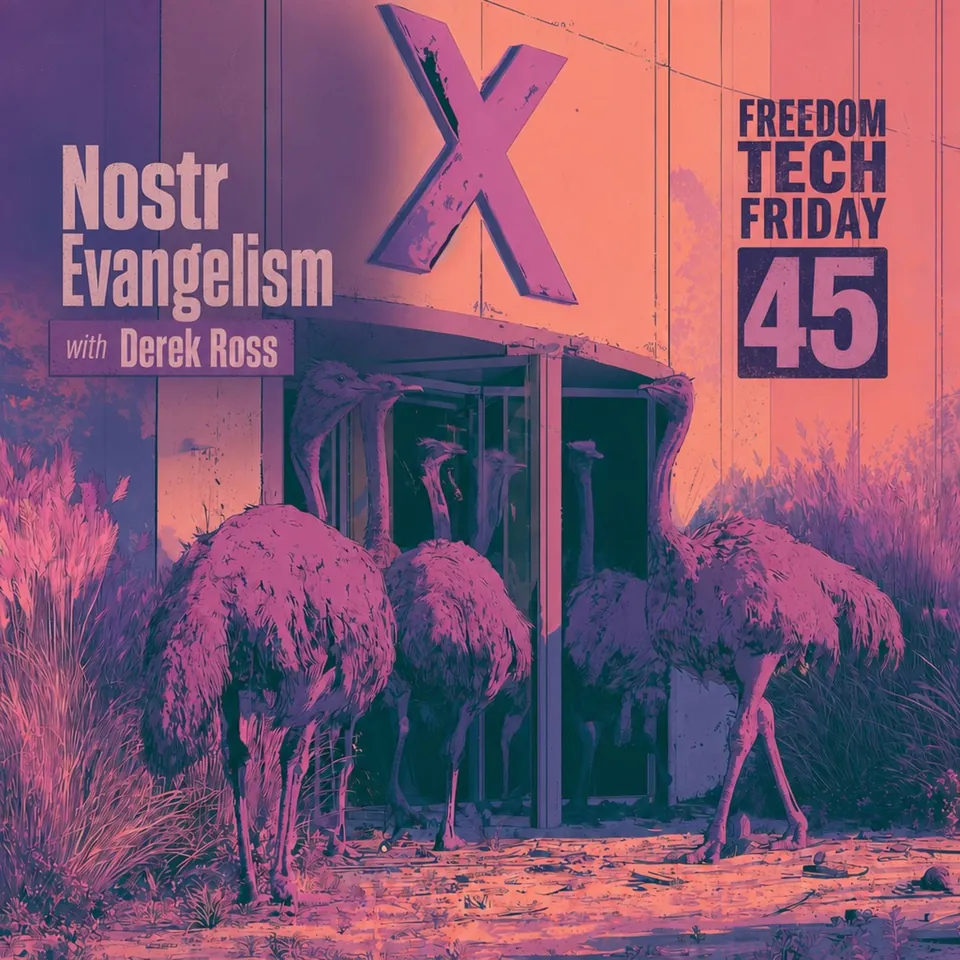
Nostr Evangelism with Derek Ross
Discussed in this episode
Boost this Episode
Send sats directly to the creators. Value for Value.
Plus 1% to Podcast Index, 1% to Boost Bot.
Show Notes
A weekly live show covering all things Freedom Tech with Max, Q and Seth.
HELP GET SAMOURAI A PARDON
- SIGN THE PETITION ----> https://www.change.org/p/stand-up-for-freedom-pardon-the-innocent-coders-jailed-for-building-privacy-tools
- DONATE TO THE FAMILIES w/ USD ----> https://www.givesendgo.com/billandkeonne
- DONATE TO THE FAMILIES w/ BTC ----> https://pay.zaprite.com/pl_JpxtkLv95T
- SUPPORT ON SOCIAL MEDIA ---> https://billandkeonne.org/
TO DONATE TO ROMAN'S DEFENSE FUND: https://freeromanstorm.com/donate
VALUE FOR VALUE
Thanks for listening you Ungovernable Misfits, we appreciate your continued support and hope you enjoy the shows.
You can support this episode using your time, talent or treasure.
TIME:
- create fountain clips for the show
- create a meetup
- help boost the signal on social media
TALENT:
- create ungovernable misfit inspired art, animation or music
- design or implement some software that can make the podcast better
- use whatever talents you have to make a contribution to the show!
TREASURE:
- BOOST IT OR STREAM SATS on the Podcasting 2.0 apps @ https://podcastapps.com
- DONATE via Monero @ https://xmrchat.com/ungovernable
- BUY SOME STICKERS @ https://ungovernable.network/shop/
FOUNDATION
https://foundation.xyz/ungovernable
Foundation builds Bitcoin-centric tools that empower you to reclaim your digital sovereignty.
As a sovereign computing company, Foundation is the antithesis of today’s tech conglomerates. Returning to cypherpunk principles, they build open source technology that “can’t be evil”.
Thank you Foundation Devices for sponsoring the show!
Use code: Ungovernable for $10 off of your purchase
CAKE WALLET
Cake Wallet is an open-source, non-custodial wallet available on Android, iOS, macOS, and Linux.
Features:
- Built-in Exchange: Swap easily between Bitcoin and Monero.
- User-Friendly: Simple interface for all users.
Monero Users:
- Batch Transactions: Send multiple payments at once.
- Faster Syncing: Optimized syncing via specified restore heights
- Proxy Support: Enhance privacy with proxy node options.
Bitcoin Users:
- Coin Control: Manage your transactions effectively.
- Silent Payments: Static bitcoin addresses
- Batch Transactions: Streamline your payment process.
Thank you Cake Wallet for sponsoring the show!
MYNYMBOX
Your go-to for anonymous server hosting solutions, featuring: virtual private & dedicated servers, domain registration and DNS parking. We don't require any of your personal information, and you can purchase using Bitcoin, Lightning, Monero and many other cryptos.
Explore benefits such as No KYC, complete privacy & security, and human support.
Hello, and welcome back to Freedom Tech Friday, a weekly live and interactive show hosted on the ungovernable misfits feeds. We go live for one hour every Friday at 9AM eastern and 2PM UK time, but you can also catch up later on the podcast feed.
On Freedom Tech Friday, we like to cover the latest news, trends for anything relating to Freedom Technologies. That could be anything from Bitcoin or Monero, encrypted messengers, privacy tools, and everything in between.
Essentially, if there's a news item, tool, or topic that can help you take back some control in today's digital panopticon, then we wanna talk about it. My name is Q and A, and I'm head of customer experience at Foundation, where we build Bitcoin focused sovereignty tools.
And as always, I am joined by my good friend Max, the head honcho from the Ungovernable Empire, and Seth who, as if by a stroke of magic, is just what Literally pinged. Yeah. Who is COO at CakeWallet.
Fintech Friday is a live and interactive show, and you can help steer the conversation by commenting live, pre submitting your questions on topics or topics on socials, boosting the show via podcasting two point o app, sending tips, just sharing the show with your friends.
Top support from the last show with our dad, John, comes from Closed Network who sent 5,000 and said that this is an absolutely based episode. I do need to catch up on that one. Thank you for the reminder.
Thanks for your support as well, closed closed network. Without further ado, we the boys are back together. Max, Seth, how's it going?
Oh, there we go. There we go. Sorry. I, saw you at the door. I just didn't wanna let you in. Oh, you're talking about me and leave leaving me stranded in the in the cold, the rain. I'm doing well. I'm doing well. I'm I'm pumped to be here. Pumped to chat with Derek. He's been doing awesome stuff lately. Sorry if I spoiled the guest,
but looking forward to it, guys. Cool. Max, are you well? I'm very well. And wasn't stuck out in the rain, but very happy to hear that you are in extreme heat, and Brits hate heat. And I also know that you can't run your fan, so you'll be very hot and sweaty and miserable, and that makes me very happy.
Yeah. So so just to paint a picture for the listeners, it's it's about 34 degrees Celsius. I don't know what that is in American freedom units. Guys, you can do the math. We, in The UK, are wholly unprepared for temperatures like this. We don't have AC like you lucky Americans do. So I am currently sat in my underwear
at my standing desk with a fan with a fan behind me that I can't turn on because it will destroy my audio. So I'm profusely sweating. I'm looking forward to to
to bring in on our guest, and I will be turning the fan on intermittently when people are talking. And if you do hear any background noise, I do apologize, but I am literally sweating. Anyway, let's bring on our guests.
Where are my notes? Oh, yeah. Today, we have a guest who, without exaggeration, is one of the loudest and most tireless voices for the open and decentralized web. Derek Ross is developer relations at Soapbox.
He's a twenty year tech veteran. He is founder of Nostaplebs, cofounder of the Grow Nostro initiative, and a fixture on stages ranging from BTC Prague to Nostrica to the Bitcoin conference in Vegas, all the way down to Bitfest in Manchester where we met as well.
And he's arguably, without goes without saying, I guess, of Nosta's biggest evangelists. But there is a twist that I'm gonna dig into today. Derek has spent many years telling people to to leave the walled gardens and come to Nosta. And recently, he's come back to x.
And we are gonna dive into why. We're also obviously gonna talk about Nosta's staying power, his company soapbox,
and a project that his team has shipped, I believe, in a single weekend that is already being used by activists in the field, and that is called Agora. So we're gonna dive into all of that. But first and foremost, Derek, welcome to the show. How are doing?
Wow. What an intro. I hope I can live up to it. Thank you. Thank you. I am excited to be here. I'm doing well. It's it's,
not a sweltering hot day here yet, so I don't have a fan on. But it's gonna warm up, and I'm looking forward to a beautiful day. Thanks for having me, guys. You you mean to say I'm the only one in my underpants right now?
Oh, no. I'm I'm wearing pajama pants still. Like, you know? This isn't you know, there's no video, so we're alright. Yeah. We'll leave that to the listeners or viewers' imagination. Alright. Cool. Well, it's a pleasure to have you on and to to get to dive into all this cool stuff with you.
You left Twitter, I believe, about three and a half years ago and went all in on Nostal like many other people did around that time.
But you recently turned the x account back on. I know it's kind of been laying dormant because I do listen to your podcast, and I know you've had your your AI guy managing that for you. But I believe that you're back in full and in person. I am. You've are indeed nice nice.
But before we dive into that, I believe there's quite an interesting story around this Google plus Android community that you you kind of started and grew, which then met met its demise thanks to, I guess, centralization.
Do you wanna do you wanna kind of set the scene for us there? Because I I I think this this is a great explainer or impetus as to why technologies like Nostra are important. Yeah. Yeah. So in a in in, like, another lifetime, I guess, like, fifteen years ago, Google Plus launched, and it was a new social network. And
I was all in on Android. I mean, I still am all in on Android, but I was all in on Android even more so. And I joined Google Plus the first or second day that it was available and started talking about Android because that's what I love to talk about. And fast forward over the next year, I ended up building a very large following
there. Like, I I personally had oh, it was over a million followers myself, but then my Android collection, like my Android feed, had over 4,000,000 followers. I was on the Android the all the suggested user list from Google. I went out to Google's HQ and
was on there. Like, when you signed up, they would recommend that peep you know, new people followed me and all this stuff. It was kinda crazy. And I had this massive following to talk about Android, and that's all I did. I I, you know, wrote blog articles, memes, you know, tutorials help and everything.
It grew this massive Android community. And then,
funnily enough, I told, like, all my friends and family on Facebook and Twitter at the time. I'm like, you know, catch me on Google Plus. This is where I'm at, and I'm all in on it. And I didn't post on Facebook for a couple years and Twitter for a couple years.
And then Google kinda rugged us all and was like, yeah. We're gonna we're gonna stop putting effort into Google plus and shift directions. And then immediately, like, the network died. Like, back in the day, Google plus was actually had more active users than Twitter did, in, like, two thousand twelve, I think it was.
It it was very popular. But then Google, as they often do, they shifted directions because they're a large company and you are you kind of have to follow what they do if you use their ecosystem.
So they rugged their users slowly over time. I mean, they told us they were doing it essentially. And my massive community that I had built, the name I had built for myself kind of disappeared, and I I really couldn't do too much, about it. And that kinda sucked.
So that, I guess, led me into, you know, building my following up again on another centralized platform. And I I, rejoined Twitter and amassed it wasn't millions of followers, but I had, like, 30 some thousand followers that I gained from, like, 2020 to late twenty twenty two, early twenty twenty three.
And then and then I found Noster. I discovered Noster and decided, oh, this is the way forward. This is social media that users control.
Large corporations can't take away your following. They can't ban you, censor you, rug you, shut down, and and kill your community that you built. So I was like, oh, hell yeah. I should go all in on this.
And I did.
I ended up telling people essentially what I had done before. Hey. I'm no longer on Twitter. I'm using Noster, and I spent a couple months teaching people about Noster and not really using Twitter.
Every once in a while, I would maybe post something, but I barely used Twitter. I wasn't, you know, productive. I wasn't active. It was I was all in on Nostril in the beginning. And then March 2023 came about, and I came up with the hashtag march off Twitter.
And I told all of the nostriches, all the people that were using Nostrich and were very bullish on Nostrich to march off Twitter and never return. And then a lot of us did. A lot of us did.
And it was great. It was a great feeling for, you know, three years. You know, people would try to contact me, and and I would say, oh, I'm noster only. And they're like, wow. You're noster only. And he's like, yeah. It's great. It's great.
I think that was a mistake, though. That's I mean, I don't know how much you want you want me to keep rambling here, but now that I I you are you did hit the nail on the head. I did return to Twitter recently.
Yeah. I love that you you mentioned Google plus, man. I have not heard that name in so long, long before my, my NEM days. Google plus was my hot. It was an absolute blast when I was doing Android dev and stuff as well. I feel like that's probably why I know your name even though we haven't interacted a ton.
Maybe, man, I'm not percent sure. Like, all the, you know, all the Android devs, like, the devs, like, I was good friends with all of them. We used to go to Google IO. We used to go to the big Android barbecue.
Like, a lot of people in the community knew me. I was an Android blogger. I wrote for FanDroid, Android Authority, like, all the Nice. Yeah. The all the blogs back in the day. You know? But, yeah, maybe, man. Maybe we know each other from that. It it's a small Internet. There's actually a handful of people on Noster that
you know, like, half a dozen that I've actually known for, like, fifteen years or so from the Google plus days. They followed me back to Twitter, and then they followed me, you to to Noster. And every once in a while, like, Google plus will come up, and I'm like, oh my god. I remember this. I remember you from,
you know, another another lifetime ago. It's pretty wild. Yeah. Yeah. That is crazy. That is crazy. I had had no idea that that was part of your story too. So it's good to hear. I I I wonder, was it the I'm assuming that it was mainly the Google plus thing that made the idea of Nostr click for you?
That you had been you had had such a platform and built that up and spent so much time and that Google could just say Yeah. We don't like this one, and that was the the main push. But why also completely leave x? Like, what was the So Why the pairing?
So if we rewind to around the time that Elon had taken over Twitter, you know, we saw Twitter change hands and the future was uncertain. I started looking into other options because, you know, I had already done this once. You know? Fuck it. We're gonna do it again.
And I I started looking into options, and I actually joined NVK's bitcoiner.social, his Mastodon instance, and was posting on there for for, like, two two or three months or something like that. Because I I was looking at, you know, uncertain futures where somebody essentially controls my
community for me. I mean, at the end of the day, that's really what happens. You can build a massive following, but if you're using one of these legacy centralized social media platforms, like, they can ban you.
They they can suspend you. They can shadow ban you, silence you, do whatever they want. You don't really own your feed. You don't own anything. And we and we would see this happen. Right? Like, how many how many of us know friends from the Bitcoin ecosystem
that they would rejoin Twitter with ghost of so and so, ghost two of so and so, ghost three of so. Like, we we saw how many, like, ghost accounts in, you know, American huddle one, two, three, four, the way up to, eight or something like like, we saw this. We saw people getting rugged constantly.
And with Twitter's future uncertain, you know, four years ago, I said, well, it's maybe, you know, the writing's kind of on the wall that we really need to find a social platform, you know, protocol that users can own
and that no one can actually do this? Like, we shouldn't have to worry about censorship and starting over and new accounts and banned and getting your entire livelihood rugged. Like, I wasn't making money on Google plus like people do today when they're influencers with millions of followers. But imagine
I mean, the people with millions of followers, their whole entire livelihood is to use, you know, Instagram or TikTok or Twitter. That's where they get all their money. And then the platform taking that away and literally wrecking their
their job, their career. Like, it's wild that we actually live in a society where we do this, and we think it's it sucks. We know that it sucks. We know that it's also normal that this happens, and we just accept it. So Noster clicked right away that there was a better future. And because it was early days and I'm a,
you know, in in the technology ecosystem, my, my career's, former systems administrator, now developer relations, I immediately said, oh, well, I can build on this new ecosystem. I can create tools and apps and services and so forth. So it's it's simple enough for
my smooth brain to figure it out. So let's let's figure out some things we can do. And I I loved that I was able to contribute and participate with its its growth. And like I said, like, all of these things came together, and all these things clicked right around the same time that I could kinda see
Noster as a beacon of hope where this couldn't this couldn't happen again. So so I started preaching that to everybody. And one day, I was talking to Odell on Noster, and he's like, Derek, brother, have you joined us in deleting your your, Twitter account or your ex account
or whatever it was called years ago? And and I said, no. I just I just abandoned it. I haven't posted in, like, three months. He's like, oh, you should delete it. I was like, oh, okay. Fuck me, I guess. So I went and deleted my account because Odell told me to. And I thought, you know what?
He's right. I don't use it. Why should I keep it there? But, yeah, I I guess the the funny part of that is him and I both realized that that leaving the conversation probably wasn't the way forward. You can't continue to be an evangelist for something if you can't talk to the people you want to evangelize.
So him and I both rejoined right around the same time, I guess. Do you do you think that maybe both of you and and others who did it overestimated how many people in the Bitcoin community and the the types of people that were already following you would move across?
And therefore, you think yeah. I think I think that was the general feeling was like Yeah. 100%. Gonna go. Yeah. And I spent the first year of of of my Noster experience really coming to terms with that and trying to figure out why. And at the end of the day, like, I I remember I was being interviewed for, Bitcoin Magazine, and and I and
I, said something. I was like, I'm gonna make people hate me when I say this, but I think these some people were in, Bitcoin for reasons other than they say they are. Meaning that, you know, that they're they say that they like decentralization.
They say they like censorship resistance, and they say they like and they understand proof of work. But do they, though? Do these things actually click? And
it's hard. Like, it no one wants to start over. No one, like, goes out and says, hey. I'm gonna start over and build my social following and my social social system and web of trust and all this over again. That's hard work. And we, you know, we already do a million things every single day.
So at the end of the day, it's just easier to just keep using what you know is bad, but it it also works for you. Like, you've adjusted your yourself, and you kind of accepted this stuff as normal, and you and you just keep using it because it's easier. And I didn't realize that people,
you know, felt that way. I didn't realize that some people were maybe addicted more than I thought. Like, it's hard to delete and stop using something that you're addicted to. So
I I think that, at least for me, what I was ended up telling myself, that some people are addicted more than they think they are. Some people are in our ecosystem for different reasons than they say they are. And, ultimately, it's just a pain in the ass. And Bitcoin adoption, you know, fifteen
years ago was very small compared to what it is today. I mean, it's still small compared to the population of the world, but but it's obviously gotten better and grown. And maybe Noster's in the same way. It's, you know, too hard in the beginning years, and not everybody wants to
to use it in the beginning. So maybe, you know, maybe in a decade, that's different. I don't know. Noster's a long term, you know, project, long term mission, and maybe I was too, I don't know, too egregious or something. Just just thought that it was gonna adoption was gonna happen overnight. I oh, man. I think in, like, I was on a
I was on in BTC Prague in 2024 on, like, main stage and and or something. And I said, yeah. But you know? And by the end of year three, Nostril will have, like, a a a million users. Well, I was wrong.
I was very, very wrong there. Do you think just I know Q wants to take us somewhere else in a second, but it does remind me you sound a lot more excited about Nostro, and I think a lot of people were than me, probably because you're more technical.
But it reminds me of my feelings towards Bitcoin and being very sure that everyone that I spoke to about it would understand and start using it. Yep. And I was so confident because I was thinking, oh, this is just makes so much sense to me. It's so great. Like, why the fuck would you not use this? Why would you use this shit technology
rather than the good technology? And then, like, nearly a decade later, I'm like, ah, yeah. That's because people don't like change. And, like Yeah. So it it just it feels like that. It feels like, yeah, it has so many of these great benefits, but
people are still people, and that's why we are where we are. Yeah. And that, I guess, for me, I've always been an early adopter of technology, and I've always taught people about technology. I mean, I have for my entire adult life, you know, for over two decades. That's that's what I do.
So whenever I was explaining to people why I felt this was better, generally speaking, people understand and say, oh, okay. Yeah. I agree with you.
I guess maybe I had more confidence in myself to in others to to inform people about Noster and able to change people's habits, I guess. I I I thought it was a no brainer. I'm like, oh, this immediately clicked for me. Why won't this click for everybody else? I like, well, it's gonna take some time. You know?
I'll work hard at it for a year, and then that working hard at it for a year turned into two years and three years, and here we are. You know, it's it's hard to come to terms with, I guess, but you're right. You said at the end of the day, people are people, and people don't like change. Like, most
people don't like change. Early adopters and technologists probably like some change. That's, you know, that's what we do. But the rest of people, you know, they
they don't like change. They're sitting their way. They just want stuff to work. They just want stuff to be easy. And if it's if if it ain't entirely broke, you know, don't fix it, the saying is. Right? And I and I think that we kinda recognize that legacy social media is broken,
but we've used it for so long that we're used to it being broken, and we've worked it into our careers and worked it into our lives. And these things that we see happening, like, it doesn't really affect me, so I'm just gonna keep using it.
But I think that we also recognize that there has to be a better way, and,
you know, it's good that other ways exist. And maybe it's not for me right now, but I'm happy that it exists. And I think that's what a lot of people think. They ended up thinking with Nostril. Like, oh, yeah. You know, Nostril is great. It's great that it it exists.
I don't really use it because of x y z reasons, but I'm happy that it it exists. So so now my my goal was to change that that that mindset. You know, try to get people to say, well, I'm happy it exists, and I want to use it, you know, and I want to use it. I that that's the big the big if. How do how do we get people using Oster?
Yeah. I think, unfortunately, sometimes things just with the legacy system just have to get really bad for people to have to look for alternatives. You know, we see that with, you know, with banking, sometimes with social media, with, you know, like the Canadian trucker incident, that sort of stuff around COVID and things like that.
So it's a shame that that seems to be the most common impetus for people to look for change, but I guess that's what history's taught us at least for now anyway. Yep. I wanna I wanna move us on and away from Noster per se and and talk about Soapbox a little bit because a a lot of people here listening to this or watching this will
know you as that agnostic guy that's always helping people onboard and evangelizing like we've just been talking about. But that's not your your day to day job despite how often and how regular you are on there. You do actually have a day job working for Soapbox. So so talk to about Soapbox. What's the what's the company mission?
And then walk us through, you know, what you guys, have built there. One I'm I'm a huge fan of, so maybe you can kick off with that one is is Shakespeare. Sure. Sure. So about a year ago, I started working part time for Soapbox.
And then about six months ago, I went full time. So now Soapbox, working at Soapbox is my full time job. I left my fiat mining job of sixteen years to do this full time. So am I still bullish on Noster? Absolutely.
Absolutely. So Soapbox, we we build tools that allow you to own your your community, essentially. You know, whether that be with some of our our flagship tools like Shakespeare, which I'll talk more about, Agora, which I'll talk more about, and Ditto. Then we have a whole bunch of developer tools as well, like NostrHub.
We have, you know, Nostrify, Nostrbook, and whole bunch of other microservices and apps and libraries and so forth. So we just build software for the decentralized web for the, you know, FreedomTech movement. So everything that we do, everything that we build is, you know, tied to Bitcoin or Noster and
free and open source software, decentralization, censorship resistance, so forth. Our company was founded by Alex Gleason, and Alex has a really interesting story that a lot of people love. He was very well known in the Fettyverse Mastodon space for several years, and he was approached, by someone
couple years ago and said, hey. You're a really smart guy. Do you wanna come build this thing for us? It's really high profile, very secretive. And he's like, oh, yeah. That sounds fun. I like jobs. You know? So so he goes and he builds this thing, and it turns out the thing that he built was Donald Trump's truth social platform.
And he he ended up being the CTO for that company for a short amount of time and then leaving his CTO job at Truth Social to go build upon Noster because he, you know, he he recognized Noster's importance for the world and didn't wanna build a, you know, closed, another closed ecosystem, another closed platform.
So lo and behold, he started Soapbox and, you know, fast forward, like, two plus years later or so,
joined a collective of companies that is funded through Jack Dorsey's Start Small organization. Jack donated a bunch of money to this collective, and several companies are operating out of the funds from that, and Soapbox is is one of them.
So to get back into our products a little bit after that brief Soapbox history. So you mentioned Shakespeare. Shakespeare is awesome. Shakespeare is kind of what I would say got me started with with soapbox.
Say, Shakespeare and the underlying technology like MK Stack is essentially a tool for vibe coding. You can go to shakespeare.diy and build any type of website that you want. And Shakespeare is trained on, knows, has the all the code examples,
code snippets, so forth to build the perfect Noster and Bitcoin website. Like, it knows how to do a Bitcoin wallet. It knows how to do Noster events and social and every single nip. It knows all the nips, all the specs. It knows how to work
to and build Noster. And you can go to Lovable, and you can do this. You can go to Replit, and you can do this. But they won't build Noster and Bitcoin websites like Shakespeare can. It they don't have the tools for that. Shakespeare also differs from our competitors because it's false. It's free and open source. All the software,
you can go and download it and run it yourself. But the coolest thing is is that we don't have, like, a back end server that we keep all of your data on. It lives all locally on your device.
So this website, this application that you build, it's not on our server, the code. You have it. It's all on your device. You can do whatever you want with a code. It's not branded with our logo.
You can edit it and change how whatever you want from it. You can use whatever model that you want. Like, we don't lock you into using one model. Ultimate freedom. You can choose, you know, whatever AI you want. You wanna use Claude? Go ahead and use Claude. You wanna use ChatGPT?
You wanna use ZAI, DeepSeek? Whatever. Like, you can use OpenRouter and choose from their hundreds of models. So you can use literally anything you want. And then when it comes to deployment, you know, you can deploy on Nostra. You can deploy on Vercel, on Netlify, Insight, Railway, Cloudflare, whatever. We we support all of the things.
So there's almost too many options. Right? Like, we we literally give you every single option that exists essentially because we don't wanna recommend or force people into using things. Ultimate Freedom. The Ultimate Freedom AI builder out there. Everybody was building closed systems that keep your code and your application and your data,
and we kinda went the opposite route with that. So we don't we don't do anything. You can pay in Bitcoin. You can buy AI credits from us with Bitcoin over the Lightning Network. You can use credit card if you want. So all of it freedom to build. And Shakespeare has, you know, users building every single day all day long.
It's nowhere near as popular as lovable. You know, obviously, we wish it was. We wish the freedom tech route, would win. But, you know, if you don't take VC money and all this other crazy stuff, apparently, you know, it's hard to succeed in this world. So we,
we we're we're the little guys here compared to our competitors, but that's okay. We have a niche market that we go after. We go after the Freedom Tech folks, the decentralization folks, the people that want to build and own all of their content and own all of their data and not have to be gated, you know, behind any type of wall. So
that that's what Shakespeare is. It's been out for almost almost a year. We're coming up on, I think next month will be the one year anniversary from our our, beta launch that we had.
And then we launched Shakespeare two point o last fall, which was the the the I'll say the more freedom version. And I said people are building every single day. It's really wild to see some of the the games people have built, the the Noster apps that that people have have built.
We had a hackathon in in Oslo, at the Oslo Freedom Forum. We also had a a Noster event that week, and there's, like, a 100 developers from around the world that were there building. And I was really surprised at how many people, like, use Shakespeare and use our our developer tools and so forth to build. So it was really cool.
Yeah. Have you guys built anything with Shakespeare? Have you played around with it at all? So just before Seth jumps in, I know he's got a question. Fun fact, Shakespeare was my very first foray into vibe coding.
Nice. It was literally I was listening to to to your podcast actually, and you were obviously you were talking about it after the first launch, and I was like, I was just poking out. I had no idea what I was doing.
Let's not say that I have actually have a clue these days, but I'm I'm certainly a little more more versed in in in prompting than I used to be. And I remember poking around and and quickly burning through some tokens because I literally had no clue what to build. I was just, like, throwing ideas at the wall just to see what sticks.
And it was a very, very useful experience for me, actually. And and, yeah, I just wanted to throw that in there, really. It was it was my first foray in there. And,
yeah, it's nice to see that it's going from strength to strength. I I was actually trying to pull up the the the website to to show some example, but it seems that it's not working on my end. The website is, but there's no examples.
What what are some of the the kind of cool or fun apps that that are being built? And maybe if you can pull up your end to share screen, that'd be even better, but if not, just Oh.
Well, yeah. Yeah. So, yeah, if you scroll down the homepage, you'll see a whole bunch of apps that are put that are dominated right now by we we changed this a while ago to where anybody can submit their apps that they build to show up.
And our, like, number one user that is just building stuff all day long, his his apps are his examples are everywhere.
I'll say the the most exciting thing that I I I've seen people build, recently, we we launched an app called Agora, and we actually we we built that in in a in a weekend. We we built it, like, with with Shakespeare and the underlying tech from from
from Shakespeare. So that was that was really exciting. I've built, multiple apps. I built a music app. I built a, calendar scheduling, like a like a meetup alternative built on Noster with with Shakespeare.
What was the the podcast one that you did? Oh, yeah. Podster. Yeah. I built I built Podster. Podster's, you know, open source decentralized hosting for podcasts on the Oster. Podcasts generally use RSS.
Like, you you guys, you know, you guys are aware of that or doing RSS feeds. I wanted to have an Austrianative way, so I used, Shakespeare to build an Austrianative, way to host podcasts.
So it uploads your media to Blossom servers. It creates the event in the track list and everything for the podcast, our Noster events linking to the media that's hosted on the Blossom server. But then for backwards compatibility, it'll also build an RSS XML
file for you based on going out and crawling Noster and pulling in the events and building the RSS file. It is kinda like a community hub for your for your podcast. So it it would give you a website and,
you know, a way to communicate with your fans and get support and zaps. So it's a a website for your podcast, but also hosted your podcast on on Noster as well. So, yeah, I built that with Shakespeare.
But one of the one of the coolest apps that that, you know, no one from our team built, it was a Bitcoin,
like Pokemon Go for Bitcoin, essentially.
There was Bitcoin Sats in the world, and you would go out and you collect Sats. So so you as an event organizer would
geofence an area, you know, a region, your town, neighborhood, whatever, however large of an area you wanted through this app. You would geofence it, and then you would fund it. You know? So you would say, whatever. I wanna spend 10,000 sats or something like that in the in this area, and then it would randomly drop these
sats all all over this geofenced area. And then you would walk around like Pokemon GO using, like, you know, AR, then walk around and and look for
these sats in the wild. And then when you would walk over the sats, you would collect them. So it was like, you know, for meetups and conferences, events, so forth to put sats out there and have people walk around and collect them. It was really, really cool.
This summer, I think it's gonna be used, in a Noster event. I don't know if anyone has used it elsewhere, but I do know the guy that made it. He's planning on using it at using it at his Noster event. So excited to see how that goes.
Yeah. One more, quick one. Just a little bit more about Shakespeare. Like, for someone like me who ashamedly had not heard of Shakespeare before hopping on this podcast, which I I feel like I should have. I'm surprised I had it.
And has been using Cloud Code, Cloud Code Work, others like that to to do some AI driven work. Like, what would be the main advantage to me of moving to Shakespeare? Like, in terms of the user experience, in terms of I know it's very Freedom Tech centric.
Mhmm. Are there other things that would draw me over? Obviously, that would be my personal preference would be because it's Freedom Tech, but I'm I'm kinda curious what someone who maybe isn't ideologically driven would benefit from Shakespeare versus being locked into one of these walled gardens. Yeah. So, personally, for me, I,
you know, I I use OpenCode. You know, I'm a more I'm a more technical guy, so I I use the command line, and I use OpenCode or CloudCode, you know, all day long. If you're a more technical person, you may like Shakespeare to kind of do a quick and easy I
just to see a an idea come to life. I know some devs, what they will do with their workflow if you're more experienced, you know, like yourself. You'll use Shakespeare to have it be ease of use, do it on mobile, and so forth.
And then you can use Nostr get and sync your code to Nostr. You can deploy your code to an end site, like an a Noster site. So your website is deployed across Noster relays and and so forth. So it's decentralized too. And and I know some developers that actually do that. They,
you know, they're used to, you know, work working all day long, you know, in the terminal, but they like to go to Shakespeare to get started. They look at it as an easy starting point. And then once it gets to a point where they're ready to take over,
then they'll, you know, deploy it, as I said, to, like, Nostrick Git, then they'll clone the repo on their machine in their terminal, and then they'll start hacking away locally. So I know people that do it do it that way.
But if you're not an advanced user, you know, maybe, you know, talking Nostrad and terminal, all this stuff, isn't entirely for you, and and that's okay. So I I would say the advantage is just to have it be easy to to get started, and you don't need to know models. Like,
the average person doesn't know the name of, you know, a 100 different models that we support, and that's fine. We so we have Shakespeare AI, which is essentially just a rebrand of Claude.
So you can go and use Shakespeare AI. You don't need to get API keys. You don't need to go the full Freedom Tech route if you don't want to. You can just buy AI credits from us with a credit card or a lightning and and just, get started.
Say your prompt, your code will live locally on your device, and it'll also be backed up automatically to to NostradGet. So an advantage of using, you know, Replit or, you know, Lovable, you know, you don't have to pay us a monthly fee to to to use
this. You don't have to pay a monthly fee to to host. You're allowed to export your code and take your code with you, so you can take your code with you at any time. It's just it's just more flexibility, and that's all. There's more flexibility than what other platforms have.
But if you're but if you're like I said, you're you're a dev that likes to live in the the the command line, the terminal, then, you know, use it as a a starting point. Like, hazard, the guy that invented Blossom, I was amazed that that he gave a workshop on Shakespeare recently down in Nashville at Bitcoin Park,
and he was talking about how he uses it to kinda get started on ideas. Like, if he just has a random idea, you know, he'll just toss the random idea into Shakespeare and then clone it, clone the repo later and work on it in the terminal and deploy it directly with an insight,
through Shakespeare. He he loves it for that. Kinda it's just showing that that Noster's dev ecosystem and the infrastructure, like development infrastructure actually works, and it is actually there. And people can actually, you know, build, deploy, repos, clone, deploy to production, and so forth, all all with Nostra if you want to.
And so what well, you mentioned a lot of, like, not having to pay for specific things that sometimes people are paying for outside of that. What's the the profit model for Shakespeare? Like, what's your what's your vision for how it will be sustainable?
And I do wanna I know Q wants to get into it, Gore, and I really do too. Because using silent payments. I don't wanna take too long, but I'm curious. So so that is an amazing question.
We don't really make any money with Shakespeare even buying AI credits from us. It it essentially is just a wash. Like, there's a small mark a very, very, very small markup, but it doesn't make us any money. Like, we we don't make money for from Shakespeare at all. The the goal the ultimate goal for Soapbox is to start a foundation
and continue to seek funding to build the decentralized web to build the free and open web. So that is our current goal, and we're actually man, I don't know if I'm allowed to leak that, but I guess I just did. We're we're actually, in the process of starting a foundation.
Nice. Okay. So a very different focus there. That's not meant to be profitable. That's meant to be more of a foundation and a sustainable thing that others build on top of and you build things on top of.
I think we might have lost them. Can anybody else hear me? I can hear you. Yeah. That that was mental.
Sound like a hurricane just blew through his house or something. Yeah. Let's hope not. Derek, are you around? If you are speaking, by the way, we can see that you're on mute. Talking Freedom Tech and Freedom AI, and it just disappears mid mid podcast. I don't know, guys. I don't know. Getting a little worried here.
Chad Chad Farrow in the in the Nostra chat just said that they killed his Internet. Somebody's watching. He's been cut off. Well, let's let's fill the void just for a few minutes. Hopefully, he's gonna come back. But, Seth Oh, man. I I said something that I
said something that, you know, the the governments didn't like, and and they they cut me off. No. What really happened was
Oh, we'll never know. What really happened was it cuts off there. Oh my god. The agents are definitely watching. Yeah. Make this up. Also,
when he was speaking then, I could still see that he was on mute, which is which is very weird. Woah. I don't know that you guys spotted that as well. He was speaking, and he said that he was he was on mute. So I I have no idea what's going on. Fishy going on here.
Cortic is saying that X is having issues as well. So maybe they just shut down the Internet because there's just way too much signal coming out of this problem.
So I I at this point, I have no idea whether we're even still live. So let's assume that we are. Well, we're still getting chat coming through, so let's assume that we are. While while we wait for Derek to come back, what I was gonna say is let's fill the void.
Seth, any any useful cake updates in the last couple of weeks that we can talk about? Man, the the most pressing one I want to talk about but can't, but we'll do that we'll do that here in two weeks. Oh, I'm excited about that one. Oh, he's back. Here he is. He's back. He's back. The agents let you back in.
Yeah. The the agents let me back in. Man, no. I I apologize. That was a that was a dumb Derek mistake. I reached for my drink, and when I reached for my drinks, because I'm an idiot, somehow I unplugged my laptop docking station.
And then I started swearing on myself, so I quickly, like, I quickly hit the mute button so you guys didn't hear me, like, dropping all these f bombs and everything. And then it took a few seconds for things to come back. But by that time, like, I was already kicked out of the the studio, and I had to rejoin.
And, man, Freedom Technology is hard. Like, I'm sorry.
Oh, man. That's funny. No worries. That's all. What were we talking about before I fucked up? Seth Seth, what was the the question that you asked to oh, god. Did we lose somebody else? No. He's back. Seth, what was your your final question to Derek?
I think you covered it. So we're we're I was mainly asking about, like, what the profitability model for Shakespeare and how they're gonna make that sustainable. But you mentioned the foundation briefly.
Yeah. We're we're in the process of starting a foundation. That that, is our end goal is to continue to build FreedomTech software for the decentralized web, for the free and open web because the the web is essentially splitting into two versions. Right? We we have the the free and open web, and then we have the KYC
and and controlled and permissioned web. Like, we see these initiatives happening literally all over the world that is splitting the web in two. So our goal is to continue using Freedom Technology, Bitcoin, Nostra, open source software, personal AI, and use the Freedom Tech stack and
to start a foundation and and seek, funding efforts to continue. Because, you know, FOS and Nostrand Bitcoin. It's it's it's really hard to it's it's no. It it's it's really hard work, and somebody somebody needs to do it. So we're gonna continue pushing forward with that. And, step one is to start a foundation.
Cool. Sounds like a good path forward. Yeah. I was talking to myself on mute then. We're we're
we're not doing well today, are we guys? Just before I move on to because I wanna talk about Agora. We had a a message in the YouTube live chat from l v ninety nine Slacker that just wanted to know the name of the Nos the the Pokemon GO application you were talking about. Yeah. I will look that up.
I don't remember what it it's called off the top of my head. I know the guy that made it, and I'm gonna visit his, I'm gonna DM him. And, actually, I think he DM'd it to me. So I just need to look at my DMs, I should be able to find it. But Yeah. Cool. Yeah.
I'll I'll I'll You can send it to me on it. Share it. Yeah. Absolutely. Yeah. I I will do that. Nice. Alright. Awesome. Well, the the latest project or tool to come out of the the Soapbox ecosystem
is is Agora. So Yes. What is it? Why we why did you build it? What problem is it trying to fix? Absolutely. How is how is it different for from what was already out there? Like, take us on that journey. Alright. So personal note is Agora is so cool that whenever I've told people over the past year what I do,
you know, they they they don't care. You know? I mean, they do, but they don't care. They don't understand. I I talked to them about Bitcoin, and they're essentially like, you know, what the hell is that? I talked to them about Noster, and they're like, well, what the hell is that?
I tell them about all the apps I've built, all the tools that Soapbox is building, and they don't understand any of this. But what people do understand is they understand the human rights angle of freedom technology. They understand there's, you know, a billion people all around the world
that are under oppression and live under authoritative regimes and have their human rights squashed. And we see this all over all over social media. We see it all over the news. People understand that people live under oppression and live under tyranny.
So Agora is what I lead with now whenever people say, hey. What do you do? I tell them about Agora, and immediately immediately, they understand the need for Bitcoin. Immediately, they understand the need for Noster.
And so I'm on a personal note, I'm very, very happy because now I can finally tell my friends and family, hey. I've always done this, but now I'm doing something that you understand. So so what is it? It it is a tool that helps human rights activists around the world crowdfund
for their campaigns, for their on the ground work, for their initiatives, and so forth. Think of it as like like GoFundMe, but it's, you know, built on Bitcoin and Noster. So this started about six months ago. My team, four of us, went to Bitcoin Park in Austin, Texas for the AI for Freedom Human Rights Foundation
Hackathon. So HRF sponsors this hackathon at Bitcoin Park, gets couple dozen developers there to build freedom technology tools for activists, human rights activists. My team ends up meeting Leopoldo Lopez. He's one of the opposition leaders of Venezuela where he was the mayor of Caracas.
He became popular in his region, decided, hey. I'm gonna start speaking and growing in popularity and do good things, maybe even run for president, and then he got jailed. And then he was thrown in prison for seven years, I believe four of those years in solitary confinement,
and now he lives in exile. And, apparently, this is a very popular story in in, Venezuela that this happens. There's a large percentage of the population lives in exile, and they have things there that that happen where their regime
holds an election and says, oh, well, we won again. And and the opposition says, yeah. How did you win? Our our party had these thousands of people all around, you know, the election, polls and voting locations and so forth. So we started out with Agora as a way for human rights activists in Venezuela to be on the ground and do,
you know, do do political actions, do grassroots movements, go to a protest, go to an event, go to an election, take a photo, and say, hey. Look. There's a thousand people here voting. The government says nobody voted, but at this location, there was a thousand people. Things like that. So that was the first,
goal of Agora for that hackathon weekend, to build a tool that would allow human rights activists on the ground to participate in campaigns and earn Bitcoin. And the crowdfunding for these small campaigns was really interesting, and and it worked.
And then we decided to expand upon that idea. And then at Oslo Freedom Forum, HRF's event a couple weeks ago, we launched the new version two point o of Agora, which is a full blown crowdfunding application that human rights activists all over the world can create campaigns and get zapped,
get paid right away for their campaign. We have ways for people to use web of trust and verify campaigns. So anyone can become a campaign verifier, but, obviously, some people are more reputable than others to verify campaigns.
But that's how social consensus works. That's how web of trust works. So maybe, you know, Seth or q and a, maybe you guys verify a campaign, people from your social circles. Maybe I verify somebody that you guys don't know and so forth and and so forth and so forth. So we we use web of trust to help,
facilitate that. But, yeah, as you're you're showing on the on the the screen here for the people watching, there was a major earthquake in Venezuela, two days ago, I believe, very, very, very recently.
And we have multiple campaigns now where people are raising funds, for humanitarian efforts in in Venezuela. So if you go to agora.spot or the Android app, if you installed that from Zap Store coming to iOS, here soon.
But if you go to agro.spot, you can install I'm sorry. You can, donate relief efforts directly to human rights activists, humanitarian efforts around the world, and there there are several campaigns.
This uses Noster. So all all this is using Noster and then Bitcoin. So we like to say that Agora is unstoppable money, meaning that there is no way for this to be taken down. Like, all of the other platforms that exist to do crowdfunding, at the end of the day, can be banned, can be taken down.
This the code for Agora is free and open source on our GitLab. Anybody can go and run it and deploy it anywhere. It lives on Noster, all the data. There is no back end server. Noster is essentially our back end. So all of the events, all of the identities, all the campaign information, everything all lives on Noster.
Anybody can incorporate this into their apps. Amethyst, the popular Android Nostr app, has incorporated Agora campaigns. So it's in that app. But like I said, it's an it's an Nostr event. So anybody can run an Agora website. The application is on Zap Store, so it can't be taken down, the Android app. So this is unstoppable
from an application and websites standpoint. And then we use Bitcoin, unstoppable money. We decided not to use Lightning for Agora because at the end of the day, most people that use Lightning use custodians, and we didn't want to force people to use custodians.
We wanted truly, truly freedom money because these are the people, human rights activists, you know, these are the people where their governments will literally block applications. We'll stop them. We'll request information from tech companies and so forth. So we wanted to do this on chain.
That way, everybody just with a Bitcoin wallet could receive funds without custodians. So there's two main ways to do it. You can get funds through public payments. Then we also support the new BIP three fifty two silent payments as well.
There's not there's only a handful of, like, maybe a dozen or so wallets that less than that, actually, probably that that support silent payments right now. But silent payments were all the rage a few weeks ago whenever Spero Wallet launched with support, and we said, you know, this is perfect timing. We should support
silent payments as well. So you can do silent payments, through Agora. You can also you can also do, you know, generate new addresses and, you know, and and so forth as well. But we derive this all from your Noster address.
It's So not multiple wallets, not multiple keys for people to manage. So you get your mnemonic seed words that you can use that will restore your wallet, and it's all derived from one Noster key. So it's one key for your identity, one key for your your Bitcoin, for your campaign. So it's we think it's the easiest way for somebody to just
create a campaign and boom. You can start getting money literally right away. And so we we have several campaigns that were created recently for Venezuela as well as, dozens of other ones, around the world.
And now that we're rolling out these verified campaigns, I'm in the process of talking to Bitcoin circular economies around the world, and our goal with that is to have these circular economies become verifiers themselves so then they can verify campaigns in their community.
And then we can verify the, circular economies, again, web of trust, social consensus. So there is no person at the top that is in control. There is no one person at the top that is controlling who is verifying who. It's all all through web of trust and all through social consensus.
That's about it. It it's it's awesome. It it again, this is probably one of the most rewarding apps that I've ever had the pleasure to work on because it's real humans on the ground in some of the hardest places around the world that are that need Bitcoin more than most people.
So it it's really it's really powerful to be able to to see it in action. Really excited to to watch this grow. Yeah. I absolutely love, like, this this piqued my interest, especially when I saw that you're using silent payments, and y'all y'all kindly enough opened a PR to to silentpayments.xyz
to make sure I got listed there as well. And, like, to see this meeting a real use case where it is the really the perfect fit here is is super exciting. It's just so good for for on chain payments like this. I did see that y'all aren't doing Lightning right now, and I definitely understand that from the complexity angle.
But I'm curious if you've thought about using Spark or Arc for something like that. Like, we've we've used Spark for Lightning and Cakewallet exactly for the same reasons you've kind of listed while you haven't done other Lightning approaches. Like, it needs to be
needs to be simple. It needs to be easy to use. It still needs to be at least what I consider self custodial, and it needs offline receive, which is a really critical piece for this type of thing. Yeah. So the version one, that we built in our hackathon, we built it over the weekend, and we actually,
won second place in the hackathon for for this app. I actually implemented Sparkwallet in version one. And, ultimately, I love SparkWallet because developers can implement it. It's really easy, and users can just use it, and it just works for users.
However, at the end of the day, it's still gated behind, you know, an API key, and it's still something that another entity controls. Like like, sure, you can get your seed words, and sure, you can say it's it's, self custodial.
But at the end of the day, like, it's controlled self custodial. I mean, you can always you can always unilaterally exit, which is the key for both Spark and Arc that does does distinguish it where, yes, if the, like, if the Spark entity goes down or the the Arc server I really love I really like Arc.
I I don't so much I don't so much like Spark because there's only two Spark entities, like like David Marcus and his brother. I forget what his name is brother's name is, but they're they're the only two Spark servers right now, I believe, unless I'm wrong.
ARC, on the other hand, I really like ARC, and I've been especially second HQ, the the second team, I've been talking with them a lot, Matthew. I'm really, really impressed with all the work that Matthew is doing. And I stay hopeful that at some point maybe in the future,
maybe we would be able to add support for ARC or or or something along those lines. But right now, just to for ease of use, just so it works, it's just just on chain for now, but we are exploring other options.
We're in conversations with the Cash App team for having a stoppable money. Jokes aside, but but that that is something that, we need onboarding. Right? Because right now,
most of the world doesn't use Bitcoin. So, sure, there's somebody that's in another that wants to donate. They see a campaign. Oh, wow. Relief in Venezuela. Yes. I wanna do this. I'm not a Bitcoiner. I don't have Bitcoin. What am I supposed to do? So there needs to be a way to onboard non Bitcoiners to this. So, you know, we're we're
exploring, like, using other companies, onboarding rails to to to this. So so maybe that'll lead to something else. I don't know. I'll say that I'm I'm a fan of using other things besides, on chain transactions. I would like and and silent payments and so forth, like, fee fees, like, microtransactions.
If someone wants to donate a dollar, those add up. If you have, you know, thousands of people that wanna donate a dollar, that adds up. But doing that on chain kinda sucks. I I would like to do micro transactions with Lightning or Arc or something in the future. I don't know if we're ever gonna get to that point, but I
will continue to beat the drum to do that if if the need presents itself.
Awesome. Well, yeah, this is this is a very, very exciting project and clearly, you know, doing great things for for very needy course causes. Excuse me. We are a little bit overtime already. We could go on for hours.
Oh, I could talk forever, man. Yeah. Yes. I'd love to geek out talking vibe coding with you at some point. So maybe we'll get you back on and and go down that tangent. But just to close this out, like, where do you wanna send people to to find out more about Agora and everything else that you're involved in? Absolutely.
Yeah. So you can check us out on soapbox.pub, and you'll get information on Agora. There, you'll get information on Shakespeare as well as our our unique Android client, Ditto that I didn't get to talk about. But the all these websites individually, it's agora.spot, shakespeare.diy, and ditto, ditto, ditto.pub.
Check us out on Ditto. Ditto's awesome. I'd love to come on here and talk about Ditto, man. Like, who remembers Myspace and themes, customizing your entire app? Like, that's why I love Ditto. You can customize literally everything on it.
Then I'm back on x now, apparently. So toss me a follow on x. I I'm a nobody there now, but it's it's hard to rebuild an account. I now I understand why no one wanted to move over to Noster. It sucks starting over.
I'm I'm living there right now. So Derek m Ross on on x, and also, you know, please follow me on Nostr. Nostr is still my home. Nostr is still my family. Check me out there. Awesome. Well, I would definitely have you back on to to talk about all the stuff we didn't have time today.
This has been a thoroughly great conversation. Thank you so much for for your time. Thank you everybody for thank you everybody for stopping by for the comments and the questions in the chat.
And, yeah, as always, we'll be back at the exact same time next week. So Max, Seth, Derek, thank you very much. Hope you have a a great weekend. Thanks, guys. Cheers. Thank you. Have a good one.
Thank you for listening to Freedom Tech Friday. To everyone who boosted, asked questions, and participated in the show, we appreciate you all. Make sure to join us next week on Friday at 9AM EST and 2PM London.
Thanks to Seth, Max, and q for keeping it ungovernable. And thank you to Cake Wallet Foundation and my Nim Box for keeping the ungovernable misfits going. Make sure to check out ungovernablemisfits.com to see mister Crown's incredible skills and artwork.
Listen to the other shows in the feed to hear Kareem's world class editing skills. Thanks to expatriotic for keeping us up to date with Boost's XMR chats and sending in topics. John, great name and great guy, never change and never stop keeping us up to date with mining news or
continuing to grow the Meshtadel. Finally, a big thanks to the unsung hero, our Canadian overlord Jordan, for trying to keep the ungovernable in check and for the endless work he puts in behind the scenes.
We love you all. Stay ungovernable.
Machine transcript; expect the odd mishearing. Click a passage to play from there.