Omarchy Mobile with Derek Ross
Discussed in this episode
Boost this Episode
Boost from here and it goes to the show. Boost from a podcast app and it splits like this:
Plus 1% to Podcast Index, 1% to Boost Bot.
Show Notes
A weekly live show covering all things Freedom Tech with Max, Q and Seth.
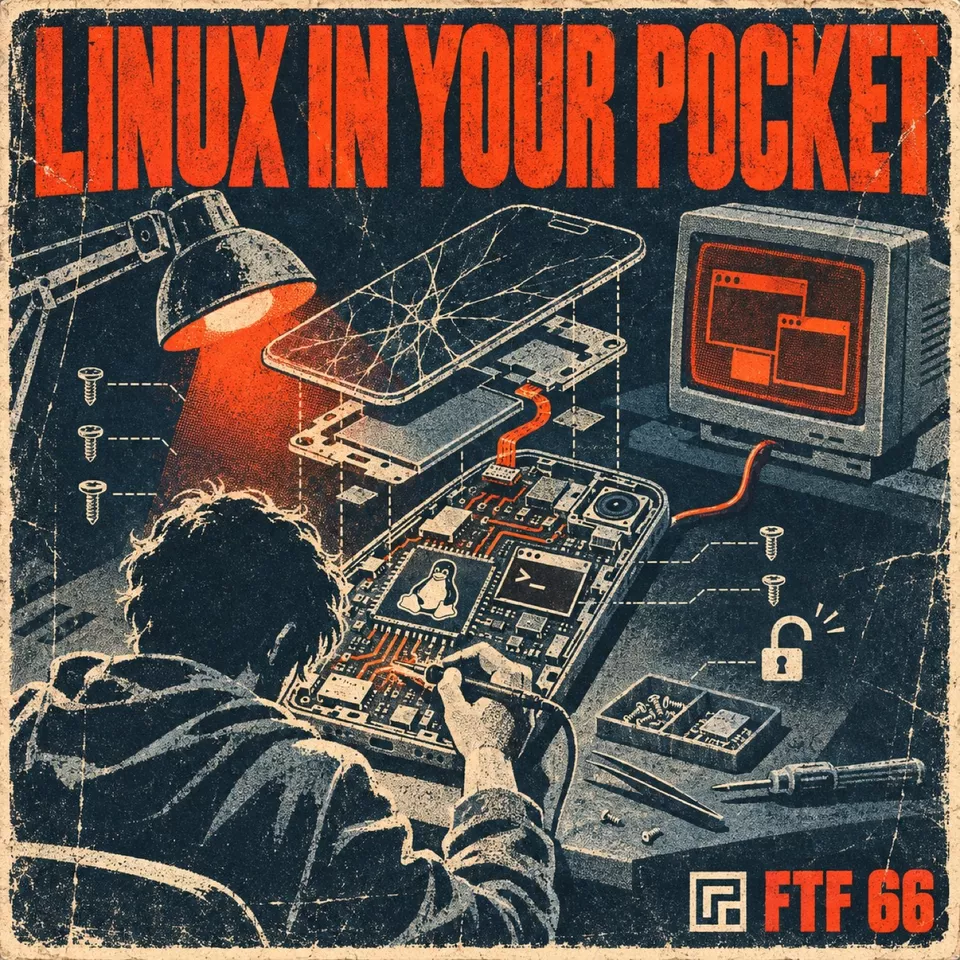
Derek Ross returns to talk about Omarchy Mobile, the Linux phone build he started six weeks ago on an old Pixel 7 Pro and which has since pulled in hundreds of GitHub stars and dozens of contributors. He explains what a Linux distro is, why DHH's Omarchy exploded in popularity this year, and how Omarchy Mobile differs from GrapheneOS: no Android underneath, full customisation, agent-built drivers, but no banking apps, no tap to pay and no Play Store for now. He walks through the devices matrix, the mainline kernel work, PWAs standing in for an app store, and what still doesn't work (Android apps, RCS messaging, NFC payments).
Derek also tells the story of getting his Nostr private key compromised through a forgotten Owncast admin panel on his home server, how the attacker pivoted from there to flash rogue firmware on a Blockstream Jade, and what it's taught him about self-hosting in an age of AI-driven attacks. The conversation closes on his other projects: Opal, a Nostr bunker app for Omarchy; Nostrometer, his interoperability scoreboard for Nostr clients; and his work with Nostr Four and the wider ecosystem.
Find Derek at derekross.me, and get started with Omarchy Mobile at omamobile.org.
HELP GET SAMOURAI A PARDON
- SIGN THE PETITION ----> https://www.change.org/p/stand-up-for-freedom-pardon-the-innocent-coders-jailed-for-building-privacy-tools
- DONATE TO THE FAMILIES w/ USD ----> https://www.givesendgo.com/billandkeonne
- DONATE TO THE FAMILIES w/ BTC ----> https://pay.zaprite.com/pl_JpxtkLv95T
- SUPPORT ON SOCIAL MEDIA ---> https://billandkeonne.org/
TO DONATE TO ROMAN'S DEFENSE FUND: https://freeromanstorm.com/donate
VALUE FOR VALUE
Thanks for listening you Ungovernable lot, we appreciate your continued support and hope you enjoy the shows.
You can support this episode using your time, talent or treasure.
TIME:
- create fountain clips for the show
- create a meetup
- help boost the signal on social media
TALENT:
- create ungovernable misfit inspired art, animation or music
- design or implement some software that can make the podcast better
- use whatever talents you have to make a contribution to the show!
TREASURE:
- BOOST IT OR STREAM SATS on the Podcasting 2.0 apps @ https://podcastapps.com
- DONATE via Monero @ https://xmrchat.com/ungovernable
- BUY SOME STICKERS @ https://ungovernable.network/shop/
FOUNDATION
https://foundation.xyz/ungovernable
Foundation builds Bitcoin-centric tools that empower you to reclaim your digital sovereignty.
As a sovereign computing company, Foundation is the antithesis of today’s tech conglomerates. Returning to cypherpunk principles, they build open source technology that “can’t be evil”.
Thank you Foundation Devices for sponsoring the show!
Use code: Ungovernable for $10 off of your purchase
CAKE WALLET
Cake Wallet is an open-source, non-custodial wallet available on Android, iOS, macOS, and Linux.
Features:
- Built-in Exchange: Swap easily between Bitcoin and Monero.
- User-Friendly: Simple interface for all users.
Monero Users:
- Batch Transactions: Send multiple payments at once.
- Faster Syncing: Optimized syncing via specified restore heights
- Proxy Support: Enhance privacy with proxy node options.
Bitcoin Users:
- Coin Control: Manage your transactions effectively.
- Silent Payments: Static bitcoin addresses
- Batch Transactions: Streamline your payment process.
Thank you Cake Wallet for sponsoring the show!
MYNYMBOX
Your go-to for anonymous server hosting solutions, featuring: virtual private & dedicated servers, domain registration and DNS parking. We don't require any of your personal information, and you can purchase using Bitcoin, Lightning, Monero and many other cryptos.
Explore benefits such as No KYC, complete privacy & security, and human support.
(00:00:00) Welcome to Freedom Tech Friday
(00:03:39) Welcome Back, Derek
(00:07:36) What Even Is Omarchy?
(00:12:40) Building Omarchy Mobile From a Cracked Pixel
(00:17:45) Omarchy Mobile vs GrapheneOS
(00:27:23) 500 Stars and a Billion Tokens a Day
(00:34:23) What's It Like to Use, and What's Next
(00:40:59) The Night His NSEC Leaked
(00:54:11) Opal, Nostrometer and the Rest
(00:58:44) See You Next Friday!
Hello, and welcome back to Freedom Tech Friday, a live and interactive show taking place every Friday at 9AM eastern and 2PM UK time across the ungovernable network. Each week, we dig into the latest in Freedom Tech, including Bitcoin, Monero, encrypted messengers, privacy tools, and everything in between.
Essentially, if there's a a news item, tool, or topic that can help you take back some control in today's digital Panopticon, then we want to talk about it. This show and the topics that we cover are powered by freedom.tech,
a daily news desk that uses AI to monitor hundreds of sources so that we can continue to bring you the signal each and every week. My name is q and a, and I'm head of customer experience at Foundation.
And as always, I'm joined by my friend Max, the head honcho of the Ungovernable Network, Seth, who is COO at Cape Wallet, and we do have an in person live guest who who I'm gonna bring on very shortly, live from Freedom Fest or Noceshire in Manchester.
Top support from the most recently released show on mining with dad John comes from Bon who sent 8,008
sats and said, sorry that I missed the live one this time, John. The change messed with my FTF alarm that I have set. The rest of the world changed their clock, but our our area didn't for the first time. Missed the old show as well, guys. Yeah. I think that's just further confirm... Confirmation that,
daylight savings times does no good for anybody. But thank you for your support, Juan. And before I bring on our guest, Max, Seth, how are both doing?
Good morning, guys. I'm I'm doing pretty well. Doing pretty well. I mentioned I have a headache, but it may be because of the the sweet, sweet wine of a new switch connecting all my eight sparks together behind me. So it's worth it. It's worth it.. They're
so loud. Good god. The switch is so loud. I have have Noctua fans coming because it has to be fixed, or I think I'll be getting a divorce shortly.
I thought they were silent, those things. The sparks are silent. As I have learned the hard way, the Switch is not silent. It is Right. Stupid loud, and you can't tweak the fan curves really at all. So it's obnoxious.
You can't just turn it on. I need to, like, divert it with the with the mining guys, yeah, and put it in, like, a cooler box or something. I don't think I'll need to. I have some Noctua replacement 40 mil fans that I'll swap out the stock ones with.
So I think with that, it'll be Or liquid cool? Silent. We'll see. It's probably excessive, but that would be a fun a fun, if unnecessary, project for it for sure. But I I think with the fan swap, it should be should be totally fine. But,
yeah, we'll see. Good. Nice. So... Well, sorry, Max. How are you? Jumping in. Very well, mate. I I have nothing interesting or cool. I've got no flexes to flex, so
we we we can get on with the show without without my rambles. Fair fair enough. Well, as you might tell, my audio is slightly different to normal, and that's because I am in a conference room at a conference. I'm in in Manchester for Freedom Fest or Bitfest or Nostershire. They seem to have multiple names.
Today is the is the Nosta focus day, so there's been some great talks this morning. My guest is actually giving one of those talks. We have our tour guest. Mister Derek Ross is back on the show. He originally joined us back in June, I believe, and company Sounds about right. Yeah.
Which was a great show as expected. So we're not gonna do the the normal intros with signpost anybody who wants to get to know the the basics of of who Derek Ross is and how he became the CEO, you can go and check the
the first show. But, yeah, Derek, welcome to the show. What you've been up to since June? I can't believe it's been nearly six months already. Yeah. I can't believe it's been that long either. It's great to be back in person. No no other. You know, that's fun. That's fun.
All been up to a lot. You know, building the future is is never something that is going to be completed. So constantly working on building new applications, finding new angles and new ways to communicate freedom and privacy to people, pitching Noster as,
you know, not not as social media, not as a social network, but instead pitching it as decentralized infrastructure, an infrastructure that different services, applications, companies, and so forth can build upon. So that's a slightly different focus, but I think Noster's infrastructure is really interesting.
And I'm not the only one that is thinking that because this morning, there were two other talks
that talked about using Nostril's infrastructure. Ben Ark talked about using Nostril's infrastructure, and Avi Burra talked about Nostril's infrastructure. Actually, three. Crypto Donkey. He literally... His whole entire talk was talking about Nostril's infrastructure.
So three different talks this morning out of, like, the five we had were were all about that. So it's nice to help facilitate that conversation. I've been working a lot on a Marquee mobile.
That's that's taken up actually a lot of my time over the past month. That was a project that I think we're gonna talk about today, but, I I didn't know that I was gonna get into that. It kinda just fell into my lap as something cool, and it kinda blew up. I'm really, really excited to continue to work on that. Yeah. I'm I'm definitely...
That was one of the main reasons I wanted to get you on the show was to was to talk about... I never know how to say it. Is it Omarchy? Omarchy? It... It's it's just like noster. Right? Some people say noster, and some people say Noster. I don't know what the right way is. Actually, I've I've always said Omari.
And then two weeks ago, whenever I was in Amsterdam at Bidfast, I was talking to Corey Clipston from from Swan, and I told him that I was working on
a March mobile, and he goes, a marquee. Or or or the other... I don't I don't I don't remember which one. Yeah. Whichever one I said, he corrected me and said the other way. And I looked down. I was like, oh, yeah. I I have heard people say that. Oh, well. And now, like, I don't I don't know which way to say it. I'm so confused.
I don't I don't even know which way he said it now. Let's just make it up as we go along. I think it's fine. Everybody knows what you mean. Yeah. Do you know what? Let's dive in there because that is the the main thing I wanted to talk about with you today was, like, you've obviously...
For whether you... Somebody's dropping in the comments. OMARCHI. OMARCHI. They broke it down into OMARCHI. Yes. Whether they're right or not, who knows? Oh, that... He said that's how d a... D h h says it. He he says it as Omarchi. Yes. Omar... Omarchi.
That's how... I I swear I've always said it Omarchi. Well, you're right. But I swear Corey called it Omarchi. Maybe Corey's wrong. I I thought it was Omari, and I kept getting corrected to Omari by people. So Well, you know at this point. Maybe it it it really is. We're just gonna we're just gonna keep saying it interchangeably.
Two two comments now, both confirming how the... What you think is how DHH says it. So let's just call it good at that. Okay. Oh,. That's what we'll try to do. Alright? Let's let's set the scene. Okay. Before we dive into the mobile stuff, there's gonna be people thinking, what the hell are these guys talking about with Apache?
Because it seems to have exploded onto the scene, and it was like Yeah. It was like the OS to Yeah. Wasn't it? So walk us through that. What what is it first? So it's just Linux. It's a Linux operating system. But
about, I don't know, three months ago or so, you know, a few a few months ago, DHH, you know, from Ruby on Rails, Bandcamp, that guy, he published his version of Arch Linux and his configuration, essentially what he was running himself and and said that he's building it with AI, and he built it from the ground up to be customized with AI.
And since if you're using anything with AI, that's, like, the the new sexy thing to do AI, boom, it got a lot of attention, and it kinda blew up. But rightfully so because it's built from the ground up for customization.
Now I've been running, you know, various flavors of Linux for years. And even though when I was running PopOS previously, I did use AI to customize some things, and you can absolutely do that very easily with Linux compared to, like, you know, Windows or something like that.
But with, Amarchi, it's kinda built from the ground up to allow these customizations, and it's built in a way that makes, I'll say, AI integrated throughout the system, and it's built in a way where
the operating system and the agents that run on it know all about its own configuration through various skill files and stuff. So it makes customization easier. Well, it it it rode the AI hate, hate? AI hype train. It it rode the AI hype train, and everybody jumped on it because it was AI
and using AI. And he already had a large following. And, you know, some some really interesting things started happening about about it. He had donated, like, a million dollars of his own money towards the project.
And then, like, Michael Dell decided, hey. I'm gonna donate a million dollars. And then, like, Jack Dorsey is like, hey. I'm gonna donate money. And all these, you know, big tech companies, large names started donating millions of dollars in tokens and funding,
and a foundation was formed. And this kinda, like, blew up over the course of a a few weeks. Really wild because if you look at it, like, I've ran Linux Mint for years. It's been around for twenty years.
It's never raised over $20,000,000 in funding. And here you have, a brand new, version distro of Linux that gets, like, $25,000,000 in tokens raised over the course of, like, a month or something like crazy like that. And everyone's like, this is insane.
How is this happening? Why isn't this happening to other Linux distros? And I I don't know. But,
I think that it just kinda shows the the time that we're in. If you're using AI with anything, like, it it just has hype around it right now. Yeah. Definitely. The the two things that stood out for me was, number one, obviously, that it was... Like you say, it was built for agents by agents. Yeah.
And I wanna dive into that in a second with you. But the other one was that in terms of the virality of it, it just had really good looking user interfaces and window management and stuff like that with... That that seemed to just catch.
It certainly caught my eye in terms of, like, the interaction that you have with it, and couldn't put my finger on one specific thing that I thought, you know, I need to try this OS because of that. I just thought it looked really good. It it looked kinda, you know, cypherpunky, cyberpunky, kinda techy, nerdy.
So if you have that mindset, you're like, oh, wow. This is built for me. And
you wanna use it because it kinda, you know, fits with your whole identity because of that, and it just... I don't know. There was there was a lot of fun with it. Yeah. Absolutely. Well, for the benefit of Derek, because he can't see my laptop screen, and for everybody in the in the chat, Seth
or... Who is it Seth? No. Max has just dropped the link from Mia Labs... Mia AI Labs on... Who I'm sure you'll know on Twitter. That's literally about an hour ago, a tweet from DHH that says, Omachi is coming preinstalled on Beelink mini PCs very soon. Oh, wow. So still growing. Like, the hype is not stopping.
That's that's crazy. Yeah. Absolutely. Andrew Lundy, just kinda saying shout out to Derek. He said I hung out with you in Las Vegas,
in the last couple of years. Nice. Wanted to say hello. Nice, dude. So... Yeah. So I'm actually caught your eye. Yeah. You you jumped on the bandwagon. Yeah. Yeah. So I I started running it myself. Right? And I'm and I'm running it and customizing things. I'm building all sorts of Nostril plug ins, obviously.
That was, like, literally the first thing I did. I started... I built, like, six different Nostril plug ins, and and I and I started playing around with it and and thinking, you know, the Noster audience wants to be self sovereign and have control over the network, wants to have control over their identity, their data, and everything.
And the Amarchi user base wants to have control over their machine. So it's essentially two groups of people that don't otherwise interact with one another but have the same mission. They want control over what they're using.
So I was like, well, we need to unite the clans. We have the we have we have the desktop, you know, laptop users over here. We have the social media network guys over here. We need to combine the two together. And I start thinking about ways to do that and thinking about different ways to do it, coming up with different plug ins.
I started thinking, well, you know, for years, we wanted a major new player in the mobile phone space.
You know, on the last show, I briefly talked about this that in another life, I was big in the Android scene and and kinda got started there. And, you know, I'm I'm used to running custom ROMs, custom operating systems on my phone for many years. I did that,
but it was still Android. The custom ROMs were still Android. There's been several attempts at Linux phones, and they just never took off. They just... This never took off. You know, sad face, but 99% of the market is owned by Google and Apple.
And that's a problem. There's... It's a tough, tough barrier to entry. And I started thinking, and I said, well, you know, for some reason, a Marchi is blowing up with hype. What if what if mobile could ride that hype and gain popularity?
And then what if I could turn this into some big sign up? Like, if you're an Amarchi user, like, this is my ultimate goal. And I've said this is my ultimate goal is what if I could tell people that are using Amarchi mobile about
Noster and about, you know, Bitcoin and privacy features and being self sovereign across your digital identity and all this stuff. And it unite
all these different groups of people together that have all the same thoughts and same goals. So I said, okay. I'm gonna see what I can do. I'm familiar with running custom ROMs in this whole mobile space and wanted to see what I could do. I had an old Pixel seven Pro lying around that I didn't use
anymore because it had a a cracked screen, so I never turned it. It was actually my wife's phone. I'd never traded it in or anything. And I hooked, it up to my computer, opened up Claude, and said, let's start working on this, basically. You know, let's port this phone over to, Omari, and I wanna
build a full Linux experience. I don't want any Android. I want a Linux kernel. I want it to be a full Linux, you know, hype with Hyperlin and, like, everything, Amarchi running on my phone. Well, that means we're gonna have to build all of the hardware drivers, like, the kernel modules. We're gonna have to build everything,
and it's gonna take a lot of time and a lot of testing, a lot of work, but, you know, let's let's do it. And I start doing it, and I start talking about it. And then other people's like, yes. Yes. Yes. We need another player in the space. We need somebody else. Oh my god. I wanna customize my phone. Like, I customize my laptop.
And other people, after I, like, announced my beta first, like, development version, it boots and has, like, 90 of the hardware working. Other people are like, dude, I want this. This is so cool.
How can I help? And I said, alright. Alright. This is gonna turn into a real thing. And I went out, and I made a contributing document, an agent's document file, and set everything all up on all the lessons that I learned, had my agent go out and add all the lessons it learned.
And then I told people, okay. Go to the repo. Point your agent at the repo. Read these files and say, port my phone that I have plugged in, basically. And to this day... You know, fast forward thirty days later, there's, like, 500 stars on GitHub. There's, like, 40 some contributors.
There's a dozen phones that people are working on. Like Wow. This is my most popular project I've ever had.
It's crazy. Like, I had it up. So my Pixel phone is fully working. Another guy has his phone fully working. We've called each other. We've texted each other. Like, it's a full... All 100% of our hard... Our hardware is all working. There's other people that are basically taking
the knowledge that our agents learned, and they're porting their own devices over. So maybe in another month, we'll have a couple more devices. Like, a lot of people are really close to getting all their devices working.
People contact me daily. Hey. Can you get this to work for my phone? And I'm like, well, I don't have a thousand dollars to buy a new phone... To to buy your phone to test it. So either, one, you give me a phone, and I'll work on it. Or two, which I would prefer is you be the maintainer, and you start working on your phone.
And, you know, and you you plug your agent in and and tell it to get to work. So it... It's been a wild ride. It's not been a month. Like, it's really crazy. Sorry. Derek, this this might seem like a bit of a basic question. But for someone who is wanting a different operating system, maybe not wanting to use, iOS,
what... Or anything Google, what's gonna be, like, the main differences for someone running this rather than Graphene as an example? Like, what... Why would I run this rather than Graphene?
Yeah. Absolutely. So there... There's gonna be some major differences. The the first one is if you're running GrapheneOS, it's it's Android. Right? Like, it's it's based off of AOSP, the Android open source project. It's it's an Android operating system, so you can run Android apps.
You can also run Google tools sandboxed on GrapheneOS, so you can run, you know, certain applications. But as a GrapheneOS user, you know that, like, banking apps and, like, tap to pay NFC, like, these things don't work. But if if
if that's okay, then the major difference then is full customization. Like, you can customize privacy settings on GrapheneOS, and GrapheneOS is amazing. The team is great. They're very privacy focused, but it's also very complicated. The average user is not going to do that.
Probably the average user is probably not gonna run a Marquee Mobile either, so
that's okay. But if you wanted a full Linux experience and you wanted to be able to run any app you run on your laptop, being able to run it on your phone, any app you run on your desktop, being able to run it on your phone, like, it's a full Linux operating system. So you can run anything and everything.
You can customize anything and everything. And because it's built with agents in mind, like, you can have the agents help you customize and do everything. But getting back to the the, you know, what you can do and can't do. So right now, with the Marquee Mobile,
you can't run Android apps, but there is a Linux package called Wageroid that allows you to run... Use Wayland and run Android applications. So I'm gonna get that working at some point. I just haven't had it, the time or opportunity yet. So there will be Android app support eventually.
And I've had so many people reach out to me and say, well, what about RCS? What about, you know, banking, you know, tap to pay? So RCS is the, you know, rich communication standard that Google bought a number of years ago that all the major carriers in The US and and around the world are starting to, you know, adopt encrypted
communications. It's like the next version of SMS. Like, SMS is bad, and then there's the new RCS standard. Mhmm. A MarketMobile one probably never get support for that because you have to have Google buy and carrier buy. And, like, you have to... You you can't just, you know, get on to to that protocol, unfortunately.
But that's okay. This is where the SIOP comes in. Right? Somebody's like, well, I want encrypted communication,
and I can't use RCS on this phone. And I'm like, okay. Have you heard a white noise? You know? Like, here's this package. It's a... You know, you can have full private encrypted communication on your device. Right? So that... And then when someone says to me, well, I want tap to pay, and I wanna be able to do mobile payments.
And I'm like, well, we're never going to get that because we have to have support from Visa, Mastercard.
Every bank in the world literally has to approve this. We're not gonna do that. Hey. Speaking of that sign off I mentioned, have you heard of, Cashew payments and Bitcoin? And, like, there's literally apps that allow tap to pay with Bitcoin. So these are alternatives that I wanna tell people about.
Give them a choice. I'm not gonna tell people that they have to use this. I'm not gonna have it come preinstalled on their devices, but I'm gonna make a recommendation to people that solutions do exist if you want to try it. So
Makes sense. We'll we'll see how it goes. I mean, there's gonna be a lot of ups and downs and a lot of differences, but the main difference is if you want a full, essentially, desktop experience on your phone, you know, and run any app that exists and do anything you can do on your desktop, you can now do it on your phone.
I, I have one follow-up question from that. Sure. So you have all this stuff that you can do, which you can't do with graphene. You can use any of the applications or install anything that you would on a computer.
One side of my brain goes, that's really exciting. You can do so much cool stuff. And the other side goes, the last six months has felt like a decade of pain with hacks and attacks. And Yeah. Just every morning I wake up, and there's just more pain, more tears. Yeah.
You know, literally, think it was yesterday, the the samurai lotto prize pot got hacked. There's... It's just nonstop. And so the other side of my brain goes, the more that something can do and the more that I can do as a user being an absolute mog, I will just fuck it up, and I'll install something that
I wouldn't be able to probably on graphene, and I'm gonna shoot myself in the foot. So would you say that this is more for a more technical experienced user or someone who isn't holding funds?
Yeah. I mean, at this stage, absolutely. It's definitely experimental at this stage. Right? You know, maybe we fast forward in a couple months, and it's it's less experimental. It's, you know, for technical people that maybe they already run a marquee on their laptop, and they wanna run it on their phone as well. Mhmm. I I think that...
You know, I'm not thinking future terms and users. I'm doing this because I think it's cool, and I think other people think it's cool. Maybe maybe we get real traction and people really want this, and then that makes us have to maybe have a,
more simple version, like a more simple UI or something like that. I don't know. There are people that are suggesting... Like, so we do have our own mobile apps that that I made. And there's a text message app. There's a contacts app.
There's the the phone app, a settings app, an update app. There's a half a dozen... You know, probably about, there's a location app to turn GPS on and off and location by Wi Fi, like, all the stuff that Google does, but doing it in a private manner. There's voice dictation that does it all on your device, so it's private.
Yeah. So I am thinking of privacy, when I do this Mhmm. But trying to take some of the stuff that Google did and and do it private minded on device. But that's... I'll say that making the experience for nontechnical users is not what I'm aiming for yet. I I want it to work.
And then once it works, then maybe we can build experiences for others. Yeah. I think too, just on that note, like, this... The main downfall of Linux on mobile over the years is that it's... You don't have access to all the apps. Or if you do have access to Android apps, they have to go through something like Wadroid, and it's
it's different. It's limited. I'm not even sure you... Like, you won't be able to install apps from the Google Play Store. It's not gonna be Play Store certified. Like, it... It's always going to have limitations in terms of app distribution outside of, obviously, native Linux apps and PWAs,
which that's another thing that Omari does really well, which is PWAs as, like, quote unquote apps that you install. Yeah. The PWA support works great. I... When I tested the audio and built the audio drivers, speakers, everything, I was I was playing, YouTube Music, signed into my Google account, running the YouTube Music PWA.
It works great. Yeah. Yeah. And I think that that will fill a lot of the gap, but it also means that, like, the average person who's used to I go play store, I hit install Yeah. Like, that that... That's just not... It's not going to be for them, and I think that's okay. Like, I I think we also don't have to make
every tool have to be for every normal user. Gonna have to be pretty pretty far down the pipeline to even consider installing a Linux build on a phone. So Sure. I think it's also just an an okay piece of this.
I I am curious. One thing that I always thought was interesting about some old Linux on mobile builds and something that Samsung did with their, their OS, at least for a while, if they still do it, is the ability that when you have, like, a real OS running on your phone,
people would be surprised how powerful their phones are. And you used to be able to, like, plug it in over USB c to a monitor with KVM and stuff and have full Linux on your on your... At your desk running off your phone, which is wild. Is that something that works here or is being 100%.
So my device, the Pixel seven Pro, does not support that. It doesn't have the hardware for it. Like, it it it can't.
But other people's devices that are newer that do support that, they have that working on their devices. You plug it in, and you can do video out. Like, you can plug it in in a, you know, an HDMI cable or a splitter or whatever, a USB hub, and plug a
HDMI monitor into it or whatever. And, yeah, it works. So you can have the full Samsung Dex superior, experience there where you can have your phone be your desktop then. Like, use a Bluetooth keyboard and mouse. Like, yeah, absolutely.
That's very cool. Yeah. I just wanted, like, take a step back here and and just to get some perspective. You've been working on this for how long?
Time flies. It's probably six weeks now. Like, that's just completely wild to me that you've got to this point in six weeks. Like, it... It's just what boggles the mind. Listen. It's... I mean, most of the work, sure, like, the...
Doing the initial port was, you know, me and then get... You know, and getting all the custom apps working. But all the other devices, like, other dozen devices, the other Pixel devices, the Moto g, the...
Let's see. There's a Xiaomi phone,
and then there's, like, two OnePlus phones. Like, other people are doing those. Like, the the community wants this. Like, there's, like I said, 40 some contributors that are that are submitting PRs every day. My... The amount of PRs that my agent is... My... I have an agent bot that essentially just reviews PRs for me.
I get hundreds a day. Jeez. Like, every time... Like, it's insane. Yeah. I I... I'm spending a billion tokens a day. A billion? Yes. Oh my days. Yes. It's Okay. My my my clawed code max 200 subscription is fully going to this.
Holy shit. That's wild. And you you reeled off a list of phone makes and models there. How how are those being chosen? So that... That's the thing that... That's tough. We can only support devices with unlocked bootloaders.
So Google's Pixel phones, if you buy it from Google... You know, if you buy the carrier version from, like, Verizon or, like, AT and T, they'll lock the bootloader.
But if you buy it from Google, you can unlock the bootloader, and then you can... Because it's almost like a... It's a developer device. So you can un... You can unlock the bootloader and flash custom applications, ROMs, switch to graphene. You know? So if you have a cost... If you have a phone that has an unlockable bootloader,
then your your device can be supported. Otherwise, we have to go the route that we did ten years ago in the Android world, and you have to hope that there's an exploit for your phone and have Claude hack, you know, your phone.
But manufacturers are pretty good at securing those nowadays, and they patch those with over the air updates.
So it's really, really hard. Like, you can't just go to the store, pick up a Samsung phone, and say, hey. I wanna put a Marquee mobile on this. You're not gonna be able to do that. Yeah. Yeah. And I and I am curious. Obviously, all... A lot of the work would have been done upfront to kind of get it from zero to one.
When you got it working for the Pixel seven Pro, how much work is it to then go from that to then get it working for, like, the Pixel 10? Yeah. Yeah. A lot of the legwork is done. I mean, now it's a completely different Tensor chip. Like, it's a completely different set of drivers,
but a lot of the stuff is iterated on. So I I think that, like, a lot of the legwork is done. But what I did whenever I was building these drivers and the kernel modules and everything, I had my agent write full test plans, like everything it learned,
and then it publishes those learnings. So then, essentially, we have this massive amount of documentation skill files that other agents can use to learn to make drivers for their film. So, like, it it it seemed the best course of action there to try to record as much of this as I could
so they can reuse a lot of the work. And then what can't be reused, what drivers can't be reused, then they learn from my initial port. Got it. Yeah. Okay. Andrew Lundy in the chat is asking, is there or will there ever be an app marketplace?
Lot of different thoughts there. So I have, like, half a dozen apps that I had to make to make, you know, to make it work on mobile, and maybe that expands to a few more in the future.
But, honestly, like, the app marketplace, like, these exist. These are all the different various Linux app marketplaces. Now not all of them will support small screens, and they'll not be formatted for mobile. Rust applications, like... In reactive applications, those look pretty good. A lot of the Amarchi
apps that are, like, built in, like, QuickShell or Rust, like, they reformat very, very, very well for mobile. A a lot of, like, older, like, Gnome and GTK apps, they they don't look too well. And then in touch, they kinda don't work too well. But the, Marchi ones, they they work pretty well.
I wanted to tell people about Zap Store in the future and and have people install Android apps that way. And and jokingly, by talking to Fran, Fran was like, hey. Maybe we need to support, you know, Linux apps. And I was like, maybe you do. I thought I did. You know, I don't know. The... You know, there's...
This is also very new, Andrew. Like, I don't know. Like, I'm kinda running and falling down and picking myself up and continuing forward,
like, kinda rolling down a hill. Like, I don't know how I'm gonna get to where I'm going or even where I'm going. This is just a cool project, and it's happening really, really fast. Like, I thought there maybe be, like, you know, a dozen other nerds that would be like, hey. This is cool. I wanna do this too.
I didn't know that there'd be, you know, 500 people starting this on GitHub and wanting more. So I don't know. Does there need to be a mobile focused app store? Maybe. That gets into, like, things that I don't want to run and maintain.
Ultimately, like, ultimately, this turns into a project that is governed by a community, and, you know, I'm just another community member. Maybe I'm a figurehead that helps drive some stuff, but I don't wanna have that responsibility.
That's too much for me. I... We'll see. I don't know. This is all early. Maybe maybe something insane happens and
somebody comes around and says, hey. Here's, like, gobs of money. Let's do this and actually be a third competitor in this market. I don't know, man. Yeah. Well, maybe maybe if somebody buys you a second Cloudmax plant, we can get that shit in. Yeah. Exact... Yeah. Step one is pay for my damn tokens.
Seth, I know you wanna just take them in then. Yeah. Just another quick one, which I think is my last one around it. It's just like what... I know we've touched on, like, app marketplace on,
like, how it is to install, but, like, what is it actually like to use? Like, I know, like, Ubuntu touch was always so promising, and then whenever I would try it or other people would, it was just, like, nothing quite worked right. Touch didn't quite work right. Gestures and stuff were always really funky.
Like, how how is that feeling so far So across the board?
So you you mentioned installers. I actually am making a pretty installer now. Like, there is a pretty installer out there on the web, kinda like Graphene or or that, and you can download and install an app on your on your device to install. So I do have pretty installers now. They're, you know, still early.
But in terms of the experience, I have a lot of gestures that, like, mobile devices are used to having working, like, you know, swiping up for app drawer and swiping down for notification system shade and swiping back side to side, on a home screen. You know? Like, basic gestures work, they feel normal.
Some apps don't. Like, they're not made for mobile. The... And and they don't function that well. Like... So if you could hit escape and escape from an app or close an app, the back gesture will work. Right? But if the app was never made, the escape, like, closes it, then, you know, it might struggle.
There's always gonna be some apps that will work better and some apps that won't work just because they weren't made with mobile devices in mind. You know? And and maybe that'll be the struggle, and maybe that'll maybe that'll kinda go with the the whole
App Store thing. Maybe in the future, there's a recommendation of these apps are fitted for designed with mobile in mind, or these apps function best on mobile or something like that. I don't know. Like, we're really early.
I think that that there's gonna be a a transition period where where there's gonna be some apps that work good and some apps apps that don't, but you're gonna use it because you want that full,
you know, desktop experience in a mobile device. I I don't know. It it... These are a lot of questions that will be solved, I say, you know, as time moves forward. I mean, come on, man. The project's been out six weeks. Like, you haven't answered every question and implemented everything already. It's a project that I kinda, like,
didn't know was gonna be a project. Right? Like, it was something that I was hacking away on because I thought it was cool and nerdy. And then there's 500 other nerds who are like, hey. This is cool. I'll I'll nerd on this too. And I was like, oh, man. I gotta have a road map.
Yep. Yeah. No. I definitely understand that. It's crazy how quickly it's moving. One last question actually just popped into my head. Like, obviously, one of the the superpowers of Remarchy on desktop is that you can plug it into your cloud subscription to your local LMs,
which is the big thing DHH is... DHH has been pushing on lately, which is awesome. He's been running Sparks and Yeah. Running local models on them and all that. Is that sort of functionality also,
like, native and really useful in mobile? So, like, I can I can use my agent to tweak something while I'm on the go on 100%? You can you can use your agent the same way that you can. It's the full experience. Whenever you first install it, it asks you to choose an agent.
You choose the agent. It downloads the software and installs it. It's it's literally exactly like, you know, desktop, Amarji. In that regard, you can choose your agent. If you had a, you know, a local model on your network or you connect to over tail scale or something, you know, you can do that. Like,
the local models that run on phones, at least on the older Pixel seven Pro that I touched, I mean, it it... I'm only using the... I forget which one. The... One one of the the the two that, you can use with VOX type for, the text transcription.
Like, anything beyond that, it'll be really too slow. Like, g p... Local GPUs on devices... Mobile devices just aren't up to Spark capability yet.
Yeah. Yeah. No. For sure. But I think I think people will be surprised even on, like... Obviously, you can't run this on an iPhone, but it would be cool if you could. But even, like, the foundational models on iPhones now, regular apps can use, which is cool. There's somebody that is getting this to run on an iPhone.
And they're not... It's not running on iPhone bare metal. It's essentially, like, running as, like, a VM somehow. And I haven't fully looked into it, but it is running on, like, iPads and iPhones,
but it... It's a second layer. Like, it's as soon as the phone boots, it boots into this, like, VM or something like that. So it... It's it's... Yeah. It's it's essentially like a like a VM, but I don't know if you'll fully ever be able to use iOS hardware or not.
Unfortunately, I would assume not. But Again, that means that that means that that there's a bootloader level exploit available for the iPhone. Yeah.
There's obviously, like, a million and one things that you are gonna wanna work on next. Yeah. What... What's next on the horizon for him, Archie? For you and the Well, I I wanna... Before I came over here, I was working on the installer experience.
Like, even though more technical users are going to install this, it's still a little weird to unlock your bootloader and, like, flash software. Like, you can tell your agent to do it, and your agent will 100% do it for you.
But there might be people that... I don't know. Maybe they aren't comfortable using agents, but they're... They they wanna be an early adopter or something. I don't know. I'm sure not everybody fits in the same box, so I did make an installer. I wanna polish that installer, make it a little bit more user friendly,
make it work a little bit, you know, better, polish that up, and then get back to supporting, you know, devices and making the mobile experience, you know, work.
I wouldn't say it's never gonna work as good as, you know, Android and and stock Pixel just because, like, the the... For example, photography. I have full... You know, all four cameras working on the Pixel seven Pro. I can do telephoto.
I can zoom, wide angle, all that stuff, HDR photos. But Google was really, really good at computational photography. The photos will, in my opinion, will probably never be as good as Google's.
They'll be really good, and they are good. But Google would like... I don't know. They're they're better than that. So making it as close to stock Android where people don't feel like they would be a second class citizen, you know, running this.
Alright. Interesting. Well, I'm definitely looking forward to you giving me a in person tour of it after after we finish recording. I'm looking forward to seeing it. We started off on a very, very positive note, and we should have done this the wrong way around. But you're best known for your...
Well, as being the CEO of, basically. You've you've worked on and contributed to many, many more projects than I care to count. Yeah. You recently had a bit of an incident where I actually discovered this by seeing a picture of you with a a shoe on your head on, which obviously piqued my interest as to be like, why is Derek doing that?
And I then read that, unfortunately, your, you're not the private key, your NSEC, had found its way into the wrong hands. What's what's happened there? Yeah. The the short version is that I was attacked, hacked, targeted.
And, unfortunately, the timing of everything, I had a server backup on my home server because I was migrating from an old device to a new device, and all of that data, the the backup data was compromised.
And that compromised treasure trove of data had a lot of data in it, including my NSEC. And I didn't even know that this was happening. Like, this happened over the course of, like, twelve hours, and then I knew. But, Peter Pamplona, the dev of Amethyst, comments on one of my posts, and I got notification. And he says, WTF is this.
And I'm I'm like, what are you talking about? Like, I said, like, good morning or something. And then I looked at the post that he replied to, and it's just a bunch of weird shit. It's a bunch of links and URLs.
And I was like, I didn't post that. And then I looked at my profile, and I see several of these with, like, just links, and I had no clue what any of this was.
So Sorry. Just to jump in. If that was me, my first thought would be that one of my agents has gone rogue. Was that your first Yes. Yeah. Yeah. Well, my first thought was, oh, man. I have an agent that is posting things that shouldn't be. And then I and then I thought, my agents don't have my NSEC.
My agents, they don't. And the only way that, like, they could have posted something is if I had a Amber Noster Connect bunker string and gave them,
but I knew I didn't have one. But my first thought was, oh, man. Maybe I have something I don't know about that an agent's doing. And, like, it shouldn't have access to this. But in the back of my mind, I'm like, no. No. I never...
I've never given my agent my insect because that's given that's given anthropic by NSEC, you know, essentially. Like, I'm not I'm not gonna do that. Yeah. So I immediately was like, oh, man. I think my home server was compromised because all the links it was posting on were links to my, like, home server.
And I told Claude to go look at my home server. Was like, hey. Here's a bunch of links in JSON from these Noster posts. What's going on? Investigate, you know, my server. And, yeah, it it found, that I was compromised.
The the... I won't get into too much detail, the most interesting thing about the compromise is that,
my Bidax was compromised. So they compromised my home server because of something dumb. And then from there, they got SSH keys and start compromising, like, all of my servers that I run internally at my house and then my VPSs.
Like, it was like, it was pretty bad. Like, lots and lots of stuff. But then they scanned my network. Yeah. That makes sense. And then they saw an ESP two thirty two device, a Bidax. Mhmm. And they, over the air, flash custom firmware on the Bidax to scan my Wi Fi network and, like, like, traffic and ship my
Wi Fi data, like, off somewhere. Like, that's insane. Holy shit. That's scary as well. It is scary. Yeah. So... Yeah. So once I saw that, I, you know, I unplugged it immediately.
Turned off, like, my Wi Fi, so all my IoT devices, my IoT jail, like, you know, everything. You know, ran upstairs, grabbed my Glock, you know, coming down. I'm like, who's trying to who's trying to get me? You know? Like Jeez. I was like, you know, it's like, alright. Who's coming through the front door?
And, yeah, they're getting shot in the face. But, anyways, it was a scary few minutes. Like, I figured it all out. But, yeah, it was bad. It...
You know, like, I... It sucks because I tell people every day to care about privacy, care about their their private keys and do, you know, cold storage and don't type your endsec into every single app. Don't copy and paste it into every single app. And I do all of that, but I had it in a server backup,
and I left the server backup connected for a few days to my new server. And I was gonna get back to it at some point. Negligence. And all it took was a few days, and that server was probed.
And they got in because, I said, this is fine to say. I use Owncast. Owncast is streaming software, so you can run your own media server and then... And and stream it... And and stream. Like, I was using it for Noster.
It was a Docker container. And when I reset up my server, I said, you know, I don't really even use owncast anymore, but someday I might wanna use it. I'll set it up later. It's not a priority for me to set up tonight. It's, like, midnight.
I'm go to bed. I'm tired. I've been build... Rebuilding this server all day. I'll set up the own cast and configure it another day. Well, I forgot about it. And then four days later, somebody probed my, you know, derekross.me and...
Or... And and solved it. And, you know, I had an own CAS server and went to my stream server and and went and saw that the admin page was open because, again, I didn't lock it down because I kinda forgot. I I wasn't gonna use it. I went to bed.
Since the admin page was open, that means I also didn't disable the default admin credentials. And it logged in with the admin credentials. And then from there, they installed a bunch of plug ins and escaped the the sandbox, the Docker container sandbox, hopped to the next Docker container, and hopped to the next and and just...
You know, it was a pretty sophisticated attack. But it was just... It was all dumb. Like, I... Not I was planning on coming back to it. I just, you know, didn't. It's... That is just wild and so scary. It is. Like, it's it's it's very 2026, I guess. Well well... Yeah. I mean, sure. Like, we've all
seen what's happened in our ecosystem over the past couple months, all the, you know, vulnerabilities, all the hacks, all the leaks, and everything. And each time, you know, you see it, you're like, man, I'm glad it's not me.
Yeah. And and then it is. And then it is. I tell you what 2026 has done for me is it's made me really worried or being very critical of what I actually self host. Whereas previously, I'd be like self all the things because,
you know, it's it's Yeah. Our ethos is what we do. We own your data. Yeah. For twenty years, I've I've I've... Since 2006,
I've literally hosted everything that I can. Yeah. Now I wanna cut back on a lot of that. That was gonna be my question. So it has made you wanna rethink that decision. And that's that's the opposite of what we preach. Right? We tell people to be sovereign and run your own stuff for privacy, but
a stupid, stupid mistake like this literally, like, fucked me. So now I'm like, well, man, maybe I don't host everything anymore. Like, it's an... I mean, it's not an attack on being self sovereign and digital sovereignty, but it is. It is. It's unfortunate
that this is the new normal that... With AI. Like, somebody was driving that AI, you know, that was used to attack me, and this is what everybody that self host is now gonna have to deal with. It's unfortunate.
Yeah. I mean, e... Even to the point where you would...
Like you said, the streaming thing was like a a lapse in concentration or just something that you didn't deem to be be something that was anything to worry about. And the fact that you're arguably following all the best practice advice where your end tech, you didn't give it to your agent, and you didn't give it...
You know, it was on a server within your house, within your home network, which generally speaking, we consider to be Secure. Somewhat secure. Yeah. Just wild. Absolutely wild. So it sucks, but, you know, it gave me a new topic to talk about. And one
thing was, you know, I try to try to turn everything into a positive to help, and I try to turn my experiences into help people. It's what I've done in tech for twenty years, try to help people out where I learn stuff. So I was on stage today here at Bitfest in Austellshire,
and I told people, you know, like, ways that we can fix this, ways that we can, you know, try to prevent it and try to make the transitions easier, you know, try to use this to to help people. And I I, you know, I
need to do what I can, and when life gives you lemons, you make lemonade. Right? So I'm trying to make all the lemonade I can right now. Yeah. I think maybe Go on, Seth. Yeah. Yeah. Yeah. Sorry. I was I was just gonna say I I think that's one of the frustrating things about this is that while AI has made self hosting
easier than ever, like, can self host any of this stuff at this point, which is awesome. Like, I used to have to build a lot of tools and docs and guides that told you how to get this thing running with step by step commands. Like, that just doesn't need to exist anymore, which is great.
But now, also, we have to be using our AI to think critically from a security perspective as well. Yeah. And I'm not... And just... Yeah. Don't take any of this as me casting shade or anything like that, but that's, like, one of the really weird things is that just how we spin off agents to deploy things and optimize them,
it also needs to become something like the PR review loop that you have
for a Marching Mobile. Like, we we need that sort of thing for our our self hosting at home, which is a pain in the ass. Thankfully, like Yeah. The thing the thing we do need to remember is, like, our home self hosting stuff can deal with an outage, so we can be really aggressive and even have agents that are unattended
that look for security updates for things Yeah. That look for vulnerabilities, and they automatically patch and update and roll things.
And just let you know in the morning, hey, this was updated. And if it's an outage because of an update, it's okay. Yeah. I have self hosted. Something similar to that, like, now running. Like, you know, like, I have hourly... Like, I'm paranoid as fuck now. So I have, like, hourly probes into everything running and reporting stuff,
and I'm constantly, like, reading logs and having agents read logs and stuff just because I... You know, I'm I'm paranoid now. So if anything, comes from this, I'm gonna have more agent agent skill bots running and checking things
that I, you know, maybe would only do whenever I was doing updates or something like that. They weren't doing it, you know, around the clock. And then... And that's that's what maybe what... Right? Like, maybe that's where we're going. If you constantly have rogue, you know, bad actors constantly probing
the Internet twenty four seven to do bad stuff, then we... Then everybody needs their own personal agent probing to do good stuff. Right? Like, I've always said that in this weird dystopian future that we're gonna have, you know,
to not get to that dystopian point, we need to have the good agents fighting the bad agents, the good AI fighting the bad AI. I've literally said this before, and maybe this is where we're going, where we need this. We... You know, you just can't use clogs. Clogs slap my wrist.
When I was doing the cybersecurity review, like, it, like, starts running all these things. It's like, flagged. You look... Looks like you're trying to do a cybersecurity, you know, blah blah blah. This has been blocked. I'm like, yes. I know. I need you to do this. But
Yeah. I think that that sounds like something we could talk about for the next hour is, like, the the the whole dichotomy of, like, the The US arguably has the most powerful frontier models, and they have the ability to help us have these sorts of protections, but they just won't won't let us do it. They won't let you do it. Yeah.
They they get very jumpy very, very quickly. It's hit me a couple of times this week when I'm doing
not even anything remote that you would even deem remotely dangerous, so I'm just, like, looking for vulnerabilities in my own kind of stuff. Something you would do as a security researcher, as a developer that you would do anyways. Yeah. Yeah. Alright. Let's end this on a more positive note.
I've got loads more notes, obviously, because you do so much. Quickly, pick any of these. We've got Opel, Nostrometer, GitBots. The Sure. What are you most excited about those? Tell us what they are and what you're up to.
The... Well, Opel's cool. Opel's in a Marchi app that you can run on your computer that... It's just a bunker. So it's a it's a... Like like Amber, you would have for your Android phone. It's just a bunker that runs on Linux, and you can sign applications and view your notifications.
And then I also have it, it'll scrub a music. So if you're listening to any music, it'll publish a status update to Noster with your... The current song you're listening to. And,
if you're in a meeting, it'll automatically mark you busy if you want You... Like I said, this is... You can configure as much of this, you know, privacy settings. If you don't wanna do any of that, you don't have to.
But you can go in and and have it, you know, flag you as free and busy if you're free or busy or listening to music if you want to. And that's an app for Omachi? Yeah. Yep. Yeah. So I I made that. That was one of the first, like, six, like, Nostril apps I made for Omachi before I decided to, you know, go for Omachi nerd.
It's it's fun. I like it. Awesome. What about Nostrameter? What's that? Oh, Nostrameter... So my developer relations role across Nostrameter the past, you know, couple years, I I talked to all the developers. I know
a lot of the apps that people are building, but then I also see the frustrations that people have because some things aren't compatible or some some things don't work. And talking to developers,
they hate to do quality assurance. They just wanna build shit, and they don't wanna do QA testing, and they don't wanna do all the boring stuff. I don't mind that. I like that. I like to find the things that don't work or the things that aren't compatible or incompatible or aren't interoperable
and then tell people. So... Because the specs matter. Like, if we have a protocol, we have design guides that we should be using them. You know, things should be interoperable if we're gonna say they're gonna be interoperable. So I came up with this website called the Nostril Meter, which I go out and I review applications and score them
and give developers a chance to do this. Anybody can score them. It's not just me. It's an actual spec that exists on Nostr, but I'm compiling them into, like, a pretty visual graph where people can go and they can review.
My ultimate goal with this would be to... All the most popular apps, I review, give them scores, then I have my agents go through and review why they scored a certain way for interoperability, compatibility with the spec.
And then agents could sub... Submit issues. Agents could submit PRs. But I wanted to reach out to the dev and be like, hey. Did you know this is broken according to the spec, or are you doing it this way for a specific reason? Hear what they say and say, well, you know that you're incompatible with these 12 other apps.
Figure out the direction that we need to go. Hey. Are you gonna fix this, or do you want my agent to fix it? And go from there. It was just a way to kinda do quality assurance across the decentralized ecosystem. I was just about to say, yeah, the joys of decentralization
or the headaches of it. Yeah. For those that are not interested... Sorry, that are interested, obviously, to notforme.com, but Ditto is is top of the leaderboard there in terms of compatibility with just three
of the tested incomplete items, which I thought was Yeah. And and there... And I haven't fully tested every app. The... Right. The the... Honestly, I haven't worked on this in probably, like, six weeks because I've been, you know Some what we working on something else. Working on, you know, something else.
But, it's a project that I'd like to spend more time on. And, actually, I submitted a a grant application to HRF
to try to get support for that. And if I do get that grant, then I will go back to spending more time on it. It does take a lot of time. Like like, I... The agents review all the code, but then I physically go and test the apps myself because the agents can't do a lot of the things themselves.
They they can, you know, look at the code and point me in directions of things to physically test, but then I test it, give the agents the findings, and then we come up with another plan of attack from there. So it's a... It is still a lot of work.
And I want developers to actually submit their own applications so they can own their listing themselves,
And then I, like, submit the issues and feedback and scoring onto their onto their events that they sign. So it's working with the developers that I already work with too. Sounds like the makings of a new net or a new kind. It's it's a lot of work. It's fun. But, yeah, hope... Hopefully, I get that, HRF grant for it. Fingers crossed.
Yeah. Absolutely. Well, we're already at time, so I wanna quickly wrap this up. Obviously, Omachi mobile is is the headline. I'm personally very excited about it.
I think we might be able to fire it along, but we'll we'll continue Some... Good summon. That's the end of the show. We'll wait for the flames we'll wait for the flames to come under the door before we wrap up. Where where can people go to learn more about OMA mobile? So you can go to omomamobile.org.
We're not gonna dive on It's still now. Alright. False alarm. The the the alarm is over. You can go to omamobile.org, and you can, find me, derekross.me. You can also check out all the things that Nostril four, the company I work for, is doing in the web of trust space, nostril4.social.
Awesome. Well, Derek, thank you very much for stopping by, being a return guest, and for being
an average spender of Clawd's tokens. Yeah. Thank you for everything that you do. Thank you for giving us your time. Thank you to everybody in the live chat, send your boost and your comments, and thank you to Seth and Max for joining us. Thanks for having me.
Hope you all have a wonderful weekend, and we'll be back at the exact same time next week. Until then, make sure you stay on the call.
Thank you for listening to Freedom Tech Friday. To everyone who boosted, asked questions, and participated in the show, we appreciate you all. Make sure to join us next week on Friday at 9AM EST and 2PM London.
Thanks to Seth, Max, and Q for keeping it ungovernable. And thank you to Cakeballet Foundation and my Nim Box for keeping the ungovernable misfits going. Make sure to check out ungovernable.network to see q and his clankers web design skills.
Listen to the other shows in the feed. Stay up to date and stay ungovernable.
Use the tools. Live free.
Privacy is a human fight.
Join the discussion.
Share the ungovernable network with friends and family who value freedom.
We love you all. Stay ungovernable.
Machine transcript; expect the odd mishearing. Click a passage to play from there.