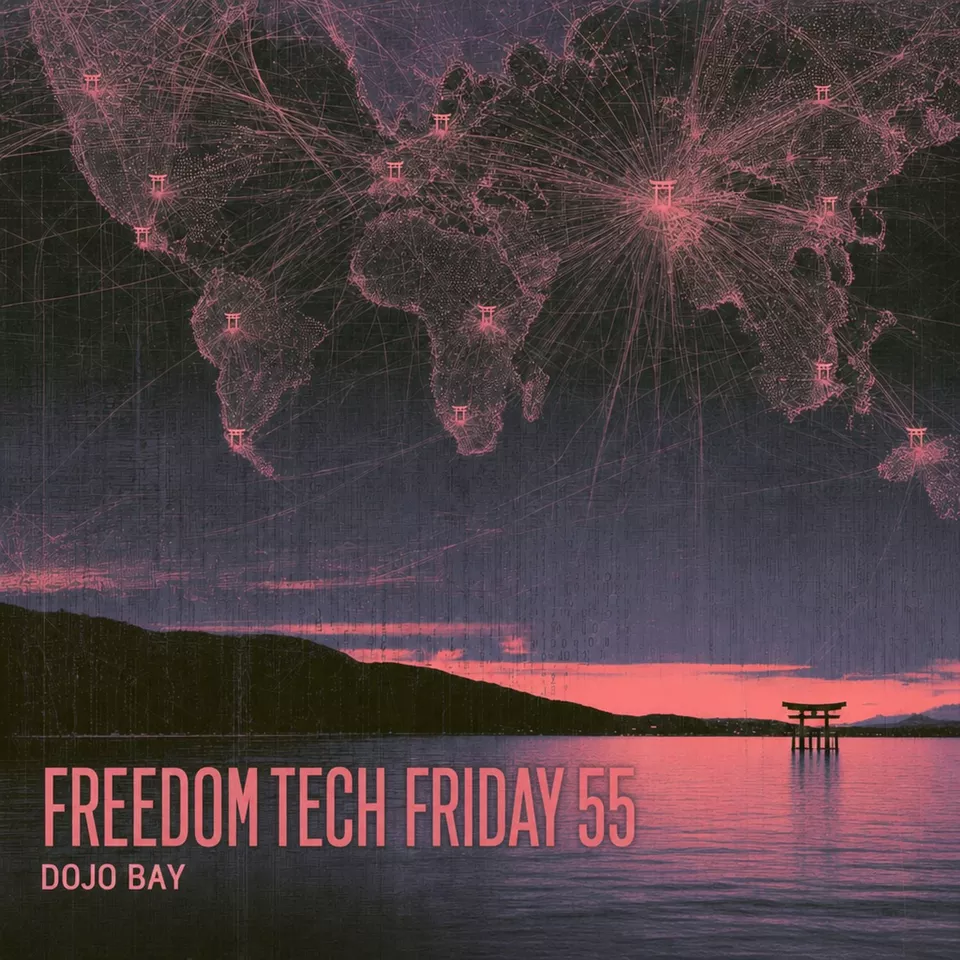
The Dojo Bay with Max Tannahill
Discussed in this episode
Boost this Episode
Boost from here and it goes to the show. Boost from a podcast app and it splits like this:
Plus 1% to Podcast Index, 1% to Boost Bot.
Show Notes
A weekly live show covering all things Freedom Tech with Max, Q and Seth.
Thanks to xTx for coming up with DojoBay! Follow him here: https://x.com/91xTx93x3
Go and check out https://dojobay.org for more information and be sure to follow Max on twitter at https://x.com/maxtannahill
Get the tor browser and visit the reference client: http://dojobayeryasshgghz537de5ckgd5hhi4z5sdeil3roeh65fwhdnu2yd.onion/
HELP GET SAMOURAI A PARDON
- SIGN THE PETITION ----> https://www.change.org/p/stand-up-for-freedom-pardon-the-innocent-coders-jailed-for-building-privacy-tools
- DONATE TO THE FAMILIES w/ USD ----> https://www.givesendgo.com/billandkeonne
- DONATE TO THE FAMILIES w/ BTC ----> https://pay.zaprite.com/pl_JpxtkLv95T
- SUPPORT ON SOCIAL MEDIA ---> https://billandkeonne.org/
TO DONATE TO ROMAN'S DEFENSE FUND: https://freeromanstorm.com/donate
VALUE FOR VALUE
Thanks for listening you Ungovernable Misfits, we appreciate your continued support and hope you enjoy the shows.
You can support this episode using your time, talent or treasure.
TIME:
- create fountain clips for the show
- create a meetup
- help boost the signal on social media
TALENT:
- create ungovernable misfit inspired art, animation or music
- design or implement some software that can make the podcast better
- use whatever talents you have to make a contribution to the show!
TREASURE:
- BOOST IT OR STREAM SATS on the Podcasting 2.0 apps @ https://podcastapps.com
- DONATE via Monero @ https://xmrchat.com/ungovernable
- BUY SOME STICKERS @ https://ungovernable.network/shop/
FOUNDATION
https://foundation.xyz/ungovernable
Foundation builds Bitcoin-centric tools that empower you to reclaim your digital sovereignty.
As a sovereign computing company, Foundation is the antithesis of today’s tech conglomerates. Returning to cypherpunk principles, they build open source technology that “can’t be evil”.
Thank you Foundation Devices for sponsoring the show!
Use code: Ungovernable for $10 off of your purchase
CAKE WALLET
Cake Wallet is an open-source, non-custodial wallet available on Android, iOS, macOS, and Linux.
Features:
- Built-in Exchange: Swap easily between Bitcoin and Monero.
- User-Friendly: Simple interface for all users.
Monero Users:
- Batch Transactions: Send multiple payments at once.
- Faster Syncing: Optimized syncing via specified restore heights
- Proxy Support: Enhance privacy with proxy node options.
Bitcoin Users:
- Coin Control: Manage your transactions effectively.
- Silent Payments: Static bitcoin addresses
- Batch Transactions: Streamline your payment process.
Thank you Cake Wallet for sponsoring the show!
MYNYMBOX
Your go-to for anonymous server hosting solutions, featuring: virtual private & dedicated servers, domain registration and DNS parking. We don't require any of your personal information, and you can purchase using Bitcoin, Lightning, Monero and many other cryptos.
Explore benefits such as No KYC, complete privacy & security, and human support.
Hello, and welcome back to Freedom Tech Friday, a live and interactive show taking place every Friday at 9AM eastern and 2PM UK time across the ungovernable network. Each week, we dig into the latest in Freedom Tech, which includes Bitcoin, Monero, encrypted messengers, privacy tools, and everything in between.
Essentially, there's a news item tool or topic that can help you take back some control in today's digital Panopticon, then we want to talk about it. This show and the topics we cover are powered by freedom.tech,
a daily news desk that uses AI to monitor hundreds of sources so we can continue to bring the signal every single week. My name is Q and A, I'm head of customer experience at Foundation. And as always, I am joined by my good friends, Max, the head honcho of the Ungovernable Network, and Seth, who is COO at K Wallet.
This show is live and interactive, so please do help steer the conversation by commenting live, asking questions, boosting the show, or just sharing it with your friends. Top support from the last show with Carl Dong of Obscura comes from eight Mythrande, who sent in 0Point00997 XMR
and said, I see that on the Ungovernable website, you can boost the show directly from the website. Is that an LN exclusive feature or can XMR enjoyers get in on the boosting? Well, Ape, thank you for your support. It's funny you should mention that because we've been doing some troubleshooting this morning.
The short answer is you can do both. If you go to ungovernable.network/v4v, you can boost in anything you want. If you go to the episode pages, that's kind of the lightning powered one
where, obviously, you can't do any XMR stuff for now because it's all podcasting two point o stuff. But that is currently broken as is the way with Lightning and podcasting two point o, so bear with us. Thank you for your support nonetheless. Without further ado, before I bring up our esteemed guests, Max,
crayon eater Max, and Seth, how are you doing? I am doing. I was telling you a little bit before you're alive. I'm a little under the weather, so I'll take a backseat a little bit this week. But I'll listen in, learn from the the great Max Tannehill, excited to to dive in today.
Yeah. Although I'm gonna yell at him if he doesn't set a profile picture because I I can't. My my OCD is over Can't handle it. Can you do it live? Yeah. The OCD is. Okay. Crayon eater Max over here is very happy, actually. I thought I was gonna have to deal with a dreary Canadian this morning.
And instead, I I get a a Brit, so I'm very happy. I feel outnumbered. Like, very outnumbered right now. Oh, you should do. Right? You should do. You know? That's how the revolutionary war was as well. It's no less. So It's a reverse reverse revolution.
Yeah. They're coming back for for retaliation here. Please to call it a revert please to please to call it a revolutionary war and not war of independence. I can tell now that that was half one.
Max, what Sorry. Go on, Max. Go ahead. Non Crayon Ether Max. What mic are you speaking into? Is it your computer, a microphone, or a headset?
If I'm honest, I actually don't know, so I speak loudly. I've got my my thing plugged in. If you click if you click on the bottom left, there'll be, like, a little microphone thing, and there's an arrow to the to the right of it, and it will tell you what you're speaking through just because it's not as clear as you usually are.
It says hang on. I'm gonna
right. One second. I'm gonna unplug and plug. Oh, no. What have I done? Okay. Speak again. No. You sound good. You sound fine. Yeah. It's good. Okay. Alright. I'll speak I'll try and speak loudly and clearly anyway, so hopefully you can pick me up. Thank you, mate. Thank you.
Nice. Oh, well, we've kinda jumped the gun a little bit, but today we are welcoming Max Tannehill back on the show to, this time, talk about Dojo Bay
and a question that goes kind of beyond Bitcoin wallets really, and how much control do you really have if the tool that you depend on stops working when somebody else's server disappears. That's what Dojo Bay is all about.
Running your own infrastructure is obviously the answer and the one we we that we would push most people to. But not everybody has the hardware, the knowledge, or the time to to do that straight away. And so the Dojo Bay helps bridge that gap by connecting wallet users with people running public Dojo nodes.
We're gonna dive into it all about it, how it works, where the trust sits, and how the directory itself can be run by anyone. Mister Tanahill, welcome back to the show, mate. How are you?
Very good. Yeah. Thanks for for having me back. Nice to kinda hear from all of you. And, yeah, be a good chance to kinda speak about this. And also, like, I think I think, honestly, speak very much about the trade offs of all of this, like everything here that we you know, with all the tools that we use, you know,
nothing's perfect. Nothing's ever gonna be easy on this, but I think, you know, I'm looking forward to get some kind of challenging questions about all of this as well. And I think that's exactly what this show should be about.
Definitely. Yeah. Listeners of the show will know that Max doesn't shy away from from anything, pretty much. So, get your questions ready in in the in the live chat.
Before we kinda dive into the technicals and we just go straight into to into Dojo Bay, I wanna kinda take a step back and set the scene for those that may be less aware of kind of how we got to to today, starting with, obviously, the the the the the main Samurai Dojo seizure, the the predominant back end for Samurai Wallet users that
didn't run their own Dojo. Let's let's start from there because I feel feel like it's a good jumping off point chronologically, and then we can kind of move forward to earlier iterations of of Dojo Bay before we get on to, you know, what you're heading up to to today.
Yeah. Sure. Thanks. I think there's a couple of things just to start with. So, like, number one, I'm sure most people listening will kinda know, but the dojo or Samurai Dojo as it's known, and it you'll find it now in at a website called the Dojo Open Source Project is
maintained by Pavel. I think Septic is the right right pronunciation there. But, you know, he he basically maintains the the back end node for for the Samurai wallet that was was was was incredibly popular a couple of years ago amongst the kind of, I say, a privacy niche of Bitcoiners,
and he's also was also used as a back end for the Sentinel wallet. And then since, obviously, the Samurai guys got taken down, there's been the Ashigaru wallet, which is a fork of Samurai that uses that that same back end.
At least kind of when Samurai was in operation, I think, you know, where if anyone was using it from the early days, you couldn't even use your own back end. You had to use theirs. And
it was pretty neat in the fact that you could access that over tour, but, obviously, the the back end sees a lot of your your information, like, in terms of transactional information. You get a lot of network privacy. There was never any email or sign up type thing. You never disclosed your name, But it is seeing,
you know, that that public key, the extended public key, which is used to generate your addresses and therefore kind of you you anyone with access to that does see all your transactions. And so Samurai kind of eventually open sourced that back end so users could run it themselves.
And then when a lot of their infrastructure got taken down and I I'm pretty sure, like it was actually quite a while back now, isn't it? It's almost two and a half years ago. I'm pretty sure, like, the the the Samurai Dojo went down pretty much instantly along with Whirlpool and along with, you know, OXT.
And there was some other infrastructure that seemed to kinda hang around okay, like the pain himself, for example, for a while. So it's a bit uneven what was taken down. But, yeah, the that that server got taken down, and, you know, it it would have hit a lot of people with quite a degree of panic and inconvenience.
Certainly, we saw in, like, the wallet chats at the time. Folk were just needing to wanted to move their funds to another wallet. They were anxious. And, yeah, you couldn't see the balance because the the dojo was out. And so it was a pretty kind of painful migration, I think, for a few people.
I think shout out Seth. You kinda did a guide for kinda helping people sweep their their assets over to something like a sparrow or there was yeah. I'm sure there are guides for, like, cake and Envoy and all that. But, like, you know, many people don't really run their own notes. And, you know, they were you they're really resting
a lot on the samurai, you know, back end to provide that. And, of course, you know, like, the samurai guys are pretty confident with the note that they were know, you that they had the right infrastructure,
but, of course, it was like a central point of failure. And, you know, when it get did get taken down much to their surprise, they weren't expecting anything like that. You know, it really you know, aside from putting kind of some pretty sensitive information in the hands of the feds,
it it's it also just mainly, I think, kinda caused the issue for for folk not being able to use their wallet and not having an easy thing to kinda turn to. Because the nature of that of that wallet, the dojo is a kind of pretty heavy
kinda indexer. So it's not something that you can just kind of point and switch easily to another wallet. It's always been a bit of a you know, you gotta rescan. You have the wallet rescan the server in order to kind of point it to another dojo.
So kinda, you know, just in terms of background here, you know, it was a bit it was a big kinda central point of failure,
and I'm sure, you know, like, people appreciate the kind of the work that Samurai did in in making it available for for for those that wanted to. But, of course, as we all know, like, it's a fairly rare thing to be running your own node as a Bitcoiner when using these wallets still.
Yeah. I I didn't actually know that in the early days, you you had no choice but to use the default node. I guess that must be must have been a feature that they you know, the custom dojo that they added thereafter. So that's interesting little tidbit for me there. When did that when did that get added?
So I I I don't know, actually. I don't know if it's around it might be I mean, I'm struggling with memory now for kind of, like, obviously, anything that happened pre COVID feels like twenty years ago, and during that time, I have no idea.
I I got a feeling, like I mean, don't quote me. It might have even been something like 2018, 2019 that they released Dojo. And, I mean, before I even used Samurai, they were using the, I think, the blockchain. Info APIs.
And that was kind of when it was in it wasn't even called beta then. It was in kind of an alpha state. And, you know, without getting distracted too much, that was one of the early criticisms that they had, which they'd kinda made sure everyone that was running the wallet fully understood. But there's a pretty kind of,
you know, shade pretty early shade thrown at them then for saying, like, hey. You got a privacy wallet, and, you know, you got a back end that's, you know, hitting up on a on a provider there or something like that. So, yeah, it was, it was an it was an early kind of drama that they that those guys have had.
Interesting. Yeah. A bit of a bit more of a pointed question while we're talking about Dojo itself. Like, why the the kind of custom back end software? Why not leverage what the, you know, the existing stuff that's already out there, the the more kind of vanilla Electrum server type architecture?
Yeah. I mean, I think, yeah, it's not an easy question to answer in some ways because the Dojo stack itself has changed, and it's quite it's a lot easier to answer now, I think, because there's quite a lot more features in in that project in terms of what you get in the in in in that node distribution,
for want of a better word, versus others. But I think kind of even in the early days, you know, I Pavil was better for kind of to explain the architecture, but just one thing to explain to everyone. It is straight Bitcoin core at a at at at the basic of the at basis of the architecture.
And there is in the early days, there was a thing called I think it's called address indexes, and I don't know if it's maintained to the same degree. Now it might be fully switched out with Fulcrum. But effectively, it was even back then a way to run your node, not just with Bitcoin Core, but having, an Electrum indexer with it.
But one of the neat things it was is rather than communicating over the Electrum protocol, you actually had, a oh, my mind is going in terms of the architecture, but it's like it was a MQ, I think, communication, and it's like a it it was a it was a a less heavy API to access
in terms of getting the information back is the kind of the simplest way to say it. So with something like an Electrum server, you're doing
oh, god. My my memory is fading me again here. I'm trying to think of the the name of the protocol, but it's like a SPV. That's it. Sorry. And you're you're downloading, like, block headers. You're downloading quite a lot of information. And you'll actually notice this if you ever use something like Sparrow
over Tor. Like, even though it's a, you know, very efficient app, even if you're using something like Fulcrum, you use Sparrow over Tor. It can take a couple of minutes on a deep wallet to actually fully sync, and that's just not really usable on a mobile wallet. So Dojo is very much built to to serve mobile devices that were going to be
operating over Tor. So you're not headed to the same extent. You're you're actually able to do a far more efficient query. And, like, the indexing of of of, like, the transactions,
you're actually kinda storing the XPUB on the node. So even when your wallet's not open, it's keeping track of all the transactions that are relevant to you. Like, that's probably kind of the simplest way to put it.
Since then, of course, like, you know, more things have been added, but you got some really neat stuff on on that architecture. Like, you can query an API endpoint to see if, like, an address has been seen before.
You can you've got you've got very good, like, fee estimation. Things like Ricochet were only possible on the dojo stack. They're not something that you can do on on Electrum.
But one one of the things I would say though is Dojo as a package does still include Electrum, and it would utilize Electrum if, say, you do, like, a full rescan of the wallet or something like that even if an ongoing basis you're doing the Dojo API.
But, yes, it's it is a kind of it's very much an architecture built for a mobile wallet over Tor, which does have different demands to, like, say, a desktop wallet you're accessing over HTTPS.
Makes sense. Alright. So the arrest happened. The main server goes down. Ashigaru pops up at some point thereafter. I can't remember the time line specifically. Right. Then we have this thing called Dojo Bay pop up
because, correct me if I'm wrong, but Ashigaru didn't run any back end whatsoever. So if you if you were kind of you had a samurai shaped hole in your stack and you wanted to maintain wallet and then you migrated to Ashigaru, you have to use either your own node or point it to a custom
Dojo back end of somebody that you knew or trusted or want or were happy to trust. So from then on, you know, we we saw Dojo Bay, which I believe was on a different domain back then, spin up as a as a community project, I believe. I can't remember the name of the name now. Is it XTX
or something like that? Like, take it let's jump off from that that point in time and and walk us through what happened. Yeah. So I can't remember, like, where the idea came from Dojo Bay. I'm not even sure, like, if it was even mentioned in that Ashigaru podcast
as, like, something that the community should do or if XTX had already explored that. That's the name that set up the Dojo Bay originally. I'm also sure that Laurent, who I think built Dojo in the early days before Pavel maintained it and was the guy that built OXT.
I think he I can't remember. I I was trying to find a tweet earlier. I'm sure he said something about, like, it'd be good to use kind of other folks' dojos, but if you're gonna do any kind of directory, they should be they should be signing for it in some way. You know?
Like, so you're not you're not just kind of blindly trusting kind of payloads because, you know, hooking up to to to someone else's node, you know, they are serving you, like, a lot of sensitive information as well as the fact that you're obviously giving them, you know, some some information on a selective kind of basis.
But what I do know is is that, like, it's really kind of quite an effort. XTX, when he kinda did this, he as far as I know, he, like, he worked with I think it was MindInbox to get a server up and running. It was originally hosted dojobay.pw.
And, effectively, it was like an HTML site with some Python scripts going out. And the idea that he had was I will set up all the I'll I'll I'll use my own kind of social kind of, you know, skills here to kind of find people that are willing to kind of put up their own dojos, people that are known in the community.
And I'll host them on here, and I'm gonna put a load of disclaimers here and say, look. These aren't know, I don't run a dojo that you know? Sorry. As a dojo, as an operator to this site, you're not trusting me or my dojo, but you're trusting any dojo that you decide to kinda go to. And it was a fairly kind of
good mix of of different dojos. And one of the things that kind of became clear to me as well is I thought, like, wow. Like, this is pretty cool because, like, you know, this was the first stage of, like, decentralizing, you know, the idea of dojo because, obviously, you had this incredibly painful centralization
with samurai in the first go. And all you needed suddenly was this huge gain with Dojo Bay, which is is that if you actually think even from a point of view of some kind of law enforcement inquiry,
they could easily go previously to samurai who are a known legal entity and say, I expect know, I want you to provide me the, you know, transactions that involve this address. That was always an avenue of of law enforcement action.
But if you, of course, you go to something like a Dojo Bay, which is just a website and I think, you know, named kind of in a similar way to Pirate Bay, it's just a directory. You know, you're not going to someone that's necessarily got the dojo. And even if they are maintaining a dojo,
like, it's just a website, and whoever's gone to them, like, if all the Samurai and Sentinel users, like, there's no indication there of which dojo it like, they necessarily be using. And, of course, what was also clear is we've got people in Spain, Singapore,
The UK, The US, Canada, like, this whole set of different jurisdictions that people are operating in. And so you now have a choice of, like, I'm you know, maybe I'm in The US, and I don't want my dojo with my sense of information to be in The US. You know? Yeah.
I've gotta trust maybe this guy in Mexico or something like that, but hell, I'd rather do that than have someone, you know, that's in in the same country of of the the law enforcement or tax advisers or whoever it is are looking at. And, you know, that's where, you know, it's important for my privacy or, you know, some marketing
folk that are aggressively kinda trying to steal data. You know, like, you you kind of you you got a hugely kind of you've gained there. So XTX did, like, amazing work there. And I think in the early days, it was only, like, say, three or four different kind of dojo operators.
And by the end of it, there was, like, about 20 dojos all kind of, you know, on this site across various jurisdictions, and he also hosted test net ones as well. So it's really, really kind of great project.
And I always I was always interested in it, and it was kind of it was at a late stage. I thought, actually, I think we can have even a bit of a different approach to Dojo Bay. But just stop there if there's any kind of questions on that or anything I can make clear.
Yeah. So in in the early iteration, like, what what was the the the user flow? So, obviously, you've got these power users, benevolent kind of community members that are like, yeah. Sure. Like, I've got a dojo.
It's sitting idle most of the time. You can connect to it if you want to. Like, what was the the user flow? Like, was the I don't wanna say whitelisted, but was it a feature kind of Yeah. So they would of Ashigaru, or was it more of a manual process?
No. It's completely manual. And, like, I think the so there's two things there that was kinda manual. It's like, one is getting a use to even be aware of it. And, it's it's at a clear net site. It doesn't have the best SEO or anything, but it was something that was really useful I found useful
to give to people, say, on, like, the Samurai support groups. Like, they wanted to continue to use Samurai. They have their back their Samurai backup,
and they knew quite a lot of people that have been helping out in the telegram groups for a while. And so I could I could say, hey. You can use my node, and rather than trying to send them some pairing code, I could just send them the Dojo Bay link.
Was always a bit awkward, and I think it's probably still the same in Ashigaru trying to repair a dojo. Although Ashigaru did introduce some improvements on, like, the the rescanning. So, you know, you didn't lose, like, painting connections in the same way like you did with Samurai.
But I think, you know, really, like, probably where it needs to go in the future is not to just be some site. I've seen, like, BTC wrestlers here, but, like, wrestlers looking at, like, maybe doing some improvements on Sentinel and trying to get a pull request in there and trying to actually bake in, like, the Dojo Bay into
the Sentinel wallet. And I think if that works and if that's successful, obviously, it would never be possible to do in the Samurai wallet, but I think there's possibly a chance to ask the Ashigari team. Hey. Like, this seems to have gone down well with Sentinel. We've got something working here.
Would you guys be up for, you know, improving the onboarding flow so that when someone downloads the wallet because very rarely that someone, you know, that's, you know, first using Bitcoin or first trying out this wallet is necessarily gonna have all the infrastructure.
It gives them a way to say, okay. Like, in the same way, if you do use Sparrow or or some other wallet, you see kind of a set of nodes in there available, you could, like, hook up to the Dojo Bay, get a web page or something like that and select, like, nodes according to the jurisdiction
or the NIM that you want to use. So I think that's kind of the next step of where this goes. The other thing I say is is that XTX was doing a bit of a job of actually managing the Dojo operators that elected to put their their credentials on the site.
So he'd do a bit of approval process. And one of the things that I think he pioneered as well was beginning the effort to get folk to actually sign with a bit 47 signature, their actual pairing credentials.
And it was never kind of fully uniform across his site, but he started that. And what that meant was is that, let's say, you know, you decide to connect to my you know, Max Tannehill's Singapore dojo, and you're like, okay. Cool. I you know, I trust Max. I'm okay with using his dojo,
but I'm not sure if I trust trust XTX and his dojo based site. Well, with what the information that I provided to XTX for him to put on the site, I provided him my pairing code, and I signed it with Bit 47.
So if he tried to actually if someone didn't trust him and he had manipulated my my code to go to say a malicious dojo, that wouldn't come through as a valid Bit47 signature. So that was, like, where it really started to kind of, I think, become a lot more viable as a decentralized alternative to centralized dojo.
That's clever. I didn't know that part.
So you can you can have trust in because a lot of the relationships that people can build over the years with Nims become friends, and there's a certain level of trust. And that is, like you said, that's so much better than just having one centralized point. I do remember, though, before the arrests,
I can't remember what it was called, but there was there was there was a push to decentralize and make it so that you were connecting to other Dojo nodes anyway. And I can't remember what it was called, but I feel like That was very close.
That was over the Soroban network. That's right. Yeah. And so that was about, like yeah. There's actually that's about broadcasting your transaction. So you'll find other Dojo nodes. There's Soroban onion. You'll kind of you'll do that.
One of the kind of the the funny things here, actually, one of the benefits of for me of running Dojo and DojoBay is I actually don't enable my Dojo to when it broadcast transactions to go to other Dojo nodes. And the reason I do that is because it just because I don't want my transaction broadcasting slower,
But I also personally don't need the privacy benefit of of of Soroban because other people use my note to broadcast transactions from it. So I've already got, like, a bit of it, but I still make sure I kind of my my dojo relays other sort of band transactions,
and that's kinda configurable. But, yeah, it's, you know, it's a very yeah. It's a real mix, and you got a lot of So provides it provides cover by allowing other people to broadcast transactions, then it's like, well, it could be my transaction. It could be someone else's. Exactly.
That's yeah. That's a good way of looking at it. Yeah. So so we had the first iteration. I'll call it v one that XTX did, and I can see him in the Twitter chat as well. Hello to you, sir. Hope you're well.
What was the the impetus to kind of migrate from that to to the new one? What did the new site allow before we dive into, you know, the details of it? Yeah. So so first off, I didn't start off with the intention of doing any kind of migration.
I actually just basically ran it through, like, Claude and asked for a bit of a design difference, like, to kind of make it a bit kind of more modern as a UI, try try it out. And then I kind of went down a rabbit hole, and my original intention was actually to just have it as almost like a separate project. So I started
I did actually end up doing a v you know, having a VPS, but my original vision for this was actually to never have, like, any kind of dojo bay like XTXs on Clearnet,
which he also had available on tour. And my thought was, I'm gonna just try an alternative kind of user interface, try a few differences, build it in a different code base that's, like, just JavaScript or TypeScript because that I'd had some success with that with a bit 47 DB project.
And I thought, you know what? I'm just gonna try and make this a tool thing because it's just kinda like another level of, like, decentralization and censorship resistance because, you know, when you're operating, which I thought, you know, for for XTX's site, when you're operating a site over ClearNet,
even if it is available over over the onion, it's still an IP address that someone can find elsewhere. So I kind of thought mine my site as more just like an alternative implementation and just like a a more less kind of obvious, but kind of something that could be spun up.
But then, like, I kind of did more and more on it. And, you know, like, I mean, I felt a bit bad at one point because I just called it the dojo bay, but XTX didn't have any ego or anything. And he was just like, yep. Really like your project.
And we just exchanged some ideas on a signal chat with Jordan and kinda went back and forth. And then I just kinda started I I think the kind of the vision came a bit clearer as I started doing it, which is, okay.
I will actually, thinking of it, the Dojo Bay itself doesn't need to be on Clearnet at all because it can just be on Tor because, you know, the only people that can be connecting to it are gonna be using Tor anyway.
And so then I kinda thought, oh, I just have an introductory site on Clearnet, and that would just be on GitHub pages so I don't even have faff around with any hosting costs. And then that'll give people instructions on how to download Tor and to give a bit of information on the project. But, actually, the whole site will be on on Onion.
And I thought eventually I'll have it on my desktop, but then I thought, you know what? If I'm not gonna do it on the same hardware as my dojo because it's also testing the uptime of the dojo.
And that was the other big change I made is that, like, I don't know if you ever kinda seen these status page websites for various services, and they'll show, like I think Uptime Kuma is a if that's the right word name for the project, do something similar. But one of the things I'd always noticed is that it was really
really problematic, but annoying. Like, if you're connecting to a dojo, you didn't know if Tor was being unreliable or if actually this the the the the dojo site was up. And so what I first did was when I did my implementation,
I built, like, a kind of a tracker on how long it'd been up and what the uptime was so you can get an idea of how reliable that node is. And then I also did another thing, which was I actually had my Dojo Bay authenticate
to every Dojo and get, like, the latest block hire. And so that then gets put on a panel on the Dojo Bay. And then that way, if you're trying to connect to a Dojo, you wanna know if it's up, whatever, you actually compare it to a whole other bunch of dojos.
And, you know, if the indexer has fallen behind on one, you don't sit there and get frustrated with your wallet. You're like, oh, okay. You know? Jordan's node is down. I'll use Maxis or something like that. And so that was kind of, like, my initial kind of start on that as to kind of where I was finding I kinda wanted to improve things
myself. The other aspect as well was and the one of the reasons I chose JavaScript or TypeScript as a service is that Jordan had done this website called paymentcode.io, if you remember, and it's kinda gives you all the yeah. It gives a lot of instructions on how to use bit 47, how to use auth 47.
And then I decided, you know what? Rather than just having this as an optional thing where you can sign your credentials, I'm now gonna, like, enforce it on on the Dojo Bay. And so, like, where we are at the moment, like, I've had to couple cut a couple of dojo guys
off the bay because they just either couldn't be bothered or didn't really wanna sign for their credentials. But now we've got, like, over 10 dojo nodes all basically where every operator has got a bit 47 code, and you can see their pairing information, and it's verified with a bit with a bit 47 signature.
And when you and because I was able to use the payment code site, and that would help my kind of coding here of the site, I also made it so that I didn't have to be the guy that, like, registered people's dojos and had people contact me by a signal. So now what you can basically do is you can log in with all 47
into the dojo bay and add your dojo for other people to see. And if you wanna say change the pairing code because you've moved dojos, you wanna change the name, you wanna change the location, you can just do that and log in to the site.
And then for me as the operator of that site, I can also log in, and I have, like, an admin console where I can approve and delete dojos, and I log in with bit 47 as well. And so, like, now you've kinda got this situation where, like, this directory is not only just supposed to be trustless.
It actually is entirely trustless because it it does the or the cryptographic verification of all pairing loads against signatures. And so it'll only even allow a dojo in if it's been signed by a bit 47 address.
And even the other thing I kinda realized as well is how do people know to even trust my site, like, my URL for The Onion? Well, I make sure I sign that with a bit 47 code,
and you can see at the bottom left hand corner of the site, like, you can actually verify that my wallet has signed for The Onion. So now any user that comes to it can actually, like, go to the site, be sure this is a site run by Max Tannehill.
And when they look at it, they can go, oh, I can actually use a node for Max Tannehill or one of, like, the other 10 people here and use one of those nodes. And so it's like now it's like this very, very kind of not only a censorship resistant directory, but it's very, very, like, trustless.
And it's kind of very decentralized because you can't really get much more decentralized than down to your individual. And if you, as a wallet user, just wanna literally, hey. I wanna use, you know, x t one of XTX's dojos, you can be absolutely cryptographically sure that you are using that.
And so, like, that was a kind of a couple of the things that I put into the new site. Very nice. Any chance of a little showcase for anyone who's watching? I hope we can I can share my screen, but I'll just try now?
Let's just see. Can you see that? In a second, we can. Yeah. Nice. Cool. So, yeah, I can kinda talk through some of the things here. So you've got, like, the panel here. So in this case here, this one is syndicate systems.
That particular dojo is run by a guy that I know and has been in the samurai community for a long time. He runs a very kind of powerful node. And, you know, obviously, I wouldn't kind of
allow people on that I didn't personally trust, but, you know, the idea here is is, you know, some people are gonna pick people that they also do trust as well that they know. Mhmm. But you can go through here and, you know, you've got some detail. He's not said where he is, but he's got a good reliability score.
He's kinda said, like, the hardware he is. You've also got a dojo version here as well. And this information along with the block height, the dojo bay is actually grabbing every, like, ten minutes and authenticating the Dojo. So it's completely up to date. We don't rely on any of the Dojo Bay users
to actually kind of update and keep it in check. The API o p Dojo API, you can just copy and grab, and you'll find this embedded in the pairing details in a QR code here. And although, obviously, the site itself is verifying
and won't allow a pairing code that doesn't also have a signed message, you could also copy this and put it into a tool or into your Ashgag or Samurai wallet and verify that the that the that pairing code is a is a properly signed message and hasn't been interrupted.
The other thing that's probably worth knowing, we also have it's not just dojos that you have here. A lot of the dojos will include their own Electrum servers, And so we grab from the actual pairing code through an authenticated endpoint.
It's not part of the signed pairing code, but you can actually grab this yourself as well. You actually got a you can actually copy Electrum
server endpoint. So if you're using, like, Envoy or Sparrow or something like that, and you just want a dojo that you can communicate with over tour or something, you just grab and copy one from someone that you trust here, and you don't even need to use a dojo, for example.
And so this is also gonna be important for if you're using Ashigaru terminal or the Ashigaru desktop.
You might not even use Dojo, but you'll need, like, an Electrum server, and you'll want a set that are available maybe if you don't run your own node. You can grab it off the Dojo Bay here as well. Also got some instructions here that, you know, if you actually wanna grab this information
and not rely on the website to present to you, you can just put these details into a terminal, and it will give you the ability to kinda just grab this information directly as well. See here as I scroll through on the operators, I've also given an ability for people to put in a website. So in this case here, I put in my own dojobay.org
website. And this is if you've ever guys have ever used something like Keybase where you're, like, signed for a site,
All of the only websites here that approve are shown are ones that I've actually or we that the user has actually done a verification with a bit 47 over here. So you can actually see you can actually kind of verify on a TXT record on that site that person's owned. And the idea here is is, obviously, the the are
are are a good source of trust. But if, for example, like, maybe you're a fan of RCAD and his Spanish educational Bitcoin site, You can be sure this is really Arcad because his professor did I can't pronounce that.
Privacydadbitbitcoin.com is actually definitely owned by him and run there. So you kinda got a lot of, like, you know, useful kind of information to help you to go through. I'll just, like, log in onto the dojo as well.
Let's hope this works. Okay? So you'll see here as I go into manage my dojo. Now I am an operator on this site as well, so you're gonna see a little more than just that. But you get, like, a challenge, an all 47 challenge. This will be similar if you've ever used Dojo with your payment, if you'd log in to the Dojo maintenance tool or
if you've used the Jordan's payment payment code I o website. And what I'll just do here is obviously, you guys can't see it, but I'm opening a Shigaroo wallet in the background. And I'm now going to the tools menu, going to authenticate using PayNim, scan that QR, and then I'm gonna authenticate.
And then that will sign that challenge there that's being presented to us and, like, log me in there. And you can also kinda copy and paste it if if you need to as well, but I'm just scanned with a QR.
And so here you are. I can now manage my dojo. I don't need to deal with the the operator, and I can do things like edit my pairing code, change the name,
put in the details here. And this is what would happen if you, you know, added a new dojo and wanted to submit there. And when you just actually submit that, it's gonna check your your payment codes as well.
As the administrator of this site, I can also open an admin console here, and this will be kind of more useful for you as we kinda go speak a bit further in this. But, actually, you can see what this is like for me to actually operate as a site as well.
And so you can see here, I've got, a moderation panel. So none are pending review.
So I've approved all that here, and I've got a list of all, like, the people that have asked to list their dojos on my site. And so I can edit, reject, remove them, approve them as as as and when they go. It's very nicely laid outside just to get away from the technicals for a second. Is is this all your handiwork?
Or Well, it's closed, isn't it? Yeah. I mean, I've had to kind of, you know, have to fill me a bit and go through. But, yeah, like, again, you know, like,
one of the nice things here, I mean, like, you know, hopefully, it doesn't look like every other fucking dashboard that, like, clause, Gemini agree that seems to have kind of a plague the corporate world.
And for anyone that's also looking to do, you know, dashboards and various things, at least one of things you can do is, like, go and go, you know, head towards, the old samurai site or the very nice Dojo SP site and say, give me that color scheme and, you know, make it look a bit more like this.
So I've kinda tried to make it look bit more like kind of something from the samurai kind of ecosystem. Yeah. It's very nice. For me, though, the most important thing here, and this is where we kinda get, and this is kinda something I've really done just in the last few weeks, is what I kinda call, like, the next level of decentralization
of this is that you can actually see here is when I push code and update to GitHub, I can actually click this button update from GitHub here. Now we're up to date here because we're on release 1.1.
But as updates are done on GitHub, for me running this Dojo Bay, and this is completely possible for anyone else to run as well, they can just click that button, and it'll update with the latest commit and reboot, and you'll just have the Dojo Bay run from there. So it's no kind of complex command line interface
bullshit to deal with. You could just literally update it with a button. The other thing that's quite neat as well, and I've had quite a lot of success with this, I've tested it quite a lot, is you can actually update from this peer.onion.
And so let's say my GitHub gets seized, I can click this button update from peer onion, and let's say someone else has kinda taken on the Dojo Bay, added a bit more code, I can download. Just I put in their URL into here, and I can download their source code and overwrite it with my website.
And when I actually enter in that onion, I'm also prompted to enter in their bit 47 code. So you, you know, you are only gonna be getting source code from from a URL of somewhat of a of a NIM that you actually trust.
So it's kind of it's pretty powerful. And, like, if I actually just go back to the main directory, you'll see at the bottom at the bottom left hand corner,
you have my my little name here that shows that I'm running it. And, obviously, for different people that are running it, you click here and you see a different logo and different QR, and you can verify that as well that, you know, this is my onion.
The neatest thing here really is is that you can see what build we're up to if you wanna check for whatever dojo bay you're looking at, what one that is in GitHub. You can obviously go to the GitHub project, but this button here, this little Git button, this is where you actually can download a zip of the source file as well.
And so this is quite something I feel quite strongly about. And a lot of this has to do with my experience. And there was a guy that was kind of fairly active in the software and Bitcoin chats. He was doing some cool stuff, guy called Vibrant the BTC.
Did some really cool stuff, like built a kind of Whirlpool stat site, did some couple of other things. And if he's listening now, he's a big fuck you because he went ahead and just deleted everything and then fucked off of the fucking comms channels, taking a load of code with him, which pissed me off no end.
So one of the things I feel pretty passionate about is if I'm gonna build a tool, even if I disappear or whatever, you guys can hopefully just run this tool. You can go to the website, and you can download the whole source code.
And so I don't even know now, but there could be other people running Dojo Bays, and I wouldn't know because they've come to my tour instance, then they click this download. And if they spin up their own Dojo Bay, I wouldn't even know about it because those URLs are private on Onion.
So this is a way to try and get this source code as, like, viral as possible and to make sure it's not easy to delete. The other kind of nice aspect of this is the dojo bay that
is at the kind of the reference dojo. So this one here that I'm actually looking at now, this sits on a VPS. So it's fundamentally a bit more vulnerable than, say, if it was in hardware on my own home.
But one of the nice things is is because it's so easy to install. Like, when I actually download this. Yeah. Can I just jump in there? Yeah. When you say it's more vulnerable, what do you mean by that? Do you mean more vulnerable for seizure or a problem? Because okay. Fine. Just because I'm running in the safety.
No. It's just like I'm running like like, I I fully trust my VPS provider. They're great. Like, they're really good. But who knows? Like, it's still a third party. If they disappear, then, you know, that box is gone.
Similarly, you know, if there's a legal kind of order and they know what VPS at is at, they could potentially say, right. You gotta take that dojo bay down. Like, you know, think back to the days of the Pirate Bay where they would you know, that kept on getting taken down. Even though it never had any torrents,
it had URLs or trackers to other torrents. And so, like, one of the things that we get away from here is we're not relying on any DNS, so there's no kind of clear net domains where we've gotta do what Pirate Bay did and go to, like, you know, piratebay.com.org, you know, the piratebay.org.
You're straight on tour. And secondly, any instance,
you could just download the whole source code. Now I don't know what Pirate Bay was like to run back in the day. I don't think it was particularly complex, but the website itself was would have sat on GitHub. You do have to have a fairly good at least a rudimentary knowledge of probably PHP,
and you'd have to be a bit of a server admin and spin that up. But with DojoBay, you can just download the source code here. You can open up, a command line installer, and it just runs you through, like, it's a TUI.
And it will say, you know, basically, yep. Do you wanna install the Dojo Bay here? And the idea here is is that anyone that's got, like, an Ubuntu machine that's probably got a Dojo on it anyway, they can just download this source code,
unzip it, literally run it from there, and they'll enter in they'll have to have a Dojo because it requires that to kind of start up the Dojo Bay. Needs like an anchor Dojo. They'll put in their pairing code. They'll sign for it. They'll generate an onion address. They'll sign for that onion address.
And then after that, the the terminal installer will just crack through crack on. It'll be a minute or two, and you suddenly got an entire Dojo Bay website spun up on your on your on your Ubuntu machine that you can now give out to people. And so I actually I actually manage another Dojo Bay that I've never published,
and I do it because if if this one ever got seized,
I could just then publish the other one. And then and the other thing is if you go to my admin page, you'll also see I do another thing here is that aside from obviously going to another Dojo Bay site and, you know, getting updates of the source code, you can actually import dojos from another Dojo Bay.
So let's say you're running your own Dojo Bay privately for yourself. You decide being an enthusiast, and you're like, you know, I also wanna that a 100% trust Max to run that source code. So I'm gonna download the code, make sure it's the same code. I'm gonna run it myself.
Well, people are gonna add more dojos over time to my dojo, and you your dojo bay might fall behind. And so now you can just go import other dojos. You put in the onion, and then you can download, and it'll only import other dojos into your Dojo Bay if they've got signed and verified payloads.
So Yeah. Sorry. Jumping over you there, mate. So that's how to run your own Dojo Bay. Yeah. But what about someone who's running their own Dojo and wants to add it to a or the or a few Dojo bays?
Then what they would do is basically click into the manage my dojo, and then they'll be prompted to sign in in the same way here. As I've already added my dojo, it's already there, my verified domain. But as a brand new user, you'll log in, and effectively, you will then be able to enter in your details
there. And, like, that's kind of worked because people like Tom Cruise here,
He Didn't didn't know he was involved. Yeah. He's just I feel very fortunate. He he just basically I didn't even get, like, a notification. Like, he didn't contact me. Just put his details in.
XTX, who runs like a fleet of dojos, his Ronin, like, died, and then he kind of got the new firmware that's come out just recently. Did that. He didn't even need to get in contact with me. Just logged in and and, you know, added his dojo. And then once I saw it in the in the admin
panel, I just approved it. So, like, just to keep even to get added, you know, there's no registering. You don't even need to contact me. You just need a working Samurai Ashigaru wallet that you could do an all 47 sign in with.
So, like, no accounts, no passwords, nothing like that. And, like, you know, I think the other thing here as well is is that this site and the administration of this site, the idea behind it is it should it should not require you to to to, you know, to have more more hardware or anything. Like, fundamentally,
any Dojo operator is gonna have a Linux machine, hopefully, like, or an Ubuntu machine. They're gonna have a phone with with, you know, with with Samurai or Shigeru on. They could they they could just spin up a Dojo Bay and run it alongside their Dojo if they want. So when you went through that, you clicked manage my Dojo on the Dojo Bay.
Yes. If you're completely new so let's just say you're running a dojo
on your own hardware or you're running, yeah, you're running it on, like, the Umbral one or whatever. Like Yeah. You you would then click manage my dojo on the Dojo Bay, and then you'd go enter some credentials credentials that you get from your own dojo? Or You just you'd actually just all 47 in first.
And once you're all 47 in, it's now grabbed you know, your payment code is now the identity. Yeah. Yeah. It's just that form is obviously slow now because it's Tor. Yeah. But that form, you do all you need to do is basically provide like, if I remember, I've done it. It's been a while since I did it, but you put in your country.
You don't obviously, you can you don't have to do an actual country. But if you do, you get a little flag beside. Put your country, you say your name or what you wanna call it. So bumpy blank here. It's called his thing Tom Cruise.
He's given a good description of his hardware here. But then you don't really need to give much else because after that, Dojo basically do a couple of things. It's gonna check your your pairing code, check your signature of your pairing code, then it's gonna log in to your Dojo and check your Dojo version. And as long as it's above 1.27,
it's gonna accept it, and then it will start grabbing reliability stats from there. So by the time I see that that dojo waiting for my approval, I can actually already see if it's got uptime already. And so I've kind of decided to take my time. Okay. Okay.
The the other thing as well is is that, like, all the kind of the uptime data, that's the only thing really the dojo bay is, like, storing and you're trusting it with because, you know, you're actually relying on it to obviously, it itself goes out, authenticates
to every Dojo, and and determines whether it's kind of, you know, valid or not. You can actually get this data. It's kinda top right hand corner here on the JSON. So you can actually download
or this might be just actually all the dojo. It's actually in the JSON file here. But, like, this in in my read me in the in the GitHub, if you actually wanna just import, like,
dojo history, you can do that, and it will store up to, like, ninety days of uptime as well. I think for me, it's, like, been quite interesting in the fact that you can actually see how unreliable accessing stuff over tours.
Like, you know, like, you have got to be patient and work around with it. Oh, yeah. For sure. So if you're a new user, I mean, like, when I first started messing around with Samurai, the like,
anyone who you talk to who is in the groups and stuff would say, run your own node. Run your own dojo. Don't like, yes. You can connect to Samurai service, but don't do that. It was, like, pretty strongly recommended.
Now that we have these different options, like, what are the trade offs for someone who they could run their own dojo,
but not put it on Dojo Bay and allow others to connect, which means they don't get that additional privacy of other people using it for spend, so it's not mixed in that way. But they're not no one else is using it, so maybe there are other issues there potentially.
And then using someone else's from the Dojo Bay and connecting to that. Like, if you were to look at it as what what's better, they're the three. Run your own. No one connects. Run your own. Have it on Dojo Bay.
Connect to someone else's Dojo Bay. Like, they're the three. I I think that's broadly right. I think I I wouldn't oversell the privacy benefit of putting your Dojo on the Dojo Bay.
I'd love it if I could give more incentives for people to put their Dojos in the Dojo Bay, but the reality is there's there's not much. I mean, if you want privacy for your broadcast, you can opt in to Soroban, and you can get that. I think your main benefit putting your node on the Dojo Bay is
is actually a kind of it's a community kind of gift. And that isn't as silly as it sounds because I I'm pretty sure, especially for the listeners on this podcast, most of us have got a few close friends that we've onboarded onto Bitcoin.
And when we've onboarded, like, sure, the vast majority will be like, hey. I want a KYC onto Binance or Coinbase. The ones that have been good onboarding, we've gone and helped them set them up with a Samurai or Ashigaru wallet,
and then we've probably onboarded them to our own node. And I think the benefit here is rather than onboarding them to your own node, you actually say, write this down with your with your recovery seed and all that, dojobay.org.
And then if you ever can't get in contact with me again, go to dojo bay. You will find my dojo there, hopefully, if I yeah. If I'm never not in contact. But the other thing is is if you need access to your funds and I'm not around or my notes down, there's other trusted people that you could go to to do that.
And so I kinda feel that's the thing. The other thing, of course, is is you could run your own dojo bay with three or four of your own close friends' dojos,
and you don't have to publish it. You don't have to tell anyone else about it and just tell your own friends about it. No one's gonna find that Dojo Bay because it's on tour. It's on, yeah, it's on Onion. So and you don't even have to publish it online.
Mine is just like a reference one, which should hopefully be the most popular because there's a a clear net path to it via the kind of my GitHub Pages site. But, ultimately, you know, it's
it's very much kind of up to you. I would say is that if you're gonna onboard people and you're like, say let's say you're concerned about the whole XPub thing. You know? Someone's, know, using a dojo.
You're always gonna be giving away a do you know, those XPubs to to that dojo operator. One of the things that you can do is and it's it's also another cool thing is you can help that user that you set up with a bit 47 code.
And then, you know, let's say you sold them some Bitcoin for their kind of their first stash, and they've got us set up on the wallet, and it's connected to your node, you can send it to to their bit 47 address.
And the bit 47 addresses aren't x pups. They're not tracked as x pups in the dojo. They are tracked as loose addresses.
So when you actually receive to bit 47 and you're using a dojo, like, you've got no privacy kind of real concerns. You know, the only thing that that dojo operator knows is it's an address. They can't type the user. You're connecting to them over tour.
There's no kind of timing correlation or anything like that that they can realistically do. So, you know, you've got like, it it's a great way I find to set people up. And, you know, the other thing as well is is amongst the most sovereign of us of users,
I'm sure there's always been times, like, if you're trying to use samurai or Ashigaru, you may actually need to use someone else's dojo. And I think it's I've you know, I could say for myself, I've got at least three peoples that I know, others at least three other guys that run dojos that I would personally
happily put my x pubs on. Not because I want them to know about my transactions, but because they wouldn't know they're mine. Like, I'm connecting over tour, and I trust them to to to to realistically, you know, secure their servers and not worry. And it's not like I'm announcing to anyone, hey. I'm storing on those devices.
And one of the things that Pavil's done with the Dojo is you can delete XPUBs from a Dojo via command line. I'm hoping that would be something that'd be built into, like, wallets, maybe like Sentinel later.
But, yeah, I I think, you know, it's a very, like, realistic set of trade offs and, you know, just a small thing. But, like, you know, when when Keanui just before he you know, when he was having to pay that horrendous, like, $6,000,000 fine, for example,
he paid that with Bitcoin and didn't have a node to connect to. And, obviously, he only had, like, a samurai wallet. That's kind of one time he was allowed to make a a transaction. Like, he connected to my dojo because of the dojo bay.
So, like, when you've actually got the developer of Samurai wallet comfortable in a set set of trade offs using someone else's node. I think it kinda tells you that, you know, some people are a bit
a bit too prescriptive on, you must always use your own node. Like, yeah, it's obviously preferable, and you would use it to validate, but there are very realistic ways of of of managing your privacy
and and also making sure that you don't screw yourself over and having backups for you and your friends and family that might be using this ecosystem of software. Yeah. I I'd add to that as well that it it depends how people use Bitcoin, and I'm for having not all your eggs in one basket and not just using one device or one system. And so
if you are sharing sharing your XPub and you're trusting in, you know, someone you know in the community or on their their dojo, you don't have to necessarily have all your funds Of course. Complete you know, do know I mean? It's like Yeah. You could have them go through Whirlpool,
and then they're on there, and that's your spending money, which is what I see Ashigaru as being the, you know, the best really for spending on chain. So then you can do that. It doesn't mean you have to share your savings or your kids or your wife's or whatever else you've got. Separation, especially, like, given now
what we've seen over the last couple of months, lightning attacks, cold card, this and that. I've always just separated things because I don't trust myself to know enough. So I've always gone, well, have, like, five different systems. And then if one or two gets attacked, I'm not fucked.
And that's kind of, like, maybe more necessary now than ever. And I agree. Yeah. I think anyway, that's that's my 2¢. No. Absolutely.
I I 100% agree. I think the other thing as well is, you know, for for good reason, a lot's made about concerns about the XPub privacy because it's not just about the transactions that you've done. It's all the transactions that you will do. But, like, the other thing is is, you know, you could just set up new wallets as well.
So, you know, if you've been using a wallet and you kinda move to someone else's node, you can just do a throwaway wallet on someone's node to use for a period of time and then kinda go back to your other one.
Or, you know, if you said, you know, keep it in a savings wallet that's, you know, maybe connects over an electron server like a sparrow or something like that. But, yeah, like,
you know, I actually think though, you know, the website, although, obviously, you know, there's been some time put into making it somewhat presentable and usable, I'm actually kinda hoping that the website is not where people find this.
I'm actually hoping this is something that does get baked into the wallets because it is one of these things that just really ideally needs to be behind the scenes and just basically be part of a kind of more, you know, more kind of normal UX, and we kinda
get a get a point you know, get get us hopefully to a point where, you know, users can get on to the more advanced wallets that have got those capabilities
without having, like, this just horrendous kind of friction friction of, like, oh, yeah. Before you use this one, you've got to have your own node first. Yeah. Yeah. It's just it's horrible that. So, yeah, that's kind of you know, that's the hope here.
Yeah. Absolutely. Yeah. I think Sparrow, like you said earlier, Max pioneered that kind of, you know, choose your own journey. If you've gotten a great connector, if not viable alternatives and the fact that you
know, some in some way or albeit, like you say, you can there there are some improvements to be had to make that even more friendly, but the fact that it's kind of coming in the Dojo architecture is is very promising to me. So we are coming up on time. I just wanna quickly give you a chance to sign off with,
basically, what's next. I know Max has kind of held the mic for the past ten or fifteen minutes with in terms of asking question, but I just wanted to say,
looks incredibly well thought out. Clearly, a lot of thought has gone into it. It's not a kind of one shot type of website like that. So I just wanted to doff my hat to you, sir, and ask you, like, what's coming next?
Do you see it as a finished product, or is there anything else that you kinda wanna tack onto it to to further it and push it further on?
I I think at the moment, probably I I'll probably like, I've actually still got to do some work on bit 47 dB. Kind of as I've done this, I've realized there's some things I should improve back there, so I kinda hop between. I hope this is as I don't intend to rejig this much more.
It'll obviously need to be maintained a bit, but, like, I think it's as it's as close to finish just as as it as it as it ever ever has been. So it's kinda quite good. I think kinda next up is I've got, like, a proof of concept that I'll I'll
yeah. Hopefully, I get a chance to speak here or whatever that's similar to the the UTXO Oracle type thing with getting, you know, an inferred USD price from the blockchain, but really just something that, you know, a lot more coupled to running on Dojo.
My other intention, I just haven't got around to it yet, is is to move these repos into the Dojo open source project.
Pavel invited me to do that, which I'm very grateful for. But that's also important because it gives people, like, other people access to the repo and, like, you know, also eliminates central point of failure with, like, one guy in a GitHub, which we wanna move away from.
And so if I can move these projects and they're hopefully in a in a way that is is readable as well. I mean, that's one of the nice things about using AI is even if you can code, at least get you get the AI to give you a really nice read me and document your repo really well because, you know,
in the event of any kind of someone taking over from you or forking it or whatever, that that's gonna be really helpful. So that's kind of, like, at least my immediate plan. I would like to do an MPC basic kind of cosigner.
I've talked about that a lot. I'm still I'm now finding I've now about probably got the capability to do that. I don't know how secure it will be, but it's that's probably a kind of a more worthwhile project.
Probably take me a few months, but, like, you know, what's quite nice now is I'm getting a bit more confidence with doing these projects. Like, bit 47 dB, I think, was one month, and this has been two months in, like, you know, the odd evenings and weekends
and all that to do. And, like, really, I just, you know, would just say to everyone as well here is is that, you know, look at what I've done here and, like, you know, I'm not a developer.
Obviously, you know, exercise caution with the code that I've released here, but I have tried to audit it with other tools as well as much as possible. I have actually, as a result of this, even done some upstream feedback to
other code bases that I built on where the where the security could be improved. So that really goes to show you the benefit of, like, when you actually do fork an open source project and try and use other kind of sources there, that's where kind of vulnerabilities do get found.
The other thing as well is I don't know if it's something I would do, but, like, maybe it's something someone else would do is, like, yes, this is the dojo bay, and I've done this for dojos and all that. But I've got this kind of nagging feeling here that potentially here this directory structure,
like, it could be used for some kind of, you know, an equivalent of a WooCommerce, but that's better backed by Dojos and is more decentralized and could be your darknet only. And the idea of just being able to spin up, like, your little shop or something like that on your PC really easily.
Like, I kinda hope that this would be a bit of a kind of a service, a bit of an inspiration to do it. Obviously, this here is very niche. It's just for dojos, and it's a kind of very small thing.
But from what I can see from, like, the, you know, the the website I built, you know, the old 47 makes it a dream to kinda maintain and log in. You know? And it's easy. And, you know, I I'm not entirely sure what else could be done with it, but I I'm pretty sure it's a good, like, foundation
for if you wanted to kinda spin up, like, other directories that have other useful information, you know, hell, even on something like a KYC, not me, You could have other people submitting it with bit 47 codes or or something else.
You know? But but just try and do something which is, you know, onion first and just foundationally built around authentication of credentials so that there's the least amount of trust in the actual directory operator themselves.
Awesome. Yeah. This whole AI stuff is just getting wild, the fact that people like you or either not developers can build sort of cool stuff is is is still very, very novel to me, I'm very impressed with it all. I actually had a thought the other day
about a tool that you and I did manually by hand. Remember the Whirlpool stats tool that we did with spreadsheets Oh, god. Yeah. Back in the day. Imagine how easy that would be to spin up now.
And that was that was really hard work. And and also the other thing that you you're obviously still going, but your Bitcoin seed tool started off as, I think, a bit of a kind of personal thing, and then you got in super fat arrow to help out. And you're just completely dependent on,
like, a full stack dev to come in and, like, do these last parts. And here I am. And, like I mean, there's no way I couldn't even set up an onion site before. Mhmm. And, like, now I can do that. And I've got, like, you know, not only all 47,
but bit 47 verification going through as well. And so, like, you know, every kind of thing one of these that you build as well,
you know, you you you know, you learn from your mistakes, and you can kind of iterate as well. So, like, you know, like, there's things here, like, that aren't here on the bit 47 DB project. You know? More use of TypeScript, and that was from advice from Pavel on this project.
I've got a full security dot m d file. I've got more kind of test cases. Yeah. It's just there there's been more
you know, I I do code GL, I think it is, on GitHub. So before everything goes in, it, like, it even has GitHub do AI checks and stuff. And so I've kind of run this through Claude. I've had GitHub. I've done Gemini on on aspects of it. I ran a
a bit of Claude fable until it kind of, you know, told me not anymore. I had a bit of Kimmy when I had a bit of this zed.a I to kind of run on very specifically testing the, you know, any weaknesses on the on the verification signatures.
So I'm pretty comfortable that even for someone like me that's not, like, an actual developer that, like, there's been enough eyes on this, at least from clank eyes to take a look. But, yeah, I think, really, the the the real
the real test of it will be as if someone else takes that project and forks it into something else, and then there's yeah. If there is something wrong with it, they'll find it then. Definitely. Well, thank you for sharing this
this with us today. Thanks for giving us your time. Thanks for hopping in for the Canadian last minute. We do really appreciate it.
And we look forward to having you back on in in, you know, another three to six months with the next project. I I love getting underneath all of this sort of stuff, especially when people are on kind of similar technical chops to to myself that are really diving into this stuff and and being able to nerd out about it.
I absolutely love it. So thank you much for stopping by, mate. Oh, go on, Max. Just say before we sign off, we did manage to get the American to retreat. So I think we've won this war. He
couldn't handle three bit Brits. He's gone. There we go. The revolution. It it did come on. Well, Max, Max, thank you very much for stopping by, guys. Thank you everybody that stayed around in the live chat and was part of the conversation.
We will, of course, be back with the Saints on next week. Maybe with the Canadian, maybe not. Depends whether he wants to Who fuck you. Or not. Yeah. And we'll we'll also be back live on Monday with the very first live Bitcoin brief. So Yeah.
Whether we see you on Monday or we see you on Friday, we'll see you soon, and I hope you all have a great weekend. Cheers, guys. Stay uncomfortable. Cheers, Sengi.
Thank you for listening to Freedom Tech Friday. To everyone who boosted, asked questions, and participated in the show, we appreciate you all. Make sure to join us next week on Friday at 9AM EST and 2PM London.
Thanks to Seth, Max, and q for keeping it ungovernable. And thank you to Cake Wallet Foundation and my Nim Box for keeping the ungovernable misfits going.
Machine transcript; expect the odd mishearing. Click a passage to play from there.