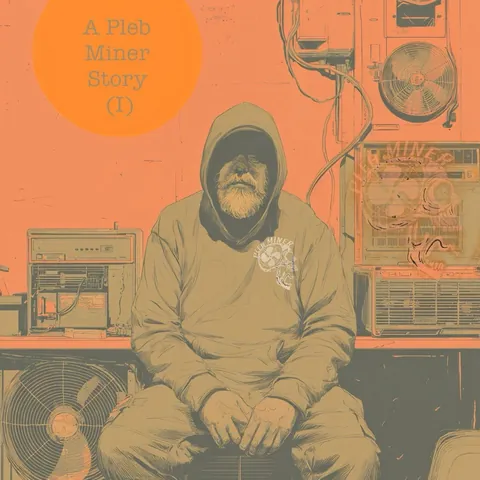
Mining bitcoin in the desert - Pleb Miner in the Wild - Desert Dave.
Discussed in this episode
Boost this Episode
Send sats directly to the creators. Value for Value.
Plus 1% to Podcast Index, 1% to Boost Bot.
Show Notes
Pleb Miner in the Wild
This episode’s Pleb Miner in the Wild is Dave of the Desert visit him on NOSTR @ DesertDave@nostrplebs.com
Dave and Jon talk about Dave’s solar setup and how to achieve a build like his in an economical fashion. Dave has created a video describing his setup.
Also, get your UNGOVERNABLE asses over to Fountain and BOOST THE SHOW!
Thanks for listening.
Bitcoin is close to becoming worthless.
Let's go!
Now, what's the Bitcoin? Bitcoin's like rat poison. Yeah. Oh. The greatest scam in history. Let's get it. Bitcoin will go to fucking zero.
Yeah.
Yeah.
All right, you ungovernable misfits. I'm your host, Max. Everybody knows that Bitcoin is useless, worthless, and doomed to fail. But what if everyone's wrong? What if it's the system that is doomed to fail?
Join me as I speak to some of the brightest people in the space and slither to the deepest, darkest depths of the Bitcoin rabbit hole.
This episode is our pleb minor in the wild, and for anyone who is thinking of doing some off-grid mining, this is well worth a listen. I want to say a quick thank you to everyone who's been boosting on Fountain and from everywhere else, we were number two on Fountain this month, which is fucking awesome.
So thank you so much to everyone. Thank you for all the messages. We really do appreciate it. I've done a couple less episodes than I usually would, so I just want to say thank you quickly to my normal show sponsors.
And I'm going to do this in under 60 seconds. I'm starting a timer now. Sx6.store. So, here we go, Bitcoin's in marine grade 3.1.6. L stainless steel. What does that mean? It means it won't melt or degrade once you've stamped your seeds into the steel.
If there's a fire, if there's a flood, they do not go missing. That's what you want. So go to Sx6.store. You can get these things from £24.99. If you're in the UK, you get even better with the shipping.
And they have other bits on there as well, so check it out, Sx6.store. Foundation device is next. Take ownership of your Bitcoin, self custody, as we all know, is very, very important. It's fucking easy with a passport.
I can do it, meaning you can do it. It's fully open source. It's beautifully designed, and it is so simple to use. From £199, it is an absolute no-brainer. Go to foundation devices.com. Oh, no, no, no, no, no, no, no, no, no, no, no, no, no, no, no, no.
Right, fast Bitcoins. Fast Bitcoins is an exchange. They tell everyone not to use an exchange, but they still pay me because they're just fucking good blokes. They want their show to succeed, and I want them to succeed for anyone who actually wants their KYC Bitcoin.
These are the people to go to. They will do everything that they can to keep you safe, but you will still be giving over your details. So there is still a chance, and there still is a risk that someone is going to fuck you over or fuck you up.
So, I suggest not using KYC services, but I really do appreciate fast Bitcoins supporting the show, and if you are going to go somewhere, go there. And we're done. Today, we have the privilege of observing the elusive and often misunderstood player might.
If you listen closely, you will hear the unmistakable sound of its mating call. To others, the sound is offensive, but to the pleb. It's a rousing beyond measure. These creatures survive by scouring the Earth for energy and scavenging hashrate from others whose over exuberance costs them dearly.
The pleb minor may not be at the top of the food chain, but make no mistake, its ingenuity, scrappy nature, and unquenchable thirst for sounds, make it a force to be reckoned with. This month's pleb minor in the wild is desert Dave.
Dave is a desert dweller currently working towards off-grid sovereignty. He is an electrician by trade, formerly running an electrical contracting company. He now puts that knowledge to use in his off-grid solar mining setup.
Dave is here to tell the tale of a sun-baked Bitcoin prospector, the story of a man unplugging from the grid and plugging into the sun. David, welcome to pleb minor in the wild. Hey, how's it going? It's going well.
Dave, a mutual friend of ours hooked us up to talk. You are an electrician by trade, but you now live in the desert and are building a homestead. I just want to know what awakened inside you to inspire you to pick up stakes and move your family into the desert and pursue this homesteading lifestyle that you have there.
It came in a couple of stages about six years ago. I kind of had this, I don't know, it was an awakening to me, whatever that means. I think that can mean a lot of different things. But for me, my reality shifted and through a kind of intense experience with the plant medicine ceremony, it really shook up everything that I believed in.
I suddenly started questioning everything, questioning my reality, kind of questioning my path. Realizing that I felt like I was stuck on this path and I was going to just be there for the rest of my life and then die.
So I had to step away from work and do a little bit of soul searching, spend some time alone out in the desert. Then I kind of sold my house, moved to Marana, and that was like when I happened in stages, because even there, I found that I was still wrapped up in the system more than I wanted to be.
I wanted more freedom still. You got to walk before you can run kind of deal. Yeah, yeah, it was a step on the along the way, but I got there and I'm just like, I'm never going to be able to put all these panels here.
I couldn't really see my full vision. I was still paying bills and I still had a bank account and had an ad. I was just still pretty tied in. So, yeah, and now on this next step, we're really out here in it.
Completely off the grid, pretty inaccessible, pretty isolated, and yeah. I'm enjoying it. It's very healing. Let's talk about that plant medicine ceremony just for a second. Max has had guests on the bit by bit pod.
One of them was Jay Arnold at Reclaim Mind on Twitter, and he does a lot of ayahuasca journey, self-exploration type stuff. He's in Australia. Was it ayahuasca? Yeah, that was the first, you know, I've used psychedelics in the past, but this was the first time I ever went to a ceremonial space with ritual and with intention.
Yeah, I started with ayahuasca and since then I've kind of done more work with other medicines, and it's kind of become a bigger part of what I do, but that's where it started. And when I first got there, I left thinking like, "What the hell is going on with these people you're out of your mind?"
I did not think it was the place for me, and it turns out after some time, it's kind of a big part of my life now. I'm involved with the church and it's like, it's been hugely beneficial.
It's been a fantastic tool for me. It's not for everyone, but for a lot of people, I've seen it, you know, seen a lot of miracles, it's been pretty healing for a lot of people I've come across.
Yeah, that's not typical of something I'm interested in, but I appreciate people who've gone on that journey, you know, like Jay has, and another member of the Mechdel, psilocybin Citadel, Decrim Nature.
She's trying to build something up in the Pacific Northwest to help people go on those journeys and get into psychedelics. So your mind was opened by an ayahuasca journey, and you realized that you needed to unplug.
So you do this in steps. What step are you at now? What is your homestead look like? Well, honestly, I'm looking to shift in a way that I wasn't really expecting, and that it looks like I might be splitting my time between here and another spot, because I, you know, as much as I love building out here and kind of like proving
I can do it and like showing people what's possible and just kind of, it's pretty rough, you know, and it's hard to grow a garden here. And so there are certain areas where we're like, we want to get property a little further south in Arizona, where there's a river nearby and there's a lot of greenery.
And then I want to be able to kind of like go between the spaces, because this is a beautiful place to serve the medicines that my wife and I serve, Bufo and Cambo. And then this other place would be a place where I can like make retreats happen.
There's already like infrastructure in place and they have a well, and it's still small town, very isolated, but kind of looking to strike a balance. Like I've been in this kind of like very isolated place, and I'm excited to at least explore the idea of kind of like splitting time between that,
because I am kind of a hermit, but I also find that I want to connect with people because I like sharing ideas and, you know, I think there's a lot of things to be built, and I want to work on that, which involves other people.
Right, you're working with the meshedodel concept within your own network there. You're distributing your citadel amongst the different nodes. Yeah, the node you're currently at, you are mining on solar, which I think is a powerful sovereignty tool to be able to capture and harness that much electricity and use it.
So can you tell us about your current solar setup and what you're running off of? This is plebminor in the wild, so tell us a little bit about your mining operations. Yeah, so it's, I would say it's about as basic as you can get for an off-grid setup.
I kept it really minimal. I'm using used solar panels from Santan Solar in Phoenix here. They have another location. I don't remember where it is, but definitely check them out. I really, you know, they've been great to work with.
I've never had a bad panel with them. Purchased 124 panels plus from them, and they've all been good. And they're like 35 bucks a piece, you know, and that price isn't always the same, but you can get them as cheap as that at times.
And so starting with the panels, I got a lot of those. And then they're just set up with simple like wood framing. So that was really inexpensive. Just, you know, two by fours from Home Depot for like three, four bucks.
And then everything else came from Amazon, inverters, batteries, battery cables, solar crimps, little devices to keep the packs evenly charged. And I'm putting out a video also that kind of walks through it.
And there's a list in there in the description of all these different parts. It's a very basic, you know, just kind of introduction, but I'm happy to go into depth. But it's like four kind of like little micro grids, which is pretty sweet, because I have four separate packs.
I have four separate inverters. So if one has an issue, it's very easy to just like manipulate things. And I can turn on and turn off miners as need be, depending on how much sunlight I'm getting, and how much AC we need, or if we're needing water heaters, whatever we need,
we need our needs first, and then whatever way of extra we can mine with. Which in my case, I'm able to run five or six S19 miners off of, I got about 24,000 watts of solar. And it's like on a micro scale, what's possible, like with our energy grid, like our energy grid super inefficient.
If we had like smaller grids, and then we had miners that were locally right there, and we weren't trying to send power like over these long lines, energy would be way different. Right, just getting a little bit more upstream than downstream.
Your setup is, you said 24 kilowatts. Yeah, roughly. All right, I just want to give everybody a little bit of understanding as to how much that is, that's quite a bit. So thinking of some typical home electrical devices, like in air conditioners, probably what 500 to a thousand watts.
Yeah, let's see here. An AC might be like 10,000 watts or something, like a big AC unit. Okay, I was just thinking like a window unit. Yeah, like little window units could be as little as a thousand watts.
So with the power we have, we can run multiple small water heaters, multiple small air conditioners. We make more power than you would use on a typical household. We could run a big AC and everything, but since I'm running the miners, they use up 90% of it because I can easily, I could overload my system if I overclocked the miners.
They like the power, but yeah, we can easily run, you know, an equivalent of what you'd run in an entire house. And then we have a battery backup that's like, it's okay. It's like we can run AC into the night for a while, but it's not like, it's not sufficient to have like, it's not like a lithium ion, Elon Musk, you know, $50,000 pack.
So it works for us, but it does require a little bit of balance. But that was kind of the focus of the system, was to mainly have enough to run the miners and then be able to get us through the days and we get our needs met.
So let's back up a little bit and go over the components of a solar system. So yeah, you got the panels, of course, the panels wire up in a series, run to a breaker, which just protects the wiring, runs through the wires.
Then I got like splitters to bring a couple, you know, a few arrays together, it splits off, branches off to those different arrays. And then those come into another breaker. And the breakers are there to protect your wiring again.
And in case someone were to trip on the wires or cut them or whatever. And then that runs into this all-in-one inverter unit. The ones I have are their power mister brand. There's lots of them out there and they do everything.
They can accept utility power generator backup. They'll charge batteries. They're an inverter and they're a solar charge controller. So it's just everything in one box. So you hook your batteries to it, you hook your loads up to it, your 120 loads or whatever, the miners, whatever you're controlling.
And yeah, everything just plugs into that one unit. So it's very centralized. It's super simple. I used to install solar like, you know, at people's houses, you know, stuff that was quite a bit older and more complicated.
And because it was on the grid and it had a permit yet of all this extra stupid crap that's not necessary. And it just was like so expensive and complicated. And this is so easy. One box hooks it all together.
And then I have like smart outlets and some fans and stuff that I'm able to toggle remotely. I can turn my miners on remotely and stuff. And if I put the work into it, I have it all in timers and you could have it, you know, coordinated with the weather and stuff.
It's pretty cool. I got a home automation thing running on a Raspberry Pi. And that's also got my Bitcoin node and all that lightning wallets. Yeah, got the full Bitcoin thing happening right here.
Do you use batteries very much or you're just doing on demand kind of stuff? I mean, in terms of mining, it's mostly on demand. The batteries are really there just as a buffer. If there's a little bit of cloud cover.
And then the batteries do give us enough capacity to run our ACs for a few hours while it's cooling down. Since we're out in the desert, it actually does cool down out here. It's not like in the middle of Phoenix where it just is 100 degrees all night.
So as long as we get a few hours with the battery with ACs and then we have enough to run fans 24/7 or whatever. So we've been surviving. It's not too bad. It's, you know, hang out in AC for some hours during the day.
And then yeah, so we could have more batteries. It would be nice to have more batteries, but you know, it works. It's interesting to see the difference between somebody that lives in the desert and someone that lives in a cold climate.
Because cold climate miners, obviously your solar is not going to do as well because lack of sun, like what I'm looking at right now outside, it's pretty cloudy. And where I live, it's often cloudy.
So I don't think my payoff for solar is that great, but I can do more heat capture things. What do you see for applications of the heat for the miners there? You can get an ROI a little bit quicker if you're using the miners for other things.
So do you have any heat capture plans? Even though you live in a desert and it's hot most of the year? Yeah, it hasn't felt like it would really apply here yet because, you know, I don't want to spend more on batteries.
And the only time I would want to use that power is at night. Well, yeah, I can't store that in a battery anyways. So yeah, I would need more batteries to run them later in order to run them when it would be relevant to have heat.
But I imagine, you know, there's got to be all types of ways to capture energy, you know, and I like to try to think outside of the box and think like, what's the way to capture heat, you know, like, I'm sure there's ways that have been done.
But like, I think it's an important thing right now to kind of think for ourselves and remember everything hasn't been done under the sun. And definitely open to, you know, I always want to capture all the energy I can.
That's one of the biggest things out here. It's really a lifestyle, you know, it's like every time I wash dishes, it's like, how can I use less water than I use last time? How can we reuse or this water?
We use water many times, you know, we can capture it. Use it for one thing and then filter it, use it for another thing, and then let it run down to it, you know, a pond or so. There's a lot of ways to capture energy and I'm definitely always thinking that way, but I haven't thought of anything for the heat here yet.
Right now it's just getting blasted outside, you know. That's so necessary for homesteaders and permaculture folks. I just spent a few days with Rev Hodl at his farm and just to see all the things that he reuses.
And everything is part of the life cycle there on that farm. So of course, heat reuse is important to him. He lives in Michigan. He's got his dryer hooked up to a miner. He dehydrates all kinds of different things with his miners.
So I thought about the heat applications in the desert. They're hydrating, you can always do that. We were at an event, the Lake Satoshi Beach retreat, and he had a whole big setup that he brought to show off his miner dehydrator.
And we were drinking a number of ciders with different dehydrated elements in them. When I was like white clover flower, that he dehydrated with the miner. So it's exciting to see those type of applications.
It's quite necessary at a small scale to be able to use that stuff. I mean, that's a great idea. The biggest heat capture thing that I've ever thought of is just storing it all in water and then using the water and taking the heat off of the water in other places, because it's easy to deliver.
Yeah, that makes sense. Yeah, I definitely always want to be thinking that way. I like the dehydrator option. My wife and I, we haven't worked a regular job in a while. And we always figure out a way to make it work.
But it's not like the mining we do is like, it's just savings for later. It doesn't generate a lot right now. But I'm a die harder for life. So to me, it doesn't matter. I just know I'm prepared for the future.
But we're looking for other ways to kind of share our arts and crafts. And she's so good with foods and stuff. And I'm going to tell her about the dehydrator idea. Because I think it's important to also be self sustainable with your food.
And hopefully we'll be in a position soon to be able to have a really large garden or some kind of little community farm thing going on down here. And yeah, and to be able to be a great use of, you know, with some fruits or whatever to dehydrate.
And that's a pretty cool idea. I think the novelty of it is a draw as well. A little bit of marketing to say that you dehydrated it with a Bitcoin miner. Yeah, it's cool. All of it feels so magical to me.
I mean, to me, it's the magical internet money. And I'm using magical sunlight to print it out of nothing. And it goes to my private key wallet that, you know, it's just so magical. I love technology.
I live simply, but I'm actually still a technologist too, you know. We have like a media server and a photo server. And I do all my own cloud shit. Like we can have, we can still have those nice cities without giving everything over to the, to the big boys, the, you know.
Sure, you can live simply, but you don't have to go back in time in order to do it. Yeah, it just takes a little more work. And we have to take responsibility for stuff. And that's a big part of our expansion that we're going through right now and consciousness and society, whatever, however you want to look at it.
It's like we got to learn to take responsibility back, which means kind of, you know, how do I take care of myself? Can I secure my own money? You know, am I okay without somebody holding my hand?
It's challenging though, we're conditioned. So you brought up a good point that you need to secure your own money and blowing it on expensive solar builds is not the best way to do that. In the video that you've made, you call it a, what a dirt cheap solar build.
So can you tell me why your build is dirt cheap? Why it's simpler than a, than a more expensive build? And what can plebs do to design their solar builds in the same way? Yeah, so I'm going to put out this little overview video, but I'm happy to do more in depth stuff and point people in a direction.
I like communicating online and connecting and answering questions or whatever. But you know, the panels are huge, right? So cheap property, you know, you need good sunlight to start with.
So, you know, a place with sunlight and cheap property, which I got, you know, I don't know, you know, an acre out here for a few thousand dollars is pretty cheap. I'm sure there's cheaper land somewhere, but that seems pretty low to me.
And then, you know, the panels are a huge deal because typical solar panels are three, four hundred dollars. So I'm buying them for like one tenth of the price, and maybe they only have two thirds of the output, but that's still a way better return.
So that's a huge savings. And then like, you know, I'm not afraid to get cheap shit off of Amazon. That's probably Chinese, but it works fine. You know, it's like, if it's got good reviews and people have used it and it's tried and tested, it's good enough for me.
You know, you can spend as much as you want on a solar charge controller and an inverter. You know, you could get the most expensive ones and spend two grand, or you can get it all in one unit for five, six hundred bucks.
So I just believe I put in the time to kind of like think from scratch, and scour the internet and figure out what was the most cost effective way. So I just feel like it would be hard to build something cheaper.
Unless you're building your own batteries and stuff, people do that. You can recycle batteries, take out the bad cells. I just never really wanted to get into that much detail. So you could even do it cheaper.
They maybe have better quality batteries. Mine are lithium iron phosphate, which is pretty good. It's not as good as like lithium ion, but it's a good middle ground between like old school batteries and the super advanced ones that you get pretty good storage with them.
They last, well, you get like like five, six thousand cycles or something. So yeah, just finding that point where it's like, you know, the optimal money back for what you're investing in, and I don't know exactly what my system cost.
It might have been around $20,000, but with battery backup and the size of it, it's really cheap. Like if you had a system like this on your house and you paid someone to install it, it probably cost $100,000. So it doesn't seem super cheap, but I'm also making a ton of power.
You could easily live off grid for a quarter of this power. It's only because I'm mining Bitcoin that I have so much of this. We only use about a fifth of this for our actual usage. It can really be at any scale.
And so if you want a little small system to just kind of be sustainable for a couple trailers and an AC or two, you could get by with a system that probably costs five or six grand. So pretty reasonable.
Will you be able to provide a parts list or a shopping list for everybody out there that wants to replicate what you have? Yeah, I'm definitely going to be sharing the parts that I specifically bought, like links on the videos, and I can share them anywhere.
So I'm happy to share all that. I didn't like put prices on there, but it's just, you know, it's the most inexpensive stuff I could find. They're always fluctuating. Yeah, yeah, stuff changes, but, you know, not completely.
And it's all, you know, Amazon's nice and easy. I don't like Amazon. I'd love to be without it. But, you know, for the time being, I use the tools available to me, like a TikTok. I just got a TikTok and I'm like, I swore it off.
I said it's evil, but I've been getting so many people telling me, oh, if you want to, so my plan is to go on there and do a little content, but I'm never going to consume anything because it's just not entertaining to me.
All I needed was an email to sign up. So I'm like, okay, whatever. I'll try it. We'll see.
Well, scary. Everybody wants to head over to David's TikTok. It's Desert Dave 44. The video will be posted on Odyssey. And that is Life Is But A Dream. Desert Dave's Noster is Desert Dave at Noster Plebs.
We'll also be hosting the video on Ungovable Misfits YouTube page and probably up on the Ungovable Misfits homepage. So you can view David's content there and find out how to build a dirt cheap solar setup.
If you like Dave's stuff and appreciate it, maybe give him some zaps on Noster. It would probably be the most plevy way to do it, don't you think Dave? No, that's the best way. But we're so early, but it's good to be early.
It's kind of fun to be an early adopter. I feel like I get to, eventually I'll get to be one of the OGs in these spaces. You could be an O-G-noster. Yeah, yeah, I'm excited about it. I know it's weird, new, and glitchy, and whatever.
But I'm big on the freedom tech stuff and I'm an optimist. I think stuff's going to get better. If we can have the self-awareness to make better decisions for ourselves, I think there's going to be a lot of tools out there for people to be free and share freely, you know?
That's exciting to me. And just not holding all that information to yourself, get it out there so people can replicate what you do, because we're all in this fight together. For sure, yeah, it feels good to give something away.
And yeah, and I'll be sharing a lot of stuff. You know, I'm big into the plant medicine space and just kind of, because to me it all kind of all goes together. It's all about self-awareness.
And yeah, I'm just always kind of looking to understand myself better and share my lessons along the way, whatever those look like. And those who are wanting to hear it might listen, and that's okay.
There are a lot of people that's not for it, but that's cool. Well, we listened and we appreciate you sharing your knowledge and experiences and information with us. Thanks for being this episode's plebminer in the wild, and I want to send a thank you out to our mutual friend for setting up this relationship.
It's exciting when all these different nodes get together and you know a friend of a friend, so you know who you are. Appreciate you setting up the relationship. All right, David, thanks so much for being on the show.
Yeah, thanks you. I appreciate it. Bye bye. Bye.
Machine transcript; expect the odd mishearing. Click a passage to play from there.