Pleb Miner Redux – What is a Bitcoin Miner?
Discussed in this episode
Boost this Episode
Send sats directly to the creators. Value for Value.
Plus 1% to Podcast Index, 1% to Boost Bot.
Show Notes
Pleb Miner Redux – What is a Bitcoin Miner.
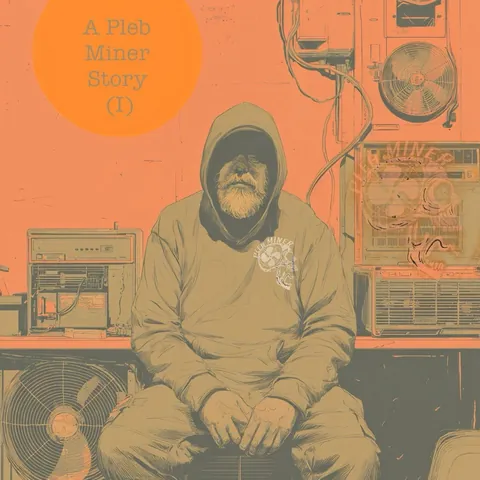
The month of September is dedicated to pleb miners who will not unplug nor comply. The backbone of the bitcoin network, dedicated to decentralisation and freedom.
To kick things off @JonPDiGiacomo explains - what is a pleb miner……
“Who and What is a Pleb Miner”
The original Bitcoin miner, Satoshi Nakamoto mined the Genesis Block with a reward of 50 Bitcoin, Bitcoin that can’t be spent as the Genesis Block is hardcoded into new nodes as the root of the blockchain. The signature of his mining was later analyzed by Sergio Lerner. He dubbed Satoshi’s miner as Patoshi and its signature as the “Patoshi Pattern”. The technique that Lerner used determined that Patoshi hashed a different set range of nonces. This behavior created a unique saw pattern in nonce data analysis. It’s estimated that he had up to 48 CPUs mining with another controlling the operation and/or on standby to protect against a 51% attack. Satoshi mined solo until he invited Hal Finney and Martti Malmi to join the network. Famously on January 10, 2009, at 10:33 PM, Hal Finney was “Runnin’ Bitcoin”. Soon others joined in.
It’s fascinating to look back at those first blocks: difficulty of 1, block reward 50 BTC, the delicate balance of the 10-minute mark not quite there yet. In reviewing this short Bitcoin history lesson, we bring light to the fact that Satoshi wasn’t running a giant mining operation with a cool name, a board with multiple investors, and billions in capital expenditures. He was possibly a guy in his basement or garage that he considered his lab. He shared the code with associates he knew online. Their goal was to discover blocks and secure the network. He mined because he was passionate about the innovation that he built. He was the original miner, he was a Pleb Miner. Sometime in May of 2010, Satoshi turned off the Patoshi miner, confident that he had passed the torch on to the next generation of miners……..
Link to full article bellow.
Link to article - https://ungovernablemisfits.com/pleb-miner-redux-what-is-a-bitcoin-miner/
Show guest
twitter - @JonPDiGiacomo
twitter - @MaxBitbuybit
twitter - @bitbuybitpod
Website - https://ungovernablemisfits.com
As always please feel free to reach out and ask me any questions.
Today you can exchange $1 for 5021 Sats (Sale ends soon.)
Thank you Foundation Devices for sponsoring the show. Use code BITBUYBIT at check out for $10 off your purchase
Bitcoin is close to becoming worthless.
Let's go!
Now, what's the Bitcoin? Bitcoin's like rat poison. Yeah. Oh. The greatest scam in history. Let's get it. Bitcoin will go to fucking zero.
Alright, you ungovernable misfits. I'm your host, Max. Everybody knows that Bitcoin is useless, worthless, and doomed to fail. But what if everyone's wrong? What if it's the system that is doomed to fail?
Join me as I speak to some of the brightest people in the space and slither to the deepest, darkest depths of the Bitcoin rabbit hole.
Welcome to day one of Plebminer Month. To kick things off, we have John narrating his article, "What is a Plebminer?" Enjoy. Who and what is a Plebminer? The original Bitcoin miner, Satoshi Nakamoto, mined the Genesis block with a reward of 50 Bitcoin, Bitcoin that can't be spent as the Genesis block
is hard-coded into new nodes as the root of the blockchain. The signature of his mining was later analyzed by Sergio Lerner. He dubbed Satoshi's miner as Potoshi, and its signature as the Potoshi pattern.
The technique Lerner used determined Potoshi has to different set range of nonsense. This behavior created a unique saw pattern in non-stata analysis. It's estimated that he had up to 48 CPUs mining with another controlling the operation and/or on standby to protect against a 51% attack.
Satoshi mined solo until he invited Hal Finney in Marty Malmi to join the network. Famously, on January 10th, 2009, at 10.33 PM, Hal Finney was running Bitcoin. Soon, others joined in. It's fascinating to look back at those first blocks.
Difficulty of one, block reward of 50, the delicate balance of the 10-minute mark not quite there yet. In reviewing this short Bitcoin history lesson, we bring to light the fact that Satoshi wasn't running a giant mining operation with a cool name, aboard with multiple investors and billions in capital expenditures.
He was possibly a guy in his basement, a garage that he considered his lab. He shared the code with associates he knew online. Their goal was to discover blocks and secure the network. He mined because he was passionate about the innovation that he built.
He was the original miner. He was a pleb miner. Sometime in May of 2010, Satoshi turned off the Satoshi miner, confident that he had passed a torch onto the next generation of miners. In all time high, block height later, Bitcoin is still running.
Much of the hash rate on the network is coordinated through large mining pools, like F2 and pool and Foundry's pool. Companies like Core Scientific and Marathon control a commanding amount of the Bitcoin network's hash rate.
But 30% of all blocks ever discovered are labeled as Found by Unknown. And 20% of all blocks categorized as others. There's something beautifully mysterious about the fact that almost 364,000 blocks, approximately half of all blocks discovered throughout the time chain, have been discovered by anonymous miners.
That fact conveys the sentiment that not all the hash rate is controlled by pools or large mining operations and that individuals have had an enormous contribution to the network, individuals like pleb miners.
Everyone has their own definition of a Bitcoin pleb. It's not defined by the amount of time you've been in Bitcoin, the number of sats in your stack, or how many followers you have on Twitter.
The same can be said of a pleb miner. Pleb miner is not defined by your total hash rate. How many watts are required to run your operations or the complexity of your setup? The title is not something that someone bestows upon you or issues you are right of passage.
So then the ultimate question then begs us for an answer. Who and what is a pleb miner? A pleb miner is simply a Bitcoin pleb who mines Bitcoin. A pleb miner is dedicated to the Bitcoin network, contributing their hash not only for the chance at finding the next block and receiving the block subsidy
and transaction fees, or helping as pool find the next block for a share of the reward, but hashing because they know in their hearts that securing this network is a moral imperative. They might because Bitcoin is a chance for humanity to restore sovereignty to the individual, to the family.
They heed the clarion call that sound money leads to freedom. They mind knowing that for Bitcoin to be decentralized, they must be the ones to do it. Their motivations aren't to gain more fiat currency.
Their motivations are to stack more sats, and in doing so, they innovate, collaborate with other plebs and share their mistakes as well as their triumphs. They spend time on chats offering advice to new pleb miners, as well as learning even from the newest in our ranks.
They make guides, videos, and how-tos. They share pictures of their setups, not only to share in their innovations and to be critiqued, but because they are proud of their work as they should be.
Proof of work is not just a motto for the pleb miner. It's a way of life. Pleb miners come from all backgrounds, locales, and experiences. They bring various skill sets and craft. To be a successful pleb miner, you quickly learn many trades.
Mining encompasses several science and mathematical concepts, basic physics, electricity, thermodynamics, acoustics, and cryptography. Pleb miners quickly become proficient if not master skilled trades.
Electrician, IT, telecom, HVAC, plumbing, welding, carpentry, and more. The pleb miner knows that mining is much more than plugging in machines. This month, on the bit-by-bit pod and ungovernable misfits, is dedicated to you, the pleb miner, the stalwart that defends the network,
the unsung anti-heroes of Bitcoin, no influencers, no think-boys, just plebs plugging in machines and hashing. The same way Satoshi and Hal did, thousands of blocks ago. In this way, we answer the question of who and what is a pleb miner?
A pleb miner is you, and you are all Satoshi. Thanks for listening. Make sure to check out ungovernable misfits.com. We'll be hosting this article with many others. Extra audio, prizes, and everything else we'll be doing for the month.
If you are supporting this month with Podcasting 2.0, I want to say thank you. All of those sats will go to postage to get these incredible prizes out. Catch you on the next one.
Machine transcript; expect the odd mishearing. Click a passage to play from there.