
Bitcoin fucks a chain spy in the park.
Discussed in this episode
Boost this Episode
Send sats directly to the creators. Value for Value.
Plus 1% to Podcast Index, 1% to Boost Bot.
Show Notes
Bitcoin fucks a chain spy in the park.
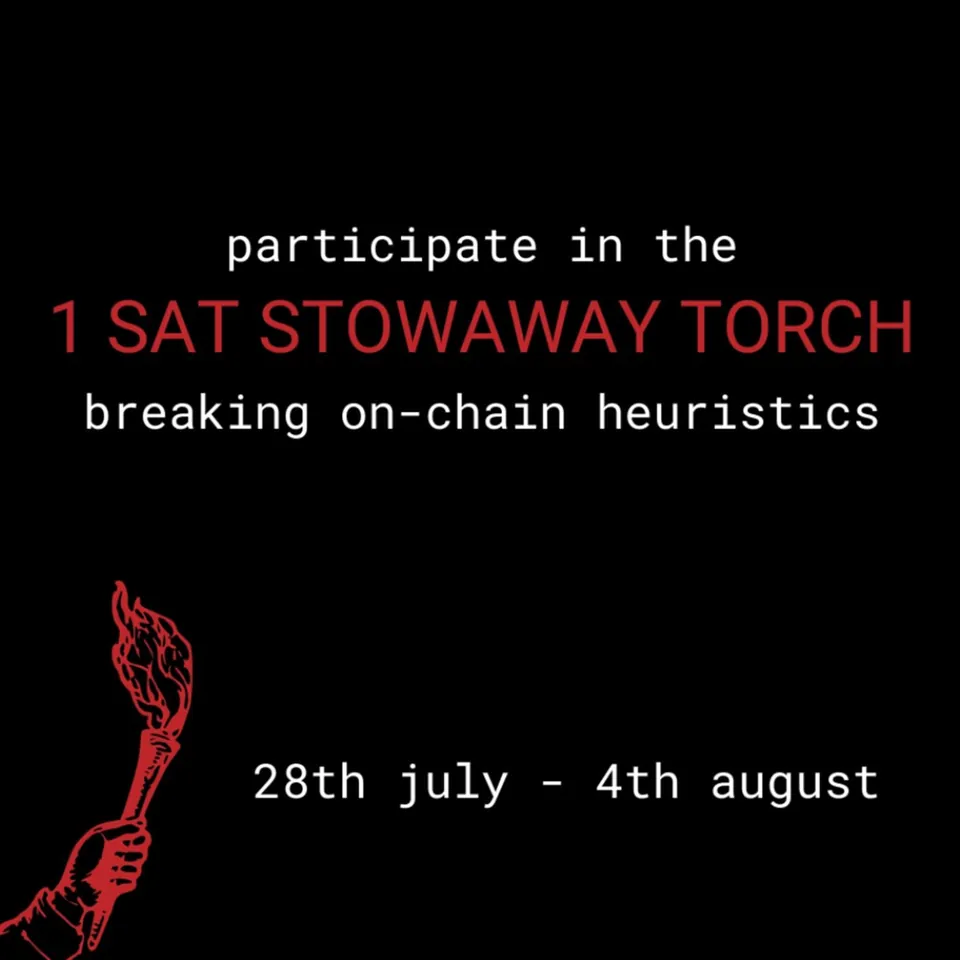
In this episode I met up with Brother Rabbit to discus the 1 sat stowaway torch him and samourai are running to help break on-chain heuristics.
Stowaway is a form of peer-to-peer payjoin developed by Samourai Wallet where one party pays another, obscuring the transferred amount, breaking on-chain heuristics, with no server required to be run by the sending or receiving party.
You can send and receive a Stowaway in Samourai Wallet and Sparrow Wallet. For the transaction, both parties participating provide input(s) into the transaction, and both parties receive an output. The transaction can either be carried out manually between the two parties in-person (doing the "QR code shuffle"), or remotely by quickly and automatically exchanging data between the two parties using Soroban; an app agnostic Tor based communications layer developed by Samourai Wallet.
As the name "Stowaway" suggests it works to obscure the amount being sent from one person to another.
By using inputs into the transaction from both parties this breaks the "common-input ownership heuristic" applied by chain analysis firms in an attempt to trace flow of funds. Common-input ownership heuristic; assumption that all inputs to a transaction are owned by the same entity/person.
Stowaway's are not easily detectable on the bitcoin blockchain. The very fact that Stowaways exist on the blockchain adds doubt to all other transactions which have multiple inputs and two outputs (i.e. a simple spend).
How to send/receive a Stowaway in Samourai Wallet
Writen guide: https://docs.samourai.io/wallet/cahoots#stowaway
Tutorial video: https://youtu.be/C8YZI1bY1P4 or https://inv.pistasjis.net/watch?v=C8YZI1bY1P4
Short bitcoin privacy series:
https://youtube.com/playlist?list=PLIBmWVGQhizLrPjpFMN5bQdbOZRxCQXUg
or
https://inv.pistasjis.net/playlist?list=PLIBmWVGQhizLrPjpFMN5bQdbOZRxCQXUg
Show Host: Max
https://twitter.com/MaxBitbuybit
Guest - @BrotherRabbit_
Ungovernable Misfits Socials
https://www.ungovernablemisfits.com
https://twitter.com/ungovernablemf
Show Sponsor - Foundation Devices
Foundation builds Bitcoin-centric tools that empower you to reclaim your digital sovereignty. As a sovereign computing company, Foundation is the antithesis of today’s tech conglomerates. Returning to cypherpunk principles, they build open source technology that “can’t be evil,”
Thank you Foundation Devices for sponsoring the show. Use code BITBUYBIT at check out for $10 off your purchase.
Show Sponsor: sx6.store
SECURE YOUR BITCOIN IN MARINE GRADE, 316L STAINLESS STEEL!
As always please feel free to reach out and ask me any questions.
Bitcoin is close to becoming worthless.
Now what's the Bitcoin? Bitcoin's like rat poison. Oh. The greatest scam in history. Let's get it. Bitcoin will go to fucking zero.
Alright, you ungovernable misfits. I'm your host, Max. Everybody knows that Bitcoin is useless, worthless, and doomed to fail. But what if everyone's wrong? What if it's the system that is doomed to fail?
Join me as I speak to some of the brightest people in the space, and slither to the deepest, darkest depths of the Bitcoin rabbit hole.
Welcome back. I'm gonna make this one quick. I rushed this episode out. I edited as fast as I could and pushed all the other work to the side so I could get this to you. I wanted to get this episode out because Brother Rabbit and Samurai are running a one-satt, stowaway torch.
The five participants picked at random who enter are gonna get their own personalized pain in, and I think this is really cool. It was an absolute pleasure meeting up with Brother Rabbit.
As always, we had a couple of beers and then headed to the park to record. The audio quality isn't the best. I've done everything that I possibly could to make it listenable, and I think it is now.
And this one is well worth a listen. If you care about your privacy and you think it'd be cool to have your own pain in, then this is an episode for you. Make sure you give it a go. This runs until the 4th of August, so you will have one more full day to enter and hopefully win that personalized pain in.
And for anyone who isn't already following Brother Rabbit, I suggest you go and do that now. Before we start, I just want to say a big thank you to my sponsors. Let's start with my newest sponsor, SX6 Metal Bitcoin seed phrase backup plates.
Quite a mouthful, but very simple. You stamp your seed into steel. And you do this in case you had a fire or a flood or anything else that could fuck up those 12 or 24 words. You do not want to lose these.
You want to keep them safe and stamping them into steel is the best way you can do this. Black coffee is the man behind SX6, so I know these things are quality. I've held them in my hand.
I have felt them and they really are amazing. So if you're upgrading your setup or you still have your backup on paper, just do better. Go to SX6.store. You can use the code MAXBBB. That'll get you 10% off your order.
And you can reach out and ask me if you have any questions. But these are great and so is black coffee. Go and buy some. Next up is foundation devices. Foundation devices are making my favorite hardware.
Not only is it the most beautifully designed, but it is fully open source and they've just dropped the price to $199. These things really are simple to use. Any fuckwit can secure their SATs properly with one of these and they have an amazing team.
If you have any problems setting one of these up, you also have the option to have Bitcoin Q&A hold your hand through the process. But honestly, you're not going to need that. This is a cypherpunk tool for fuckwit.
Anyone can use it. Check them out at foundation devices.com. You can use the shield code BIT by BIT. And yeah, if you have any questions at all, you can reach out and ask me. They are a sponsor because I chased them because I think they are the best.
If you haven't already got one of these, maybe it's time to upgrade your security. Go to foundation devices.com. Last but not least, fast bitcoins. Fast bitcoins are actually, I think, sponsoring not just this show, but the Bitcoin beach retreat as well.
Fast bitcoins are a KYC exchange. So I do tell everyone if you can avoid it, avoid it. Go and buy in cash, go in mine. Go and buy off a friend, do it peer to peer. Then you're not going to be in the system, but I know not everyone is going to listen to that advice.
Or not all of you care. Some of you want to have some KYC SATs. If that is the case, you really need to make sure that you go to the best people possible. You want to make sure they do everything that they can to keep your data safe and to keep you secure.
Fast bitcoins do not want to hold your SATs. They push you to get your SATs off exchange. Once you've done that, you can go and get a passport. You can go and get one of these plates from SX6 and then you are fully self-sovereign.
If you are going to go and buy some Bitcoin and you're going to use an exchange, please go to FastBitcoins.com. I don't think I have a shill code, but you can just mention me and I'm sure they look after you.
Alright, on with the show. So this is not quite Bitcoin for the streets. It's Bitcoin for the park. Yeah, beers in the park. Cheers in the park, wow. Screaming kids behind. It's what we're doing today then.
What are you teaching me? Well, we met up today, didn't we? For a beer. Yeah. And at the moment on Twitter, I thought I'd organize something called the one SAT, still a way torch. Okay. So you've heard of pay joins, right?
We do. So Samurai has implemented into the software and the ability to do a pay join, which is a really great transaction for Bitcoin privacy. It's not something that's commonly known or it's certainly used, but the sort of the motive behind doing like a bit of a thing on Twitter
is to get people more involved with, you know, using the wallet, maybe using the tools or spending tools that they perhaps are not so familiar with. So that's why I sort of kicked off this one SAT stowaway torch.
So stowaway of the uninitiated is Samurai's implementation, their own implementation of pay join. Okay. So with an ordinary transaction, if you were just to sort of spend to a Bitcoin address, what tends to happen is that you merge a couple of UTXOs together in the input side of the transaction and on the output side of the transaction,
you tend to have the spend output and then the change output which comes back to you. Yeah. So the cool thing about a stowaway transaction, which is a pay join, is if I was to pay to you, rather than you give me a Bitcoin address and I just send some SATs to you in a sort of simple method,
instead I ask you to participate in the transaction, what that means is that we both work together to construct the transaction. Okay. And rather than just my inputs going into the transaction, even though you're receiving the amount that I want to send to you, you also provide some of your UTXOs into the transaction input.
I see. Okay. Yeah. So rather than being one or two UTXOs from just the sender, the receivers adding one into the mix. Yeah. Yeah. So we can do this in Samurai wallet. You could also do this in Sparrow and that's called a stowaway.
And maybe I'll describe in a bit why it's called a stowaway. But yeah, we work in communication, if you like, between our two wallets, to construct this transaction. And then on the output side of the transaction, you get your Bitcoin back that you provided into the input side of the transaction, plus the amount that I've sent to you.
Yeah. And I get my change back. Yeah. So what this type of transaction pay join does is it breaks some, it breaks common ownership heuristics. Yeah. Yeah. Yeah. Common professional, aren't I?
Yeah. Common input ownership heuristic. So this is a heuristic which you can interpret Bitcoin transactions in a certain way. Say if you see a transaction on the blockchain and it has one input a while, that tends to be interpreted as a self spend.
Yeah. But it doesn't mean, not to mean that it always is a self spend, but that's the sort of heuristic that is, you know, labeled against it. It's likely a self spend. And is that because there's no change?
Yeah. There's no change. So, you know, you might have sent, there's a single input, a single output. So they're spending the whole UTXO. So it sort of tends to be interpreted as well. That person or entity is probably just sending that to themselves.
Because it's unlikely that you have the exact size UTXO for the product. Yeah. But again, that's just, that is just an interpretation. Yes. Yeah. I mean, I, I send, sometimes it's also read that transaction.
One input, one output, sometimes it's referred to as a sweet, sweet spend. Right. But I do those spends all the time, but not to myself. You could say that, you know, that it's almost like there's a rule.
There's rules that are applied and the heuristics that I've lost generally. But yeah, so if you have good UTXO management, you would presumably have a range. You have a range of sized UTXO.
Yeah. So that actually, quite often, we would just do what they would class as a sweet. But it's actually a spend. Yeah. Yeah. You're not, you're not, you're not sort of sending it to yourself or transferring it from one Bitcoin wallet to another.
You might just be paying someone or paying a service. Yeah. I mean, some of like the gift voucher services, you can buy gift vouchers with Bitcoin. Rather, say if you wanted to buy a, I don't know, like an Uber gift card.
Or an Amazon gift card or something. Yeah. What you can do in that situation is, and we're going off a bit, but off topic here is if I want to send a single UTXO and don't want to send it to myself, I can send it to one of these gift card providers.
But I can top up my account balance from that provider. So rather than like just buy an Amazon gift card of like $50 and if I try to buy that directly, I might get some change back in that transaction.
Instead, I can just top up my gift card account. Yeah. Then I buy the, you spend that whole, you send the whole meeting. So you change. Yeah. Makes sense. So getting back to the, like, the page and the stowaway, it's a transaction that's organized between two parties and the receiver.
Even though they're ultimately going to receive some Bitcoin, they're helping the sender out and providing inputs into the transaction. And then both the sender and the receiver get outputs.
Yeah. But the cool thing about this transaction is on chain, it just looks like an ordinary spend. Right. It looks like often that there's been two inputs into the transaction, two outputs.
And when you look at it on the transaction, on the blockchain, you have, you have no idea that two people, two entities have constructed that transaction. Yeah. Provided an input each into that transaction.
Yeah. And received an output each. It just looks like an ordinary transaction where there's been two inputs and say two outputs. And you could sort of interpret that as, "Oh, well, one of the outputs must be the spend.
One of them must be the change." Yeah. But you have no idea that it's been constructed by two people.
And hence, it breaks this common input ownership characteristic, which usually tries to apply his sort of heuristics to the blockchain and interpret that any transaction that has one or more inputs means that those inputs belong to a single person or a single entity.
The person spending. Yeah. But we know for a pay join, that's not the case. So we're breaking that puristic. And then the other cool thing about a pay join is that because the receiver is providing inputs into the transaction.
When you look at the transaction on the blockchain, you can't. It's very difficult to tell the way in which the transaction is constructed, how much Bitcoin is actually being sent from party A to party B.
Right. So that's where the name Stowaway gets its name from. Okay. So this is like a really good method. If you're using samurai wallet or if you're using sparrow wallet, you can construct these transactions with either samurai to samurai, sparrow or samurai to sparrow.
Yeah. And you can pay a friend and, you know, on the blockchain, you can't. It's very difficult. Sometimes it's not nearly impossible to tell how much Bitcoin is transfer into one person to the other.
So if I was going to pay you back for a beer, we could create one of these transactions. Yeah. And so when you say it breaks the common ownership, heuristic, what you mean is it basically makes it so the chain analysis can be less and less sure because it's a guess in the first place.
Sure. But now it's saying we know these transactions that have two inputs that each input is owned by two different people. Yeah. We know it breaks the heuristic. Yeah. So the very fact that these pay join transactions exist on the blockchain.
We can also then say, well, what about all these other transactions that probably aren't pay joins, but we'll never know that we could be. And so it makes the reliability of their guesswork less and less.
Less and less. It's not scientific. Yeah. But then valid. One thing I always want is cool. Like, I'm not slagging off the method or anything. You know, a lot of this stuff is kind of like you have, but that's logical. You'd go, okay, it's not scientific. You can't be sure.
And therefore, you shouldn't be able to use this in a book of law or whatever they want to use it for. But sometimes if you're playing in their world often, if you're playing in their world, logic, as you've seen over the last few years, logic doesn't actually matter.
And so is it that, you know, say it comes up in a court case, they say, well, we think this was spent. And you say, well, it could be in a collaborative transaction. You know, you can't know that.
They might say, well, that's not how we say it. Yeah. Well, I mean, you've raised a really good point. I mean, you might be familiar with the last things stogan off, Roman stogan off, is it?
This case in the US where he's being, I guess, accused of running a service back in the day called Chip mixer. I think it is. Yeah. Like a custodial mixer. A custodial mixer. Yeah.
And they've arrested him and I'm trying to charge him under, I don't know exactly what the charges are, but no doubt it's probably to do with money transmitting licensing and being custodial, right?
And he's up against it in the sense of the people, well, inadvertent commerce, the evidence, some of the evidence that's being used to try and let's convict him is from chainalysis.
So, you know, they've written a chain. They've written these reports, I guess, and provided them to the court to say, you know, we can prove again, inadvertent commerce for us, but we can prove that he is the man because of this, this and this.
But what they do is very black box. They are not open with their methodology. Yeah. I mean, specifically about this, you know, about this case.
And did you hear Samurai wallet on one of the podcast speaking about this? So I think from what I heard on that podcast with Samurai wallet, the OST guys are trying to help out Romans defense team to have a look to see what's been put into the court conviction
sort of statements and trying to pick apart any sort of heuristics that have perhaps been used to convict Roman and then getting back to this sort of stowaway thing, you know, like, I mean, I don't know the ins and outs of exactly what examples they're trying to
convict Roman with, but, you know, going back to the stowaway thing. Well, let's just say, for example, chainalysis have provided some evidence to the court in Romans case that, oh, well, you can see this transaction here.
Perhaps this was Romans or perhaps this was so and so, or, you know, we can see this transaction here. The inputs to the transaction are owned by the same entity. And therefore, we can conclude that this input belongs to the same person as the next input into the transaction.
But what we know is that a pay join can be constructed by two. It can actually be constructed by two or more people. But in the case of the stowaway, it's two people. Pay join can be constructed by two people so that immediately breaks that assumption.
How do you know that that transaction, how can with any certainty beyond a reasonable doubt, can you prove that transaction on the blockchain hasn't been constructed by two people.
And if the legal system acted in a way is advertised, which is innocent until proven guilty, which it doesn't really, but if it did, then you'd be able to say, well, you can't prove this, you're guessing at this.
And therefore, we have to. And so I get your point. It's like, even if they are cut and they are cut and even if they do lie and they do weasel through things and they fuck around.
At the end of the day, the more people who use something like a stowaway or any type of pay join, the more it muddies the waters and the more it becomes common practice.
Yeah. And then so you can say, well, this is something that is done often enough that, you know, because if it was only ever done once, it'd be like, well, we still think that the likelihood is.
Yeah. It's not. But if it becomes more and more common practice, and it probably doesn't even have to be that much of a percentage to be. No, not at all. Just the very fact that we know that pay joins exist on the blockchain can cast out on all the other transactions.
That perhaps aren't pay joins, but we'll never know. So basically, the more we do, the less strong they become, oh, no, difficult. It becomes for them. Okay. So I'm paying you back for a beer.
Yeah. Which I'm not actually because was it din who said it'd give us a beer? Yes. Thank you, din. Appreciate it. It was very nice. So I'm actually not paying rabbit back for a beer, but let's say I was want to send you some sets. Obviously, the upside is like, I'm doing this collaborative transaction with you.
It makes things harder for the surveillance companies. What's the downsides? Are there any other than presumably just transactional costs?
These may be higher. Negligible. In terms of a stowaway transaction, the transaction fees aren't necessarily higher. You are using probably, you are using more inputs into the more inputs into the transaction.
So therefore, you know, the more inputs and the more out more inputs, more out that you have a transaction, the more expensive, the minifies are, but, you know, for the sake of paying a few more sats for your minor fees, you know, you're getting a direct return in terms of privacy.
Yes. So both the sender and receiver are gaining that on-chain privacy. I mean, any privacy personally, and you're also, if you care about Bitcoin, I'd like to think people who listen to this podcast specifically do care about Bitcoin, not just the number going up.
You care about the fact that this can actually be a money that you can use and can't be taken and can be spent, how you want and all the rest of it.
Then, you're not only protecting your own privacy and the person you're sending to, which was you and the friend or someone you know, or business, you know, but you're also making the whole Bitcoin ecosystem stronger.
And you're taking power away from these guns who are trying to put people in prison who shouldn't be there. Yeah, so in your part, and also it's beneficial to you as well. Like, not only is it beneficial to cast out other transactions on the blockchain, but, you know, you're getting a very good return.
In terms of the downside of a pay join, that there is perhaps a small downside. It can be mitigated, and it depends as well who you're doing the transaction with. So let me describe. So if you're sending to me, okay, and I'm reconstructing this pay join together, you're sending to me.
So I'm providing you with an input, one of my UTXOs is an input into the transaction. Okay. So you could look that transaction back, you know, back up on the blockchain. And you could go, oh, that's rabbit's input. So, you know, perhaps I provide you a large input, and you go, oh, shit, that's how much rabbit's got.
Yeah. Okay. And then there's outputs in the transaction. So you've one of the outputs is mine, one of the outputs is yours. You can then go, oh, I know that the first output was rabbits.
So I'm going to keep an eye on now, and see what happens with it, see if he spends it, see if he does some further merges with it. Yeah. Okay. So, I mean, we can, I'll come back to how we can, we, me and you could both mitigate the privacy considerations between the sender and receiver.
For a stowaway in particularly, and any sort of page on the sender and receiver should be conscious that because we're both sharing in that transaction, we're sharing UTXO information with each other.
Yeah. I'm telling you, here's an input of mine. Yeah. Use this to construct the transaction with one of your inputs. Yeah.
And then on the output side, I get an output, and you get an output. I mean, it's not this, I'm going to see that anyway. They're going to be more somewhat. If you send me from a large UTXO to pay for the bit, I can still see that and go, this cuts got loads of money.
You can get the next round. So, I mean, surely it's not that different. The alternative, I mean, look, it's, the alternatives are that right. If I'm paying you, I'm not doing a stowaway for a page on, and instead I say, "Oh, hey, Max, just send me a Bitcoin address. I'll pay you back for that beer."
Yeah. Okay. I send you, what's the cost of the beer these days? What's about? 15 quid? You know, I just send you a small amount of Bitcoin to that address. Okay. You've not provided any input into that transaction. It's not a page on.
And then it's up to you in the future, then, to go, "Okay, I've received this small amount of Bitcoin for the beer from rabbit. I made a label to that. I made a label to that transaction."
So, you are right. When you're transacting, you should still be labeling. I'm just sort of saying, like, in a stowaway and a pay join. You know, you have to be conscious about, and I'm maybe getting into the weeds here because this is the sort of things that I think you should...
I don't know. The whole thing needs to be aware of. But just, you know, considering it is maybe important. But, you know, between the sender and the receiver, you're not really gaining, you know, that the sender isn't gaining any sort of privacy from the receiver.
As such, the receiver isn't really gaining much privacy from the sender. But what the two parties are both gaining? It's privacy from the block buying. Exactly. Because you can't tell that that transaction was constructed by two people.
It's very difficult to tell how much Bitcoin was sent from party A to party B because they both have a pay join, right? Yeah. I don't see that as a downside, then. Yeah. And then, further to add to that is that with Samurai Wallet and Sparrow Wallet, you can choose if you were to send Bitcoin to me,
you can choose which account you spend that Bitcoin from, and I can choose what account, because I'm receiving it, I can choose what account to provide a UTXO to you from. Yeah. So, hence, I mean, really, I mean, hopefully, people listen and read between the lines.
In Samurai and Sparrow, you can choose Bitcoin from your post-mix account from World War. Yeah. Yeah. Yeah. So, already, you know, if you're using, like, the tools as you should be, you know, you should be using, you know, privacy-press practices.
Spending from post-mix. Yeah. You'd have already mixed your Bitcoin before this. So, effectively, it's like, we're both putting an input from post-mix, which is already... Should have a good level of privacy because it's gone through World Call, so you're already in a great starting position.
So, we're not giving each other any more information than we would in any other transaction, and we thought we'd privacy, and then we're no worse off in any way, other than potentially it's a few more sats to do the transaction, but, as you said, it's better privacy overall for the reasons that we've covered,
and it gives you privacy from the prying eyes that you really don't want. So, I don't see that as a downside. The only... There's loads of upsides. Well, the thing with privacy is a sliding scale. It's, you know, often I'll get a question as to, like, is this the best thing to do, or am I safe?
Yeah. You know, am I safe? And I hate using this phrase. It's used too much, but there are trade-offs. There are good things and bad things to certain things, and when someone asks me a question, I don't want to just turn around and say, "Oh, no, you're fine, mate." Like, if they truly want to understand the ins and outs,
and that's why I was talking about the little... You could interpret it as, "There's little privacy between the sender and receiver, but you get a good privacy on chain." So that's good, but, you know, just mentioning that and passing might actually light a few light bulbs for a few people and think,
"Oh, I'll think about that when I do it." Or look into that and understand it a little bit more. Yeah, it is a complicated topic, but I think that it doesn't have to be complicated, and samurai's implementation of a join, of which Sparrow has later implemented a couple of years after samurai did.
So when you actually go to do a stowaway, it's really easy. Should we do one? Yeah, so I'm running this... I say I'm running. It was just a sort of a tweet. I try and get some people to try and use stowaways, because a lot of people haven't done one before, or aren't really familiar with exactly how to do one.
So it's a good barrier to entry to just try it out. Before we do this, do you know the other implementation where you can spend and do a pay join? What do you mean, Sparrow? If you wanted to like spend to a company...
Yeah, isn't there a pay join in BTC pay, sir? That's correct. So we have it on our non-governable misfits. I think we're one of the few. Yeah, and what that requires is that requires you to have a hot wallet on your BTC pay server.
So when someone wants to pay you, you've got a hot wallet running on your server, which has to have funds in it, because you, you, as the receiver are providing an input into the transaction, right?
So the Samurai wallet doesn't work quite the same as BTC pay server, but it does require both parties to be online, right? And there's two methods you can do a stowaway in Samurai. When Samurai first implemented this into Samurai wallet a couple of years ago now, let's just say the UX user flow,
you know, it wasn't as pretty. And we're going to do one of those now. It's called a manual stowaway. Because what we want to do in the transaction, let's go through it. So I'm going to send to you. So I'm going to send one sat to you.
Okay. And we'll, I'll talk you through it. And this isn't, this isn't good for radio, is it? Actually, I think it is, because it's real world. We're going to do this sat in a park. Maybe you can put some, some music over there.
Elevated music. Yeah. We're adding quite a lot of music into our plug mine a month. It makes it just a bit enjoyable. Sorry, what shows up? That's just a shit show. Some fucking cunt called John. I run it with.
He's American, so he's obviously irritating guy, but he knows a bit about mining. Okay. So I'm going to send to you. So what, when we do this transaction, what we need to do is, I need to pass some information to you. Yeah. You need to pass some information to me.
And we go back and forth. Yeah. Because we need to share information about how we're going to construct this transaction with each other. Okay. So the first implementation, or the first thing you have samurai, put it into the wallet, is called, is called a manual kahoots. Okay.
So if you tap on your, your painting in the top left and you go to collaborate, tap on participate. Okay. Right. And just hold it there for a moment. So on my screen, I'm sending to you. So I'm going to tap on, I'm going to initiate the stowaway. Let's do that again slower. Okay.
So for people listening, you open your samurai wallet. So you're receiving. So you open your samurai wallet, your paintings in the top left hand. Yeah. Little picture of a cute robot. Press that.
And then the second tab down, collaborate, click. Okay. And you've got two options now. Yeah. You've got on your screen initiate. Yeah, participate. So you want to tap on participate and just hold that thought.
Yeah. So I've done the same. I've tapped on collaborate. Yeah. I've tapped on initiate because I'm sending the stowaway. Yeah. So I'm going to select transaction type stowaway. Yeah. And I'm going to send them what's called a manual stowaway. Okay.
And that's, so I tap stowaway and I tap manual. Right. Okay. I'm going to select to send from my post mix account. So I've done that. And now I'm going to put in the amount you should always do from post mix.
I mean, unless you have a ideal world, there are good arguments to say that you could do, you could receive a stowaway to your non post mix account. Okay. In certain instances, like, like to say if you've got some, I would always recommend it if in doubt use post mix.
And I'm going to say that straight up front because I don't need to say, Oh, but you said, yeah, always use post mix, but you could arguably say there are some instances where if you have some toxic change. Yeah.
Which is a small amount of Bitcoin that isn't, it was still associated with its past. Yeah. It's not been large enough to go into the local. If you construct a transaction, if you're a receiver of a stowaway and you provide the toxic change into the transaction as an input,
then if you were to look at that transaction on chain as chain analysis. Yeah. Yeah. Chain analysis for whoever. They could see that toxic change as the input. And then they could see another input, which is actually my input to the transaction.
And they probably conclude that both those inputs go on to the same to hers, but they don't. So using your toxic change as an input into a stowaway is actually a good privacy preserving method because now when it comes to the output, there's more sort of fuckery that's going on.
The spend amount isn't wholly obvious on changes to how much is sent from one person to another. So, you know, that transaction you helped construct could be interpreted as a single entity, but it actually not. And you use toxic change.
Anything is you're giving your toxic change to someone who's sending it. You're sending it. So you have to trust that person. Let's say you put your life savings through world and you have toxic change.
Yeah. That toxic change is associated with that world called TX0. So TX0 is the transaction you send when you want to send SATs into the world. So don't leave a Bitcoin event for the first time and decide to do this for a beer and dox yourself for your life savings because that's done.
Yeah. But I see what you mean. But all I mean is there are some instances where you could have you could have toxic change or small amounts of Bitcoin that have been obtained here or there.
And for whatever reason, there can be some utility in using them from your non-mixed account. But generally, I would just always advise use your post-mixed account for everything because you can't choose, you know, there's less amount of shooting yourself in the photo or something.
Right. Okay. So you're waiting on the participate screen. I have just constructed on the on the initiate screen. I've gone sturway manual because we're going to have a manual sturway. And I've selected I'm going to send you one SAT.
Okay. So I'm going to hit review transaction set up and I'm going to go begin transacting. Right. Now, this is a manual sturway. So you want to tap those three dots in the top. Oh, select post-mix account.
Yeah. Yep. So you're participating. So you'll select post-mix account. Tap the three dots in the top. Right. Yeah. And hit payload. Oh, I've told you this wrong. Okay. So I'm sorry. So we're going to go back to the deposit screen.
I should know better. So we're going to go back to the deposit screen and tap the QR code scanner. This is a general QR code. So all the way back to the beginning. Yeah. I bolt it up. Let's do this bit again. So we're on the front screen.
Yeah. So you want to go to your post-mix account. So you tap on the three dots. You're going to your post-mix transactions account. Post-mix account. Yeah. Okay. And then tap the scanner.
Yep. So we've gone from the main screen to post-mix and now we're going QR scanner. Perfect. Grant access. So granted permissions to the QR code scanner. Okay. So I've started to construct the transaction. I'm on step one of five.
Okay. Okay. I'm going to show you my QR code. You scan this QR. Okay. So now you've scanned my first QR because I've constructed the transaction. And now you go step number two. You've got to show me your QR.
So all we're doing. You've shown me yours. I'll show you mine. So what we're doing here is we're sharing data between, so we're not, all we're doing, we're just constructing the transactions via data.
We're passing between each other via QR codes. Do we need an internet connection for this or not? No. I need to talk to the node. No. You don't need, so the sender needs an internet connection.
No, technically neither of you need an internet connection. But you need a way to broadcast the transaction afterwards. Now you could do that via like the TX tenant stuff, like the go to tenant stuff.
But yeah, you've somehow got to broadcast the transaction. Okay. So I've scanned yours. So I'm on step three. So if you just click on there. Yeah. Right. You want to launch your QR code scanner again. Right. You've got scanner.
I press launch QR. Yeah. Right. Right. We'll keep going. So basically we're just scanning each other's QR code scanners. Yeah. Show QR. So you're on step four. So you show your QR. Yeah. Okay. I'm going to scan your QR again. And all this is doing is passing information to and from each of our phones to construct this to person.
Do you like coin join or yeah, pay join. And now I'm on the last screen. I'm on step five or five. Okay. Yeah. So we're ready to broadcast. Okay. Okay. So I hit send. I can see the amount that's being sent and the total minus fee. So I'm going to send the broadcast this transaction.
And without using a server, we have constructed that to person pay join between the two of us. When you say without using a server. That's because we're sat next to each other. So there's no data being passed other than other than us scanning QR codes. Yeah. Yeah.
Okay. So there we go. We can see if you exit. If you just close that down and go back. Yeah. Yeah. You go back. And then you go back again and we refresh. I can see it on mine because mine's already refreshed.
But I can see here a transaction going and the amount of Bitcoin I can see going out is the minor fee plus how much I've sent to you. Yes. Which is one sat. So what was the minor fee to send that one sat?
It was 1512 sat. So yeah. Cooh successors they say. So that serverless are, I keep seeing a load of stuff on Twitter about serverless pay join. HRF serverless pay join grant. Yeah. Is it that they're looking for an implementation of serverless pay join because they don't know
that it exists or they're not happy with what already exists? Because it seems like that works. We've just done it. I'm not, I fuck everything up and that works. Yeah. So for those, maybe don't know, the Human Rights Foundation put some sort of brand bounty. Yeah. And one of them was to implement serverless pay join, which is a different
implementation to Samurai. And there was a little bit of sort of let's say who Twitter about it because I for one would say sort of why have more than one standard? I mean, I'm all for different standards and stuff, but when something works so well, yeah, it already exists in Sparrow.
If you're going to encourage people to implement stuff into wallets, just encourage them to implement something that already exists and works. And it's already got like a bootstrap of users out there who are already using it.
Well, because you already have Samurai, best mobile wallet, Sparrow, best desktop player, both using it. So what you're saying is rather than trying and fucking reinvent the way it just say, guys, look, we've got this thing. It's the wheel that's really fucking useful. Yeah. Why don't you put it into your wallet and we'll
work on the same standard rather than create a new. Yeah. Because it was quite a lot of sats as well. Rather than say, right, your bounty is to create a whole new implementation. It's just, why don't they say there's a bounty for every wallet that implements it? Well,
I think, I think there is that, but I don't think you can have this sort of debate and conversation without sort of also saying that there's some really cool features in various Bitcoin wallets. I mean, I'm a big fan of like Samurai and like they're painting stuff that they pioneered over the years, right? If something
works and it's a great feature, why aren't people or teams sort of incentivized to implement other features from other wallets without sort of needing to claim a bounty to do so? If you want to attract users, you should be already putting in the features that are helpful and useful for your users, right? And
you know, paintings is a big one for that. It's arguably one of the most useful features in a Bitcoin wallet, but why, you know, the argument would maybe perhaps be tongue-in-cheek from my point is, oh, well, they're not that good, why would we want it to that end? But the truth is, paintings are fucking wicked.
Yeah, amazingly. Why aren't they in every Bitcoin wallet? And I don't know how many people, you've got them in Samurai, you've got them in Sparrow, you've got them in the Duo wallet. Yes, Stack Duo.
Stack Duo. And then the only other one that I know of is Lincoin, Paul. So, pain in Majorals, that's correct. And that's why we have them as a sponsor, because I reached out to Medium's likely fucking legend. Yeah, you've actually done this. No one else has bothered.
I mean, and it actually solves a real problem. A real sort of address for your use problem from mining payout. So, you know, no one else. I just think that sometimes, look, on the other side of this sort of coin of like grants, Bitcoin grants, and maybe sort of be the last to sort of say of it really is that why do any decent
development on software products in general at all? Why not just sit on your arse, wait for the grants to come up, and then only work on what those grants are asking for? Isn't that a good way to make some money? I'm not saying that should be done, but I'm saying, you know, like, you should be working on the stuff
that brings users in and try to monetize in a fashion that actually brings tools to users that really want them and demand them, and rather than just working on things that, you know, it's that sort of, with the, I mean, with the HRF grants that are going out, you know, they're listing all these
things that I don't think a lot of them are used, you know, should even be a consideration to give some, you know, really, you know, real a lot of money away for these things that probably aren't going to be much used or even desired. I mean, it's the free market to decide what
is useful and what isn't, and if you're not listing to your users and implementing the things that your users are desiring, you know, desiring, then you need to think about what you are working on. So, I think as an element of not having being incentivized for the wrong reasons to work on something that's just because it's just because
it's just the other way around where, if I win the lottery, I'll just make a, you've made cool shit, a reverse grant, like, you've already made it, if you are, I'm just going to give you some stats because it's fucking cool what you've built, and then it makes people maybe think more outside the box because they're like, oh,
wouldn't it be cool if, and then they just go, yeah, it would be cool, I'll build that rather than, wouldn't it be cool if, yeah, but that doesn't pay, whereas this other thing pays. Is it really that cool? Is it really that good? I don't know, but it pays. Yeah, look, I'm all for developers getting some money, but you know, I think,
yeah, that does, with grants, comes along to misaligned incentives. Okay, well, anyway, the point is there is, uh, an implementation that works, and we've literally just done it, and it worked, and it's gone through. Yeah, and we did that without using a server. That's the important thing, right? Okay, so now,
so I've sent one sat to you. Yeah, okay, and as I say, we just did a manual store away. After Samurai Wallet implemented manual store ways, as we've seen here, we have to be in person to exchange those QR codes to construct that page join together. So, I sent one sat to you.
So now I want you to send one sat back to me, but this time, this time, so after manual store way, Samurai came up with something really cool, which allows us to construct this transaction, but not sitting on a park bench together.
Okay, they developed something called Sorriban. That's the name of it, you might have heard of it. Yeah, so it's an agnostic, so that means that it's not necessarily tied to Samurai Wallet, so it's a, anybody could use this protocol, so it's like an encrypted messaging protocol. Yeah, so encrypted messaging protocol over
Torquels, yeah, Sorriban. And what happens, we're going to construct this transaction, again, you're going to send one sat to me, but instead we're going to do what's called an online code. Yeah, so where we were scanning each other's QR codes back and forth, almost like sort of doing a bit of a
PSBT with hardware wallet, right? Yeah, yeah, yeah. But instead of us constructing that doing QR codes, we're going to do it online, right? So we're passing data manually, and now we're going to do it through the Sorriban communication protocol, and our wallets are going to talk to each other
automatically, and where, you know, it was like one QR scan, the next one to me, the next one to you. We'll both see on our screen, it will go from one to five, and it will be like one, two, three, four, and then on five, because you're sending to me, you then hit the send button, and that's it.
So let's give it a go. All right, so open my Samurai Wallet. Yep. Okay, this mine's just loading up. Right, so we got sidetracked before, but you can see the first transaction's coming to you, can't you, the I sent to you.
So what you've received there, it doesn't look on screen like you've received one sat, it looks like you've actually received the input that you provided into the transaction. Yeah, plus the one sat. Plus the one sat, yeah.
So, right, you describe what you're doing. Okay, so you're going to do the same thing. Yeah, so I'm clicking on my little painting, top left, then collaborate, then initiate, yes, which is on the left, transaction type underneath it. Stir away. Next one.
That was stir away. So click stir away, and then online. Yep, so you could have you picked in person or online, so now you need to select the collaborator. Okay, well, because you need to tell who to reach out to collaborate with. Right.
So for the collaborator, we use Paynims as a wallet identifier. So when you speak on the through the Swirlbound communication method, you're basically sending out a message to say, I'm looking for Rabbit. Yeah, I want to initiate a transaction with you. So you've got to select my Paynim from the
collaborator. Right, let's add you. There you go. We're back on the collaborate screen. So you need to, you've done a stowaway online. You need to select and find a Rabbit. Rabbit. Perfect. Now carry on tapping on the next selection.
Yeah, set up transaction. Okay, so you want to go from post-mix? Post-mix. And then you want to send me 0.000001. Yeah, right, done. Okay, you can leave that at the standard mind. If you, what is it, seven steps, but yeah, that one.
Do seven steps per byte. Okay, so before you do that, I'm going to get ready to listen, because I need to listen over Soroban for you to initiate this transaction with me. So we don't have to be in the same location. I just hit collaborate, participate. I'm going to participate from my
post-mix account. Okay, I'm going to hit listen for Kahoot's request. Right. Okay. Go for it. So you send it to me. So you send it to me. So you can see on screen, it's going one to five. So that's your opinion. It says you wanted Kahoot.
So it says Max wants to Kahoot with you using stowaway coin join. So this is a notification I've seen. Would you like to collaborate in this transaction? So I hit yes. Now this will happen quite quick. So let's watch both our screens. Right.
It goes one out of five. You can see it says Kahoot's request accepted. It's gone two out of five. Three out of five. Four out of five. And on five out of five. Five out of five. And on your screen, send.
Bang. Send. Are you sure you want to transact? Yes. Broadcasting. Transact send. Kahoot success. So where we did like that QR code shuffling before, doing a manual stowaway, we've actually, instead we've communicated more. And we've used our paintings as wallet identifiers.
So there we are. That's slick. It's pretty handy, isn't it? And that's kind of the reason why I've done this sort of like trying to get people to pass one sat from one person to the next to the next to the next doing stowaways. Because you know, a lot of people haven't done one before
or are not familiar with the collaborate menu in samurai or in sparrow. So yeah, it's just to get people familiar with doing pay joins more often. How many of you had so far? Not including ours. Not including ours. Last I checked was I think it's 31. Okay. 31 passes of the torch.
And how much longer have you got? So it's going to, I mean people can continue doing it for as long as they want it. But I mean I put till Friday and then I don't know when you'll get this out. So maybe people might want to jump in and try and grab the torch as quickly as possible. I'll be lucky if I get this out of my Friday.
Okay. All right. Well in that case guys you've missed out because if you'd have partaken in the passing of the torch samurai wallet retweeted my tweet because I've been keeping track of each of the pass. I think we were like two or three passes in. Yeah. He retweeted my tweet saying oh for five participants
chosen at random to get a custom painting and a custom avatar. Nice. So if you listen to this now then... It's too late. Tough shit. I'll try and get it out because that is quite cool to have a little custom.
No pressure. Unlikely. No pressure. Oh it was a pleasure. Thanks for that. Yeah. Hopefully that helps people and even if I don't get this out by Friday people can do it. Every time you're paying someone who uses sparrow or samurai and you're paying them give it a go. I mean it's taken us a little bit longer than I think it would obviously
usually because we've just been talking about it. But once you know exactly where to go into right I want to send a stairway to you cool. I'll start listening and I just construct the transaction and hit initiate.
Yeah. So yeah try it out. Maybe you have to get some friends first and paying them for it. That's the hard bit. Or direct people to use samurai and sparrow. I think one thing actually I've just remembered that I can see the vertical is downside to stowaways is because if I send to you and you're providing an input into the transaction
you of course need to have Bitcoin in your wallet to receive a stowaway. Yeah. So it's not a very good on-boarder. No this is someone who already involved. More we got Bitcoin in their wallet. Hopefully in post-mix they've got their world-boarding coins. So anyone who's using samurai or sparrow and they are using Bitcoin when
you're paying each other back or whatever then this is so you should try. Thanks Max. Well mate I appreciate it. Yeah I know technical difficulties with that. That's amazing. This gives you a sat here.
Honestly this is definitely going to go wrong 100% but no. Very impressed. Cool close it out. Thank you mate. No worries.
Machine transcript; expect the odd mishearing. Click a passage to play from there.



