
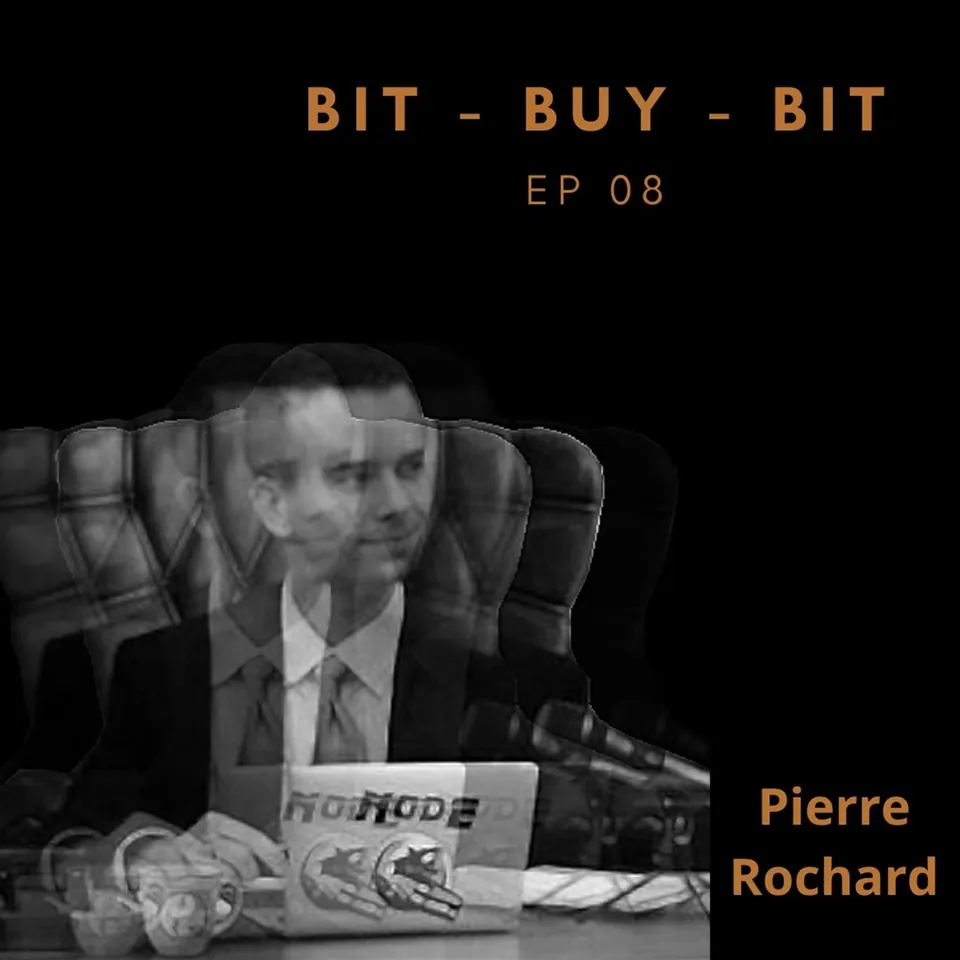
EP08 Bitcoin podcast with Pierre Rochard
Discussed in this episode
Boost this Episode
Send sats directly to the creators. Value for Value.
Plus 1% to Podcast Index, 1% to Boost Bot.
Show Notes
In todays episode I talk bitcoin, lightning, stock to flow and the future with my guest Pierre Rochard.
For reference here is the plan B stock to flow model - https://medium.com/@100trillionUSD/modeling-bitcoins-value-with-scarcity-91fa0fc03e25
Pierre has a wealth of knowledge in bitcoin and Austrian economics, the articles he has written have been invaluable to me and many others over the years.
If you are interested in bitcoin and not already following Pierre you are missing out.
I really enjoyed this discussion and I hope you do too.
Follow Pierre:
Twitter - www.twitter.com/pierre_rochard
Website - https://rochard.org
Github - https://github.com/pierrerochard
Articles - https://medium.com/@pierre_rochard
https://nakamotoinstitute.org/mempool/speculative-attack/
As always please feel free to reach out and ask me any questions.
Website - https://www.bit-buy-bit.com
Twitter - https://twitter.com/Maxbuybit
Welcome back to the bit by bit podcast. In today's episode, I interview Pierre Richard. I was really excited to have this discussion with Pierre as his articles have really helped me over the years wrap my head around Bitcoin and Austrian economics. If you're not already following
Pierre, I suggest you click on the links in the show notes and follow his work as it's absolutely invaluable. In today's episode, we discuss a variety of different topics. If you're new to Bitcoin, some of them might sound a little strange, so please feel free to reach out and ask me any
questions. I've also provided a link to plan these stock to flow model. Me and Pierre discussed this at length during the interview, and I suggest you read through it. It really is a fascinating piece of work. I really enjoyed this interview, and I hope you do too. This isn't the bottom
right recording now. Is that right? Yep. Okay, fantastic. Oh, thank you very much for writing back to me, Pierre. I was quite shocked that you did, to be honest with you, so thank you. I really appreciate that. Yeah, sure thing. You've moved to Kraken recently. How's that going?
It's going really well. Yeah. Quite a big move then. Yeah, not really, though, because it's just more Bitcoin, right? It's Bitcoin every day all day, and that's been my day-to-day for quite a while now. And so I just get to do more of that at a bigger scale at Kraken. Yeah, to move from New
York for it, did you? No, not at all. In fact, there was a lot of flexibility about where I could be, do you ever ever do? Well, Pierre, I wanted today, if possible. This is quite a new podcast.
I've explained in the best way I can about Bitcoin's sound money and the possibility of just replacing what we have now and why it's better. But you put it very, very well. I really hope that today, maybe you could help my listeners understand a little bit more. What it is that
grabbed your attention initially and what's made you really want to stay in this industry and spend all your time in Bitcoin? Yeah. So I think that I developed a view on Bitcoin very early on when I heard about it the second time I heard about it. The first time I heard about it, I didn't know
anything about Bitcoin's monetary policy. I didn't even get that far in learning anything. All I knew is that it was being used on the Silk Road, and that wasn't interesting to me. So that was my first exposure to Bitcoin. And then the second exposure I had to it was in an entirely
different context. It was as part of participating in the MISA Circle at UT Austin. MISA Circle is a reading group that was founded by none other than Michael Goldstein, I believe, and a few others, but Bitcoiners will know Michael, of course, co-hosts on the noted Bitcoin podcast. And Michael had
caught my attention, of course, because of memes he had been posting on Facebook that were relating to Austrian economics. And he seemed to be the best Austrian economics meme stir around, which is really, you know, yeah. So in any case, we quickly became friends and we,
and Daniel Craywhist as well, we're discussing issues like fractional reserve banking and 100% reserve banking and gold and monetary economics and interest rates, because that's just what interests, you know, college students who are into Austrian economics. And in those conversations, Bitcoin
came up because Daniel and Michael had already been dabbling. They'd already been a bit curious. And that's when I learned about the monetary policy of Bitcoin and the scarcity of the 21 million Bitcoin, the difficulty adjustment. And then it became clear to me that this,
this went from zero to one, right, because at that point, this was in 2013 or at the end of 2012, at that point, Bitcoin had value. And so it had already gone from zero to one. I'd already heard about it before because of the Silk Road. And I, you know, just drew a line and was like, hey,
this is going to increase in value a lot if we believe in its fundamentals. Because you, you were in accounting originally. We used interested in Austrian economics before you learned about Bitcoin, or was it? Oh, yeah, long before. So in the summer of 2005,
when I was going to be a junior in high school, that's when I stumbled across a Wikipedia article about anarcho-capitalism and read through it, basically determined that it was my political ideology and quickly ended up on Mises.org learning about Austrian economics and Ludwig von Mises,
Murray Rothbard, Hans Erman Hoppe, Henry Haslett, Bassier. You know, there's just an endless list of different brilliant thinkers in the Austrian School of Economics. It's, it would be challenging to read everything that has been written by the best Austrian economics scholars. So when I,
you know, and the other thing too, already at this point, I had an iPod and I was able to load MP3s from Mises.org onto my iPod. And that's what like podcasting was in 2005, is that you go download a 100 megabyte MP3 and then drag and drop it into iTunes. And it worked. And so I was
able to listen to all of these really long lectures from, you know, Walter Bloch and Lou Rockwell and Tom Woods and all these different guys on my commute to school on both in France and then later on in college. So I think that, you know, having access to the internet and to digital technology
more broadly, like it's what allowed me to so early on get interested into Austrian economics and really learn a lot about it. And so that's what reading Mises' description of accounting is what led me to wanting to become an accountant and to learn in depth what accounting is. And so that's
why I majored in accounting in college and I got my bachelor master in financial accounting. So since then, I've learned a lot about software development as well. There's, there's only so much accounting. You really need to learn from the business perspective before you've got diminishing
marginal returns. And then learning how to code and how to build my own software has been a hugely rewarding and exciting adventure as well. I'm starting to dabble with it at the absolute lowest and most basic wrong of the ladder. But it's amazing what can be done with it. And I can see
it just becoming really, really addictive. Yeah, absolutely. What was it you jumped into first? Did you do work development or were you sort of lower down the stack? What was your? Yeah, so I started out just with Python on code Academy. And basically at that point, I wanted to automate
scraping PDFs and putting them into an Excel spreadsheet. And so this just required Python scripting of taking a PDF, turning it into XML, parsing the XML, and then extracting the data to put it into programmatically into a spreadsheet that then had formulas in it as well to compare
the values to values that were provided by a client. And so this is just a standard type of auditing or attestation service offered in accounting firms where I was. And so automating that with Python was my first adventure. And it was immediately fruitful and very exciting. So that's when I
was like, all right, I want to learn how to make a website now that is connected to a database and can update the database arbitrarily. And so that's when I started learning a web framework called Flask, which allows you to do both front end templating with Ginger, and then the actual server code
in Python. So that's, you know, and then I started learning about like SQL and Postgres and ORMs and whatnot. So yeah, that's kind of been my adventure in Python. Now there's been other side adventures as well into other programming languages, which I do enjoy a lot. And I,
yeah, that's I don't want to, I could go on, you know, the entire show talking about software development and all the different little things I've done. Well, you did, yeah, you did your node launcher as well, didn't you? Yeah, there's an endless list that check out my GitHub. I'd like
to be able to spend more time maintaining them now that I'm no longer in New York. So yeah. Yeah, I'll definitely have a dig through. So back to the how you got into it. So you were already interested in Austrian economics. You came across this and was it sort of an instant you read through
and you were like, right, this just makes sense to me, straight off the bat, or were you skeptical coming in? I'm sorry, could you repeat the question? When you first discovered Bitcoin with the background you had in Austrian economics, did you just straight off the bat think, right, this makes
absolute sense to me? Or were you quite skeptical? Oh, I was quite skeptical. My first counter argument was, well, there's, you can always break cryptography. There's no such thing as world proof cryptography. And that was my belief after having spent, you know, way too much time
browsing slash dot for years. And it's funny because at the same time that I was discovering Austrian economics, I also discovered open source software. And the free software movement and Richard Stallman are also people that I read and listened to and tied in perfectly with my
anarcho capitalism and my opposition to intellectual property. Check out Stephen Kinsella. He's leading author in this area. And so I was already installing Linux on my parents old computers in high school,
and that was just like, nerding out to Max, right? And that's really, so just from like that high school level introductory, you know, thanks to software, I thought that, you know, if past encryption algorithms have been broken, then the present ones will be too, in short order.
But then Daniel Crewe, who has corrected me and said that, no, like, there's part cryptography now that has been, you know, that have mathematical proofs. And that the, you know, the processing power required to brute force them is greater than that of the sun, you know, that it would take
several dyson spheres to get any progress on reinforcing some of this stuff. And that even if they are broken, going forward, they can be replaced. And that's actually what is currently happening with the potential future snore software, where ECDSA would be, you know,
no longer used ideally, and everyone would use snore. So I think that there's a lot of different, yeah, so that learning about hard cryptography, that addressed my first concern about actually, Bitcoin actually having monetary value. And my, I don't know, did I have a second concern? I'm
really thinking hard back, because the volatility never faced me. Like, you could just look at the chart and it was going up at the time. So it was like, well, obviously this thing is going on.
But yeah, I think that after that point, when I learned about that 21 million hard cap and how they have things where the scarcity aspect of it to me was just, and the transaction fees would replace the block subsidy. When that all tied together, I was like, all right, this system is
coherent and more likely to succeed than not, especially given that it's already like at $20 or $30 or whatever. That point, just really. Well, coming from nothing to something is almost, that's when it's most vulnerable, wasn't it? Yeah, it's wrong time. And you were saying about
snore being implemented, this is sort of, I guess what you're saying about patent protections being a problem, because from what I understand, that otherwise could have gone straight in. Yeah, yeah.
And that's where, I think that we should have, like, Stefan can sell a jump in with a long rant about patents and intellectual property. But yeah, it's great that that expired, but in any case, it would have been nice if it had been snore from days zero, I guess. Yeah, absolutely.
And so now it's been, so was it 2013 you first got involved that kind of time? It seems that whenever I speak to somebody who's more technical, they seem to come up with more issues over time, or just, you know, Christian Moss? Yeah. Yeah, I had an interview with him the other day, and
he was sort of saying, you know, over time, he's been involved, and as he gets his hands on the code base more and understands more, he has more issues than he did coming in. Have you found the same thing, or is it sort of boosted your confidence the more you've dug into it? A little bit of both.
Overall, it has boosted my confidence with regards to a lot of the test coverage in Bitcoin Core, and there's a lot of really excellent contributors who have kind of backfilled tests in some regards
and made Bitcoin Core more robust, and that is just ongoing work. And so I think that there's, it's certainly in a better spot than it was, you know, when Satoshi released it, right? I think it's been a constant, there's a couple of take-ups. I think the couple of take-ups are, in 2013,
the Berkeley DB upgrade, which I think was my current or Gavin, who were involved with that. But in any case, it's everyone's responsibility to be reviewing the code and to make sure that it's safe to use. And then there was another hiccup, though, more recently there was an inflation
of potential, unexploited inflation bug. A few months ago, which wasn't it? Yeah, so in this case, it's really, it speaks to the complexity of this software that this became
possible, but it's something that we need to always be aware of. And I think that it promotes a culture of very strong peer review and very high quality clean code that is being added. And so Bitcoin Core is like significantly improving and it has significantly improved over the past.
And it's really, I think, going to accelerate because we have companies like Chaincode and Blockstream and Square Crypto and Lightning Labs and all of these others that are working
on or on top of the Bitcoin protocol that are able to contribute to its improvement. And so I think that people will talk about Bitcoin as stagnant or frozen. And I'm just like astounded by that because I don't see how they can move faster without cutting corners or making mistakes.
And if you do want more activity, the solution is to go hire some developers to contribute to it, like Chaincode Labs has done, and to get involved, right? If you want to accelerate the development of the protocol or of the software stack, you have to contribute open source contributors.
Sorry, I don't want to repeat it. You have to provide open source contributors or a sponsor or create foundations like the BTC pay server foundation. And that can accelerate things. But to say that it's currently stagnant, I have to completely disagree. It's got a decent velocity
to it. And we're going to have several soft forks coming up that are really interesting and will be, I think, useful to Bitcoin users. From the little time that I've been involved in this, I've been absolutely astounded and trying to keep up. It's just trying to wrap my head around
something. And then there's something new all the time, how anyone could think that it's moving slowly. It's just an unbelievable pace. And, yeah, like you say, things like BTC pay server and these kind of things are just absolutely awesome. Lightning seems to be from what I can tell.
I mean, I know everyone says, don't be too reckless and don't put your hopes and dreams too high. But it seems the pace of which is moving is amazing. And it seems to me that when people are using Lightning bet, they're more willing to actually play around and be reckless.
And you can make changes, which on the protocol level, people just couldn't do. And, yeah, to me, it just seems like what's going to happen in the next couple of years, just, yeah, it really extends away. Yeah. And I think that the reason that people use Lightning at this point,
I think is more out of an enthusiasm for how elegant of a solution it is to Bitcoin scaling and an excitement about the user experience as it is today, which is not perfect, but when you get it to work, it is really imaginable. So I think that a lot of people have seen it
work at least once. And that got them excited to keep digging in and to understand it better and better and contribute to software around it. And so I think that it's going to be like a snowball that's accumulating snow and getting bigger and bigger and bigger. And it's progressing very well.
I think that atomic multi-path payments was something that will dramatically improve the capital efficiency of the network and its liquidity. So that's something that is going to continue to improve as well. And the other thing that really caught my attention
was this WhatsApp chat app that was created by Juice Jager at Lightning Labs. And I think that that's going to be really powerful because basically, the reason people use Lightning is because Bitcoin's a sound money. And so you have a bootstrapping effect, network effect,
where essentially, if people are trying to run Lightning Nodes, because Bitcoin is going to continue to increase in value and utility and liquidity. And thus, this will give them a secure identity online that is open or up 24/7, and that allows them to also have decentralized
communication in a really nice environment. So I hope that continues to get developed. I've heard people argue against doing this. And I don't have, from first principles, like any kind of arguments against this, because people are paying the routing fee, and you can charge the routing fee
any way you want. And for privacy, presumably, it would be pretty good. Yeah. I'd love to see, I mean, I'd love to see what happens with that kind of stuff, because I think we're all sick and tired of what we've got with social media and everything being tracked. Oh, yeah. This is, this is fiat technology is going to call it, right?
And I think that like big tech, and like Google and Facebook, they are fiat technologists who I think ought to be replaced with more self-sauver and decentralized
solutions. Because otherwise, it's really open to all sorts of abuse. And we've already seen it. And what the end result is, is that you have these private corporations become public courts of law, where now they've got to adjudicate disputes between litigants, right, which is a bit crazy
from the perspective of what I want corporations to be doing. And I want them to be building rockets and advancing civilization, not getting tied up in petty disputes on social media platforms, you know, running free speech is the way it's going really, isn't it?
Yeah. So I don't, people should be allowed to control their own private property, whether it's physical or digital. And I feel really strongly about that. And thus, the best way to do that is to physically, you know, host your own everything. And I think that
the bootstrapping effects of lightning will allow people to do that. And we already seen it with things like, you know, the CASA, not all it projects where you have dedicated hardware that you keep online 24/7. And so I think these platforms are going to continue to develop at an accelerated pace
and allow for more decentralization on the internet. We've seen some examples like I think Mastodon is another big example in terms of decentralized Twitter. But it's just, you know, the federated model, there's just more to it, if we make it really secure and cryptographic, which is what we
get, if we start with lightning as that layer for messaging, then I think that we can build some really rich applications that are decentralized, you know, using things like macaroons and whatnot, really have fine grain control over our digital property.
Yeah. What's your thoughts with Jack Dorsey? I know he came out and basically sort of either said or hinted that he would like to have an open protocol and I know that he's very much behind Bitcoin and lightning. What's your feelings around that? Do you feel that he honestly is
thinking about trying to work on something? What's your thoughts? Yeah, absolutely. I think that every company should be trying to disrupt itself continuously. And so every company should be trying to fund projects that fundamentally replace the existing product or, you know, in like a 10x
band or whatever. And so I think that that's the way Jack Dorsey sees the world as well, because otherwise you get into like, you know, you become Kodak, right? So it's much better to leave the charge than to be left behind obviously. So that's what he's doing at both of his companies,
I believe. Yeah, it seems like he sort of is yearning for that and it feels like Twitter's not gone quite the way that maybe he planned or it's not creating the world he wishes for. And yeah, I mean, I have to imagine that it's a massive headache for him. He has become
a one person Supreme Court, essentially, where all of these human disputes, sorry, big thing, you know, they go up the chain command to him until like he has to be like, okay, we're going to ban Alex Jones, right? Or we're going to ban Milianopolis because we've decided based on the evidence for them to do us like without any kind
of due process or anything like that, which, look, it's a private company. They can do whatever they want. I just mean, pragmatically, there's a reason why judicial systems have evolved to have the norms that they have today, right? And it's something that our founding fathers here in the United States
paid tremendous amount of attention to when writing the Constitution. And it's also, you know, something that our legal system, despite its thoughts. So I actually think that on a global basis, if you compare it to all the other countries, like our legal system is
pretty good. So we can't really complain on a relative basis. Now you could imagine an ideal world, right? And so in my ideal world, there would be no criminal law. There would only be civil law. And so there would only be torts. And so the government wouldn't even necessarily have to be
involved because these torts could be adjudicated by private arbitrators. And then, you know, the only role of the government would be to enforce arbitration agreements or arbitration, you know, results that come out of these private proceedings. And perhaps that's, you know, the most efficient
way to do it. But in any case, regardless of who owns the courts or whatever, the underlying principles of, you know, what evidence is admissible in court? Or how does due process work? How should arguments be presented? You know, how can you object to things in getting out of all these
procedures? But also, you know, there's, there's just a huge amount of common law precedent that has been set from Old England, and older than that, right? It's all tremendously to present day United States. And so there's a huge amount of wisdom in that because it's, it's Lindy, right?
And so the problem is that these tech companies have to rediscover and implement all of these principles, which is a tough part. And they have to build, build sovereign legal systems within their corporate structures in order to adjudicate these disputes because that's the only,
because they have jurisdiction, right? And, and nobody else really does. And right now, it's really currently, I think that it's basically very primitive. And it's laws of the jungle. And you never know, now you could say like, hey, look, the U.S. just ordered
a drone strike of Selimani in Iraq, in Iraq. So, you know, don't tell me that Jack Dorsey banning someone on his platform arbitrarily versus droning someone arbitrarily is any different. But, yeah, I mean, I see that. And yet, even in the military, they have rules of engagement,
right? And these rules of engagement have evolved over the centuries in order to try to like rein things in and not have an absolute circus of a war zone. And so in every, even in direct physical conflict, human civilization has evolved norms and practices that are in a, in a competent
military, you know, they're trained to follow these even if it results in their debt, because it's more important to protect civilians than, than to protect their own lives because that's their soldiers, right? And so any competent military would, would strictly adhere to that and be
properly trained in it. And so these have evolved as well over centuries of like not using chemical weapons. Like, hey, we're not using each other anymore. Like that was terrible. That was awful for the environment. We're not even going to test nukes anymore. And so I do think actually,
despite being like omnipotent sovereign super nations, countries can self limit themselves due to underlying concern by the population of what their government is doing. The governments get overthrown all the time. It happens all the time. Like we can never underestimate that. And
the only reason it doesn't happen in the United States is because we have relatively free and fair elections. And so that way, all the steam gets let out every two to four to six years, you let out some steam and it goes in whatever direction the underlying population wants to go
it. And it doesn't matter, like, even as libertarians, like sometimes it goes in a libertarian direction, historically, it has not, right? But that's only because the underlying population, I think, has been, you know, lied to and manipulated not because of or, or, you know, they did, it's fine to just
read on politics. It sort of feels to me like, and maybe I'm a dreamer thinking this way, but I feel with Bitcoin, we potentially have the key for slowly getting smaller and smaller government.
And it's the first time that power can go back to people and that we can really, I mean, if you talk about sort of freedom of speech and money being free speech, then it does feel to me, like we maybe are on a tipping point. And more than ever, people are starting to wake up to maybe
what they're being told hasn't been quite true. And maybe the things that they thought about their money aren't true. And, and that now that there's more of a balance now that we've got this, and it's, I don't know, I feel quite positive about it. And I'm like, so maybe I'm a dreamer,
but it does not at all. I agree. Yeah. So I think that it's kind of, it's, it's too primed. On one hand, Ludwig von Mises also, there's an excellent lecture from a Austrian School of Economics scholar, Hoolsman, who gave a lecture about the effects of inflation,
the cultural effects. And he mentioned that the reason that Ludwig von Mises was utterly opposed to a government issuing its own currency and getting senior wage revenue is that it removed the accountability from the governing body, from the voters and from the legislative branch,
which is, you know, passing budgets, and these budgets ought to be, you know, balanced and not monetized by the issuance of currency, because people should pay their, you know, the full tax, right? And, and the full, they should incur the full costs of the government that they are voting
in, so that it's not passed on to future generations. And it's not dumped on savers, on people who are holding the money of the land. Yeah, absolutely. And it's, it's a fairly recent thing as well. And it's sort of, I tried to explain to people all the time. I mean, I try and say, I try and explain
the benefits of Bitcoin and sound money and all this. And it seems to be such a foreign concept to people, not too long ago. It was the norm. It was. Now, I actually argue that there's two things about Bitcoin that are different than what it was before, went under gold. One is the actual process
of hyper Bitcoinization. So we didn't, it, gold happened, you know, rather organically, although, in some countries, it was, you know, a swift replacement of whatever meme it changed, it had the four gold. But in any case, gold's value has fluctuated some over the millennia. But
it's not done anything like what Bitcoin has done over the past decade. And I think that it is going to cause the pendulum to swing far further than it would if we had some kind of mechanism for, you know, getting people, getting Bitcoin out there without, you know, without this price process,
right, of somehow air dropping it on everyone and replacing everything instantaneously, kind of like the euro replaced local currencies. So there's no mechanism for doing that, right? People have talked about air drops and, you know, they did Aurora coin and Iceland or whatever.
And it's these are jokes, right? Like people just sell their shit coin and they buy their local currency so that they can go spend it at the supermarket. They're not, you know, and, and stellar did an air drop as well. Like people just liquidate it. The Bitcoin air drops, right?
Bitcoin cash, Bitcoin SV, people just sold that shit. They don't get it. And so in any case,
so Bitcoin's process of hyperventilization is going to cause a swing far further than the alternative that I described would. And that's really that's interesting because we're swinging in the direction of savings, right? And it's like, okay, what this is going to be the biggest it
could possibly overshoot in the direction of savings. And so it's going to be really interesting to see what effects that has on society. I think they're going to be extremely positive and that this overshooting towards savings will be one of the best things that has occurred to
humanity. And it will catapult us into the solar system. Yeah, it definitely feels that way. You spoke as well recently. I heard you talk about some of the idea if we go into hyperventilization and people start to borrow and then buy how that then snowballs even more. And the more I think
about it, it seems logical that that would happen because when we have these huge price runs and you have these kind of, you know, everyone suddenly there is perk up and everyone starts piling in.
And especially if people actually start to realize what their currencies are actually doing to their savings. If you put it on a probability basis, how do you feel that this may happen in the next sort of 25 years? Are you seeing that as something in your mind you think, okay, no, that makes sense
and that's probable? I think the strangest thing I have ever encountered in Bitcoin since I got interested in it at the end of 2012 is Plan B's Stock to Flow Price Correlation Model.
It's absolutely mind-boggling to me that this actually exists for the historical data. Now, whether it'll hold going forward is a completely different conversation. I just want to note that for the historical data having this result is simply astounding and we'll have monetary scholars
puzzled for, you know, until they've really got a solid explanation for it because I still don't have to. And so that's fascinating. If it holds, then, you know, there's a very clear path that Bitcoin
is on, right? And that path is, in my mind, totally reasonable and I want to say inevitable, but if I say inevitable, I'm going to say it. Yeah, well, that's the way it feels to me as well, but when I say the words out loud, I realise to most people it sounds absolutely crazy. Oh, yeah,
yeah, for sure. It feels just logically like it is a better money and I would never want to hold fear now that I know what I know about Bitcoin and when you have Plan B and you're looking at this stuff and you're thinking, well, why wouldn't it? I don't understand why people wouldn't want
and I try and tap myself out of the bubble and the Twittersphere and out the echo and listen to other points of view, but every time I have someone, you know, with a counter-argument, you just, you hear basically a load of nonsense, you'll move from shift and people like that and
I'm yet to really hear a reasonable argument as to why it's impossible. Yeah, yeah. Which is exciting and like you say, I think for a lot of people, once you realise, well, if it is possible, the implications it will have on society, like you say, is I think we probably can't even imagine
yet and that's the most exciting bit is to see what is going to happen in the next 25 years, if it could be absolutely amazing. Yeah, I guess that's why we're all here. Yeah, and now I do think, so that was the first part of my explanation of, I think it's going to
swing way too far in the direction of savings, but also that gold supply was increasing during the gold standard. Here, we're going to have a lower stock to flow ratio than gold. I think not this next having, but the one after, so in four and a half years or whatever, that'll get us
below gold and that's where there's a secondary effect where now we've never run this experiment before. We're reaching levels of deflation that have never been measured before, so that's going to be really interesting to see as well. Yeah, and like you say, it's going to be one for the history
books. And then it only gets better from there, right? Then next having is going to be even further from gold and it's really uncharted territory for the rest of our lives really, which is pretty cool.
It's nice to see like some of these macro guys are really starting to talk about it and it seems like it feels like more and more people are starting to sort of wake up to it as well and sort of, you know, yeah, definitely. So I gave a talk at JP Morgan Chase for their private wealth management
team in New York. And it was me and Wenzes Cassaris who were on stage having a conversation about Bitcoin answering questions about it. And it was really interesting to hear the level, the sophistication of the questions that were being asked. Clearly, these people have
done their reading. They've done a lot of research and they're asking really astute questions that I had the same experience as well at Visa where I had all day. So at JP Morgan, it was like a few hours or a couple of hours. At Visa, it was all day. And so I was able to get into Lightning Network.
And there were a lot of people in the room that are software engineers and that are security experts because keep in mind that Visa operates in an adversarial environment every day. People are trying to scam with Visa cards. And so they know a thing or two about how to do cryptography
and all this. Now, they're not perfect, right? But in any case, they've got cryptographers and software engineers who are focused on the security of their systems. And so when I was explaining how the Lightning Network functions, they had lots of great questions where they had
really put on their adversarial hat on because then we got into an explanation of the punishment system and time-lots and all of this. And so they were fascinated by this and had lots of really great questions about it. So it was a fun conversation. And even like how the peer
network functions and tour routing and all of this on Lightning. So yeah, I think that there's a lot of people doing deep research on into Bitcoin and they are learning more and more about its properties.
And so that's going to be, you know, this is the next wave of adoption that's happening. And it's just picking up steam now because, you know, it's we're out of the bear market at this point.
And I think that, you know, the next wave is slowly building. Yeah, I imagine, you know, you've been in this for quite a few years now. It must be quite a shift from, say, four years ago to now. The sort of questions you're asked from these people, like you're saying, they're now sophisticated questions. And this seems to have a better
understanding, whereas I imagine four years ago, it was very, very different. Well, I mean, I'll tell you what, four years ago, they weren't asking me anything, right? Yeah. Like they didn't even make the time to. Yeah. So, yeah, it definitely has changed over the
past years. Yeah. Listen, Pete, I'm just conscious I'm not taking up too much of your time. I know we haven't. No, you're fine. Okay. Ten more minutes. Fantastic. And yeah, if you haven't made your way over to London, you know, if you're in London, just give me a shout because I really appreciate
you coming on and sharing your knowledge. It's been fantastic. Yeah, we'll do absolutely. I'm sure I'll be in London at some point. I've started making my way to the bit devs meets ups now.
Oh, excellent. Yeah. Yeah. Most of it goes over the top of my head, but I'm trying my best. So, yeah, you know, it's shrinking from a fire hose in the Bitcoin world. And yeah, most of it still goes over my head. No, it's just such an awesome thing to be involved in. You know, I've done lots
of things in the past, but nothing has captured my attention like this. It's just so interesting. Yeah. You know, what else I've really noticed is, you know, like reaching out to you and you've got back to me and the same with others. And I just, I've never experienced that before,
where people have been so helpful and willing to help and willing to discuss ideas. And maybe it's just because it's so early and people are still enthusiastic. But it's not something I've experienced before, not in any other industry. Yeah, I mean, part of it is I do want to get my
point of view out. And so, like, I'm just naturally inclined to say yes to opportunities like this.
And the other part is like wanting to pay it forward because lots of people have come on noted and, you know, graciously boosted our podcast. And so I just want to, yeah, pay it forward to everyone out there who is podcasting. And also, I have to say, you've had really excellent questions.
So I think the podcast is going to do really well. Thank you very much. The idea is kind of low level and trying to get new people involved. And I'm really going after a sort of, I'm trying to go after people who aren't currently involved. And my other business is a workers and artists.
So I'm trying to get artists, my idea is I want to spin up a BTC pay server and start selling online and teach others to do the same because I feel that's a sort of there's not so many people from that world who maybe know about this. But I'm hoping that I can capture their attention
because I think that a lot of them do have, well, a lot of the people that I know have more that libertarian leaning and they just don't know that this, they just don't know this exists. And if they did and they understood it, they thought, oh, God, I'll be waiting for something like this. This is just, yeah.
Yeah. So we've got a few more minutes. If you were to sum up, because you put it much more eloquently than I do, if you were to sum up to someone new, you might be listening to this, and you were to say the pros of Bitcoin or sound money and helping with their savings and advice
on holding and why that might be a good idea. What would you say to the listeners? Yeah. Basically, you have to, first of all, be in a position to have savings. And the precondition for having savings is that your income is greater than your expenses.
And so once you've established that, then you've got to divvy up that savings into different forms. And so if you go into a personal finance subreddit or you hire a financial planner, they'll explain to you what you should do with your income. And then really, on the expense side,
you can live as inexpensively as you want or as expensively as you want. There's no limit to having so many people get with the lottery and spend themselves poor. And so you've got to be
able to control that and have a camp on it. And live closer to work in a smaller house, things like that. Buy less house than you want and don't buy as much craft to fill your house.
And buy a used car that is kind of just a generic brand. Don't buy a luxury new SUV. There's all sorts of ways where the car is still going to get you from point A to point B. Like it's still going to hold the same amount of groceries. And what you're doing is that you're
reducing your expenses. And then you can increase your income, negotiating a higher salary, getting a new job, increasing your skills, learning new things, and combine those two. And you can really do well in terms of how much money you're able to set aside for investments.
Now, this is where a financial planner would say, okay, well, you're young or you're old or you're in between and you put X percentage and stocks and Y percentage and bonds. You can't just hold a large amount of cash because of inflation. So to keep ahead of inflation, you've at least got
to put it in a money market fund. But really, ideally, you got to put it into short, medium, long-term bonds. And then for the really long term of 15 to 30 years, stocks because stocks are
more volatile. But the problem with this model is that it's a model that really actually came to be in the age of fiat, in the age of inflationary government currencies, post World War II.
And it's kind of a unique set of circumstances in human history where governments were able to have the technology to issue their own paper currencies in a fairly secure manner. And if they do it in a reasonable enough manner, they were able to centralize
the gold supply in banks because it was so much more convenient to have other forms of payment. And essentially, they abused that technological advantage they had from kind of a
a stretchful point of view. And they've inflated their currencies just fast enough that inflation doesn't get out of control, but not too fast either. Now, the problem is that, so that would be fine if that were it, right, that basically we have a government that can print more money. And thus,
the budget, the expenditures are greater than the tax income. So that'd be one thing. But actually, the money gets created through a fractional reserve banking system. So it's not even that the government's issuing currency in exchange for goods and services, although that does happen.
But really what's happening is all transpiring through the fractional reserve banking system. And so banks lend out to create new money. And then the Fed creates new based money as it's manipulating the interest rates and whatnot and doing open market operations, buying,
selling bonds, and expanding and contracting its balance sheet, QE1234, etc. So this process isn't highly different than the one where you just have a government printing money. And so a lot of the bad effects of inflation go through the private sector. And so that's why we've seen
large booms and busts and bear markets and bull markets and credit contractions and all this happens because the size of the money supply is tied to the amount of credit in the economy. And so when you have an economic contraction and the credit quality goes down, then the balance
sheet of banks shrinks. And they have a negative spiral where they're trying to sell loans and trying to liquidate essentially to increase their reserves. And everyone else is doing this.
And so the value of everything is contracting. And the other part is when people repay their loans, the money gets destroyed essentially. And then when the bank issues a new loan, money gets created. And so this is one out of control in the Great Depression. Now the novelty
this time around is that Ben Bernanke actually was a scholar of the Great Depression and did exactly what you should do in a fiat monetary system when this happens is just have the Fed start buying large amounts of debt and just handing out cash debt. And this has been extremely effective.
That actually is the correct response. In a fiat fractional reserve banking system, the correct response to a crisis is to immediately convert the system to 100% reserve. And so that's what the Federal Reserve did. In addition to the FDIC, which is kind of the obvious one,
the Federal Reserve will provide liquidity to the system to keep it salted. And that was the number one lesson from the Great Depression. And so because they've learned that 100% reserve banking is superior to factual reserve banking, that's what they have to do during a crisis. My argument is
that, well, let's just not allow a factual reserve banking system, right? Let's just have it only be. And now, thankfully, I think that Bitcoin offers that. And so Bitcoin is 100% reserve as a payment system, because the other problem is that whenever you use a payment system,
you get into a fractional reserve banking system because you have trusted third parties who abuse the privilege, right? And so whether it's Venmo or Gemini USD or your Chase credit card or whatever,
when you're using the payment rails, you're giving someone else your money, you're lending them money, essentially. And that's not the case when you're using Bitcoin or Lightning. And so it's a completely different set of economic incentives that you have in the
Bitcoin system. True ownership. Yeah. Pierre, you put it so beautifully. Thank you very, very much. And thanks again for everything you do and for teaching people like me and being able to learn from you and for my listeners has been absolutely fantastic. Thanks for having me on.
No, thanks again. And if you are ever in London, do give me a shout and I should buy you that drink. Okay. Sounds good. All right. Thanks, Pierre. Looking forward to it. Bye. Cheers. Bye-bye.
Cheers.
Machine transcript; expect the odd mishearing. Click a passage to play from there.



