
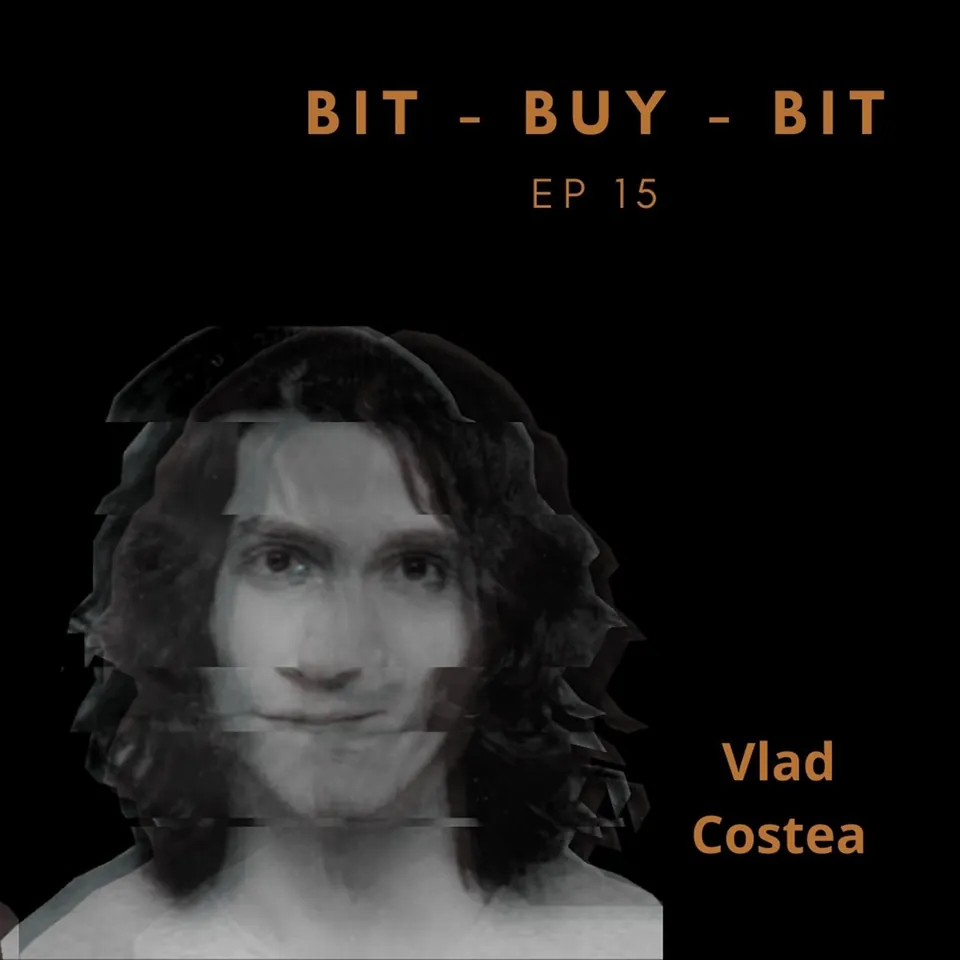
EP15 Bitcoin podcast with Vlad Costea.
Discussed in this episode
Boost this Episode
Send sats directly to the creators. Value for Value.
Plus 1% to Podcast Index, 1% to Boost Bot.
Show Notes
In todays episode I talk bitcoin, lightning, Node, Privacy and the future with my guest Vlad Costea.
Vlad has written some amazing articles and it was a pleasure to speak with him.
If you are interested in bitcoin and not already following Vlad you are missing out.
I really enjoyed this discussion and I hope you do too.
Follow : Vlad Costea
Twitter - @TheVladCostea
Website - https://bitcoin-takeover.com
As always please feel free to reach out and ask me any questions.
Website - https://www.bit-buy-bit.com
Twitter - https://twitter.com/Maxbuybit
Welcome back to the bit by bit podcast. In today's episode, I speak to Vlad Kostia. I'd just finished reading an article Vlad had written for Bitcoin magazine, buy or DIY, an overview of seven Bitcoin full node products. I thought it was a great article
and really helpful, so I reached out to him. About 10 minutes later, we were recording this episode. We had a great chat both before and after the recording and I'd also like to say thank you to Vlad for the intro and outro music. I hope you enjoy.
Hello, welcome to the bit by bit podcast and I'm joined today by Vlad Kostia. It was a complete last minute. I wrote to him, I'd read an article about Bitcoin nodes. I found it really, really helpful. I reached out to him and said, you know, I'd love to interview you and have some more
information and learn about what brought you into Bitcoin and what it is that we can learn about nodes and for my listeners so that they can get them set up. So here he is. Vlad, really nice to meet you. Thanks for jumping on and thanks for chatting with me. Yeah, I mean, this was very
spontaneous. The first time I got a job in writing for crypto globe, that's the name of the publication and it's based in London, England. It was something similar because I was having a conversation through emails with the editor in chief from crypto globe. And at some point, he said, we should do like a
call or something and talk. And he asked, when are you available? And I said, why don't we do it right now? We're exchanging emails and waiting for each other to reply. So why don't we just settle this in one spontaneous conversation? And it turned out to be great. And in my experience, I think it's
always best when you do something like this, which is unexpected and spontaneous. And you just project your momentarily energy onto something. Yeah, well, I think it's brilliant. And like I say, thanks very much for getting back to me and making it happen. So when you worked in London,
was that recently or? Two years ago, but I did not work in London per se. It was remotely. Have you been before to London? Yeah, I've been to London when I turned 23. So on my 23rd birthday, I visited London. And also, when did I go to London? Oh, yeah, two years ago for
the crypto compare conference, which took place in London. Okay. And I think it was the first of its kind crypto compare, if you're not aware, is like a competitor of coin market cap, except that they don't manipulate, you know, prices as much about methodology. And coin market cap has done
this once when they removed the South Korean exchanges from their algorithms. And that meant that the prices crashed in their indicators. And there are lots of bots, lots of trading algorithms that use their API. So when they did that, automatically, some people have lost money,
just because they have done that switch. And it's terrible sometimes. No, that's not good at all. You didn't come over to the recent one that was a couple of weeks back at the advancing Bitcoin. No, I didn't go to many conferences. So advancing Bitcoin,
where did it take place? It was in London about a week, week and a half ago, I didn't actually go to the conference. I went to the bit devs meet up afterwards, which was really good. But yeah, the conference, it was expensive. And you know, it's a lot of socializing and that kind of stuff. But
the bit devs meet up afterwards, John Newbury was there and a lot of the other devs. And it was actually a really, really good one. 99% of it went right over the top of my head. But there was definitely some interesting bits in there. Oh, yeah. So you had Andrew Polstra and Andrew
Chau of Blockstream and Jimmy Song. Yeah, Jimmy is the Nicholas Dorier, who is the creator of BTC Pay Server. And Adam Fixer, better known as No Power 73. And he is the architect of Wasabi Wallard and these coin joins that we're using today. Yeah, there was all of them there. I was
actually trying to get Nicholas Dorier on, which changed a couple of messages, but I'm sure he was very, very busy. Do you know, Christian Moss? I mean, I know who he is, but I haven't spoken to him. He said to me, I'll get in touch with Nicholas when he was over to chat about a few things with
BTC Pay Server. But I'm hoping to get him on soon. So yeah, it was awesome. I've started going to the bit devs meetups because it's just so interesting and to see what's happening from the people who actually building is really exciting. What was it that brought you into this space? What was it that
initially grabbed your attention? It's always strange when you think about it, because in retrospect, you can make up stories and you can adapt your, actually, you hear other people's stories and you relate to them and it just keeps on adding up. And it's actually hard for me to remember what it was
specifically, but I've always been somewhat of a geek. And I don't really know how to code. I just know some basics and C++ and Borland Pascal, if anyone still uses that. Because I did computer science in high school. Okay. But it was just interesting to see this assembly of geeks who
work on open source software, which to me didn't make much sense when I first got in because I come from a background where people like to take credit for whatever they do and they file patents and they do all sorts of legal protections just to make sure that their work is not going to
be copied without them earning some money. And to find a community which actually cares much more about ideas and good ideas being tested and just floating around and being used for new creative ways and just growing like this is just fascinating. And also I would be a hypocrite if I denied the
fact that I did check some price charts and I did see some news articles about the price increase and stuff like that. I think all of us when when we first got into Bitcoin, it was something related to the price. And it was either pure greed and speculation, which I had in part, but also
my experience with the inflation of the national currency of Romania. And at the time it was it was the first time when I started making money for myself. And I was thinking of ways of saving and ways of possibly investing, because I was not happy with the fact that I basically lose
4% every year just by holding my money. And I would actually be better off holding US dollars. And then I fell into the Bitcoin rabbit hole for various reasons. So that got me into the technical stuff was when I started doing bad trades, you know, and you're on an exchange and you realize
that the price is not going up anymore and you're kind of wrecked and you have no idea what's going on. And you ask yourself, what the hell did I get myself into? What is this? Does it stand any chance? Is it ever going to go up again? I think we've all been there. When you first got in,
then did you get into all the shit coinery as well? Or was it just straight into Bitcoin? I was also into Ethereum. I liked the idea. And I'm doing a PhD in internet governance. And the idea of decentralizing the internet and creating decentralized applications and all that
stuff, which was fancy in 2016 and 2017 and also the first half of 2018, I mean, it fascinated me to some extent. And I kind of believed in it until I realized that there's not much happening and there's a lot more buzz and hype than actual products. And when you see something
like CryptoKitties basically taking down and clogging the blockchain for a few days, it just makes you realize that all of that marketing was kind of exaggerated. And to the merit of Bitcoin, it does what it says it does. I mean, there are some people who make
outrageous claims about it, but it's just digital money, which has found its own ways of remaining decentralized while not compromising with exaggerated expansion for scalability. I feel like that was the important tipping point because it happened the same with the
internet in the 90s when division of Tim Berners-Lee was to have each internet user host their own content on the server. But that proved to be impractical. And we ended up having companies like Amazon and Google and Microsoft having their own server services. And instead of having hardware
in our houses, we just access their own stuff and pay rent for them. And I think it's good that Bitcoin did not end up becoming that. And we can see another failed experiment. I mean, it's not failed yet, but it's failing with bsv and bcash and stuff like that, which has basically
server farms that do all the stuff and people blindly trust in their honesty. And they don't verify their own transactions. They don't verify their own balance. They just use SPV wallets on their phones and believe that it's the right way of using it just because it scales.
I think it's a lot of misinformation as well, isn't it? I mean, for people who are non-technical, it's hard to know who to trust and when they're being told. Oh, it's decentralised and it's this and it's going to be great and it's all the things that it can do and all the marketing hype.
It seems appealing and it's only after spending enough time learning about it that you realise that things like bsv and all these things are just shit. But it's hard for people who are coming in, I think. It's hard to find that sort of the voice of reason. It takes some time. In the beginning,
sometimes it's all up to the first person you meet in real life who is into this. And I think I was fortunate enough not to have to deal with people in person. It was just me finding sources on the internet. But when you have a friend who's into something and he comes up to you and says,
"Oh, I found this really great stuff. You can upload anything on the blockchain by paying a fee. Why don't we put our pictures on the bsv blockchain because that's the future?" That's dumb. It doesn't make much sense. It can be fun when you try it as an experiment. I'm not denying this experimental
dimension of it. But at the same time, if you're looking into creating good money on the internet, then you actually need to have some powerful fundamentals. Yeah, and I think that's what's missed by so many people. Bitcoin is the first cryptocurrency
and it's the only one that is, in my eyes, a currency. And all the rest of it are just random experiments that use the word blockchain. And I think the whole problem is people don't understand money in the first place. And then if they don't understand money, how can they understand
why Bitcoin's important? And if they don't value freedom and they don't understand that it would be nice to have self sovereignty and control, then I think they just missed the point of it. They just sort of see it like it's a stock or something like that.
Yeah, and also I can tell you that there's a lot of value in having this currency that's universal. And no matter where you are on the planet, one BTC is one BTC. I can tell you that yesterday I tried to order a software that's called Hemingway. And it's useful for writers
when your copy is just too complicated and it highlights the phrases that are too long and the words that can be simplified with some kind of easy to understand synonyms. And ideally, if you follow all the guidelines of that software, it's going to make it so easy to read. Like your text
is going to be so easy to read that even a fifth grader will be able to understand what you have written in there. But I try to get that and it's like $20. And when I entered, I tried to buy it with my Romanian IP address. And it was charging me $5 VAT just because it identified that I'm in
Romania and I have to do that. So I went on a VPN service and I use the United States IP address. And at that point, I refresh the page and that fee was gone because there is no VAT in the United States. And it's software that you buy online. But I tried to buy it with my credit card credentials
and it was rejected because I don't have an American credit card. So
from this point of view, I think when you buy software online, it's very dumb to have to resort to this nation state extra taxation system. If that software is pretty much the same, no matter where you are in the world, it's just yes, that's crazy. Yeah, it's crazy. It's it's trying to fit
old rules onto something that is new. It just doesn't make sense. All the borders don't make sense for the internet is stupid. And it gets much worse than that because I follow what's going on with the internet just because I'm still doing this PhD that I hope to finish at some point because
I'm already buying time. And I'm actually buying it because I have to pay tuition fee for each year when I have to continue. So I can tell you that there is this report by Freedom House that gets published every year and it documents all the attacks on the freedom of the internet. And what's
nice about it is that on the website, you have a map where you can check each country to see how free it actually is. And can you tell the most free country in terms of internet access? Can you guess it? The most free. Oh, I don't know, maybe Norway. That's kind of close, but I mean also
geographically close, but that's not it. Sweden? No, I don't know then gone. If I remember correctly, it's Greenland. But let me check the map once again. So just to make sure it hasn't changed.
I bet the UK is not all that free anymore. No, it's actually Iceland. Sorry, not Greenland, Iceland. Iceland. Okay, it has the best score of all. And the second best I think is Estonia. Right. Okay. I guess Norway just because of Nord VPN. And I know they had a lot of
servers and things over there. So that was my guess. It's actually kind of shady what's going on with stuff like Nord VPN. They got hacked in 2018. We saw that we found out a year later. And now they want us to trust in them again. I deleted my, deleted my account and got a refund
because I was using them and I was really pissed off about that. And I don't know now who to use. I think ExpressVPN is the best for consumer needs. But it's also pretty expensive. You pay like $5 a month. Right. Well, it's worth it if it works.
What I use right now is called Surfshark. It's a more, it's a more inexpensive solution. It's like $2 a month. Okay. Has lots of servers and even has this cool feature where I can see it's called multi hop. You connect to basically two VPN servers at the same time into different geographical
positions. Okay. I'll check that out. I've written it down. I have a look to get one. Yeah. And I spoke to Peter Todd during my podcast and he said he uses let me check again which one. But it's a very private one where you don't sign up with email address or anything.
You just get a code that gets generated and you pay with Bitcoin and then you can use the service. Oh, that's cool. I don't remember the name though. It's hog VPN or something hog something.
I have to listen. I haven't yet listened to your podcast. I have to have a listen. Yeah. Peter Todd is like a paranoid genius. When it comes to security, you can just conceive every possible scenario and break it down into risk levels and assess which one is best for each
situation. It seems that the Bitcoin space breeds that sort of type of person, the paranoid geniuses who just seem to see things from every angle. It's amazing to be able to ask questions to these sort of people. It's brilliant. Oh, yeah. You should come to Romania in October, by the way.
And I'm not sponsored by their conference or anything, but TC con comp. So it means Transylvania crypto conference. That's where you can meet Peter Todd later this year. Okay. Yeah. Awesome. I've never been to Romania. So that sounds like fun.
Yeah. There's also a trip on the first day usually. I mean, it happened last year. There's a trip to a salt mine where you get to see some nice places. And last year we had Adam back. We had tone vase and I mean, you can see in the pictures. I'm going to send you the link on Twitter.
Yeah. Awesome. I have a look. Tone's over in Vegas at the moment, isn't he doing a conference? I don't know. He's all over the place traveling all the time.
I used to, I used to follow, I used to follow and watch all his YouTube videos and things a couple of years ago. And I gave up in the end. I now just stack sets of realized that no one knows what they're doing. Oh, yeah. It takes so much time to realize that nobody knows what
they're saying in terms of price predictions. Yeah. Absolutely. No clue. I mean, you can tell some indicators and see that there's volume and look at some trends and possibly predict based on psychology and what that suggests. But you cannot tell when some random whale decides to sell off
their coins and that there's going to be some sort of madness in the space because you don't know who that is. You don't know why it happened. You don't know if there's going to be another sell off. It just happens and you watch it. And then you see it pump and you have no idea where it
comes from. And it's so stressful when you're trying to trade. I've got to the nice point now where if we have a drop like we had the other day, I just buy. And then I feel good because I'm like, ah, getting some cheap sets. And I don't worry about it. And then if it pumps, I normally think,
ah, I wish I had more. And that's as I don't have to worry about it. I just think long term, but just think, you know, it doesn't matter. It doesn't worry me. But at the beginning, it's stressful. Yeah, I remember when I was trading and I was not able to sleep at night.
Did you wake up all through the night to check and it's just, yeah, yeah. Did you do a lot of trading or? I mean, not a lot. And I don't know, maybe I put like $2,000. And I think it's still there with long positions because I was taking profits a lot. And then I bought, I think, a 14K
Bitcoin. And it never really got to that point. I mean, it did last year, but I didn't sell at that point. I'm just huddling on one exchange. I'm just going to keep it there and cash out because it has been cash from the very beginning. I don't want to withdraw. I'll just leave it there.
Yeah, I don't know that I would find it easy parting with my sats now. I've just, I've come to peace with it. I'm just like, well, they're there, they're there for the long run. And I'll just wait. And yeah, I can't be bothered with the trading and all that sort of stuff.
But I guess, like you say, it's that learning curve, isn't it? Where you first get in and you just think, oh, I'm going to trade and I'm going to do this and I'm going to do that. And you think you can sort of beat the market. And then you realize, no, we're just along for the ride.
Nah, my favorite part about it is when you think you're a genius. Yeah. Oh man, I had it figured out. I predicted the market. I'm, I'm, I'm a freaking genius and nobody else knows what I know. So next thing you know, I'm going to create some sort of trading
seminar and start a whole career out of giving people financial advice. Possibly I can set up my own financial advice firm and handle other people's money. Yeah. Yeah, that's what happened in 2017.
There were lots of those, weren't there? Oh, yeah. And they ran out of money or possibly, I remember speaking to somebody else about this, that some people have no sense of, I don't know how I should, I should call it. They're not grounded enough to understand that
it's not going to be like this all the time. So they make no savings. They just spend everything on stuff they don't need just to flash it like lambos and expensive houses. And then when they go through a rough patch, they realize they cannot sustain that kind of lifestyle, which they created
for themselves. So they're going to have to sell everything and go back to their former lifestyle. And maybe that they're happy, you know, they got to live as kings for a while. Yeah, you see a lot of that. But that's what creates a lot of greed in this space when, when you see pictures of people
saying, Oh, I got this Lambeau with Bitcoin. And automatically, I think this is basically grounded in the hip hop culture, I think we saw that on MTV. When I was a teenager, I used to watch MTV. And it was huge. And you see rappers all the time bragging about how much money they made
with their new production studio and their new hit song and stuff like that and say, Oh, cash flows all the time because I'm so smart and I can do it. And part of it seems very similar with Bitcoin, at some point, especially during bull markets. Oh, yeah, for sure. Well, it attracts, it attracts
them in. And then when the price goes down, they all leave. And then the people who are left are actually interested and stick around. But yeah, it definitely attracts a lot of sharks. Yeah. Anyway, you wanted to talk about Bitcoin nodes, right?
Yeah, I've been looking for a while. And so this is this is quite a new podcast. And I've been sort of slowly trying to explain to people why as a money, it's better. And as a saving technology and all the rest of it. And we've gone through like holding your own keys and those
sort of things. But I am yet to run my own node. I actually had an old laptop and I tried to run one on that and it just died. So I've now now spent a bit of time thinking, okay, well, I'll get my own node and, you know, rather than running on an old laptop, actually get one. And I read
through your article. And it was really, really helpful because you had the graph at the bottom and went through all the different, you know, options and the pros and cons. So I wanted an expert to, you know, explain to my listeners the pros and cons and why people should run them and what
are the trade offs. And yeah, if you could help and explain, I'd really appreciate it. Okay. So in the introduction, I just have to say that I'm not an expert as you presented me, but I know some stuff. Everyone says that in this space. Everyone's very, very humble. But no,
they're not. No, just look at all the people on Twitter who pretend they know everything and they they project this kind of self confidence that attracts lots of followers because they think, you know, this guy has it figured out, he knows stuff, he knows how it works. So I'm gonna follow
him blindly because he never questions his own theories. And even, even when it happens that they're wrong, they double down and find some kind of way to work around it and make it look like they actually knew from the beginning. But at the same time, they were testing their
audience or stuff like that, never mind. But when it comes to the news, because that's what we should be discussing, I think their main purpose is privacy. And it's all about your own sovereignty, in terms of finances. And it's also the only way in which you know that you own your own Bitcoin,
because when you're running a mobile wallet, let's say something like Blackstream Green that's not connected to your full node or samurai, that's not connected to your dojo. Or let's say the worst possible wallet that you find in the app store, but it's very popular because it's the first one
which shows up in searches. And that's the blockchain wallet from blockchain.com. It sucks. It makes you pay high fees. It doesn't really have lots of security, but it's very simple to use. So I can see the appeal. But when you use that one, you can never be sure that you actually own any
Bitcoin. How can you actually verify that what you see on the screen is actually what you have? Yeah, you can. You're trusting someone else. Yeah, you're trusting that you're connecting to somebody else's node. And there is your confirmation that you have these funds. But it can all be
just one huge illusion that's designed by the wallet manufacturers. And I'm not saying that this is going to happen, but it can happen that they take away your funds and switch you to maybe something like the Bitcoin testnet, right? So they steal your bitcoins and then they show you that
you still have a balance, but it's either an illusion that's generated on their wallet to make you feel good about it, or it's on the testnet. And you're not going to be able to do anything with it.
But when you run a node, you know that whatever amount of Bitcoin you have is yours. And you can verify it by yourself. You don't have to trust somebody else. And the node is kind of a pompous term for just downloading the official Bitcoin core client. And you said you struggle to do it
on your laptop. I mean, an old laptop that you possibly don't use anymore. But when I use a node, most of the time sits on my daily use computer, I just downloaded Bitcoin core and use an external hard drive for it, because it takes a lot of disk space. And I don't want to possibly realize that
I don't have enough disk space on my computer, and or mix the files from Bitcoin core with my regular files for something else. And I just bought this external hard drive, an SSD of one gigabyte.
That's like 100 bucks, I think. And I downloaded Bitcoin core on it. I allowed it to sync. And it took me, I think, three or four days on this computer, because SSDs are very fast. And I just let it run day and night. And then three days it was done. I think now it's gonna take you longer
because the blockchain keeps on expanding and getting bigger. What is it? It's about 200 and something gigabytes or something like that, isn't it? I think it's 300 right now. Oh, is it okay? So if you get the 256 gigabyte hard drive, it's not going to be large enough to
store the whole information, the whole transaction history. But you can still run a prune node. So you can also do that to have like five gigabytes of data at one time. And when your data gets added, the old one gets deleted. That's always an option if you're, if you don't have much
block space. And you know, it's useful. And it's still better than nothing. But if you want to be sure about everything and you want to have the entire history of transactions and verify, then you just get Bitcoin core on your computer. Now, if you want to get another device that also
does lightning network and stuff like BTC pay server, and you can install all sorts of fancy lightning applications on it. And you can run it over tour a lot of them and all that sort of stuff as well. Yeah, because the software itself is designed to have the tour protocol on it.
And not that you cannot do that on your own computer. And there are some Linux distributions that allow you to run tour natively. But that's impractical. If you use your computer for other applications, like, you know, I do a lot of audio and video editing. And I I'm not going to have
the same software on Linux distribution. So I have to rely on Windows or Mac for that. The other thing is for a lot of people, so I think certainly the people who listen to this podcast, they're less technical, most of them have just really got in in the last, well, you know,
last year or six months. And I think almost having this separate device is quite a nice way for them to get into it if they're not so technical. Because the one that I looked at on there, I liked the look of the not all and the my node, those two both seemed like they were quite
a nice rounded product. And having it, I think almost having it separate and having all the applications on there, it looks a lot more simple, you know, some of the stuff where people have to go in and use command line and stuff like that. Think for most people, certainly for me, it's just
it's quite daunting. I don't think you have to use command line. And I I'm actually thinking right now of doing some sort of video tutorial. I'm going to get a Raspberry Pi, a new one out of the box, and possibly record the whole process of installing it and running it. And you just have
to download a ROM burning software on your computer on Windows or Mac. And you basically burn the operating system, which also happens to be a dashboard in the case of some nodes, like, and I think my node BTC allows you to download their software and run it, even if you don't
buy their hardware. So you just get that one, you burn it on an SD card, and you just put your SD card in the Raspberry Pi. And that's it. All you need from that point on is a mouse and a keyboard and a screen. And for a screen, you don't really need to buy that. It's not expensive, but it still
costs money. It's like 80 bucks for the touchscreen for the Raspberry Pi. And the recipe blitz project that is one of the most popular for running your node on the Raspberry Pi, actually relies on that screen. But you don't have to get it, you get an HDMI cable. The Raspberry Pi has an HDMI connection.
So you connect it to your television or to anything that can actually any kind of screen that has an HDMI connection. And you just need a keyboard and a mouse. It's all visual. It has been made so simple. Right now you don't need to type any kind of code unless you want to change some very
specific and advanced features. And even if you don't use any node software and you have a Raspberry Pi, you buy like a 16 gigabyte SD card, you burn, I think, Ubuntu or some modern form of Linux distribution on it. And if you have Ubuntu, you can just download Bitcoin Core. And you go on the
Bitcoin Core website, you download the client, you make sure that you download it to the hard drive that you connect, because you're going to need a lot of space. And you just get the applications by yourself. You don't have to trust that some other third party has created for you the perfect
bundle that's presented in the form of a dashboard. And you don't have to believe that they're benevolent. And they're going to serve you the best of services. That's not, that's never going to steal your bitcoins. And I'm not saying that CASA or nodal or my node BTC or any of the other
solutions are going to do this, because they're trying to establish themselves as honest businesses on the market. But if you don't trust anyone and you want to do it all by yourself, you can do all this verification and you can just get the software from your original source by yourself. It doesn't
even take a lot of knowledge in terms of coding. So basically just running one of these with Ubuntu and then downloading each bit that you want, you're saying it's not as difficult as it may seem, really. I mean, maybe two or three years ago, you need it to be technical for lightning. But now
you can get the lightning labs client. I think sea lightning is a bit more complicated. Some people say it's very elegant if you know what you're doing, because you can build your own stack of applications. And it's kind of nice. And I know that shift crypto uses it for their bitbox node.
But other than that, you're just fine with lightning labs, because most applications are developed on it. You get right the lightning and right the lightning is a very nice wallet. And what else do you get? All sorts of nice applications that are useful for lightning.
And if you don't plan to use lightning, I don't think you need to buy another device, like a computer that's going to run a node all the time. You just start your computer, you open your node. And that's enough. If you just use the main chain. But if you want to use lightning,
you're going to need to be connected all the time so you can route transactions and keep the channels open. Because some people can set their channels to close if they don't have a connection for a certain amount of time. So let's say you go on vacation for a week. And then you come back home
and you're going to see that all of your channels have been closed. And that's not it's no big deal because you can open them again. And you get your bitcoins back as liquidity. But it still costs you some money because each channel that you open is an on chain, a main chain transaction. So you're
going to have to pay the transaction fee for it to get open for closing for closing those channels down. You may know or to reopen them. You pay one day open. Also one day close. Yeah, you're right.
Yeah. So yeah, so it's trade trade offs, I guess is the thing. Well, I'm going to give it a go. When we started this call, I was like, right, I want to do my note, but now you're making me think I want to try with maybe maybe try and build something myself and just give it a go.
And if I get stuck, I might have to ask you if you get stuck, you can try my node. Or I think it's better to learn and experiment by yourself. Just take small steps. If you want to start with my node, I think that's fine. Don't put large amounts of BTC on it. Just play with it.
See how you open the channel. Also, make sure that you do port forwarding on your router. I remember when I got a Casa node a year ago, it was more than a year ago, but I got it. And it did not work for lightning. And I didn't know why. And it was because I did not set port forwarding
on my router. And their support is good in terms of tech support when you contact them. But their documentation for step by step setting up kind of sucks. Right. Okay. I hope they improved in the meantime.
Yeah. All right. Well, I'll give that one a go because I say I tried the Bitcoin call one and that just killed my computer. And I run a Mac, which from my everyday computer, so I could probably try doing something with that and just have a separate hardware
for it or something like that. But yeah, we don't want to put a ton of money in it just by an external hard drive, a one terabyte or something, and connect it to your computer and you download Bitcoin core to that one. And it will sync as time passes. Yeah. And you're going to see how it works.
For five days or something. Yeah, you're going to see how it works. And that's actually educational. You can play with a full node, see the interface, then you're going to settings and realize that you can back up the wallet and you can encrypt it. And you can send messages and do that stuff.
And then the preference is you have something interesting that's going to fascinate newbies because you realize how UTXO is work, because when you receive one payment, is going to build one UTXO. Yes. And so for anyone who doesn't know, that's an unspren
transaction output. Like I say, most of the listeners here aren't that technical. So if you explain it, so in the sort of most simple way possible. So when you let me make a parallel with cash, I think your wallet when you receive cash has these pockets, right? So you put each 10 pound
bill that you receive in one pocket, right? Not 10 pound, just any bill that you receive, you put it in a separate pocket. And when you spend it, you just want to reveal that you have the exact amount or an amount that is not much larger because otherwise you're turning
yourself into a target or something. People will know how much money you have. And it's more likely for you to get robbed or for people to attempt to rob you if they know that you're rich. Maybe that when you first start out, you're not going to have a lot of Bitcoin. So you don't have to worry
about it, but it's still useful to learn early on so you know what you're doing. And in the Bitcoin core client, you go into settings and which one is it? In wallet, you just tick the box that's called enable coin control features. It's not called UTXO control, it's coin control. And then when you're
on the send menu, you can actually pick from old UTXOs that you have. UTXO is meaning like small pockets in your wallet where you have a certain amount. And let's say you want to buy something on Tom's hardware or whatever for 0.1 BTC and you have like free BTC in your wallet. If you don't
enable coin control, then it's going to be a random UTXO. And you don't know which one and sometimes it's a large one and it reveals to the whole network that you hold that much money. So don't do it, just pick UTXO that's closest to the amount, larger than the amount, but still
very close. And when you do... I see what you're saying. So it's like when you're opening that wallet, you're then showing, you're taking a small percentage out, but you're showing that person all the rest of what's in there rather than just taking from somewhere where they can't see the
rest. So it's a privacy thing really as well. Yeah, I mean Bitcoin is not private by design. When you send an amount, the rest of the network will be able to see how much you send and to whom you sent it. And also you're going to expose all of the other people from whom you have
received all the way to the moment when the coins have been minted into the network. So this entire history is available. And if you allow some people to associate your wallet with your identity, then they're going to know... I mean, they're not going to know, but it will be
easier to find out with whom you're trading, with whom you're exchanging money. And that's not something that happens with cash. It would be like looking for fingerprints on the bills that you're using or the coins, the physical ones. But when there are too many fingerprints, it gives
you plausible deniability. I mean, maybe that you held $100 bill that you honestly use, but it ended up in the hands of some drug dealer, right? And the drug dealer got arrested by the fact that the drug dealer had that bill doesn't mean that you're automatically his business associate.
But with Bitcoin, you can see the poor history, and that's kind of a problem because you see when one transaction happened to whom it got sent. And if we all get forced to reveal our public keys, then it's going to be problematic. And that's why inventions like coin join have
appeared to mix similar amounts between holders so that it's hard to tell where it comes from. Yeah, so I think the idea is then, like you say, to run a node and then have that coin selection. And when you send something out, send it through a coin join
before it leaves you or as an intermediate step, maybe it is probably the perfect way, isn't it? Well, that depends. And sometimes it's a good idea to do coin joins. But at the same time, if you're the only person doing coin joins, then it's going to be obvious that it's actually you
doing it. When you're in a crowd of people wearing a red shirt, and everyone else is wearing green, you will be the easiest to identify. So sometimes it's good to do just whatever everyone else does to gain more privacy, because otherwise you stand out. So if you if only a small percentage of people
do coin joins, it doesn't help much with privacy, because it will be easier to tell who these people are, because they basically said, yes, I do coin joins. But everyone does coin joins, then it's going to become fungible, and it will be very hard to track anything.
I know for a fact that Wasabi Wallet and Samurai Give Headache is to chain analysis and other blockchain intelligence companies. Good. They're still not perfect, and they're still working to improve. But it's there, and we have some sort of privacy tool. And even if it's not
100% private, and it doesn't make the coins fungible, to average users, it's difficult to do the stuff, the kind of analysis that chain analysis does. So it's still better than nothing. It depends on your threat model, and from whom you want to gain privacy, because absolute privacy,
you are not going to have that with VPN or Tor, or I think you can have it with Monero if you know what you're doing. But other than that, there's always like a trade-off. And also, there's this privacy coin called Zcash, which has very good cryptography for privacy. But nobody uses it.
Zcash. Nobody really uses it. There's a small number of network participants who benefit from privacy. And the rest of the users just bought into the privacy coin marketing, and they think that any transaction that they're sending is private. Well, it's actually not.
Whereas Monero, like you said, is that ring signatures they use on Monero? But from what I understand, because I was really interested in Monero originally. And then the reason I've stopped being interested was because, as far as I can tell, you can't verify how much supply there is,
which for me then kind of not defeats the purpose. But that's one of the things that's so interesting with Bitcoin. But privacy is the only... For me, privacy is the one thing when I look at Bitcoin, I go, "Okay, that's something where, obviously, it's being improved and it's going to
take time." But it's the only real concern. As far as I see it, whereas Monero, like you say, is much more private. Yeah. I mean, so you are presenting this argument about sound money and the value, actually, of this private money. If it's private money,
it should not have all of these financial fundamentals, because you don't really care. You just want to send money that has this value right now to somebody else. And there's no point in holding it over a long time, because your purpose is to just send confidential and private transactions.
So the monetary policy of Monero, I think, is inflationary by default, and it has no hard cap in terms of how many coins can be created. It's just about the privacy. It's not about becoming some sort of reserve currency. If you can just switch in and then switch straight out, I guess it
doesn't matter as long as there's no massive fluctuations in the time you're transacting, I guess. Yeah, I mean, some people are thinking of side chains right now and moving your Bitcoin from the main chain to a side chain where you can get some privacy and then moving out. And you use,
can do that right now with Liquid by Blackstream, which has confidential transactions, and you move your coins there and then get out and you're going to have a better anonymity set. Actually, it's a lot better to trade on Liquid if you want to retain your privacy, because each
transaction has confidential transactions by default. And also with Lightning, because it's fast, it's private. I think the main feature of the Lightning network is not small fees. It was presented as such. And with people with whom I've talked about Lightning, they said it's
not going to be inexpensive for a long time. And at some point, it's going to cost because there operation costs involved in keeping your node up all the time and running services and providing liquidity for channels. There's a risk involved in that. You have companies like Bitful that have
Lightning channels that keep one BTC, so that when you do one BTC transaction, it's going to be routed by them, and they're going to charge a small fee. And they do carry the risk if Lightning goes bust, because it's not like Bitcoin to have been around for 11 plus years and received the
same kind of scrutiny. It's so young and fresh, and there is some risk involved. If somebody finds out finds ways to, I don't know what they can do more specifically, but they can arbitrarily play with your channels, I guess, or hack you to steal some coins. I don't know.
The Tread model is kind of different kind of BTC, the main chain. Yeah, it's like a hot wallet when you've got funds in Lightning, really. Oh, yeah. It's a hot wallet all the time. I haven't really played around with it. I've sent a couple of transactions, and that's it. I haven't
played around with it too much, but it seems promising. It seems promising from my non-technical understanding, it seems very promising. When I was at Bitcoin Magazine, I wrote an article which was in response for COPPA, some sort of policy for YouTubers that said that if content is also
appealing to children, then it cannot be monetized. And for a while, it was a very big concern. People were not sure if they will still be able to monetize their content if, for example, they review video games or toys or write songs that are possibly appealing to children.
And the idea that my editor, the time Christie, presented was how can we do this with Bitcoin? And if you use custodial services for Lightning, it's actually a lot better than Patreon and PayPal and all of that. It's all very simple. You download one application, and you don't have
to set up a channel at first if you just want to experiment and use it for the first time. You can use something like tip in me, which is still operational. And at the time, battle pay was all the rage. And people were tipping with it all the time. And it had this
very nice interface, like a dashboard, where you could sign up with your social media accounts. And from each account, you could receive payments in Satoshi's over Lightning. It was very nice and convenient. And if somebody manages to do that by bypassing all these crazy
AML laws, then it's going to be huge. And the only way it can happen if it's the decentralized service where everybody runs their own payment node or something, like BTC pay server. Are you optimistic? In general, or about something specific?
Well, it seems to me, I mean, we've only literally just started speaking. And from speaking to the short amount of time that I have, it seems to me that you lean more towards a libertarian sort of open free thinking kind of that's the way it strikes me. And correct me if
I'm wrong, but it feels to me that you want to see a more open and free world and that you, like I do, think that AML and KYC and all of this stuff is ridiculous. Do you feel positive about the future? Do you think we can rally against the way that the world's going?
I guess the question, how positive do you feel that we can win and that this stuff can become more usable to more people and more people have more access and that people can't have their account shut down and people get free? I mean, we can try. And if we failed and we're going to
have interesting conversations in jail, so what the hell? Yeah, I'll see you there. I mean, just imagine if all of us became criminals and we were jailed, at least we would have the most interesting conversations ever and we would have, you know, reading clubs and... Yeah,
that's true. I don't know if I'm optimistic. I tend to be quite pessimistic when I see what governments like China are doing and it hurts me when I see that people don't really care about their privacy and they just share all types of information because it also hurts you. Like,
let's say that I care about the privacy of my phone number, right? And I don't want everyone to know it. But I have a friend who has my number in his agenda and he signs up to some sort of service. He downloads an application on Android and it asks for the phone book for the whole numbers
to get stored on their servers and he says, yeah, I agree. He takes the box, clicks the button, and they're going to have my phone number. And if he also has me saved in the phone book with my full name, then it's no rocket science, really. Yeah, it is scary. It is scary. But it, like you
say, it's so hard and frustrating trying to explain to people. No one seems to care. I mean, you can explain to them that when they don't care about privacy, they hurt the people who actually need it the most. And it's not really criminals. It's people who are vulnerable, people who need
privacy to basically survive or conduct activities that are healthy to themselves. And if they don't care about privacy, then why do they close the door when they go to the toilet? Or why do they pull the drapes when they undress? Yeah, or try asking them how much money's in
their bank account and see if they they want to answer that. Some people will answer that and
I'm having a lot of fun watching the American debates for presidency. And when they just brag about how much taxes they pay, like this is the new type of birth to signaling, right? Yeah, it's it makes me feel sick. It's horrible. I mean, you're from Britain, right? And you have
the Labour Party. You had Jeremy Corbyn, who was so popular among young people. He went on stage during, I think it was Reading Music Festival, right? And he was just applauded by all of these young people who go to music festivals. And that's unprecedented for British politicians.
Yeah, it's worrying. It's really worrying. But yeah, I don't know how you get through to these people and explain to them. You know, in my opinion, is that most of these social problems come from the money. You know, it comes from the money. And a lot of the arguments that people are having
about politics, really, the reason they're annoyed is because of the money. But trying to explain that to them is very, very difficult. And and I think people like the idea of a socialist leaning because they don't understand where it ends. And that's that's the problem. They just
don't understand they don't understand it where it goes and what happens. Yeah, it's all delicate and it's complicated. I'm not saying that there is one right way of doing it or that everyone should agree with one idea. I kind of enjoy debating and finding contrarians and trying to find
at least some kind of middle ground where we can both agree on something. But I come from a country that has a totalitarian history. And my parents grew up under communism. And it's not the communism that people think is a good idea, you know, the ideological Marxist Leninist stuff. The one that
was written in the late 19th century, early 20th century. It's all about control and having central power over everything. And basically nobody. I mean, some issues were solved and it's easy to manage money and do stuff when you have a centralization of power and resources. And we
would be hypocritical if we did not give credit to all of these centralized systems that we had before and have built infrastructure on which we rely right now. You can think of the monarchy in the UK while it was still powerful. Basically creating everything that is now a
touristic monument for London and for other cities. Millions of people, you know, pay for visits in London and they go to see stuff. And it makes them municipality money. So yeah, there's that.
I suppose a lot of the roads and a lot of railroads and possibly the metro system, I think you call it the tube, was also created in times that were not as democratic as today. And people were not as free and there was a greater wealth inequality and stuff like that.
But it doesn't mean that we have to hang on to that past and, you know, prevent our lives from enjoying freedom. Would you say that from where you've been brought up and from the stories you've been told from your parents and from, you know, society that you live in,
is that something that has sort of pushed you more into this place and made you care more about freedom and think more about it than most you think? Or is this something you've just think you were always drawn to? It's hard to tell, you know, when you're educated by
parents who tell you all the time that communism was terrible and they have wasted their first 25, I think, 25, 26. My father was 26 when the revolution happened in 1989. So when they wasted their youths and were educated by this type of ideology, first of all, it's hard to really change
and have a different mindset. And secondly, it's hard to, you know, when you realize how great freedom actually is, it's hard to tell your young son anything like, oh, it was actually nice because we had money, but we never had anything to buy with it. We all had savings accounts in banks,
but there was nothing to do with them. We were isolated from the rest of the global economy. And everything was produced locally. The few imports were low quality. And you wouldn't even find essential stuff like food, clothes. I mean, you would find it, but you had to actually
search and when everything theoretically belongs to nobody and its property of the state and the state says its property of the people, then you're going to create this type of incentive where people steal stuff from their workplace and they engage into barter. For example, a butcher would
just get a few kilograms of meat and trade it for milk or for oil, olive oil and stuff like that. People were doing this all the time, just trading different products to survive because they would not find them easily in the shops. And you had these famous waiting lines that
were starting at four or five in the morning and you were just positioning yourself in line to wait and see if by the time you get to the counter and talk to the store clerk, there's going to be anything left for you to buy. I mean, people were going to like a meat store or
something and they knew they wanted to buy something but had no idea what because they wouldn't know what's going to be available by the time they get in unless they were first and could pick anything.
I think that's hard for me to imagine living in England in the time that I do. It's just hard to imagine. And I think that's probably why trying to explain why freedom is so important and why we should have self sovereignty to people, especially people in England. It's really difficult to
explain to them because they're like, well, everything's easy. Everything's fine. You go to the shop and everything's there and they don't see the sort of creeping change that's coming. Oh, yeah. I forgot to say that we also had food cards, not we as in myself because I was born in
92, so three years after the system collapsed. But in the 80s, they created the system which only allowed one person, one citizen to only be allowed to purchase a limited amount of milk, sugar, you know, all that kind of food. You had like a ratio, a monthly ratio of food, also gas.
If you wanted to go on holiday with your car, then you had to save a lot of gas in your tank. You had to use the stamps and keep adding it and not using it basically to add it up. Is that what you meant? Yeah, or when it comes to getting fuel, you would use your car a little
less and just fill the tank when you're able to and save it for your holidays. But even if you wanted to get a car and there was only one type of car that you're able to get as a normal citizen, you had to deposit the entire amount in a bank account and then wait for six months to
get approved and then wait a few months more to have the car delivered to you. So it was like that. It's not like you want to have a car dealership and you can get the car and it would become available.
Was it the Lord, Lord, and neither? Was it? No, that was in Russia. A lot was actually kind of a luxury car in Romania. We had the daisy. I think you have daisias right now, but they're made by Renault, the French builder. But at the first model of the daisy
were released in the 70s and based on a model of Renault from the 50s. And for like 30 years, they had the same prototype, just changed a bit, the design. So aesthetically, it was a bit different, but under the hood, it was the same engine, same principles. You could exchange parts from one car
to the other. It was kind of interesting, really, because it was all cheap in terms of buying parts and making repairs. Interesting. I never knew that. So just one car and you just you wouldn't see it.
I mean, you also had it was called the arrow and it was a four by four car, like an SUV, but it was more generally used for the kind of work that required for you to have extra traction to carry more stuff. And we also had vans and stuff like that that were also made. But why the
hell would you buy an SUV when you had a limited ratio of gas that you could use if you're a regular person, you wanted to buy a true the more economic car that was consuming the least amount of gas to get the job done. Yeah. I mean, it's crazy. We even had electricity shut down sometimes
randomly just because they wanted to save or during winter, they would only allow you to take hot showers during established hours, like for two or three hours a day, you had hot water for shower. But other than that, so sounds like big brother. So it was a lot like 1984 and people
who were able to read George Orwell, while still under the regime, were kind of frightened. Because I don't think we had that telescreen dimension that's described by Orwell, where you have a device which follows you in your house all the time. But the phone calls were listened to
and out of, I guess, in an assembly of 10 people, at least one was collaborating with the secret police and giving reports every month about everybody. So if you existed, there was a report about you somewhere. So your neighbors or whoever you never knew, you never knew who would talk.
I mean, even your parents could be collaborators. It wasn't like you really had a choice sometimes. They would just tell you, you're going to give me this information about that person. And even if you did nothing wrong, they would still have a file on you because they wanted to keep track on
how you're doing. And this was before the internet. Now it's a lot easier to collect information about everybody. But yeah, they had files. And after 1989, when it collapsed, you could go to the headquarters of the former secret police and request for your file to get released so you can read it.
And there's still a huge archive of files that you can consult, mostly because nowadays we have politicians that were also maybe in their 20s or 30s during the old regime. And we have these ethical norms and sometimes laws that don't allow you to work in certain
jobs if you held a position in the former security service. I think if you want to work for the government today, you have to basically declare on a piece of paper that you have never collaborated with the secret police. And you don't have a past activity in that. I remember trying to get a job
with the government and I had to still sign that paper even though I was born three years after the regime collapsed. Right. That's strange. Oh, that that bit you just said about was it one in one in two people would be reporting back. No, that's just one internship is not one in two fine. Sorry,
one in 10. Oh, wow. Well, even so, that's made me feel all weird because, but you said in 1984, there was that there was a bit that creeped me out where the children would report on their parents.
And that really creeped me out. We had that too. If it's if it's so intense. Sometimes teachers would ask you at school, have you noticed anything suspicious about your parents? Are you listening to Radio Free Europe or the voice of America? Because these were two radio stations being broadcast
from the other side of the Berlin Wall. Usually, I think they were broadcasting from Western Berlin or the United States of America. And these two radio stations were actually financed by the CIA.
And they were trying to spread American propaganda and, you know, spread the fud about communism and say how the system will collapse and stuff like that. And if you were listening to that, you're automatically an enemy of the state, you'd go to jail or forced labor. Wow. Usually forced
labor because the regime needed lots of labor for various projects. So they would find a way to make use of your existence. Wow. Well, I think if no one has listened until now, there is the reason to listen. Privacy matters and keeping control matters. And that's what happens
if you don't. And that's that's the warning. And I hope, I know you said you're pessimistic, but I really hope that we can change things because it feels to me that's the way things are sliding slowly, but surely and scares the hell out of me really does. I mean, the only way
societies can actually work at scale is if you allow people to have the largest amount of liberties. And you apply some principles that unless you're hurting somebody else, you should not be a criminal, right? If you're just in a position where you do stuff and, for example, let's say that I play
guitar, right? So I play guitar as long as I don't butter my neighbors. Why would they care about the fact that I play guitar and guitar is against the official ideology of the party, you know, or maybe that there are some songs that are allowed to be played and some other
hard band. And why the hell do they care as long as I played them for myself? Yeah, I just it just makes so much sense. But that libertarian way of thinking of like you say, if it's not hurting someone, if you're not hurting someone else or doing something that's going to
affect their life in a negative way, then it doesn't matter. It just seems logical that hope, well, that's the way I hope that things will go and that people try and interfere and stop people living their lives for no reason, just seems crazy. I just don't understand it.
Responsibly, very hard. And a lot of people don't just want to take it. It's a lot easier to have somebody else to blame or to allow somebody else to do stuff for you so you can blame them. But they're not going to care. They take your money, they take your liberty, and they will have a great
life that they enjoy. And they're going to have power over you. And you can just, you know, console yourself with this idea that you don't have to do stuff. And others will do it for you.
But you are you are never free when somebody else does stuff for you. Unless, you know, you pay for it. And when you pay for it and you get a service, I guess that's fine. But governments don't really work like that. They're not accountable with the money that you pay to them through taxes.
They don't have any sort of mechanism that ensures that they keep on the right path. I mean, you go voting, right? But at the end of the day, no, I don't. I vote all the time. Actually, every time I get the chance I vote, and I vote with the guy or the person who
can guarantee the largest amount of liberties for myself. And possibly, if I get this luxury, I vote for whoever promises to reduce my taxes or has a good record, you know, having a good record again. So or in terms of corruption is actually rare in this country.
So I go vote, right? But how much can one person that I vote actually change when he or she gets into office? Because there's this bureaucratic system that gets established around one office, and they're going to be around no matter how many people switch that office. I think
on Wall Street, it is called the revolving door or something. People come and go, but there are still some people who work there until they get retired. And sometimes they got hired there by political criteria, and somebody put them into that office for whatever reason, and they cannot
be fired. Even if you think they are incompetent, unless they commit some kind of high treason or something, they're just going to be there. Yeah. Yeah. Well, what's your thoughts on just conscious on, I don't want to take too much of your time, but just had a final question,
which again is about, you know, whether we can make this work. If Bitcoin was to survive for the next call it 20 years, and if more and more people see the value in this system, and more and more people run their own nodes and sort of live by the ethos that people are trying to explain and
trying to say, you know, take control of your money. And if that takes enough money from the system and it staves the system, do you think that we can have a world where government, even if it's still there in some way, it loses most of its power because it can't fund itself
anymore? Do you see that as a possibility or is this a dream or is it something that you think can be reality? I mean, let's be pragmatic and look at the current state of affairs. I don't think right now it's going to happen in five, 10 years, but if more development happens and more people
adopt it and it's a possibility, let's get there, you know, let's, let's see how the first, how we do in the first five years and then 10 years and stuff like that, let's take small steps.
I don't really want to think of this situation where we have a new social contract and a new beginning with everything. I like to think that at the end of the day, we will only make our own governments more accountable and we will be more collaborative and more open and they will be more
open with decision-making because with sound money that cannot be confiscated and cannot be taxed by them whenever they want, all they have is force, right? But when they imprison you, they still don't get your money and their purpose is not to imprison everybody, which is also costly, but to get money
to function. So they will have to be very efficient and they will have to basically justify their existence. They will, they will become a service that needs to exist, like maybe not a business because that's a bad comparison, but still, if this becomes your accountability.
And Peter Todd, when he was on my podcast, he said that to him, even the fact that PayPal bans less people because of Bitcoin, that's still an improvement, that's still a way in which it has made the world a better place and more free speech has been allowed to exist. So yeah, there are
lots of predictions and there are a lot of people in this space who project their ideology onto Bitcoin. But at the end of the day, I think we should just treat it as money. It's not the answer to all the problems in the world. And it's not the path to happiness. And I don't know that because
I don't have a lot of Bitcoin, but maybe if I had, and I was living in a mansion with Lambo, and I didn't have any reason to care about anything else regarding money for the rest of my life, that my mindset would have been different. But I still don't think that our human problems are
solved by any kind of government or any type of money. It's all about learning to understand each other. It's all about ethics in the end. And the way we project ourselves in relation to everybody else. And sometimes I feel like this sense of self-importance that some Bitcoiners have
is not really helpful in the long term. Maybe that they draw more people into Bitcoin and there's going to be a growth in terms of adoption because of their attitude. But it will not really help because we still have, you know, the communists of the world and the Kinesians and those who spend times
in libraries reading marks and thinking in practical terms how they can bring it to the masses. And I still believe that Bitcoin is not really capitalistic at its core because it's open source. Anyone can share it. There is a lot of left wing stuff into it in terms
of how it works if we define left wing and right wing according to current criteria. Because I think it's kind of classic classically liberal and not liberal as in, you know, United States, social democrats. Yeah, no, I can get on board with that. I think that maybe it gets
oversold in some ways. But like you said, if we can just use it as the money and I think it is a better money and I think it gives people more sovereignty and more freedom. And in my mind, that's good. And I'm sure in yours as well. Otherwise you wouldn't be here. And yeah, we just keep
plotting on. Just keep doing what we're doing, I guess. But, Vlad, I want to say thank you very much for coming on. We had a wide ranging topic, topics there. But it was really good to hear about the nodes and to hear your thoughts on Bitcoin and everything else. And really nice to meet you.
For my listeners, if you could just tell them where to find you and also where to find your podcast, I'm going to have a listen to your one with Peter Todd as well. That sounds really good.
Yeah, if you tell them where to find you, that would be great. So you can find me on Twitter at t-h-e-v-l-a-d-c-o-s-t-e-a. I guess that's kind of long, but my name is Vlad Costa. That's how you pronounce it. But Costa or whatever. However, you Westerners say it. I don't care. Costa? Yeah, yeah.
Costa? Is that right? Okay. And right. I'll link that in the show now as well. My podcast is called Bitcoin Takeover. And right now, season four is about hardware wallets and cold storage and basically how you secure your bitcoins.
And that was the brilliant. Yeah, I was able to amass very interesting and important guests. I had the creators of the Bitbox. And one of them is also Bitcoin core developer Jonah Schnelly.
And I've also had the creator of the Ledger. And I've also had the creator of the Trezor earlier this week. And I've also had Peter Todd, who is a former Bitcoin core developer. And right now he just freelances with various cryptography projects. And he is one of the biggest critics of hardware
wallets. So if you listen to this business point of view and the company is just explaining why their products are great, you also listen to him and understand that there are trade-offs. And he doesn't use hardware wallets and relies on some sort of setup that possibly is inaccessible to
average users. But it's still useful to know that there is no perfect way. And possibly that's the biggest roadblock that we have right now in terms of adoption. That average people are not technical who only know how to use a computer in terms of pressing one button and then
using their computer mouse will not be able to onboard unless there's something very simplified for themselves. But at the same time that kind of defeats the purpose because they are not able to verify anything and they trust the third party. So yeah, I guess we all trust
unless we code and unless we verify the Bitcoin core repository ourselves, we all trust that it's all good stuff in there. Yeah, it's it's where you draw the line, I suppose, isn't it? It's otherwise it's it's never ending. But I mean, I use hardware wallets, but
you know, I'm not the most hugely technical person and they've worked for me. But you know, things like Glacier protocol and all these sort of things. I think it's just above, it's above and beyond what most users are ever going to manage. Yeah, I mean, I always suggest
to people hardware wallets. And I'd say to my listeners now go across and have a listen to the podcast, listen to the guys from Ledger and Trezor and everyone on the Bitcoin takeover because I'm sure you'll learn a lot. It's definitely one of the most important things is holding your own
keys. And as far as I say, it's for most people, it seems like the best way. I don't know if you agree with that. But that's how it seems to me anyway. It's a lot better than holding your coins on exchanges, which I still do on one exchange, but whatever, I'm taking a risk there. But yeah,
it's also a lot better than using hot wallets that are permanently connected to the internet. It's not a form of cold storage because hardware wallets still get connected to your computer, but it's the best hybrid of security. And some degree of privacy, it depends on
whether or not you're running your own node and you use that node when you interact with your hardware wallet. But other than that, it's great. What about PSPT on the cold cards? Is that sort of, you don't have to technically connect it then to the computer? I mean, I like that. And I think
it's a good idea. But if you think about it, you're still connecting to the computer because you use an SD card. So you just eliminate the need for a cable that gets connected to your computer.
So maybe that your computer will not see a new device that you have connected in your USB. And we'll see just a random SD card that just was put in there. So possibly that's a security benefit. But other than that, it's not like pure cold storage, you know.
Well, something to think about. But yeah, like I said, I'd definitely suggest anyone go and have a listen to those interviews I'm going to after this. And yeah, once again, thank you so much for coming on and chatting. It's been really nice to speak to you. And yeah, really helpful your
information you've given on the nodes and I'll be cracking on and trying to set one up. And if you don't mind, I might have to reach out if I get stuck and just ask your advice. But yeah, thank you very much. You're all great. And I guess in the future, I mean, after my birthday when I'm
getting a new Raspberry Pi, I'll try to do some sort of video tutorials and record the whole process from purchasing a new Raspberry Pi to running your node on it. Awesome. Okay. All right. Brilliant.
Well, I'll stop the recording there. And yeah, thank you. Let me play this as my closing node.
Machine transcript; expect the odd mishearing. Click a passage to play from there.



