
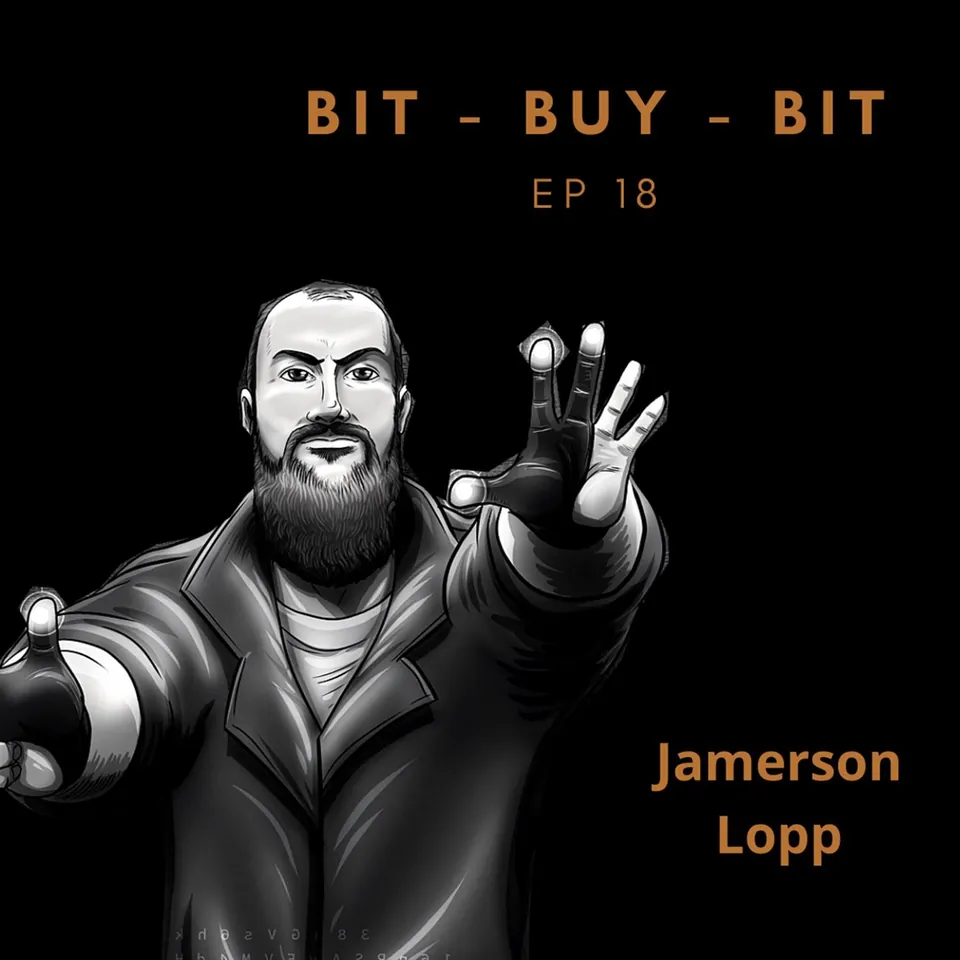
EP18 Bitcoin podcast with Jameson Lopp.
Discussed in this episode
Boost this Episode
Send sats directly to the creators. Value for Value.
Plus 1% to Podcast Index, 1% to Boost Bot.
Show Notes
In todays episode I talk Bitcoin with my guest Jameson Lopp Casa Co-founder & CTO
Jameson also created and maintains lopp.net
If you are interested in bitcoin and have not already visited the site you are missing out.
We had a great conversation and some of the topics discussed are more relevant today than ever. I really enjoyed this discussion and I hope you do to.
Follow :Jameson
Twitter - @lopp
As always please feel free to reach out and ask me any questions.
Website - https://www.bit-buy-bit.com
Twitter - https://twitter.com/Maxbuybit
Email - bit-buy-bitpodcast@protonmail.com
Welcome back to the bit by bit podcast. In today's episode, I speak with Jamison Lop. Jamison created and manages Lop.net, one of the best resources online for people who are interested in Bitcoin. Jamison is the CASA co-founder and CTO. CASA's aim is to
make security on Bitcoin more accessible to the non-technical. CASA provides Bitcoin inheritance, multi-six security and 24-hour support. Bitcoin can be complicated. CASA is there to make it easy for you. At the time of recording, the world's gone mad. People are on lockdown.
Many printers around the world are going "burr" and new laws are being passed to take away your rights. I speak today with Jamison about what I think is the most important technology and our last chance for freedom. That technology, obviously, is Bitcoin. So let's jump straight
into it. Jamison, like I said before, thank you very much for taking the call. If I can start with finding out what is it that led you to Bitcoin, how did you find it? How has it changed things for you? I'll probably never remember the specifics. I know I heard about
it a few times on various geek websites and dismissed it just as many times until eventually some article came along. I'm pretty sure it was on/dot, but it piqued my interest enough that I read the white paper. Once I did that, my computer science interest really got kicked
off. I realized that it was solving an interesting problem that I never really thought about before. As I continued to think more about that from other perspectives, like the philosophical and libertarian side of things, just looking at how money operates because I never thought
about that concept before, it made sense to me that money should be this open project where anyone who wants to can collaborate and try to make it a better thing. The entire concept of money as an open source project was what I also found to be interesting just
from the standpoint of, well, maybe that will end up being more robust, more fair, or at the very least, less likely to be wielded as a tool for certain special interests. I got interested from a variety of different perspectives and started playing around with it, created
some side projects, and then a few years later decided that I might as well go full-time. When was it it switched in your mind? Did you very quickly think, "I just want to work in this space." Or was it a gradual, "You've got sucked down the rabbit hole." At one point, you just thought, "Now I have to be just focusing on this."
Now, it took several years as I learned more and more about the operation, and let's see, I forked the Bitcoin Core repository in 2014 to create Statoshi, which was essentially Bitcoin Core plus a bunch of instrumentation and metrics, because I was just trying to
better understand it, trying to bring more transparency to how the nodes themselves were operating, trying to help other developers understand and optimize various aspects of node operation. I actually applied for a grant from the Bitcoin Foundation, which I never
heard back from them on, and it wasn't until after I had been working in the industry for many years that I actually heard that I had won that grant internally, but then the Bitcoin Foundation fell apart and ended up not paying it out. I would have ended up working probably
more on Bitcoin stuff even earlier if they had paid out that grant for me to work more on that project, but it all worked out. Early 2015, a lot of venture capital was starting to come into the space. I saw more job openings, and that's when I decided I was just going to start applying to any position that I thought looked interesting.
You've done a few things before, CASA, now that you are your CTO of CASA now, what is it that drove you to the way that the business is set up? It seems to me, from reading through a lot.net, some of the things you've written on Twitter, basically, security comes first.
In your mind, it seems that is number one. Yeah, and that's because of the nature of Bitcoin. It is very easy to shoot yourself in the foot. It's very easy to permanently lose either through an attacker or more likely
your own negligence and really lock yourself out of your own wealth. There's a million different things that can go wrong. It's a very tricky maze of obstacles to navigate. That's why if you talk to anyone who's been in the space for a number of years, they most
likely have a story of something that they screwed up, that resulted in them losing money. This is something obviously I learned a lot more about once I started going full-time and working at BitGo, doing enterprise, multi-sig, Bitcoin security. Even though that was a very
well-architected setup, there were still things that could go wrong, usually the result of bad decisions by users. I also personally realized that I was spending an inordinate amount of time, basically a weekend every year, refreshing my own cold storage setup.
That was very convoluted. I had my own inheritance that I set up, which I was not completely confident would actually get executed correctly if I got hit by a truck. I just realized that if it's this complicated for me and I'm supposed to be one of the experts, then for most people
they're not going to go anywhere near the links that I went to. I suspect that that would result in one of two things. Either they're going to have a more fragile setup where they're more likely to lose their private keys, or they're just going to throw up their hands
and leave all their money on the exchange or at some other custodian. Of course, that's against the ethos of what we're building here. It also is creating more systemic risk in the system if a lot of the money is held by a small number of entities.
I have to say, I've only been involved for a few years now. For me, coming into someone non-technical is really scary doing this stuff every time I'd send a transaction or be thinking about how I do my cold storage and thinking through what's the safest way I can do it
and where do I put my seed phrase and all these things. Definitely for normal people, you're right. I think it puts a lot of people off and scares a lot of people. The easy way to actually show the complexity is we have about 40 pages, that's four zero
pages of documentation on our website. That's on docs.cos.cos, which goes through all of our own decisions and threat modeling when we were building our product. If someone reads all of that and internalizes it all, anyone is more than welcome to build their own solution.
I think that one of the reasons we're able to provide a lot of value is simply due to the amount of man hours and thought that we've put into this and all the experience that we have seen of various mistakes people have made over the years. Really, the idea is to
build software where, yes, it is security first, but it's also usability as a component of security because if the software itself is not guiding the user to do things the secure way to follow the best practices, then even if you have a product that is basically impossible
for an external attacker to penetrate and get those keys, you're probably still leaving a number of different possible branches down various decision paths that end up in the user shooting themselves in the foot.
So I always hear that what happens more than anything. It's not the wrench attack. It's more just people making a stupid mistake and losing the coin. I guess that's emissions is still not happening.
There's just so many possible things that could go wrong. It's kind of like insurance, is that almost nobody is going to spend a ton of time thinking about everything that could go wrong in their life. Rather, you buy an insurance policy that covers all types of
different things. This is the same type of mindset that I guess we're approaching as a business. We're helping people avoid all of that overhead of thinking through and planning out every possible contingency and we're kind of wrapping up all of that planning into one
package and as long as you just follow the instructions on the screen, you'll be good to go. And you have this, it's like a key rotation thing. Is that right? You sort of have keys across a certain amount of multi-sick, basically, but making it more user-friendly. Because that's
something I keep thinking about. I've still haven't gone to multi-sick and I just get comfortable with something and then I want some comfortable, done enough research, I change. But from what I understand, you're sort of making that process a lot easier for people to go into multi-sick.
Right. And this is another one of those things where if you start trying to explain multi-sick and the benefits of this protocol feature to most people, their eyes are just going to glaze over and they'll get really bored.
At a much higher level, though, what we're doing is we're systematically eliminating any single point of failure. And that's another thing that we cover a lot in the documentation that I was talking about, where if there's any single point along the line where a catastrophe
happens, it doesn't really matter what. It doesn't matter if we're talking like a physical flood or fire versus an actual thief coming in or even you're made accidentally throwing away your seed phrase or something. If there's anywhere in your system where a single action,
whether by you, someone else or an act of nature or just bad luck, if that can cascade into a complete catastrophe for your whole system, then you've got a major problem. And so by using multi-sig, by requiring multiple different keys in order to sign off on a transaction,
by using the hardware devices that are already available on the market that are made by specialists, we're a software company, not really a hardware company. And by geographically distributing these hardware devices, we can create an extremely robust solution that is resistant to all types
of different loss and also provides a sufficient level of resiliency where even if the user screws something up, even if you lose or destroy one of your devices or even two of your devices, we have a level of resilience in the model so that humans can still make mistakes and
still recover from them. And so you mentioned the key rotation stuff. Like one of the other novel things that we've done, I don't think anyone else is at this point, is we actually got rid of the need for you to store seed phrases. And that was because once again, it just made
the security model so complex and it was very difficult to reason through how a user might store their seed phrases and basically trying to enforce best practices around all that. And so once you get into a multi-six setup, it's actually possible for you to not have to keep track of that because
we built in this key rotation functionality where if you lose a device or otherwise have the device become inaccessible, then you just go into the software and tap on replace device and we walk you through a very simple wizard of go buy a new device, plug it in, and we then help you
rotate out that particular device so that you're once again, you know, reconstitute your wallet back to the full secure state. That's cool. I think the security, like I said before, is one of the biggest things when I speak to people about it and they just go, "Ah, it's too complicated." But when
we're talking about, well, the way you just described it, it sounds pretty simple. Like, I can imagine most people couldn't get on board and understand that and it's got a nice flow and it's, you know, you feel like you, if you make a mistake, it's not all gone. And I think that's the people it scares
them. And now with the way, with the last couple of weeks and the current uncertainty around the world, it sounds like more and more people, it feels to me like more and more people might start waking up and going, "Do you know what? It'd be quite nice to have money that I control and no one
else can fuck with." And, you know, it's going to become, I feel, more obvious. So having these services for people jumping in, it just stops. Like you said, people having it on Coinbase or some exchange, which is not what we want. So, yeah, it sounds so...
The last one events, I think, make it more clear that you do need to be prepared for edge cases. And it's kind of a weird situation of trying to convince someone that, you know, they basically need to buy insurance for events that are unlikely to happen. But if they do happen,
could be catastrophic. And that is why I think, you know, when these events start happening, at least some people will start to open their eyes. But I still suspect that probably the vast majority of people will go through this event and still, you know, not be prepared for
similar types of things, because they'll probably have survivor bias of like, "Oh, I made it through fine with the other one. Anything else that happens, I'll also be fine." Yeah, it's been really weird, especially like all this stuff that we chat about on
Bitcoin, Twitter, and I speak to people who are interested in this stuff. You know, we talk about the scenarios that are happening around the world literally today. And we've been talking about them for ages, and now it's happening. And it feels really weird. It's sort of like
everyone's been saying, "Oh, it's coming." But this meltdown is just crazy. And then how people don't wake up to it, just I find it amazing. I find it amazing that people don't see the value in it, or most people don't see the value in having something that it's completely controlled by you.
And no one can mess with it. You know, I've never come across anything like that before. Even property and the nothing you really are in, because the government has their hand in it. And this, it just seems-- Well, it's kind of a new asset, right? Like you said, and I and many other people have
said, "If you're incapable of actually defending any given asset against attackers, do you really own it?" And once we take assets out of the physical world and bring them into the digital realm, that's the really cool thing about cryptography, is that it now gives the average person an
inordinate level of defensibility at very low cost, if you can use it correctly. And so that's what we're trying to do, is trying to leverage the hardware and the software that's already out there.
The best practices that people have learned the hard way over the past decade of using Bitcoin and wrap it up in a very user-friendly package so that people can attain the level of self-sovereignty that Bitcoin has been promising all along, but has had a really, really high learning curve to
actually get there. So if you talk through, for anyone who's-- I mean, most people who listen to this show already interest in Bitcoin, but for people who are newer to it, if you talk through, say today, someone goes and they buy themselves a couple of thousand pounds worth of Bitcoin, and they then
say, "Okay, I want to actually take control of this, and I want to make sure that this is mine, and no matter what happens, if we have the populace, whatever happens, I control this." What do they do?
If they were to come say to Casa, like, what does that flow look like? They've got their coins on an exchange. What do they do? What would you suggest? Yeah, so the first step is to actually take control of your private key, and so that means setting up a wallet that is generating private keys
that only you know, and there's a million different ways you can do that. You can set up wallets on desktops or mobile devices where it's just the software keeping track of that and storing the private keys on a hard drive. That's only really recommended for small amounts of money because
keeping those keys on a full-fledged operating system that could have a ton of different possible security issues. The next step beyond that is moving your private keys to a hardware device, like a treasure, ledger, cold card, so on, where now those keys are no longer on an internet connected
computer. They only exist on this hardware that never actually has internet access. You can do that for $50 to $100 basically, depending on which device that you buy. Do you have a failure? I always had ledger, then I went to Trezor, and now I'm looking at cold cards. Do you have a preferred
hardware wallet? Well, this is an interesting question because they all have their own pros and cons, and actually we covered those in our most recent blog post where we announced cold card support, and we were talking about why we believe cold card is a great complement to Trezor and
Ledger as part of a full package. But the good thing about Trezor is that it's fully open source. One of the downsides is that there are some known physical exploits where a physical attacker could extract the keys off the device. Ledger, on the other hand, does not have any known physical
vulnerabilities. However, it's not fully open source, but then cold card is actually both. It's fully open source hardware and software, and there are known physical vulnerabilities. However, one downside I would say with cold card, because of how new it is and the fact that it's
using PSBT, which is not yet supported by a lot of other wallets, I would say cold card if you're using that as a single device, that's still more of an advanced user type of setup. It also gives you really cool air gaps, signing flexibility, which Trezor and Ledger don't support to my knowledge.
I think you could get a Ledger Nano X, which has Bluetooth only, but then you have to go down that whole rabbit hole. Suffice to say, all of these devices are designed differently. They have pros and cons, but the really cool thing from a security standpoint is when you start using them in
combination as part of a multi-sig setup, the security properties are actually additive rather than subtractive. While any one given device could potentially be attacked in a certain way, you know that all of the devices are not going to be attacked in the same exact way because they
don't have the same vulnerabilities. You're also getting rid of things like supply chain attacks simply because they're coming from different manufacturers. There's one of the many reasons why having a more diverse setup and distributed key set, we believe, offers the absolute highest
level of security. That makes sense. So for people, if they're to set things up that way, I mean, it's been described to me before that if you were to try and break the encryption or trying to hack or get one of these private keys that basically it would be something like you'd
have to choose two grains of sand on the planet and someone would have to guess which ones they were out of or some sort of crazy number like that. Does having it put onto multi-sig mean that it's even more complicated and even less likely? I'd have to do some math, you know, but I think
suffice to say even if it is, you know, from a cryptographic standpoint, even harder to brute force because multi-sig is a more complex script, you know, we're already talking so astronomically high from a computing standpoint that, you know, you're basically talking about like needing quantum
computing to even make it feasible and even then Bitcoin scripts are quantum computing resistant if you haven't spent from them, which is another reason why address reuse is a bad idea, not just privacy standpoint, but also potentially quantum computing standpoint. But really like
when we're thinking about the most likely types of attacks and losses, you know, brute forcing is already pretty much out of the question. The next level down is just like general hacking and so you get rid of that by using dedicated hardware devices and of course there's all the different
loss vectors of just something goes wrong and a device gets lost or destroyed and at the end of the day, you know, if you get a really well-designed setup, then the only thing that you should really be having to worry about is some sort of phishing attack or or even, you know, malware that is like
making you think that you're sending your transaction to one address and it's actually going to another and the way that that's another good reason why we use different dedicated hardware devices is that even if you somehow got malware on your phone when you were like initializing a spend
out of your CASA wallet, you then have to go and confirm the value and the recipient addresses on multiple, you know, diverse hardware and software so that, you know, even if something happened to your device or to our software, none of those are single points of failure. Yeah, that makes
sense. The other thing that I had a question with, multi-sig, say for example, you were trying to control, you know, maybe you bought a little bit of Bitcoin from one exchange and then some was bought in cash and then some is sent from another wallet and you didn't want to have those coins
all in one wallet because then it's more trackable. If you were to have, say, a multi-sig set up, is there a way of setting it up so you could have one multi-sig set up but you could have, say, 20 different addresses and there's no way that those touch each other. Does that make sense?
Yeah, yeah. So this is basically a sub-accounts feature and I don't know how DP want to go into protocol level stuff but basically like the way that a wallet creates the addresses is a standard for address derivation and you just have these different numerical paths
and you can increment the path and it's part of the standard where if you increment one part of the path that's considered to be like a sub-accounts under the main account. So it's certainly doable and it's a lot easier, I think, to do it that way as opposed to the other way which is you have
one main account and then you're still depositing everything in there but then you're having to manually control each individual UTXO. That gets really invested. It's like coin control, basically.
Yeah, so coin control. I know Bitcoin Core and Electrum both offer coin control at CASA. You do have coin control at the address level, not at the UTXO level because it basically ends up being the same thing from a privacy standpoint but it's still annoying to deal with and I don't
recommend it. It's definitely easier to use these sub-accounts. Okay, and so if you make these sub-accounts then those coins don't effectively touch each other and there's no way of anyone saying, "Okay, well, this person has...
that we can tell that this person has these two addresses and that these coins are from here and these coins are from there and they can link it. It's kept separately. Yeah, and I mean that's the tricky thing about on-chain privacy in general is if at any point in the future those funds get co-mingled and you send both of them
somewhere or essentially you end up spending those UTXOs at the same time or I mean there's a million other heuristics that companies like Chain Analysis use to try to come up with at least a percentage probability that certain funds are owned by the same entity.
It's a very... I mean privacy in general is very difficult but on-chain privacy even more so because this is a permanent history and one single mistake can potentially link any number of different funds together. And it's there forever, right? That's the problem. Yeah, it dirty bastards
these Chain Analysis. They drive me crazy. It's so frustrating because that's always the one thing with me. I just almost get scared to do anything because I think well I don't understand these systems well enough to know if I'm doing something wrong and then you think oh well I make one
mistake like you said and it's there forever and all the things you've tried to do to keep your privacy then you've lost it from one mistake. Do you have high hopes for things like world pool and lightning network and all these sort of things eventually overcoming these problems?
I think second layer solutions will have much better chance of offering stronger privacy simply because you're no longer broadcasting what you're doing to the entire world. The main problem with mixing in its current form is that even if you do manage to mix your funds with a sufficiently
large other set of participants and I would argue that currently they're probably not sufficiently large enough not enough people are doing it. You have this problem where it's highly obvious like you're creating once again heuristics around these coin joins are so obvious that we've already seen
several different services start to ban users that were mixing their coins and it's because the service doesn't want to take the risk of them potentially accepting funds that are used for some activity that they can't track and that's kind of ridiculous because I don't think that there's
anything even similarly analogous to that in traditional fans you know if you deposit a bunch of funds at a bank they can't trace you know where it came from more than one hop for example but on the blockchain you trace it all the way back to wherever and so you get into this really weird
situation of quote unquote taint analysis and then the question is like how many hops does the money have to go before you're no longer culpable for whatever it may be? It's such a weird you know it's to me it's just crazy that it's even something that
should be considered as you know this is to me I think well it's the latest digital cash and don't do a cash if I go down to shop and I buy a paper I'm not going to they give me the change back and then I can't get stopped and said oh well you know where did you get that change and where
was it five pops before you know no one cares it doesn't make any sense. At least in America we do have the unfortunate civil asset forfeiture stuff where you know cops can basically say oh you're carrying too much money on you and we're going to assume that that's drug money because why else
would you have ten or twenty thousand dollars in cash on you unless you illegal activities? Yeah but yeah it's crazy it's absolutely crazy. Would you hold out high hopes that this stuff obviously for someone like yourself and people who understand these systems well I'm sure that
you know these things are durable but for the normal people who just wants some privacy do you think that you know the next say five years we're going to see large improvements or is it all things that I've heard a lot of talk about there needs to be changes on the protocol level to make
it so that say coin joins aren't so obvious and then is Adam Gibson who's doing this pay join or something? Yeah yeah so you know Adam Gibson is one of the maintainers of join market he also did a present he's done a number of presentations on pay join on the VR thing wasn't
it? Yeah yeah yeah and that's awesome yeah I think the most interesting thing in terms of what we traditionally consider to be a coin join because I would say pay join is kind of a different kind of coin join than we normally think of you know normally we think of large group of people coming
together and just mixing all their money together I think the the most exciting thing on that front is going to be signature aggregation that will reduce the fingerprint on chain of these coin joins that are happening okay so they will they will look the same as any other transaction
basically that that's definitely the goal will it happen the next five years I think so I mean we should be getting snore signatures hopefully in the next year or two I mean the code is already written the spec is up all all that really needs to be figured out is deployment then of course that
tends to sometimes end up being the most fun controversial part though I'm not aware of any strong arguments against signature aggregation what what you end up having more controversy over when we're talking privacy is super strong privacy that's more experimental you know stuff
like zk snarks where you're actually you're completely hiding the values of the transaction and and where it's going and the main issue with that is that it bumps up against another a fundamental property of Bitcoin which is you know the auditability of the total money supply
and so while privacy is I think very highly ranked in terms of desirability I think that auditability of the total money supply will always end up trumping privacy yeah that makes sense and say this obviously this would have been thought of but I just thought I'd ask say you had
like a way of changing you know how you have like liquid liquid and you sort of you have Bitcoin which then is turned into a liquid token or I don't know how you describe it exactly but then that's basically one for one would there not be a way of doing a similar sort of thing with
Bitcoin and having like a setup where you have I don't know ring signatures or something you had like it almost transformed into a Monero-ish type coin that was just the same one Bitcoin one oh yeah and you use that so you know you can create a side chain the the main problem with side
chains that I see is that no one has figured out and deployed a trustless pegging mechanism you know there is the drive chain concept from Paul Stork that I think is interesting but also seems controversial mainly due to you know the power that it gives to miners to potentially
misbehave you know you don't even think it takes six it's six months it's got to be locked up for uh yes it's it's something like that and it's it's complicated it's been a while since I've looked at it uh unfortunately it seems to be fairly controversial though I do think that they will
eventually launch a side chain uh or a drive chain of some sort uh as far as I know they're still working on it but um you know even liquid you know you don't need to create a new side chain you can use liquid if if you peg into the liquid or you can do a atomic swap basically into liquid
or at least theoretically I know I think some have done been done but I don't think it's extremely user-friendly at this stage um then on liquid uh they do have the uh confidential transactions enabled which um obscures the addresses uh in the transaction I think the values are still in the clear but
the addresses are not and so um I've actually I think I've I've kind of brought this up a few times before never really got an answer it's like I'm not aware of any reason why we couldn't set up mixing pools on liquid uh that are a major improvement uh in comparison to to mixing
on uh bitcoin uh I'm just I'm not aware of anyone who's actually gone down the the path of trying to write uh coin join software that does confidential transactions or you know if there's any hidden gotchas there of why you wouldn't be able to do that but um it's also you know in general
perhaps what will end up making more sense than doing on chain coin joins will be doing maybe you know a series of atomic swaps uh and you can do those on chain or you could do them with lightning um the whole idea there being that you know you break the linkability by simply going to
a different blockchain so there is no real link uh right yeah I see but you know I think those are just still mostly theoretical concepts where uh no one has actually tried to build something um you know there are projects that are working on atomic swaps but um as far as I'm aware like
there's not any extremely user friendly ones um but I also haven't really had time to play with many of them I know we had uh an interesting presentation at MIT bitcoin expo from rwin uh and they've figured out uh they've made an improvement upon the traditional atomic swap operations which
basically leverages some like ethereum smart contracting um to to store these pre-images for hashes so you're essentially doing something that's similar to you know a hash time lock contract except you're you're basically operating it across two different blockchains hmm that's interesting
I guess like you say these all these sort of things will happen on second layers and it just takes time I guess it's uh it just it feels it feels like it takes time when you sort of uh when you're interested in this stuff and you're just chomping it a bit but yeah these things take
time and it will come but do you have some sort of plans within cassock you have the nodes and am I right in saying you're not supplying or selling those anymore right and actually uh tomorrow so maybe even before this gets published we're going to be um publishing um a how to build your own
basically do it yourself cost a node guide um since we we have stopped manufacturing and shipping them uh but you know we still want anyone who's interested to be able to use that um on their own and um it's something that we will probably revisit at sometime in the future uh just for now
we're going to be focusing on our you know original mission with helping people you know secure uh their wealth it's I think a much higher value proposition whereas the new stuff is much more cutting edge and it's interesting but it's people aren't putting their life savings into you know
a lightning node no and it's sort of it's more important that you have everything safe that's I guess that's step one isn't it and you know making sure that you feel comfortable and things secure that's interesting you open up actually do that because I'm ordering the raspi and a few bits and
pieces and I was looking at my node where I was really leading with this question was um if we have technologies like lightning and the usability gets better and better can you imagine that given time you do have a sort of a node at home and everything just runs through there and you can
store your data and you can you can have your uh you know lightning on there and you can have have everything sort of uh I don't know how I'm phrasing this question but basically that you have everything controlled by yourself and that given time we can have less and less of our data
sort of sat in silos and controlled by other third parties is is that realistic is is it sort of a dream to say what we take back control of more and more of our data well yeah I mean this is actually a cycle um this has happened before and it may happen again and you know in the in the
very early days of computing um all the computing actually occurred on mainframes and you would have a lightweight terminal that you would connect to that mainframe and request you know your various data and computing operations from and then we had the advent of the personal computer where you know
we we grew by orders of magnitude in uh computing power so that you could actually afford to have an immense level of computing power in a machine that's you know in your home and so at that point all the data all the processing went mostly away from the mainframes and became more
decentralized in people's homes and then in the 2000s area you know that as the internet started happening it's the pendulum started swinging the other way where we would have we would still have our personal computing devices but a lot of the data was getting sucked up and stored and computed
mostly for marketing purposes uh by the the quote unquote cloud and now even today um you know cloud computing is is able to operate at such a cost-effective scale that it's in many cases it's cheaper for you just to buy a subscription to like a dropbox or a google drive than it is for you to actually
buy several hard drives that you then manage yourself and you know create redundancy for and so it's quite possible that we see the pendulum start to swing back yet again but i don't think that it will happen just in the sense that we go from doing cloud to for everything
back to doing everything on a device at home rather i think what needs to happen is i think the cloud needs to migrate to these um you know many computer at home devices uh by by which i mean you know that the reason that all of these enterprise cloud computing stuff has become
so popular is because it abstracts away all of the boring IT administration stuff you know just dealing with redundancy and hardware hardware failure and other natural disasters you know click real cloud computing companies mirror entire infrastructure across different continents uh
at that level and like you know almost yeah it's going to be able to have the resources to go to that extreme and and so it makes sense because you're buying a lot of uh security against those type of losses of course you're losing a lot of security in other ways by handing all your data
over to a third party now if we can get the best of both worlds if we can start to build decentralized clouds where your little mini node at home is actually participating in a like peer-to-peer decentralized storage network for all types of different things that's how i think we might be
able to get the best of both worlds and you know we learned a lot about that at kasos shipping out all these nodes over the past uh year or two in that uh you know there's still a lot of just IT administration headaches of deploying devices into unknown networks uh you know people had all
kinds of crazy network setups um with different ISPs and you know you need to be able to abstract a lot of that away to really make a uh plug and play device that also has all of the resiliency of uh this cloud computing hmm it just that would be so cool if that's doable when i was
looking at the mine node stuff i was looking at it had sort of you know little thing with vpn on there and then it had tor and it had all the other bits and then it had your wallet and it had lightning and and i was just looking at that dash dashboard you'd call it um yeah and i was looking at it and
i was just thinking how cool with this beer you had your photographs or your documents and you know everything that you'd have on a computer and like like you were describing you have it as a system where it is some sort of decentralized cloud computer and you control everything on there but you can
still you can still use it from wherever you are because i think that's the thing it's like you don't walk around with a hard drives in your backpack or whatever you know you want to be able to jump onto a phone and still be able to use these things but if that was possible i can't see why
people wouldn't switch across to it because i think people in their gut feel things are wrong i think maybe they don't know you know with things like facebook and everyone having your data and i think people feel uncomfortable they just don't know that they could be another way and it's become so
easy now with with like say that they've they've made it so easy to store your data with them that it kind of has to be as easy or close to as easy for them to switch yeah i mean i think it really comes down to convenience and i think part of the problem here is if we're talking about building
open systems then often convenience gets left by the wayside and usually open source systems are designed by engineers who are going to be prioritizing things like security and scalability but there's usually a big gap on the usability and convenience side and so that'll be an interesting
question to see how that progresses i mean you can kind of look at similar things of Linux for example i mean i've been a Linux user for 20 years and the experience has immensely improved especially over the past 10 years or so and you know you could probably have an entire show or
thesis about why that's the case but you know i can only hope that we'll see similar things with you know this particular set of industry maybe it maybe it just takes time but it feels like that's the way things would naturally slide i feel like enough people are sick to death the way
the things are and if enough people want it presumably it will eventually eventually come along but well you know there's some um sort of crowd theory around all of that of that um you only really need maybe five to ten percent of people to go through a higher friction experience
and be early adopters into technology that is sufficiently superior so i think that the vast majority of people simply don't have the time to think about these things they don't i'm sure they would care if they had time to sit down and think through them but you know people are worried
about other things and you know viruses and stop walking crashes and people like us have the privilege that we're in a position that we can think about some of these more esoteric and theoretical edge case you know black swan type of problems i mean i think the average person is
just worried about you know their next paycheck and insurance and food on the table and you know just living there sure yeah for sure that's that's definitely true and then like you say maybe a ten percent go through that friction then it changes for them as well that would be nice
so um if you've got anything that you're particularly excited about that's any developments within bitcoin or lightning that are particularly exciting to you at the moment um the biggest thing that i think is going to happen in the next year or so is taproot
mass snore um you know that's going to significantly expand i think the usability of bitcoin scripts both from a scalability perspective and a privacy perspective we're going to see much more complex bitcoin based applications coming out though the keynote that i just gave the other week at the
m.i.t bitcoin expo is kind of a warning to the developers who are going to be working on that you know that there's going to be a lot of increased complexity under the hood and we need to think about how we build these systems so that they are protected against disaster scenarios
and you know without going too deep into the weeds of the technical stuff basically it comes back to what we were talking about earlier you know getting rid of seed phrases because even just giving somebody 24 words and telling to keep it safe is just you know the tip of an iceberg of
a whole mountain of it and security knowledge that i think most people are going to need to avoid if they want to actually be able to operate safely and securely in these systems you know we we need to continue to work on usability so that the average person can feel confident in taking
control of their digital assets you know the flip side of this equation you know and the reason why it is a double-edged sword it gives you it gives you power but it also gives you the responsibility to wield that power because if you use it incorrectly if you make a mistake there
is no one else with the power to save yeah sorry for your loss yeah so with um this is what i don't particularly understand with shnoor that from my basic understanding shnoor would uh replace ecdsa is that correct and if it was to replace that is it just a security uh but it
helps with or does it have other impacts does it change other things switching them yeah so you know this i believe it's actually like a different set of uh public keys and of course the the signatures
um you know this is it's not a new method uh for you know cryptographic signing but it was under i think a patent for 20 years or so and you know is it going to change things like i think you know
one thing i haven't actually even looked into is like will existing uh you know hardware devices for example be able to easily support this um we we i mean we do know that we're going to be able to um to roll it out in a backwards compatible fashion so it's not like people are going to have
to start using it and that would be similar to the way segway was rolled out and it can be very tricky to have a wallet that you're maintaining that then has a major change like that uh you basically each wallet developer is going to have to figure out how they want to do their own sort
of migration of uh different UTXOs different uh scripts that they're creating um but you know at the really low cryptographic level you know even i don't really go down that low into understanding the actual constructions of the cryptography for a lot of things does it change anything more
than security then or does it give because it gives you more ability to do more things changing from the or changing to Schnorr or is it is that just one part of many changes that they're looking to uh like taproot and Schnorr and all of these they sort of get bundled into one software update
or whatever you would describe as so i think one of the reasons why Schnorr was uh preferred is that it does have provable security um right you know this is more of a theoretical thing and then it's
beyond my understanding um i don't know if you know anyone there's i mean it also it just it has some other properties to it that um i i think it's some of the mathematical properties under the hood that make it possible for you to do the signature aggregation um and and this is basically that um
i think it's like a a summing of of all of like a group of public keys um obviously the protocol developers can tend to explain it better than i can but this this property allows you to you know have a group of of public keys that essentially sum to a certain number and
you know that like no other possible set of public keys could have that same property and the sort of linear nature of the math then allows you to have the signatures basically be
aggregated uh you know it's so that like you don't you don't have to show every single signature to someone to prove that it's been signed but rather you can show show the sum of all the signatures and uh okay i wonder who's viewing it can have that same assurance you know there's some mathematical
proof around that that gives you that insurance okay yeah okay all right that makes sense because you know i i hear a lot of you know these things oh you know they're trying to get them done and that you know people are arguing over certain things so i hear these notional and taproot and
things and unlike it some a lot of this just goes goes well over my head and yeah it's just it's interesting to know why some of these things are going ahead but that that does sound like something very worthwhile thing to do but yeah i mean these are the things that uh
more experienced protocol developers you know spend years looking into and you're trying to save you know a few bytes here and there uh you know just trying to keep the cost of operating the the system as low as possible while continuing to expand the functionality for end users like us
hmm well i'm very grateful that they do i'm very grateful so james and like i said i don't want to take too much of your time i know uh what it's late here i don't know what time are you there you're are you eight hours behind us america america but yeah i just i wanted to just finish up
on asking you obviously from reading through lot.net and uh and hearing you on another podcast it seems that above already you care about freedom and and privacy and i just wanted to hear from you do you feel confident and and what is your what's your outlook over the next say 10 15 years
and then do you feel that bitcoin gives us some hope to turn things around and and to it feels to me like we're on a tipping point and sometimes i feel positive and sometimes i feel negative about how things are going to play out and my fear is 1980 for george or well
sometimes it feels like that's coming but you obviously spend all day every day fighting a good fight with this stuff how do you feel it's going to play out i'm confident not for any particular technical reason but rather because of the original reason why i got into it all which
is you know creating an open collaborative project where anyone who wants to can help contribute and coordinate and just the properties of a project that is architected in such a way mean that you know you can essentially create this hydra so that there is no single point of
failure in the projects there you know there are certainly plenty of large actors and participants that play various roles in the system but it's it's sufficiently spread out and and sufficiently large enough at this point i think that um you know it's even resistant to nation state attacks so
the the way that i tend to put it is that bitcoin can't die until we all agree that it's dead and then we all agree to give up trying to work on it and improve it and you know just from that like philosophical standpoint you know that's why i think that we've already gone past the point
of no return um it's very hard for me to envision a scenario where everyone around the entire world decides to give up on it i mean we've even seen nation states like india and china you're cracked down on it a lot and sure you know there's a loss of confidence but never to the point that the
people like myself you know who have basically dedicated our career to working on it uh in many people who have you know volunteered a lot of their free time and their skills to working on it um i i think it would be it would create a disaster or require a disaster of proportions that i can't
even really imagine to sufficiently disillusion all of those people mmm it does feel like that and i'm not technical or of any use really but i it's something i would never give up on as long as it's possible because i believe that this is our best chance of freedom i think it's it's such an amazing
opportunity it's such an amazing system and uh you know i i think most people who are involved in this it seems that they all care so deeply i think you're right it's uh for people to give up i don't i don't know what it would take so uh yeah well i think you're right you're fine
yeah hopefully not hopefully not all right well um yeah like i say thank you so much for joining me uh in terms of really enjoyed chatting and it's been really useful to go through some of these things that um go well above my head and i'm hoping to get one of these VR headsets soon so uh maybe
we will meet in virtual reality at one of these meetups or something like that great i'll see you in cyberspace all right fantastic yeah thanks again and i'm gonna link lot.net and casa in the show notes so anything else you want to finish on or anything you want me to add in no all good
okay fantastic all right thanks a lot hopefully we're speaking cyberspace thanks bye cheers
Machine transcript; expect the odd mishearing. Click a passage to play from there.



