
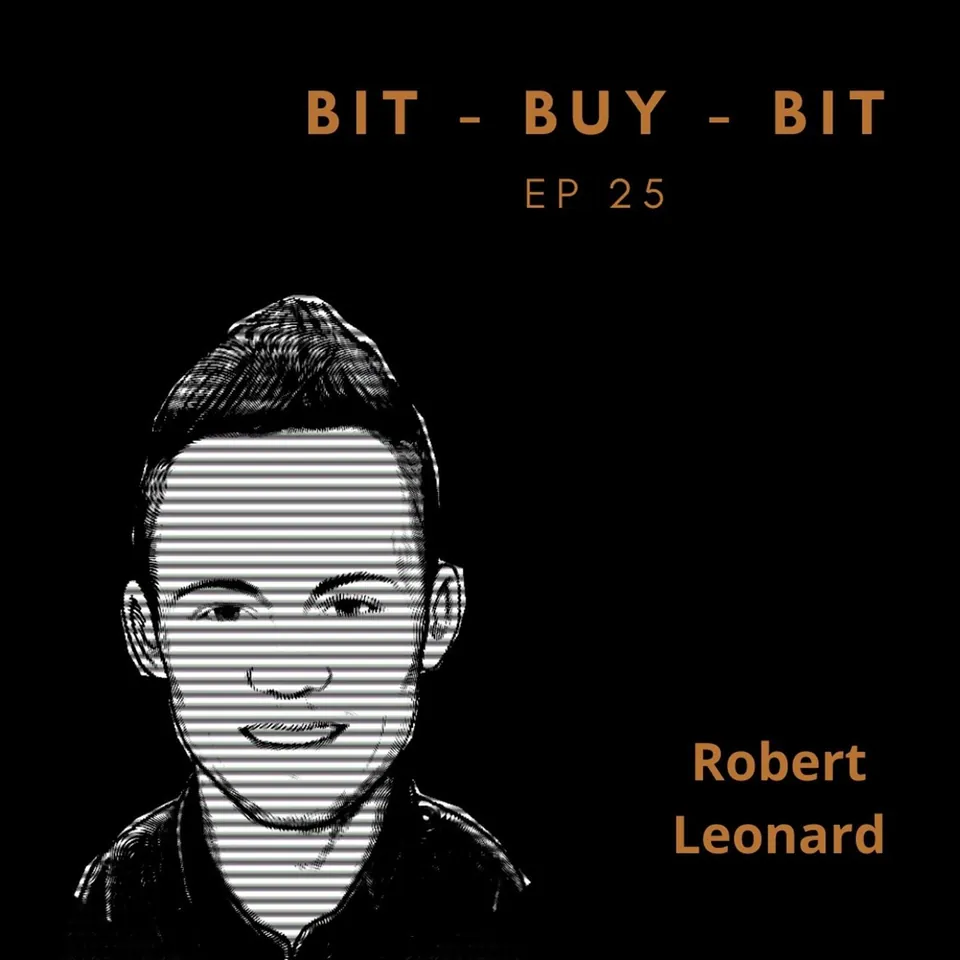
EP25 Bitcoin podcast with Robert Leonard.
Discussed in this episode
Boost this Episode
Send sats directly to the creators. Value for Value.
Plus 1% to Podcast Index, 1% to Boost Bot.
Show Notes
In todays episode I talk Bitcoin and more with my guest Robert Leonard. Robert is the Host of Millennial investing and Real estate investing on the investors podcast network.
Website - https://www.theinvestorspodcast.com
Twitter -@robertattip.
As always please feel free to reach out and ask me any questions.
Website -https://www.bit-buy-bit.com
Twitter -https://twitter.com/Maxbuybit
Welcome back to the Bit by Bit podcast. Today's episode, I'll be speaking to Robert Leonard. I listened to an episode with him and Preston and thought it was really interesting. It's not all about Bitcoin this show. We talk a little bit about stocks, a little bit about
property. The sound quality on this show is not great. I've had a few problems in the last couple of recordings. I think it's been because of my internet connection. So I apologize in advance for that. It's a little bit patchy in part, but yeah, I've done my best in the
editing to clean things up. Anyway, I hope it's an enjoyable and any questions, as always, just reach out and ask me. All right. Just wanted to say firstly, thank you for joining me on the podcast. I listened. It must have been about a month ago to one of your episodes
on the Millennial Investing podcast and really enjoyed the style. It was nice to hear somebody who seemed like you had a low time preference. It was not talking about overleveraging yourself or anything like that. It all sounded very sensible and the sort of advice I'd want
to give to friends and family. So I thought it would be great to have you on. This show is normally just mainly about Bitcoin, but maybe we can touch on property and stocks and some other bits and pieces. So if you could introduce yourself to the listeners,
that'd be fantastic. Yeah, absolutely. Thanks for the kind words. I appreciate that. Yeah, so I'm Robert Leonard. I am the VP of Growth and Innovation at the Investors Podcast. I also host two podcasts on the network. And like you mentioned, one is called Millennial
Investing. On that show, we talk about stock investing, personal finance, and slide hustles mainly. And on the real estate show, we talk about all different aspects of real estate events.
How long has that been going for? So the Millennial Investing show has been going for about eight or nine months and the real estate show is about three months old. And is it your first time doing podcasts or have you done it before? Yeah, so Millennial Investing was my first time.
Have you found it? It's good. It's great. I really enjoy it. I get to talk to a lot of really great people. It's harder than I expected, honestly, but it's a lot of fun. It's very fulfilling and I get to learn a lot of things. It is hard, isn't it? A lot of people
just seem to think you just record and that's it. There's no prep and there's no advertising and all the rest that goes along with it, but it's certainly time consuming. Yeah, and you can certainly do that. I mean, anybody could open up their iPhone and record a podcast,
really. But if you want to do a high quality podcast, a great guest, it takes a lot of preparation, both on the front end, the back end, and there's a lot more that goes into it than just hitting the record button. So what was it that led you down that path? How did you get into podcasting in the
best place? It's a bit of a story, but basically, long story short was the first podcast I ever listened to was called We Study Billionaires, which is the legacy show and our flagship show at The Investor Show. Preston, isn't it? Yeah, with Preston and Stig. And so that was the first
podcast I ever listened to. I was a value investor, and they were the biggest and most known value investing podcast when I started getting into podcasts about four or five years ago, and I listened to the shows for a long time. And then about a year ago, they were talking about
how they were looking for some hosts for new shows. And basically, I was able to get involved with them, became a host of one show, it did really well, it's continuing to do well, and we decided to launch a second show, and it just kind of continued to evolve since then. That's brilliant.
And so it sort of happened organically then, something you're already interested in that must be nice to do, something where you already have that passion. Yeah, I used to, and I still do, but I used to really look up the Preston and Stig, and I listened to their content very consistently,
and I learned a lot from them. So to be able to join their team and work with them has been amazing. Preston, that's actually how I came across your podcast in the first place, because I follow him. He has some of the best Bitcoin content out there. He's a very clear thinker,
and there's a lot of noise in this space, but he's one of the people that every time I see a tweet from him, I know that it's going to be a quality content, so it must be nice working with him.
Yeah, it's great. Preston has taken me under his wing and really mentored me a bunch on Bitcoin. He's very, very smart. He knows a ton about Bitcoin in general. I know very little, but I'm still learning from him anytime. I have him very honored and thankful to have the opportunity
to be able to learn from someone like him. It's been great. You were saying, obviously, you run the two different podcasts. You have the Real Estate one and then the Millennial Investing.
What side do you lean more towards in terms of your own interests? You sort of in between the two, what do you prefer, Real Estate? You know, that's funny that you asked that because my answer today is very different than it would have been two or three years ago.
And the reason for that was growing up, and I'm only 25, so when I say this, it's going to sound kind of funny, but for the last decade, really, or for a decade, the only thing I believed in was stock investing. That was what I thought was going to be my way to wealth. I thought that was just
the best thing that anybody could do. I knew about Real Estate, but I didn't think I could do it. I thought it took a lot of money and I thought you had to be a very sophisticated investor.
Anybody that I ever known that was a Real Estate investor, you know, was doing very well for themselves. So I just didn't think it was something that I could do. And then I more or less stumbled into my first investment. And I realized that I was a Real Estate investor without really knowing
it. And from there, I decided to learn a lot more about it. And I realized that there's a lot of people from Real Estate investing and being very successful at it, and they were no different than me. And so I really started to dive into it. And I realized quickly that I could do it too. And
ever since then, I don't know if I'd say Real Estate has overtaken me in stock, but I think they're at least equal. There's some very, very attractive benefits to Real Estate. And I'm here in the States, but a lot of the tax advantages that come along with Real Estate are in leverage, of course,
are incredible. Yeah, the leverage is one that really, once you get into that game and you work out how to play it, it can be pretty amazing what you can do in the future years. Yeah, exactly. The leverage is huge. When you first got into it with Real Estate, was it
just something that was residential for yourself, or did you go in commercial, or was it residential, but buy to that? Yeah, it was residential for myself, actually. So when I was growing up, my parents always told me that I was going to have to pay them rent when I got my first
full-time career, you know, paying me a salary. And I thought that that was fair, but I just personally didn't want to have to pay rent as soon as I graduated college. So I knew that going into college, I saved up as much money as I could while I was working, and I actually bought
a condo before I walked at my college graduation. And so I lived there for about two or three months, and I realized that the place was pretty big, and there was a bedroom in the house that I never went in. I don't think I opened the door a single time since I lived there. And I said,
"Well, I should probably do something with this and make use of it." And so I set out to find a roommate, and I found a roommate. And the next thing I know, he's covering $700 or $750 of my $1,100 mortgage, and I'm only living for $400 a month. And I said, "Wow, this is pretty great."
And I didn't think anything of it for about six months, and then somehow I stumbled upon something that talked about house hacking, which was exactly what I was doing, but I didn't know that it was at the time. And I started to read upon it, and I said, "Well, that's exactly what
I'm doing, and those people are considered real estate investors." And so I realized, well, now I'm a real estate investor. And then from here, I had the confidence to continue to learn about it and do more. And the next thing I know, I've been buying an investment problem.
It's weird that it's this impostor's syndrome that everyone feels when they're new to an industry or new to something, we always feel like, "Oh, well, you know, it can't be me. I'm not sophisticated enough about it." And then you realize, "Well, hold on, I am doing what
the other people are doing, and it's working, so yeah, I am." It takes a while to get over that. Exactly. It was at that point that you thought, "Well, okay, maybe there's something to this, and stocks on the people, and then it started to grab your attention away."
Yeah, I think it was really when I started to get that cash flow coming in from the pennant. It was just my mortgage had just cut in the third, and I didn't do anything different. My life didn't change at all. And it was just something that you don't really see much in stocks
that cash flow. Of course, you can buy dividend bank stocks into that nature. But it just was very different for me when I was actually getting the cash payments every month. That was just really enlightening for me to realize that real estate was a great alternative.
Yeah, it is. I don't obviously know the market over in America, but certainly in the UK, it's just been on a tear for the last 30 years, 40 years, and anyone who's helped these assets has done very, very well. It's changed a little bit here, though. I don't know what it's like
over there, like I say, but for me, certainly that was my background, this property. I was investing for about 15 years, and I've actually come out of it almost totally now because the regulations have become such a pain in the arse, and it's all become a little bit more hassle than
it's been worth for me. Have you found that over there that you've had the regulations have changed and made things harder, or is it the same as when you went to the market? No, it's really still the same, more or less. You're seeing a lot of the regulations in the Airbnb market, which is a market
that I don't tend to participate in currently, but that's where I think a lot of the regulations is going to be an issue in the Airbnb market. I suppose probably from hotels and they're all probably putting pressure on regulators because it kind of destroys their business model a little
bit, doesn't it? Yeah, exactly. Commercial-wise, anything that you've jumped into with commercial property or has it always been residential? No, it's all been residential so far. I plan to get into the commercial space sooner rather than later. It just hasn't yet. What was it that I imagine it's
going to be speaking to Preston? Was that your first touch with Bitcoin speaking to him about it? Or is it something that you'd heard of before or invested in before? How did you stumble across that?
Yeah, so again, it's kind of funny. Basically, I think it was back in 2017, maybe late 2016, early 2017. When Bitcoin was about, I want to say $1,200, maybe $1,300, I bought one because it was the craze. It had gone up significantly to where it was and I said, "You know what, I'm going to buy
one." And I bought one and then I literally sold it the next day or two days later because I didn't feel comfortable owning the asset. I'm the type of person. I run a very concentrated portfolio with my stocks and I have no problem with that. I like risk but I like risk and I like
a concentrated portfolio when I understand what I'm owning or what I'm investing in. At the time, and even still to this day, I don't fully understand Bitcoin so I was not comfortable with that investment. So I sold it and it ended up going on a tear. If you follow Bitcoin, you know that it
ended up going on a tear to $20,000 and I missed out on a lot of money. But I was okay with that because I wasn't comfortable with who I was owning. And so that was really my first foray into Bitcoin. And for maybe two and a half, three years, I didn't do anything with it since. I just kind of
kind of watched it, read a little bit about it here and there. And then in early 2020 or late 2019, I just really started to notice how much Preston was taking an interest in it. And like I said, I've followed Preston and Stig and just the entire TIP company for a long time. And so I value their
opinions. And so, and I know Preston at heart is a value investing guy and he's been a very hardcore value guy. So to hear somebody like him who's a hardcore value guy go into Bitcoin, it really picked my interest. I said, you know what, if there's somebody like Preston that can be as into Bitcoin
as he is coming from where he has been, I think it's something that I should at least look into. And so I ended up having some conversations with him. And I have met quite a few times to discuss it. He's taught me a lot. And I continued to, we've recorded a couple episodes about it.
I continue to talk to some people about it. And I haven't read my first Bitcoin book yet, but I'm actually planning on doing that soon. So that was pretty much how I got invested in are interested in Bitcoin. Preston taught me a lot. I decided to buy some back in March around
4800 or so. And of course, it's done well since then, but it's the short term. So I'm not really too excited or, you know, we're even really worried about it at this point. It's more of a long term hold for me. But yeah, so that's basically how I got got into Bitcoin originally and how I got
back into it today. It's interesting. You say that about holding it for a couple of days and then just getting it sold because you didn't understand it. I mean, a lot of people will say, oh, yeah, you missed out on all the games. And that was crazy. But I think that's actually very wise because
it's incredibly complicated. And, you know, people who've been in this space for five years, seven years, eight years will still say, oh, we're still learning. You know, it is very, very complicated. And to throw money at something that we don't understand is not the best thing
to do. So it was probably wise and coming back to it the second time after you've seen what it's done, I imagine you come in with a fresh pair of eyes and having someone like Preston to teach you is very useful. I actually listened to that episode with the two of you going through it. And
I could sort of hear a few times where things were clicking with you and you were just, I could almost feel that you were like, okay, yeah, your interest was growing as you were speaking to them.
Yeah, exactly. It really is super interesting. It is complex. It takes a lot, a lot to learn. But like you said, if you don't understand it, to me, the upside just really isn't worth it for me because that could have gone to zero. And then I would have been really mad because I
wouldn't have understood why. And it's the same thing for stocks. And I don't do it anymore. I don't invest in things that I understand. But it's the same thing is if you buy something and it goes up and you didn't understand it, you didn't make a good investment. You speculated it, you know,
just happened to work out for you. But it very well could have gone against you and you would have had no understanding as to why that could have happened. And so that's where I was with Bitcoin at the time. And thankfully, I had to wear with all to understand and feel that way
and make a different decision. And hopefully, you know, buying into it now and I understand a little bit better, you know, make up for those gains that I lost out on. But yeah, that was, that was my thought process. What's your view with everything that's going on now? Obviously,
you're quite well positioned as somebody who's betting you to Bitcoin but also interested in the stocks and property. You sort of sit in between the biggest asset classes going forward. What's your view of the macro landscape at the moment and what's going on in the world? How has it
changed the way that you look at investing? Or has it changed the way that you look at investing? It hasn't really changed the way I look at investing. Think about it kind of like Warren Buffett does. He's not much of a macro guy. I tend to just invest where I see value.
If I have some extra cash lying around and I think I can get a better return out of my favorite stock, then I'm going to buy that if I have, because of the valuations of presenting themselves in a way that shows that there's expected returns to be of X percent. I think I could do better in
a rental property. I might buy that or do a flip. I might do that. And Bitcoin, I'm not necessarily putting my extra cash into right now. I'm just trying to keep that at a relatively small, but stable percentage of my portfolio and just kind of watching it.
I expect to probably add to that as my understanding of the grows. But for now, it's really between real estate and stocks. And it also depends on where I am in my life, because there's different points in people's lives where if they need more cash flow,
then they're going to go, typically they'll go to more real estate and you can get higher cash flow. And if you're not too concerned with the cash flow and you just want to really just work on appreciation, you can go to the stock market and do very well there. So it really depends on
what I'm looking for at that current point in my life, but also just where the better value is. Central banks all around the world are going to be printing and there's going to be a lot of extra cash sloshing around. What do you see in terms of property valuations? Because obviously,
though I certainly overhear the markets have been pretty scared. Nothing's really been moving for some time here. A lot of the buy to let investors have jumped out and we have seen over the last year, a bit of a dip. What's your view going forward? Do you think that all of this money
that he's going to be sloshing around is going to be kept in properties? Or do you see things spawning out of control a little bit more? Yeah, we really haven't seen at least where I live and where I invest here in America. We haven't seen much of a fall off in terms of real estate. We
definitely don't see the inventory moving as much as it has been in the past, but we also don't see as much coming on the market. So it's almost like we're at a standstill. It's almost as if buyers aren't necessarily buying those areas and as much as the sell. So it seems like there's
pressure on both sides. And I think real estate is such a slow moving market when you think of other asset classes like Bitcoin and the stock market. They move very fast. They're very liquid.
And so you could have news come out and the stock market could tank or it could go up. And presumably the same with Bitcoin, depending on what the news is. With real estate, you don't really see that. It's a very lagging indicator, if you will. And we don't see that for six to eight
weeks. And so I don't think we're really seeing a lot of the implications of what's going on right now in the real estate markets. And I think that and that's partially because of the stimulus money that's coming from the US government is that a lot of tenants are able to make their payments
still right now, whether they're unemployed or employed because of some of the stimulus money they're getting some of the very high rates of unemployment payouts that we have here in the US right now. So landlords aren't really feeling the burden of their tenants not paying. So
there really just hasn't been a lot of foreclosures or anything like that yet. But I think over the next six to eight weeks, as we see, as we see that start to play out more and things catch up in the real estate market, it's going to be really interesting to see what's going to happen.
I don't know necessarily exactly what's going to happen. I think those that are well capitalized are going to be able to hold through and work with their tenants. And then I think those who are over leveraged, just like they were back in '07, '08, a little bit differently, but still
over leveraged nonetheless, they're going to have some trouble. And I think you'll see a flow of properties hit the market. Yeah, that's going to be interesting because I see a lot of that here.
People are mass or a lot of the investors are massively over leveraged because there was a sort of trend where people were just remarketing, remarketing, buying again, buying again. They keep no reserves. It's just whatever's coming in for the month from their tenants is paying the
mortgage. They don't necessarily even have money for repairs. And some of these investors have got 30, 40, 50 properties, and they don't really keep enough reserves for even a few of them not paying.
So I think we could see a lot of certainly here, the market blow up. And my question really is, people on the sidelines, are they going to be able to snap out some serious deals because I think there's going to be a lot of people default. Yeah, it's going to be interesting. And that's
kind of one of the things that I've been thinking about is what's kind of been in the past is people with the deal or with the struggling that are over leveraged. Like you said, they'd have to sell.
But then there was usually people on the sidelines with money to be able to buy those deals. And they would be handsomely rewarded over the next three to five 10 years. But now, with this really being such a systematic problem and hitting so many different people,
I'm curious to see of how many people are out there that are able to take advantage of these opportunities. Because maybe they lost their job. And last time they hadn't lost their job, and they could take advantage of those opportunities. But now this time they can't.
So it's just it's going to be really interesting to see how many people are actually in a position to actually take advantage of these opportunities when some of the landlords, like you mentioned, that are over leveraged, have issues. Because there are a lot of people that are in the same boat
as what you just mentioned, having no reserves, having no money set aside for repairs, maintenance, any vacancy, anything like that. So it's going to be really interesting to see what the demand is if and when these properties should hit the market. What would be your advice to somebody
right now? Maybe if we're talking about millennials, for example, if this might be their first chance to actually purchase a property and maybe right now they're selling the sidelines. They're not sure what to do. They're new to the market. Do you have a sort of general bit of advice that you give to
people, especially in this old time? Make sure you have enough reserves. I see too many people that analyze deals and they want to buy a property just because they can they can afford it, if you will. And what I mean by that is you'll see someone and I'm going to use numbers for an example,
but say you're buying a hundred thousand dollar property and you need to put 20 percent down, you need to put $20,000 down. There's a lot of people that think just because they have to $20,000 they can afford that property. And I would argue that you can't unless you have extra
money. And I would say you need at least 25, maybe even 30,000 when you buy a property that you need $20,000 down because you're going to need those $5,000 in reserves or $10,000 in reserves, especially today. If you buy a property today and you buy it with all of the cash that you have and then
next month your tenant loses their job because of everything that's going on and now you have no rental income coming in, how are you going to cover that mortgage? You need to be able to at least bridge that gap for a month or two months or three months or four months, however long, you know,
however conservative you want to be. But it's not just a loss of rent, it's also things that could go wrong in the property. When I purchased a property, we had a boiler that was original to the property, so it was about 20, 25, maybe 30 years old. And so we knew we were going to have to replace it,
but it was doing fine, so we didn't really worry about it too much. But we had a water heater that was almost brand new. And so we didn't really budget for that. But we bought the property and then two months after owning the property, the water heater broke, it exploded. And so this day,
the boiler is still going and it's still perfect for this day two or three years later. So you just never know what could go wrong, when it could go wrong. And Murphy's Law says that anything that can go wrong will go wrong. So my biggest advice of you to go in with reserves and you'll be okay.
That's very sound advice. It's funny you say boiler because that was the worst thing that's happened to me within properties was I had within 18 months every single boiler go. And I spoke to the agent who was looking after the property and he came into my office and just
started crying with laughter. He said, "I've been doing this for 35 years. I have never known anyone have this sort of luck. Shit's going to go wrong." And he crippled me because they're not cheap. And so that's why I think it's great advice. If you do have some reserves,
it's going to cause you less problems. I had to sell my car at the time just to pay for it. Yeah, it's crazy. Yeah, and there's no downside really. I mean, maybe opportunity cost, you could argue. But I would still say that there's really no downside. You could go in and be well protected
for the next six months. And I think that value is greater than the opportunity cost of maybe having that money to invest in something else. But yeah, it's funny if you mentioned the boilers too, because I'm looking at a property right now that I'm interested in buying. And it has three
boilers and they're all old. And I'm considering, do I want to buy this property knowing I might have to replace all three boilers in the next three years? If good chance, all three of them will need to be replaced. Do I want to deal with that? And if I want to deal with that, am I going to
go into that with the reserve that I need to be able to do that? Because if I go in and I just have the dollar amount that I need for the down payment, that's not going to get me to where I need to be, especially if and when those boilers break. Like I say, it's great advice to have that to
the side, because it can be anything. And it's not just boilers. It can be a roof or it can be, like you say, tenants not paying or anything that you might not even think of. But it's never cheap.
You know, all this sort of stuff is phenomenally expensive, especially if you're going to do it properly and you're holding the property for a long time. It can really put a dent in your profits.
And in terms of stocks, or just as a general portfolio, again, with the backdrop we have at the moment, what's your thoughts on holding cash reserves? Do you have any advice for people who are looking at building a portfolio and looking at a percentage allocation to just cash for these sort of deals
and for these problems? Or do you sort of morseers? It depends on the person and what they're investing in. Yeah, I think it kind of depends on the person, what they're investing in. I admittedly was very heavy in cash before this downturn. And I'm not saying that to say that I was smart or anything
like that. And not because I had been holding cash for maybe pretty heavily in cash for maybe a year and a half or two years. So I missed out on some good games that I could have had, you know, the opportunity of cost of that cash definitely hurt. Now, am I net better because I
was in cash based on the decline that we've seen? I don't know, I haven't gone back and looked at that. But needless to say, I had a big portion of my portfolio in cash. And then as things started to fall, I decided this is kind of what I had been waiting for. I didn't think at the time,
and I still don't think today that things are extremely cheap. Are they more attractive than they once were? You could argue that, but there's also the element of risk of not knowing where some of these businesses are actually going to be in the next six to 12 months. So there's also
that element of risk that, you know, I don't know if the value is still better than what it used to be. And I think everybody sees the 30% drop and thinks that everything's automatically super cheap.
And I would argue, I would argue that it's not. So basically coming back to your question with the cash is I've been allocating cash consistently over the last two months or three months. I did not dump it all in at once. And I think that would be my biggest piece of advice is just
do it slowly, keep some cash on the sidelines. If I've learned anything about stock investing, stocks can always go lower. And so just kind of allocate appropriately, allocate slowly and put in small chunks here and there, and you'll do okay. Yeah, like you said, they can always go lower.
And we're saying so many crazy things happening like we saw what happened with oil the other day and just these markets can be so irrational. Things can just go so crazy that things can unwind very, very quickly. Yeah, absolutely. I mean, you're seeing it with the hospitality industry
specifically, but with property here, it seems to be that I don't know whether it's a sort of an English thing, but everyone seems to want their own castle. Everyone wants to own their own property. You're taught from a young age, you know, you want to try and save up some money,
get on the ladder. Whereas in say France and other parts of Europe, they rent much more than they will buy. What's it like in America, or is it sort of split depending on where you are? I think it kind of depends where you are, but I think it also depends on your generation. I think
we're seeing that change a lot between generations and generations. You know, our my parents always, you know, they always wanted to own mostly, you know, for the most part, the overall generalization is that their generation wanted to own. And then my generation, a millennial
generation typically didn't want to own. And then the generation below me didn't want to own either. And they want because they didn't want to be held down to the one location. And you know, that was partially due to Airbnb. I mean, you can move anywhere in the world, essentially,
and live in an Airbnb for a short term, pretty cheap or pretty affordably and go somewhere else. So there was, it really depends. I'm seeing anecdotally, a lot of my friends or a lot of the people that I know are actually starting to buy houses. So I've always kind of found it
interesting that, you know, demographic data said that millennials didn't want to buy property, but it seems that a lot of people around me are buying property. So, you know, it's tough to say, but I think what this pandemic is going to do is maybe change that a little bit just because,
you know, who knows what Airbnb is going to be like after this. I don't know if people are going to want to stay in Airbnb's if they're not going to be comfortable with it. It's really going to be interesting to see how it plays out. But I think we're going to see more people own property.
I think you're probably right. I mean, travel in general, going forward, I would think at least for the next year or two is going to be very different to what it was like before. And this kind of digital nomad trend and the Airbnb, you know, hopping from place to place probably
won't be as easy as it was before. So it would make sense that people will, people maybe will settle a little bit more, which in a lot of ways is a shame because I thought that was, it was quite interesting. It was nice to have that happening and especially being able to hop from
Airbnb, especially in Europe, it was very good. But I just don't know what's going to happen after this virus and everything else, whether we're going to have a lot more restrictions. Yeah, the other interesting component is that a lot of people are interested in financial
independence these days, I think more than ever before. And so I think a lot of people in my generation are not necessarily interested in owning property, but they're interested in achieving financial freedom. So I think maybe more people will become investors just because
they want that freedom and they know that they could have that cash flow coming in without having to work a full-time job. So I think it's going to be really interesting. Maybe, maybe not as many people want to have a primary residence, but maybe more people want to start investing.
I don't necessarily have the right answer. I don't know exactly what's going to happen, but I think it's going to be an interesting trend to watch over the next five to ten years. The trend that I've seen from certainly in England is, like you said before, less people
almost want, less people want to be tied to something is the way that definitely it was going. And also because of the cost of properties here, you know, if you go back to my parents' generation, the cost of properties in relation to what they were earning is so different to what it is now,
that the lives we saw our parents live and the way that they were buying their properties, it just, for a lot of people, certainly in the UK, is, I wouldn't say unachievable, but to live any sort of normal life is almost unachievable. So a lot of people have just said,
ah, forget it, I'm not going to bother. And they just live their lives, which obviously long-term is not a great thing, but I've definitely seen that as a trend, which is part of my thesis with Bitcoin is that people want, or certainly a lot of people want something that they can jump in
and out of very, very quickly. And they want something that maybe they don't have to chuck huge amounts of money in to see good returns. So I think that's attractive to a lot of people where, you know, they might not feel comfortable putting a huge amount of their paycheck aside,
but maybe they'll dollar cost average into something like Bitcoin, because they don't have to put a fortune in. And I feel that may be appealing to them. Yeah, the other component that's becoming really interesting is crowdfunding of real estate. I mean, people are able to do exactly what you
just said, is they're able to dollar cost average or buy small pieces into, you know, different properties. And you could do it with as little as $500. So that's going to be another interesting component of what the real estate market is going to be consisting of over the next five to 10 years.
So that's a kind of shared ownership scheme, where people will, they'll have a small fraction of ownership of property, is it? Yes, exactly. Almost like buying a stock in a company on the market, but in real estate. Not quite the exact same, but for the analogy purposes, it's similar.
What do you have some form of management company or somebody who owns the property, and then will sell shares of that ownership, and they will pay into the maintenance and that kind of stuff, or they have some sort of fund for those, you know, if a boiler goes or things like that.
How does that work? Yes, it's basically like a company raises yet more or less, and they fund the prop like they, it's like a syndication kind of, I'm not sure if they have that over in England, but basically people are just pulling together money, and you have a management company that owns
or runs everything for you, and you're just an investor in the property. So you don't necessarily have to add more capital to, you know, deal with these types of things. And they're generally larger apartment buildings. You're not seeing this on like single or double units. You're seeing this
on, you know, 50, 100, 150 unit apartment buildings. So it's a little bit different, but it's another way that people are getting invested in real estate features. Yeah, that makes a lot more sense. I guess it's just, it's nice for people to dip their toes in, because it's quite
scary for somebody, you know, if someone has to save up for four years, five years, and live well below that means so they can put that money aside, and then to be buying a property, when they don't really know what they're doing, and then new to it, it's a little bit different if they have someone
close to them, a friend or family member who can advise that some people don't. So if they can dip their toes in with that kind of scheme, then I guess it gets a little bit more used to it, and they can understand the markets a little bit better before they jump in.
Yeah, exactly. I mean, risking $500, which can be a lot of money for some people. It's very different than, you know, risking $50,000. Yeah, absolutely. That's quite nice. I like, I like those kind of schemes where people can just put a little bit of money aside. Things like
Cash App is quite big over there, isn't it, where you can buy a little bit of a stock or, you know, I think it's as little as a dollar of each stock, which I think is quite interesting. Yeah, yeah, Cash App is big over here, Venmo. You know, there's all kinds of Robinhood is
another platform that's big, and I mean, really a lot of companies are offering fractional shares in this. You're able to even buy shares of, you know, stock with fractions of what's needed of the stock price. So, you know, people aren't interested in buying Amazon for a couple thousand
dollars. They're able to put $100 into Amazon if they want to. Yeah, and that averaging in makes a big difference as well. Yeah, I mean, it's a great way to get started. And so with your Bitcoin position, you said to me earlier that obviously you've bought some,
it's a long-term hold. You're still learning. Yeah, there's still things, because it's interesting to hear from somebody who's fairly new to it, and a lot of my listeners, as I said, you on the email, are also new to it. So, I'd be really interested to hear from you what still concerns you,
what excites you, and what are the things that you're looking out for in terms of development or, yeah, basically that. What is it that excites you and what is it that worries you, really?
I mean, what excites me is the potential of the opportunity and the technology. I mean, there's so much that Bitcoin could become. What concerns me is the technology. I'm almost bought in fully to the idea that a cryptocurrency is going to be some part of our financial markets
in the future. Now, I'm not necessarily as convinced that it's going to be Bitcoin. Maybe it is, maybe it isn't. Maybe I don't know enough to have a full decision. But I think one of the things that has kept me on the sidelines of cryptocurrency for so long is just that there are so many
cryptocurrencies. There are so many ICOs. There's so many, just a lot of scams and a lot of stuff going on. I mean, when you take a step back and you realize that there's just as many scams in every other financial market, regular traditional banking, there's scams, credit cards, there's scams.
So, it's in everything. It's very different for me. It hits a little different when it's Bitcoin. So, I guess that's one of my big concerns is why is Bitcoin the winner when you compare it to all of these other coins out there? And Preston gave me a very good answer to that in the podcast
episode that you referenced a couple of times. And honestly, I still listen to that part over and over and over again. I probably listened to it four or five times and I'm still trying to learn and fully grasp it. And like I said, I'm going to be picking up a couple of Bitcoin books
here in the next few weeks to read. So, that's one of my big concerns. Government regulation is a partial concern of mine. I understand as to how it would be very, very, very difficult to stop it because from my understanding is that it would have to be global in terms of it not being able
to be used. So, I'm not overly concerned with that, but it is a concern of mine. So, I guess those are probably my two biggest concerns, really. Yeah, I mean, the government regulation one is an interesting one because, yeah, it would be very, very difficult to attack
Bitcoin. I would say almost impossible unless you have nation states all colluding, all working together, which they don't tend to be very good at to try and attack the network and it would cost obscene amounts of money. And even then, I still don't think they'd probably be able to do it. But
I think it's reasonable to have that concern because if Bitcoin is what us believers think it's going to be, then it is coming for their lunch and I'd be surprised if they don't want to try and attack it further down the line. I mean, at the moment, it's nothing. It's like a drop in the
ocean. It's such a tiny, tiny market that I suppose they probably don't really see it as a real threat. If we see things moving the way we think they are, I'm sure they're going to attack it. But they would have to all work together as the thing. So, I guess we shall see. Yeah, absolutely. I mean,
it's just one of those things that it puts a lot of things at risk that have been traditional for a very long time. And if it becomes what you and Preston and a lot of others that I really understand this stuff, I think it could be then, I mean, there is a real risk of someone trying to
stop it. And so, that is a small concern of mine. But like you said, it would be very, very, very, very hard. I mean, just for an example, my understanding and I could be wrong is that in the U.S., if you're not able to technically own it, you could just set up a VPN and buy it somewhere else. But
who knows really what could happen. But that is one of my concerns. Yeah. I mean, say, for example, the U.S. banned it. I would say that it would probably have a negative effect on the price certainly in the short term, because a lot of people get scared, a lot of people would sell. You know, if they came out and said, "If you're
called holding Bitcoin and you don't have it into us, you're going to be arrested," you know, a lot of people would just either say, "Okay, I own it. I'm selling it." Or, you know, they'd be too scared. Long term, though, it's very, very hard to stop because they can,
you can still buy it, like you said, with a VPN. You can still mine it, so no one can know that you're mining it as long as you have an internet connection and you have power and you can mine it.
You can still buy it with cash. You can still earn it. So it's almost impossible to stop. But, yeah, it would certainly put a dent in the price I would imagine. And it wouldn't necessarily surprise me with some countries, but I think, I don't know, it probably surprised me if the U.S.
tried to ban it. It seems that there's so much happening in that space and there's some pretty big businesses building around it and mining could be very, very big for any nation state if they get involved in it and get behind it. So it is going to be an interesting one. It's not one
that concerns me particularly, but I can understand someone being concerned and you have to look at this thing adversarially because, let me say, people will try and attack. And I think a part of my concern is not even so much Bitcoin because, but it's also just like
my lack of understanding of Bitcoin. I don't fully know everything about Bitcoin. So again, it comes back to that understanding component. If I knew it more, maybe I wouldn't be as concerned.
Or even if I studied macro more, I mean, I know macro and I can talk it and I know it a little bit, but I have not spent as much time studying macro as I have individual stock picking bottom-up investing. So maybe if I knew more about macro more, I really don't even go into politics too
too much really personally. So maybe if I had a better understanding of these three things, maybe that would be stronger for me. Yeah, it's definitely I've noticed it's more the macro guys that have stepped into the space because they're just looking at it through that lens and they're
just looking at what's happening in the world. And I guess it just makes sense to them because of that. But yeah, it's a weird topic and it's sort of whatever. However far you go down the rabbit hole, there's always something else that's dumped you and something else to learn. Because there's so
many different aspects to it. And I think certainly for me when I first came in, I wasn't a particularly technical person. So trying to break down and see how it worked technically because you don't want to just take someone's word for it. It's like, oh yeah, this works. You have to see, well,
how does it work? And how is it secure? And how can no one stop it? And that takes a lot of time. But there's some amazing resources out there. There's some brilliant books and there's so many great articles that just given time, eventually, I've seen a trend that is the more time that people
spend learning about it, generally, the less concerned they become, which with most other things, with most other businesses and assets, I kind of have had the opposite. Yeah, and I come from it from the same point as you is that I am not a very technical person. So I just, you know,
that's a hard part for me to wrap my head around. Yeah, have you had a play around with a hardware wallet or sending transactions or anything like that? Yeah. Yes. Yep. Yeah. So I bought my Bitcoin on the exchange and then I transferred it to a wallet.
Awesome. And how was that experience? How did you find it? So when I say I'm not technical, like I don't know, like programming or coding or anything like that, but I'm pretty tech savvy when it comes to most like devices and things like that. So I can
navigate well. I found it a little, it wasn't hard, but it was a process. It took, you know, just verifying yourself on the exchange and then going through setting up the wallet and, you know, everything that needs to go into that. And then, of course, making sure everything lines up and
you don't have a single typo in the address of where it's going and things of that nature. You know, it was a little stressful and it came, it was a lot for me because it was just, you know, it was a lot to deal with. And I guess the reason for that is when you think about my background
with stocks, I mean, I log on to my brokerage account and I click buy, you know, it's easy. It's right there. But with Bitcoin, it was a little bit more complex and it's a process that, you know, that's kind of the other component of this that concerns me is how difficult that
process was. Not necessarily difficult. Let me change that to confusing or time consuming because it takes time to get those assets in your wallet and be secure. And I don't, I just can't see a mass population of adopting that because of how the process it takes. I mean, it's hard. It can
be hard for a lot of people and for people that aren't as technical as me and I'm not very technical, but even to the point where I am, I think they could have a hard time adopting it. I think that's a really good point. And it's certainly where it is now. It is pretty clunky.
I remember sending my first transaction. I was having heart palpitations because I was like, you know, have I got, have I got this code up so you write, you know, what if one digit is wrong?
And I was asking my friend when I first got involved in it. And he was like, I said, what if I get one of the digits wrong? He said, well, you lose everything. I was like, we ever, how do I get it back? He's like, you can't, that's it. It's gone. You never get it back. If you make one mistake,
you're done. So that sort of stuff is worrying. It is getting better, but it's not something that, you know, it's not something like you said, you go on a brokerage account, press buy, you press sell, whatever, you don't have to take responsibility for transferring that money. And if there's a
mistake made within your bank account and you send it to the wrong place, generally you can get it back. Then there's generally a way of sorting things out. Whereas this, when you send a transaction, it is final. And it's very different to what we're used to. So I think you're absolutely right.
It takes time for people to feel comfortable with this stuff. And it's definitely not there for mainstream use, certainly for people to self custody and have mainstream use. It may be on an exchange. Pretty much anyone can do that. There are some pretty simple UX on some of these
exchanges, but self custody is hard to do to do it right. Yeah, and that's exactly how I feel too. I mean, the exchange part of it's not super difficult, really. I mean, that's very, if you could do open a brokerage account, you could probably do an exchange transaction. It was a little bit harder
than a purchase of a stock, but some of the verification, again, it's not hard. But for me, when I had to set up my exchange account, I had to hold a sign. I had to write on a piece of paper and hold up and take a photo of who I am with the sign and just verifying my identity, which
again, it's not super difficult. This is one of those things that I think a lot of people aren't going to be willing to do. And then like you said, yeah, Preston made the same point to me of when I was transferring to my wallet, make sure that everything is exactly right. And I remember just
like you said, when I made the transfer, I remember checking my wallet very frequently to make sure that it actually was very quick that it happened. But I still, even within that, I forget exactly how long it was, but I was refreshing like every second just to make sure that I actually got it.
Yeah, it's like I said, it's very, very different to what we used to, but it's part of what makes it so exciting. And that feeling of control, I don't know if you run your own node yet or anything like that. But when you get to a stage where you're running a node, you have your own hardware
wallet, you have absolute control. And it's a feeling that I'm not used to with anything else. It's something that you know. I own this. You know, I've sensed it. It's definitely going where I want it to go as long as I put the right address in and no one can stop it. It's quite a weird and
powerful feeling. Sorry, you cut out there at the end. Yeah, my I said to you before my internet's terrible. I have what is supposed to be the best internet, like 100 meg fibre. But I'm not sure if it's because everyone's at home during this lockdown and everyone's just watching
Netflix or something. But it's been really bad the last couple of days. So yeah, sorry about that. Yeah, no worries. So what was the last Easter second response? What was I just saying? Where did you hear me to? I'm not sure where I would have cut out. I was
talking about, I was asking, I think I was saying, I'm not sure if you are currently running your own node, but that that feeling when you have a node running and you can verify your own transactions is quite an amazing feeling. It makes you feel quite powerful because you are in complete control.
Yeah, so I am definitely not running a node yet. It took me a while to mess around and get to the point where I felt comfortable to do it. But like I said to you, I'm not a technical person. I'm really not. But I ordered my parts on Amazon. I sat, I had a glass of wine. It took me
an hour or two to build the thing. And then it took a day for it to sink in the background or day and a half for it to sink in the background. And it's been running ever since with absolutely no problems. It's quite daunting at the beginning, especially for someone who's not particularly
technical. But it's getting easier and easier. I would never have thought of trying to do it a year and a half, two years ago. I was way too scared. But these things are getting easier. I'm sure Preston will talk you through it. But if down the line you have a fancy setting one up
and you want me to go through it or point you in the right direction, I'd be happy to. I appreciate that. Thank you. All right. Well, listen, we've been going for about an hour. We've obviously touched a little bit on property, a little bit on stocks, obviously on Bitcoin as
well. Was there anything that we haven't talked about that you were keen to or anything that we wanted to go a little bit deeper into? No, I think we covered a lot of really great information on a bunch of different topics. All right. Well, to close out, it would be great if
you can just let everyone know your handle on Twitter and also both your podcasts. I'll put all of this stuff in the show notes. But for any of my listeners, really do go and check the shows out.
I've listened to a couple. They were really, really good. And it's the sort of place that I would feel comfortable sending friends with family. So yeah, that's why I wanted to get you on.
And I've really enjoyed it. So thank you. I really appreciate that. Thank you so much. So you can connect with me on Twitter. My handle is Robert at tip, which is Robert at tip. Pretty active on Twitter, not the most active, but I'm pretty active there. And then
as was mentioned, I have two podcasts. One is called millennial investing. We talk a lot about stock investing, personal finance, and side hustles. And then on the real estate show, it's just called real estate investing. And we talk a lot about all kinds of different
ways to invest in real estate. And you could find those probably the most easiest by, you could search the name in your favorite podcast player, or you could go to theinvestorspodcast.com.
And we have all of our shows there. And that would be love to have you a part of the community. All right, perfect. Well, again, thank you very much for coming on. And if in the future, like say, if you want any help or advice with notes or wallets or anything like that, I was just
able to make sure Preston will help you. But I'd be happy to. And hopefully we'll speak soon. Absolutely. Thanks so much. I really appreciate it. All right. Cheers, mate. Thanks a lot. Bye bye.
Machine transcript; expect the odd mishearing. Click a passage to play from there.



