
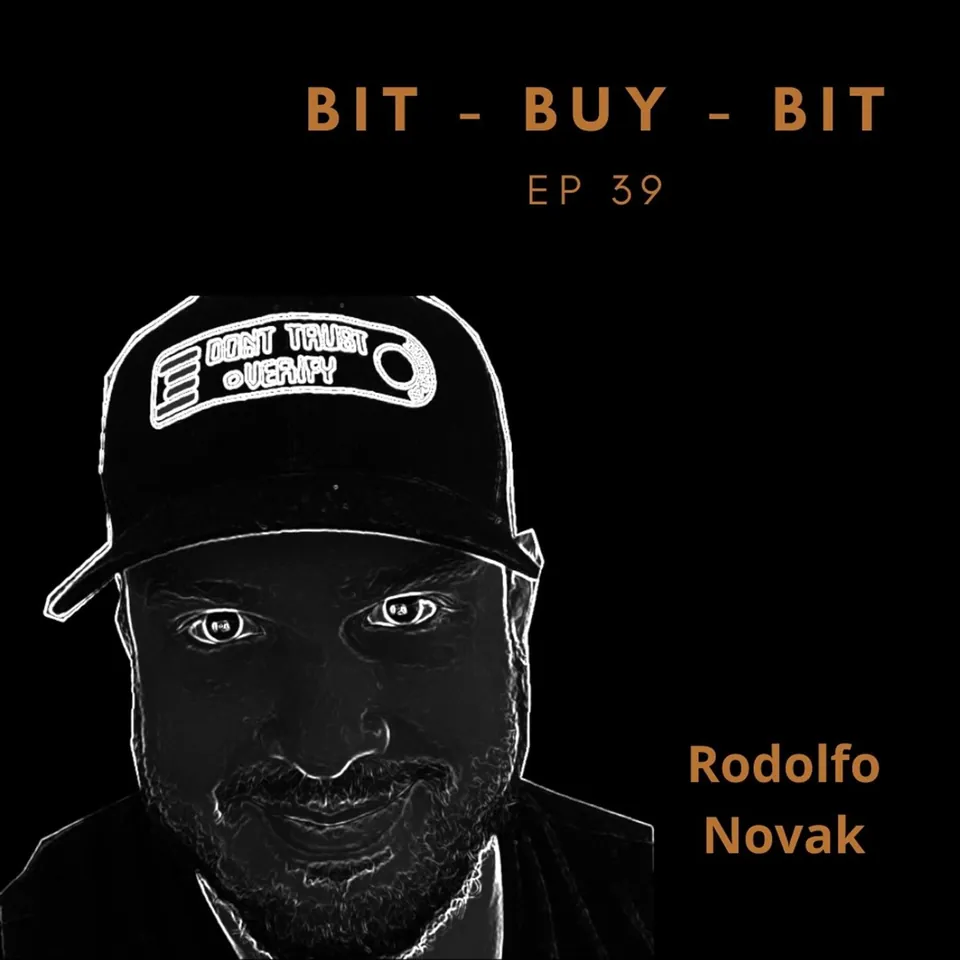
EP39 Bitcoin podcast with Rodolfo Novak.
Discussed in this episode
Boost this Episode
Send sats directly to the creators. Value for Value.
Plus 1% to Podcast Index, 1% to Boost Bot.
Show Notes
In todays episode Rodolfo and I discus Coldcard, Opendime and some of the other great hardware Coinkite are making. We talk about the early days of bitcoin, why red vs blue is stupid and why Rodolfo is on team orange.
I had a great time recording this and I hope you enjoy listening.
Twitter - @nvk
Website - https://coinkite.com
As always please feel free to reach out and ask me any questions.
Website -https://www.bit-buy-bit.com
Twitter -https://twitter.com/Maxbuybit
Email -bit-buy-bitpodcast@protonmail.com
Today you can exchange $1 for 8417 sats! (Sale ends soon.)
Thank you Coinfloor for sponsoring the show. If you haven’t signed up already then click the link below for the best way to buy Bitcoin. coinfloor.co.uk/BITBUYBIT
Bitcoin is close to becoming worthless.
Discord!
Now what's the Bitcoin? Bitcoin's like rat poison. Yeah. Oh. The greatest scam in history. Let's get it. Bitcoin will go to fucking zero.
Alright, you ungovernable misfits. I'm your host, Max. Everybody knows that Bitcoin is useless, worthless, and doomed to fail. But what if everyone's wrong? What if it's the system that is doomed to fail?
Join me as I speak to some of the brightest people in the space and slither to the deepest, darkest depths of the Bitcoin rabbit hole. Today's guest is Rodolfo Novak. Rodolfo is the CEO of Coinkite.
Coinkite make the open dime, cold card, and many other pieces of amazing hardware with a Bitcoin-only focus. I've recently changed across from ledger to cold card, and I couldn't be more happy.
But what if you don't already have some Bitcoin to put on your cold card? That's where my sponsor comes in. Coinfloor UK are the best Bitcoin-only UK exchange and offer DCA to ride out that volatility.
If you're not already signed up, check the show notes and click the link to get signed up today. Yo. Rodolfo, how are you? Hey, good man. Sorry. I think we had a time issue with the time savings or something.
It may have been me because I'm useless with that. Because I thought it was 3 o'clock in my time. No, but it worked out because I had double booked. So I had a conference call with a few people just earlier.
So you worked out for the best. Perfect. Perfect. That's good. How are you? Good man. Things are looking cool at cold card. I've just done my first order and I'm really, really excited because I've been sort of looking to play with those products for a while and I've just been holding back so I don't want to spend the sats.
But now that they're on their way, I'm really excited. It looks like you've got some awesome stuff. Yeah, I mean, eventually everybody gets them. [LAUGHTER] It's true, though. You're dominating at the moment.
I started with Ledger because I've only been involved for a few years. And that was what everyone was shilling at the beginning. And so I bought a few of those. And now after they've held all these leaks and all the shit coining and all this sort of stuff, it's nice to have someone who's in a space
and just making the products that I really want to use. Yeah, it really is a product of a few years ago, we were sort of fed up with the options, right? Just for ourselves, really. That's why the product is the way it is.
This is a product for Bitcoiners who want all the advanced features and all that stuff. It's just no apologies. This is not for grandma kind of deal. We keep on making it easier, but it's a different mentality.
Yeah, definitely. It's just sort of getting to the point now where how easy it is to use your products and my level of competency is just starting to cross. And I'll still be a little bit, I think, maybe hesitant to use all the features.
And I don't fully understand storing things on a separate SD card rather than a seed phrase. And some of those linking it to an electron personal server. And that sort of stuff where I'm starting to get excited, but it's on the edge of my capabilities.
Yeah, once you try it, you're going to understand. It looks a lot scared than it is. It's surprisingly easy. People always have the reaction. They look at the device. They look at all the features and stuff, get a little scared.
And then they try it. And it's like, oh, shit, this is so simple. Yeah. So what made you sort of go down the hardware route? Like, were you always involved in hardware or? Yeah, we've been involved in hardware for a long time.
We made the first Bitcoin, each SM back in 2011, 2012 kind of thing. Really? Yeah, we were running essentially like a wallet as a service, right? So we were essentially big go before big go.
With payment terminals and all kinds of crap, right? We were back in some exchanges. We were doing a bunch of stuff. And the market was different. We were a little too early in a bunch of things.
And once we sort of like decided to wind off the service, I don't want to be in a business where I'm holding people's bags, right? And we essentially winded that out. And we needed a device for us to keep our own hotel, right?
And there was nothing that was really sort of fitting my set of preferences. So we made ours. And we made open dime for fun. Yeah, I've got a few of those coming. I really like those. And I'm, again, looking forward to having something that's like physical.
Because I find when sometimes when I'm trying to explain to people who don't currently hold any Bitcoin, but they'd be open to the idea of having like £50 or £100 in it. And I can say, OK, we'll take one of these then.
And maybe I'll charge them the cost of the device as well, because it makes it easy for them. And I'm not going to be giving away my Bitcoin for free. But it just makes that interaction a lot easier for people, because it's now physical.
And it gets them over a lot of hurdles that I think people struggle with at the beginning. Well, it's-- yeah, I mean, open dime is dead simple, right? I mean, there really is no-- there's no app.
There's nothing, right? That's why we were trying to achieve that. It works that way. And it's a nice way of doing also very, very private transactions, right? Like, there is no trace between people, which is really cool.
And how sturdy are these things like? Well, the main micro is rated for 20 to 100 years. The devices have-- we've seen people do things to these devices. I mean, listen, it's an electronic device, right?
People should take care of them, right? And be gentle. But we've seen the kind of abuse that people do. And they tend to survive, right? We still haven't had a unit that was not salvageable, even at lab level.
Yeah. Well, I mean, you know, if you had real money in it, any recta device, right? We can try to take it to a lab and sort of, like, get the keys out, right? If that's sort of the ultimate solution, it's just a cost on that.
But a lot of times, you know, people send us a broken device. We were able to just take the micro out, right? And sort of put in one that's not destroyed and sort of do it for them. And we do that for free unless we have extra costs, right?
And then sort of we give the user the news, right? Yeah. That doesn't happen often, though. Most of the time, it really is just a matter of transplanting. So like, say someone-- say I had one of those and I wanted to have like, you know, a reasonable amount of money, but not like crazy.
If it was the same amount of money as, say, my phone costs on a key ring, then if I had some sort of, like, metal compartment or, you know, something that's specially made to store that device so that no water can get in and that it's, you know, it's got a seal on it or something like that.
And it's tough. It would kind of be-- it would be fairly safe to have that on your key ring and you just have that any time you need to use it. Yeah, yeah. I mean, yes. But remember, right?
Like, the device was designed for transactions, right? Not for a hodl. People do use them for hodl. We might have another version coming in, you know, the mid future kind of thing that will have the right properties for hodl.
But, you know, open that was designed for transactions, right? If you want to hodl, use a code card to do the stuff right. Because, you know, today's $100 worth of Bitcoin is tomorrow's $10,000 worth of Bitcoin, right?
True. True. True. How long have you been involved in Bitcoin then? It sounds like you've been involved for a long time. It must have been crazy to see what's happened, you know, with the value of this thing and, like, the amount of interest that's coming in and how sort of more normal people are
starting to get into the space and be interested where maybe it wasn't so accessible now. Like, how much have you seen this stuff change? It's been around 10 years. Wow. OK, really early then.
Yeah, it was the slash dot article, if I remember, right? That got me in it, you know, and then you're sort of in and out. And it's not that simple. In those days, there were no exchanges.
You had to meet some guy from the IRC on the Starbucks. And it was interesting days, you know. And it's like, you know, for many years, right? Like, you don't know, right? If this thing is going to go anywhere, right?
And you're in it for the technology. And, you know, I don't have an economy background, you know, that sort of came after. It's, you know, it's just a fun, interesting experiment that's been paying off.
And what was the sort of feeling like back then between people? Were people really uncomfortable with dealing with each other because, you know, they were scared that, you know, one was going to steal from the other, or there wasn't really such a community as there is now because it seems, especially
like on Bitcoin Twitter, everyone's really helpful and like willing to be involved with it. People were helpful, but there were a lot more very curious and interesting characters in the day.
We have a lot more normies now. Back in the day, it was a different vibe. Yeah. Yeah, it was, yeah. So that sort of made you get to a point where you were like, right, I believe this thing's going to stay around.
I can't imagine really working in another industry or doing something else. And I want somewhere to store my own Bitcoin securely and in the way I want. And you just sort of went, right, OK, I'm going to start building some product.
Yeah. For me, it was my first-- yeah, my first transaction really did it for me. It was like, it was a weird, very weird sort of realization and feeling of I have the value of this digital thing in the computer.
And I sent it to somebody else in another computer, right? Because like, dollars, credit cards, the value is not in the computer, right? You're just telling somebody else to send it and sort of debit and credit, right?
The idea of computer code owning value, it's insane. Like, complete batch shit crazy, right? Completely batch shit crazy, right? It's like, do you put the gold bars in the computer? Where does it go, right?
Like, it's insane. So-- It is when you say it like that. It's sort of easy to forget when there's so much amazing stuff with Bitcoin. But like, just that is amazing. It's just world changing.
It's-- Yeah, paradigm shift, right? So I did my first transaction. I was like, OK, I want to-- this is interesting. And it was not full time. I started sort of working on things around it.
And we created the payment terminals. We created debit cards. We created the server side stuff, the Bitcoin HSM's, and all that stuff, right? So we're sort of like trying to rebuild the traditional financial sort of just the mechanical services, right?
Being able to access, hold, and transfer safely, right? Because none of that stuff existed. And then we sort of realized that this is-- we're just sort of essentially remaking the old stupid.
Yeah. Seriously. And then we're like, OK, no, this is not what we want to do. And I don't want to like maintain customers 24 hours and holding bags and stuff, right? Even though we had multi-sig and all that stuff, right?
So we're like, no, let's make things that sort of really sort of follow the Bitcoin mindset, right? Where it's like, it's really moving, changing the symmetry here, and putting all the power on the user's hand, and then it's up to the user how to do things, right?
We shouldn't have anything to do with the user at the end of the day. Yeah. And so you're making the devices that allow people self-custody and the responsibility, but you're trying to take away some of the danger and the sort of pain in the ass that it can be to make this do this stuff securely.
Yeah. I like that a lot. And that's sort of a mission, a personal mission of mine is trying to learn more and more to be more in control and more private and also get listeners to be able to learn and do the same, because it's quite a steep learning curve.
But with this sort of technology, like it-- It is. --is really steep. I'm not really a techie person. And it grabbed my attention so much that I've forced myself to start learning. And I find it really difficult.
But the power that it gives you is world-changing. Well, you become sovereign, right? It's like extreme ownership, right? And with extreme ownership comes extreme responsibility. It does.
It's stressful at times. Yeah. But we try to make it as safe as possible and at least-- we try to help the user not screw it up, right? And one of the reasons why we expose so much of the technicals to our users, right?
We try not to make things too dumb down, right? It's because when you make things dumb down, you keep people dumb, and you keep them prone to screwing it up, right? So we have a lot of very advanced ways of holding the user there where we make sure they don't do certain things that could cause financial loss.
So those things are there, but we try not to remove all the agency, right? Because otherwise, we're back at square zero again, right? Yeah, that's sort of our mentality. And so some of the features that have interested me, and I'd like to maybe go in a little bit deeper and understand why they've been put in there
and what the alternatives are. And things like PSBT, I've not used it yet, but to me-- You're going to fucking love it. It seems like it's strictly better. Everything compared to the alternative is better.
Are there any trade-offs with this or? Not really, no. So the problem before is that-- and I think it still is-- is that there is vendors who are trying to essentially cattle you into sort of their solutions, right?
Their ecosystem and solutions. For a variety of reasons, right? Like, for example, if you're using a hardware wallet with the vendor's web wallet, right? They're going to try to push you to their Bitcoin selling feature, right?
So it's in their interest. Try to trade your precious sat for link or XRP or some sort of-- Exactly, right? They're all shick-oink casinos or shick-oink-friendly stuff, right? So it is in their interest to do that.
Or sometimes they just come from backgrounds or industries that made things in certain ways, right? We try a very different approach. You're going to see a lot of BIPs, BIP numbers in our updates of software, right?
We really try to sort of track Bitcoin core development with our features, right? Or even BIPs that are sort of non-numbered yet, if they're interesting for hardware wallets, we try to sort of like talk to people and push for them to get numbers to get developed, right?
So we want Bitcoin ecosystem to use Bitcoin standards, right? And for the longest time, I think some of the players, some of the vendors in the hardware wallets space just didn't have a lot of experience with USB or things
that are part of the stack. And maybe we're not communicating enough with Bitcoin core, right? Because we've been in this space for a little while, we wanted to sort of do that. So we pushed hard for PSBT to happen a little bit faster.
And we really sort of pushing for new vendors coming in to also adopt them. Maybe hopefully some of the old ones adopt them too. Because I'm a huge believer that we need to have division of labor here.
So hardware wallets should not be making software wallets. Harder wallets should be making a secure, essentially, keychain device, right, the science transactions. And then let the software wallets sort out their business models, sort out their security in half proper wallets.
And then PSBT is just how we all talk. OK, so it's like a message that never touches the two devices and never linked. It's just sort of copied on from your cold card. And then it's effectively pasted into your software wallet, which then means that there's not a bridge between the two of them effectively.
Yeah, in theory, that's the idea, right? Like, of course, the implementation of things are never as simple, right? So it's a lot easier. So for example, what we do is we have this thing called-- so let's say you create your seed on your cold card, right?
Now you have a cold card with a seed on it, right? We let you export to multiple wallets. So you can say, generate an electrum skeleton file, or generate a core, or generate wasabi, or generate a generic one, right?
And then to create an electrum wallet, or wasabi wallet, that is based on that seed, is as simple as opening that file. Right, OK. See, there is no setup on the USB. None of that crap is just super simple.
You just bring that microSD card, put in the computer, and open the electrum. And boom, that's it. That's your wallet right there. And you can verify between the two, and it's all good. You know, we still enable the USB use, right?
So if you want to have it connected, if you want to use it as an HSM, whatever you want to do, we still enable all the users. But we really think that this idea of just, you know, things just working and working on standards will take us a lot further.
Yeah, yeah. I mean, that makes a lot of sense. And I like the idea of using that, and now you've explained sort of that really what it's for in the bridge, it seems a little bit more fiddly.
But actually, I'm sure it isn't all that difficult, and it creates a lot more security, so that I'd like that a lot. It's kind of funny, right? There are things on there which-- When you remove the fluff, the cruft, things tend to look a little bit more complicated, but they actually effectively are simpler.
Mm-hmm. Yeah. Yeah, definitely. It's a lot of the time it's like technical jargon that just makes things sound complicated, and I've profound the same in finance. When I was sort of learning about the basics of Austrian economics and how that differs from our current financial system,
when I'm trying to learn about the current financial system as much as I can, a lot of it was actually easily understandable once it's broken down. But it creates a barrier for most people, just because it sounds more complex than it is a lot of the time.
Yeah, it's-- The thing is, I feel like it's too early steel for us to do the service to society and sort of dumb down Bitcoin too much. You know, Bitcoin is self-sovereign technology, right?
So it's never going to be simple. True. It's as simple as that, right? It's just never going to be as simple as an IOU who somebody else is having the responsibility. Yeah. And some of the things that I liked on Gold Card are, you know, the brick me pin and the login countdown and some of those sort of things.
I find that sort of helps put the mind at ease a little bit more for, you know, the fact that you do have this ultimate responsibility. And I guess if you don't have multi-sig and you're not holding on exchange and you're, you know, if someone is self-custodying, it's nice to have these sort of features where you have that worry
not completely gone, but certainly eased a little bit. Yeah. It's, yeah, listen, you know, if you're holding the bag, you're in charge of the bag, right? That comes with risks that should not be downplayed.
It's not because you have a pretty UI that, you know, having the responsibility over your life savings has diminished, right? Is there a way of, so like, I was, I've been talking like recently because my new thing is, like I said, trying to get better with privacy and with all this stuff.
And it seems to me there's kind of like different sort of subsections of Bitcoin hardware that are all kind of hardware and software that are all kind of being used together, but they are kind of in separate boxes.
And is there a way to say, have some kind of collaboration or something where someone who's new coming into the space, but maybe doesn't want to spend the time to understand fully each part that maybe you could have, I don't know what I'm trying to exactly say, but some kind of hardware where you had a node pre-built that is then set up
with an interface that allows you to set up, say, election personal server, and then making the storage, on, say, your cold card be very simple user. We're really there. Yeah. You can get a node, though, you can get Rasp Blitz, you can get my node.
All of those already support all this stuff. Because this is the beauty, right, of how cold card functions is. Because it was designed from scratch to be air gapped, right? You can use all these other projects, because there's no keys on them, right?
So let's say you install your my node or your Rasp Blitz or node, right, and you set up an Electrum with them. You can just export your cold card, your Electrum skeleton file from cold card and open on my node.
And boom, there you have it. Your wallet is there. But without the keys. So what you're saying is, effectively, like you have one sort of master key, master device, which is your cold card, that then generates the keys for multiple different things, like your node and your Electrum wallet.
Yeah, you can do a lot of that. Yes. And now with Bp85, you can actually generate seeds from a master seed, which is really cool, too. So you know how before you want to try three, four different phone wallets, right?
And now you have like every time you create one, you have to create a new seed and you have to write it down, right, all that stuff. Now with Bp85 on cold card, you just go there and you say generate me a new seed.
And then if you lose those seeds, yeah, you still have them under that same single backup. That's really clever. That makes things so much more simple. And then I guess I find a question on that that would make me feel secure is like, when this seed is being generated from within the cold card,
like from what I can understand, you have a way that you can generate it from dice so it can be true random. Could you talk to me, because I don't really understand that, could you tell me how that can be verified that that can truly be random and only you could possibly know that seed?
Like only you could know how, yeah, if you don't mind. Yeah, no, no problem. So, okay, so let me start from the premise here, right? So you have a few different hardware solutions, right?
For wallets, right? You have the treasure model where there's no security, right? And there is essentially not a trustable random number generator, right? Because there is no security, right?
So somebody could tamper that and tamper the random number generator. So you can't trust the seed generated on a treasure. You have a ledger that has a secure element, has what's called a TRNG, a trusted random number generator, right?
It's been audited. But it's closed source. Yeah, it's been audited, but we don't really know. Exactly, right? You know, you could say that that's some fun or not. You can enter that discussion rabbit hole however you want, right?
I'm not going to qualify it. I'm just going to sort of call it like it is. And then what we did is we created a physically secure device, right? That does use what's called a fixed function secure element.
It means that there is essentially no random software running on that secure element. The secure element is being etched in silicon and you can just put some-- you can chain some bytes so that it knows which functions to perform, but that's it, right?
And you can store information in it. Not process it. Just store it, right? So we can keep this stuff safe. And it comes with a trusted number generator in it too, right? So the thing is, in our principle of trust minimizing it, we don't want to trust it if you're the one two, right?
So what we did is we allow you to essentially throw dice. We made a UI for it. It makes you throw the dice and you choose how much entropy you want, by how many dice throws you do, and then provably, we can show to you that that entropy was entered.
We show the hash and everything. And because the source is open, you can go check the source code of the device. You can compile that source with that code that does the dice thing, and it can verify to the device, right?
So the loop is closed. So it will come up with the same seed if you were to do that effectively. You could check that-- Well, yeah. You could test it. And then we can mix in extra entropy too, if you want, from our different random generating sort of sources.
Right, OK. OK, so that is-- but a bar there being some way-- actually, yeah, that's a question. Like, is there any way, if you're like ultra-tinfoil here, would there be any way to sit in a dark room with a pen and paper and a dice and somehow create your own seed, which you could then enter into a secure--
Yeah, you can import your own seed, if you want. OK, and how would you do that, like, if you-- Yeah, see, that's the problem, right? Now, you could print all the BIP-32, all the BIP-39 awards, and then pick them out of a hat, you know?
You could run into entropy problems there, I guess. Maybe, I don't know. But, let's see, here's another better solution, right? A much more practical. Why don't you use the dice feature in a cold card?
It's provably to a degree that, like, I don't think there is any person who's not funny, who's not comfortable with it. OK, and then add a passphrase on top of that. Right, OK, and that creates the extra entropy and even-- so does that mean then that even, like, if you were an evil mastermind who, like, understands this--
Impossible, yeah. Impossible, yeah, I know, and, like, so if I had a good enough passphrase, even if you had it somehow, you still can't get in. Yeah, that's correct, it's-- but the way the device was designed is provable.
OK, and this may be where, like, the problem is a lot of the people who talk about the stuff don't really understand this stuff, right, especially on Twitter, kind of thing, like the people who love to fudge harder wallets.
They don't really understand this stuff because the arguments are kind of silly, right, and the answers are very simple, so they don't seem to suffice, right? But here's the thing. Because the chips that we use are sort of generic on purpose, right, you can buy a code card, you can remove the secure element, toss it on the garbage, OK?
Solder a new one that you randomly purchased from any supplier that makes them for cars or whatever, OK? This has to be the same model. You re-solder it in, and you reload the source code that you compile to yourself.
You just proved to yourself that that source code is for that chip that comes out of a production line genetically, right? Right, OK. What is the mastermind going to change the chip at the supply level that is for the whole world and also so simple fixed function on Silicon?
Like, it becomes a problem so huge, right, that it's just send a helicopter and take the person out, right? Yeah, definitely. I mean, especially if these chips are being used on lots of different devices-- pretty much every car has one.
OK, all right, so, yeah, it would be extremely unlikely. Because, yeah, I mean, I've got a friend of mine who is sort of obsessed with the idea of only ever using paper wallets and, like, constantly is having a go at me about using hardware wallets, and I don't understand your point.
Like, they're fine, but I just-- I don't understand your issues with, you know, if you have something like a cold, but I don't understand. And he's, like, obsessed with the paper wallet thing.
But paper wallets are really stupid. Well, that's what I think. So, OK, so look at the other side of the coin here. Let's look at paper wallets, right? So you have to have a clean computer, OK?
Modern OS's are a monumental cluster, right? See, it's like the attack vector there is just-- the attack surface is just the size of the sun, right? It's-- and everything wants to talk to the internet, right?
So you have to get a safe copy of whatever software you're going to use to generate the keys into it. You're going to have to remove all the radios and everything else so that there is no side channel attacks, which also don't need radio.
Somebody could-- there's all kinds of attacks nowadays against computers. And then you're going to have to, what? You can't write down a paper wallet. You're going to have to use a printer, right?
If you have a raw secret, the printers are not secure. They are not designed to be secure, right? Somebody could be listening? The Wi-Fi, I imagine. Yeah. It's all this stuff, right? It's just-- it's silly, really, right?
I mean, I've tried saying that, but he's just-- I guess some people will never change their idea on it. But his idea is I'd rather choose a laptop that doesn't have the internet on it and blah, blah, blah, blah.
And I'm saying, well, it's a device used for multiple applications. And therefore, surely, it's not going to be as good one that's specifically designed to do one thing and one thing well.
And it's like, yeah, but someone's built that. And I said, well, yes, but then if it's open source software and you can see what's running within it. So basically, I guess what you're saying is that it is more secure, but you just have to accept that some people sort of won't listen on that and let them do what they want kind of thing.
Yeah, because I mean, ultimately, right? Like, the source is open. The schematics are open, right? So they don't have to buy it from me to prove to themselves that the thing that's what it does.
Just build it from scratch. Use the source code. Everything is verifiable. Everything is audible, right? So just do yourself. The problem with the computers, you can't. You can't build a computer for yourself.
The firmware is on all those-- there's so many subsystems on a computer. Just a DSP audio on a chip. Like, every single-- it doesn't matter they're using your virtual signaling, ultra secure, ultra open Linux laptop.
Every chip there is going to have close source firmware in it. So at least with a harder wallet, the device has only like two chips, right? So like, a tax surface is a lot smaller and also like, they're verifiable, the generic, right?
So you can actually have some grasp, right, of trust minimization. But the computer is just too crazy. Yeah, it makes sense. It's certainly the way that I'm going to go. And one day, when I feel a bit more comfortable, I like the idea of having multi-sick with multiple devices and all that kind of stuff.
But to be honest, like, it's just-- I'm trying to take sort of small steps without trying to trip myself up and-- That's the best approach. Like, remember, the great majority of the people screw themselves out of their coins more than they get robbed.
Yeah. Yeah, it must happen a lot. I bet in the early days as well, a little bit more when people didn't really know what this stuff was worth. Oh, everybody has the proof of burn. It must be so painful, sort of looking back.
There's a guy here in-- I think he was in Wales. This was years ago who lost-- It was something like 10,000 coins, something crazy. The hard drive went-- That's it. And like, his missus made him throw it out because it was making too much noise from mining.
And like, he went to the tip, and he searches the tip. Bless him, like, all the time, obviously, it's fucked. He's never getting it back. But I hear stories like that, and I just think, oh, god, that could literally be us in 20 years if we do things wrong.
Totally. Yeah. And I guess, like, the thing is, like, what people maybe don't get is that there's two challenges, right? One is making sure nobody knows about how much you have, right? And two is keeping those keys secure, right?
And those things sort of like can't be sort of separated, right? You really don't want to docks your UTXOs to a company, right? So when you buy a hard wallet, and then you go and you use their service, right?
You're essentially telling them-- not that they're nefarious or anything, right? But like, they do have your shipping information. They do have now your UTXOs, right? So it's kind of tricky.
Definitely. Rodolfo, this is so unprofessional, but my puppy is downstairs crying at me. I thought he was asleep. Would you mind if I just literally grab him? He could sit on my knee because he's going to cry, bless him, in the background.
Just give me 30 seconds. No, it's not thick. It's all good. All right, sorry. Hey, Rodolfo, can you hear me? Yeah, yeah. Yeah, sorry. What dog did you get? He's a French bulldog. So everyone might now hear the odd snore.
He sounds a bit like a pig. Have you got dogs? I had many dogs as a kid and stuff, but no, I'm just making kids for now. Just making kids? Oh, really? How many kids have you got? I got a second one coming.
Wow. Young? You got the ones young as well? Yeah, yeah, yeah. I tried to keep them as close as possible. That's nice. I haven't got to that stage in life, yeah? I sort of-- next couple of years, I think.
I'm just trying to sort of get to a point in life where I feel I have a rhythm and at the moment, things are so hectic. I'm just like, oh, my god. Now, Bitcoiners need to reproduce. Yeah, so I hear.
That's the big meme going around. I definitely want to do it. Everyone who I know who's got kids just says, like, it completely changes your life in. Yeah, it's pretty life altering. Imagine time.
It is not definitely as bad as people like to portray. Yeah, no, it's not. Well, I guess it depends on the kind of person you are, like personality-wise, but it's not that bad. You know, it is life altering, though.
Does it make you sort of see the world? Does that sort of factor into what you're doing with Bitcoin and, like, sort of creating this world where it's possible to be self-suffering and allow people to take control of their money and speech?
Like, just have a kid's play in your life. It changes your time preference. Right. You know, now you have to think multi-generational, right? You didn't before. Yeah, it's easy to be selfish when you don't have kids and just be like, oh, fuck, it doesn't really matter.
But we do have to pass this world on to them. And, like, that's, although, you know, I don't have kids, it's something that I think about a lot is, like, our grandparents fought, you know, whether it was right or not the wars they fought in and things they sort of believed they were making the world a better place.
And, like, you know, it would be such a shame to see the world go the way it kind of seems like it could be and having more and more control and less and less freedom. And it just seems that, although there's, you know, I believe money to be made in Bitcoin, and I think it's, like, the best asset on the planet to own,
it also has the added benefit of hopefully making the world a better place. And I think that's kind of why this whole space is so addictive and exciting because there's nothing else really going on like that.
There's nothing that's-- Nothing's future-oriented, right? Everything is, like, sort of right now and everything is sort of-- Yeah, I mean, like, kids give you skin in the game in the future, right?
I mean, it's-- so it changes the dynamic there. But, yeah, you know, I mean, like, society is very sort of, like, you know, everything runs in sort of PR cycles, right? So you have PR cycles for politics, you have PR cycles for culture, you have, you know, everything is for sort of, like, insta-likes, right?
And nobody's sort of, like, building lasting things because lasting things have a lot of last immediate, sort of reward. Gratification. That's right. Yeah. Yeah, definitely. And it feels to me like it's a battle that is going the right way.
I've just had Chris Belcher on recently last week and he's talking about some of the things he's doing and things to help privacy, and when I speak to people like him and people like you, it makes me feel very confident that, actually, it doesn't matter how many guns they have or power they have, like, things are going the right way.
Do you feel that it's about-- Yeah, I mean, Chris is a monster, right? I mean, like, he's a very smart man. Crazy smart, but very humble. Yeah, he's a really nice guy, too. Well, he's, I think, he might be in your neck of the woods, I don't know.
So-- He is. You should meet him and meet up and go have a drink of the guy. It's smart and nice. Yeah. Well, I met him a bit dev's meet up before all this lockdown stuff started. And he answered a question on lightning, something that I didn't understand.
And to be honest, I didn't even know who he was. And then I was like, hold on. I recognize that voice. Yeah, it was him and then did the interview with him. And yeah, lovely guy. And like I said, it's with people like that and with people like you building the hardware, like, I feel very confident.
Do you have an idea in your head of probability-wise of, can we make this thing private enough and usable enough and secure enough over that you do good? I think, like, taproot and sort of threshold signatures, that stuff is going to make Bitcoin not perfect privacy, but private enough that will change the cost to dock someone.
So like, whoever is coming after somebody is going to have to actually spend money and time to find someone in a cost that would make it not possible to just find everybody. So that asymmetry of cost that we have now for security is going to improve also for privacy.
And that, yeah, it's coming. It's, you know, open a drink, read some books, take your time. All these things are coming. Yeah, yeah, it feels like that. And that's kind of the approach I'm taking is, you know, I'm spending a lot of time recording podcasts and reading everything I can and speaking to as many people
as I can and trying to sell my art for Bitcoin and build a position because I'm not sure quite exactly my place in all this being non-technical, but it's just all I know is something I want to be part of.
And, yeah, it's like a-- I can imagine this circular economy with enough people with a similar goal and values that we can create a completely separate economy that could be so much more exciting than what we currently have.
And, you know, the innovation can just go crazy. And that's really exciting. That's something that I really look forward to. Yeah, no, it's hard not to be infatuated with, like, Bitcoin is a tool of, like, just freedom, right?
Like, it's-- we all crave it, or at least the type of people who crave it, at least now have a-- we have a chance. Before we didn't have anything, right? Like, you can't. I mean, like, they do what?
You're going to have, like, you know, a truck of gold in your garage. And you're going to get all the guards you need for that. And it's just, you know, it's all the stuff it's pipe stream, right? That's why it never happened.
So at least Bitcoin now gives us a fighting chance, or at least a way for us to sort of segregate ourselves as much as we can from the people that don't want to play this game, right? And yeah, and another cool thing, too, is the Bitcoin-- I think it was Jimmy who said this-- Bitcoin is the enemy's money.
So we don't have to-- altruism is great, but Bitcoin doesn't need altruism to succeed. He actually uses greed, right? Which is a much more efficient system. So-- It's guaranteed. Yeah, I mean, you know, you can't-- like, because, you know, altruism changes as people's life circumstances change, right?
Why you're greed is just-- it's a compounding system, right? Like, people in the incentives are aligned, right? So creating sustaining businesses and saving secures the system and makes the system, makes number go up, and more people want this, and that makes it more even more secure, right?
So number go up is the ultimate technology here, right? Yeah. Yeah, I completely agree. It's sort of-- sometimes people sort of say, like, oh, you should be here for technology, and kind of that is the technology part of it.
You know, the number go up. Nothing works so well without that. That's kind of the marketing and fucking hell it works well. Like, when things are on a rip and people are looking at the price, like, that is what drags us all in, I think, and almost all of us in.
And I don't think there's many people on the planet that don't see price moving and get excited and then learn that, you know, the greed is actually what secures it as well. It's-- I do see it as an inevitable change that unless something else better comes along.
And I see this is, like, 100 times better than what the other option is, unless something comes along that's much, much better somehow than this that we can't understand. Like, this is going to happen.
That's how I say it. Do you have a similar view? Yeah, yeah. I mean, there is a lot of open questions, and Bitcoin is just accelerating. So Bitcoin is accelerating our capability of being self-sovereign, right?
But there's still a lot of open questions on how to build and live in a more sovereign society in the modern world, right, with the population densities that we have. It's-- there's not a lot of answers for a lot of the stuff.
We're just going to have to sort of go along and figure out as we go. Yeah. Well, I guess that's the question is, like, what happens if we can go to a point where there's less and less control by governments and corporations?
Like, what does this world look like? And how do we approach creating systems to still-- for people to have the things that they need and for places to be secure and for business to continue?
But it feels like-- Yeah, Bitcoin is like an equal-- it's a voluntary equal opportunity system, right? The rules of the game are fixed, 21 million, period, right? The problem with that is people that are looking for equal outcome are not going to be very compatible with a system like Bitcoin, right?
Bitcoin is like anarcho-capitalism, like, almost, like, it's clear as day, right? I mean, if you want to build your socialist commune somewhere, like, you're free to do so under capitalism or anarcho-capitalism, but you're not going to be able to take from the people who don't want to give, right?
It makes stocks enforcement a nightmare, right? It's going to-- it's going to-- it really changes the whole thing. So it's going to be interesting, right? But when you have too many people raised on a system where they're used to just taking, it's going to be interesting, right, because it's going to cause conflict, right?
And it's not so simple how to solve that, either. Yeah, do you think these are conflicts that are inevitable anyway, even in the current system, it feels like you have these conflicts going on right now, that Bitcoin just kind of makes it more clear that it's something that's going to need to be addressed and thought about clearly?
No, I think most people don't give a shit about the conflicts that we have right now. Like, the silent majority just chugs along, shows up to work, goes back to the house, watch their, you know, their football on Sunday.
You know what I mean? It's like, that's the great majority, right? Yeah, they're not paying attention and sort of-- Yeah, I think you're right. Most people just don't give a fuck, but-- They're being robbed, right?
Like, inflation is theft, right? Like, people think they're saving, right? But they're being robbed of their savings. Like, I mean, there is no doubt about that. It's like, just run the math, right?
Yeah, it's, you know, but it's also their fault, right? I mean, like, the political class, to a certain extent, is a reflection of society, right? I mean, of course, they are stickier than other parts of society, right?
They're very parasitic, but still, I mean, reality is, the majority of the population want all the services, right? But they want to pay for it. They want somebody else to pay for it. You know, when people are not equal, right, some people are more productive than others.
So more people are going to have more than others, right? Some people are smarter than others. They're going to make more than others. And people are going to have to make peace with that at some point or, you know, civil unrest ensues, right?
It's, or not, I mean, like, because, you know, productive people are going to find a way, right? That's amazing thing about productive people. They'll peck and leave. They will, they already do, right?
Like, I mean, people have a lot of money with shelter, right? And they'll buy politicians to create the loopholes for the sheltering to happen. It's uncomfortable truths that I don't feel that most people are ready for.
And, like, certainly, I don't know what it's like in Canada, but nobody wants to hear the truth. Yeah, it's very few that want to hear the truth. And it's, it feels more and more sort of socialist tendencies are growing by the day.
And, like, the problem with it is that some of the time, if you suggest a more realistic, let's say, like, a more realistic and honest approach, you will be called every name under the sun and, and that you're evil because you're telling them something that is, but, well, the exactly that, it's just uncomfortable.
And it's not the answer they want, even if it's provably true. Like, people just don't want to listen. So my kind of hope is that with Bitcoin, it does shape you. You were talking about time preference earlier.
It does tend to shape you and change the way that you look at things to more of a long-term approach once you understand it. And I wonder whether that can actually have a change on society when it becomes more used by more people that actually people could change.
And not because they care, but because it's just the best thing for them to do for themselves. Yeah, I mean, I think the sad reality, not sad. I mean, just reality, is that most people don't want responsibility, right?
And most people never want responsibility. We ended up in the systems that we have today because that's what we were seeking as humanity, right? It's like-- so you just look at people pre-mid century, right?
You know, there was some form of social contract, right, where you start having more social programs and more social insurance and all that stuff. And people would, in turn, save. And they would provide the cost of initializing the next generation, right?
So they'll pay for the school. They'll pay for housing. They'll help their kids buy their first car, their first house, everything, right? We sort of like, in this society that we have now, we're trying to offload everything onto the government, right?
People want the government to raise their kids. People want the government to sort of provide everything. And it's sort of like a self-fulfilling circle.
It's fascinating, right? I mean, there's zero financial education in schools. I mean, in most Western countries, I mean, all the teachers are socialists. I mean, I'm yet to meet seriously.
Like, I'm sure there are some. There aren't. But like, I'm yet to meet a public school teacher. That's not a socialist. It's true. I mean, it seems that the education system and all of it's kind of been co-opted by a kind of idea and a way of thinking that long-term just can't last.
And it's just like the most simple way. And it's so true. Like, when I left school, really very little-- because I never went to university. Like, so very little for me that I'd learned in school, other than like social interaction.
And basically, that was it, was that a lot of these ideas that they teach just don't work in the real world. And you're not taught about money, which is kind of like the most important thing, because it allows you time to do the things you want to be doing and live the life you want to live.
And no one comes out of school understanding mortgages or loans or like really understanding business, how it really works, even if they study finance generally. And no wonder like the whole world is in such a mess, because no one knows what they're doing.
And I genuinely think that it's kind of left out of schools on purpose, because if everyone understood how it was really set up, they would go, oh, it's a Ponzi scheme. I'm not fucking getting involved.
Thanks. Yeah, no totally. I mean, we're essentially usually-- well, people are being double-taxed to begin with, right? Like, just we don't even have to go sort of self-sovereignment. We don't even have to go full sort of freedom here, right?
It's just the basics, right? Like, just look at source deduction. That was the most evil, smart thing ever done by governments, right? It's like, you take people's money before they get paid.
So nobody has to think about writing a check to the government, right? Like, it's brilliant, right? Nobody cares. It is brilliant. Right? It sounds like the business actually pays the government, not you.
It's insane. And then, what they do is they have sales tax on top of already taxed income. So you get your cash in your hand that's already being taken 30, 40, 50% off of it, right? And then you go to the shop to buy something, and they charge another 10%, 20% on top of it.
It's 20% here on everything. Just think about this. You only laugh to 20% of your money. And I don't know if you have the same over there. We've also got, I think, a council tax, where you pay-- Oh, there's not taxes on it.
--just to live in your own house. And for your bin to be taken once every two weeks by somebody who looks at you like you're a piece of shit, you pay here like 300 pounds a month for that privilege of living on your own land.
And then you pay road tax on top, and you pay all the taxes on everything that you-- It's everything. And then you buy a property, and that goes up in value. And then you sell that, and you pay that on top.
And you pay another tax to buy the property in the first place. And then you have transfer, land transfer tax. And what the fuck is left? Exactly, right? And Bitcoin changes all this, right?
Because it enables people to essentially tax the shit, right? I'm not suggesting anybody should do it. No, you're not the remote. You should find-- No, no, no, no, but people should find the proper legal ways of optimizing your taxes, right?
And you don't have to really go outside of the norm, right? I'm talking about like very sort of very bread and butter stuff, right? And you know, sort out your shit, right? Because nobody has your interest at heart here, right?
Like, government is not there to-- Remember, part of the idea of collectivism is that the one doesn't matter, right? It's like the literal opposite of individualism. So, you and your kids are just sort of like one more source of income for the rest, right?
It's pretty bleak. But, you know, that quite fixes that. But the idea of it is lovely, but it doesn't work as well. It's like, you know, people will say to me over here, they'll go, oh, yeah, well, you know, the tax is pay for if someone's out of work, and they pay for the roads, and they pay for it.
And it's like, yeah, well, the roads are fucked. The people that I know who are out of work are getting not enough to get by on, you know, the health care system, which we pay so much money into, like, yeah, it's better than not having one.
But if you didn't have all your time stolen from you, you could afford better health care and food. So you wouldn't need health care. And like-- You know, I don't think people realize, right?
Like, in Canada, right? So in Canada, we have public health care, right? It's a public, right? There is not even-- it's illegal to have private health care. Really? Oh, wow. Actually illegal.
Oh, my God. Actually illegal, right? So, you know, if you live, you know, in big city, like Toronto, right, and you're dying, you're going to have, like, top health care. It's actually quite good, right?
If you have a broken arm, you're going to sit in the ER for, like, eight hours waiting in pain. So it's very sort of-- you know, of course, they will prioritize, you know, the more important shit gets treatment, right?
Yeah. And then if you want-- like, a specialist is going to take six months to a year, right? And all this is not free, right? Like, it costs, like, for, say, for a person that, like, middle class person, right?
They're paying, like, $10, $20,000 a year for this shit in taxes. Yeah. So imagine what kind of amazing health plan where they massage your feet. You could have for $10,000 a year, right?
I mean, the US, like, you know, you see some pretty amazing health care plans. I'm talking about, like, really nice stuff for, like, $2,300 a month. And that's, like, really nice shit, right?
Yeah. $10,000, I want my feet massage in the waiting room. Yeah, it's a similar story here. It's not illegal to have private health care, but I think, normally, if someone has the ability to pay for it, they will, because the NHS is, like, massively stretched.
And, yeah, if you break your arm, yeah, you could well be waiting a few hours to get in. And the whole system's, like, I used to work within the NHS, within dentistry. And the conversations that I would have with the NHS, like, trying to make things more streamlined and more efficient and better for patients,
was, like, banging my head against a brick wall, because they just don't care, because they're just, like, well, we've got a budget, like, we don't really care. Like, they don't really see the changes, and everyone forgets that they are paying for it through their taxes, and...
It is designed to be that deceiving. Yeah. It is really well designed to be deceiving. Like, this guy is, like, you know, there is a lot of stupid, like, sort of ignorant, like, lazy people in government, but there is a lot of smart people, too.
You know, like, especially on the collectivist side, I mean, there is some really, like, you know, smart and evil people, they're figuring out how to plan a society centrally, right? That's literally the role of collectivists, right?
Like, I mean, just look at monetary policy, right? It's like, you know, central banking is a brilliant schema, right, for the contingent heirs and the people who are in the game, and also we have keeping the population without revolting.
Yeah, it's really clever, and the other thing that I sort of worry about is, especially with what's going on at the moment, with people sort of not being allowed to work in a lot of cases, and either getting nothing or they get something that isn't...
It's just enough to survive on. If you then take away their ability to earn, you're basically taking away their freedom, and if that person then argues for any reason, they can just say, "Oh, you're not getting your payments anymore."
And it basically means they have ultimate control over somebody's life, and it seems that that's happening more and more, and that people are sort of crying out for it. It's almost like they're crying out for eventual enslavement and a kind of Orwellian future without realizing what they're doing, and it's so frustrating.
I mean, people are pragmatic, right? People just want to each and be happy, right? It's like, responsibility is definitely low in the woods, sort of like a chain there. And I mean, look what they did in Canada, right?
So we closed down everything, right? They forced businesses to close down, close down, border, and then government is a possible election year, right? So they started doling out to grand for anybody who asks per month, right?
Without any controls. And then they passed some legislation saying that you go to prison for 25 years or whatever if you lied. And then, no, here's the best part. I can't, I'm not lying, like this is amazing.
So it is not pre-taxed money. So they gave money to people without telling them that they're gonna have to calculate their taxes based on debt, plus whatever they make per year to give it back.
How can they expect people who didn't save to begin with, who couldn't survive three months without income? They're already on a tough spot sometimes, right? To then have to pay taxes on that at the end of the year.
- So they're literally saying, don't work. We'll give you this money. You won't earn anything else. You'll spend it 'cause you always do 'cause that's what everyone does and no one keeps savings.
And then at the end of that time, where you've got no job and you've made the behind on your bills and things anyway, we're then gonna whack you with tax. That's so sneaky. - Yeah. - That's so sneaky.
- And you know, and the people get it up, right? Nobody, like, you know, of course it made the news but nobody cares, understands. People don't understand taxes, right? I mean, we have politicians that don't understand how marginal tax works.
Like, you know, this is all designed that way, right? It's how you do it. It's how you keep people from, because if people knew, right? How much of their actual earned income is taken? How much they get back?
And how much it costs to deliver a service, right? Which is more than half of the money they have to begin with. Like, no, people would revolt. - Yeah. - There's that quote by Henry Ford, which is something like, if people understood the monetary system, they would revolt before the morning.
Or well enough, people don't understand the monetary system or they would revolt before the morning. And I think that's what you're saying. And I agree, like, can you imagine how angry you'd be if you just went, oh my God, like fucking 90% of my life is just stolen from me for what?
Like, I wonder how long it takes before people do wake up to that and then wake up to the fact that there's an alternative and how quickly things can change. Do you have any sort of view on that?
Do you have a suspicious somebody who's been involved for a long time? - I don't. It's, it's, you know, it's sort of like society. I think the grip that collectivism has in society is strong enough that, you know, we're not gonna see change on this stuff for a long time.
What we're gonna keep on seeing is more a path towards a more aristocratic society, right? Where essentially the people who are productive, the people who are the people who, you know, even unfairly came to a lot of capital, right through in here does whatever it is, right?
They will keep on buying politicians to create the loopholes and we're just gonna keep on having the disparity just going forward unfairly, right? Because at some point it is the most efficient waste, like even as a Bitcoin, right?
You have to play both games, right? Don't stop like voting or participating in politics to a certain extent. You have to always push for less government and push for less taxes, right? Play that game, right?
But then also do the Bitcoin game, right? Where you're trying to really become sovereign and sort of, you know, nomad, whatever it is, right? Play both games because, you know, it is a hedge, right?
You want the harm the government can do towards you to be the least amount as possible. - Yeah. - So I think it's important to, you know, play the political game too as disgusting as it is.
- Yeah, obviously it is disgusting but it's just having to do things in the smartest way possible, especially when you've got a family and just trying to think about sort of the most strategic way of doing best for yourself, which is, you know, kind of why Bitcoin works in the first place
but it's just nice to have that as an option and, you know, maybe it is that 90% of people just don't wake up and they continue with the way they're going but maybe a select few people branch off and create a separate economy and they have one foot in both or for the people who don't have the access
to the current system, then at least they have one. They have something they didn't have and. - At least we're going to have a competing system. - Yeah, yeah. - Right, it's at least a competing system.
We never had a competing system that had a chance, right? At least we have a competing system. It doesn't mean you wins, you wipes off the other one. It doesn't mean any of that stuff. We don't know, right?
I mean, the dollar could end next year, right? We have some Black Swan event. It could also just remain boiling frog situation with society and inflation for another 100 years, right? It's impossible to know what's going to happen but at least now we have some sort of like a lifeboat.
We have some sort of way of hedging our wealth, right? And what's interesting in that game is that like, you know, even Bitcoin has this with the private assets that it has now, right? Like, I mean, if government can't even go after people who sold their car for some capital gains taxes on that, right?
- Yeah. - Because technically every time somebody gives you $10, you have to claim that on your income tax, right? If government does not have the capability of going after people for, I don't know, selling their loan more, right?
- Yeah. - It's going to be the same with something that's way more liquid, just Bitcoin, right? Bitcoin is super liquid. So people are going to be able to do a lot more localized, localized really internationally too, right?
But a lot more in smaller networks, they're going to be able to transact without making that claim, right? And so there's going to be a lot more accidental or just sort of like a white light type of tax evasion, right?
- And that's just going to set a trend, right? I mean, Bitcoin does set that trend as Obama puts it very succinctly, right? Bitcoin is a Swiss bank account in your pocket. - Good bit of marketing from him, that's great for him.
He's done really well. I don't know what he's done. I don't follow obviously really American politics or anything, but we can thank him for that at least. That's brilliant, this is exactly what it does.
And what's cool is like, it can do it for a few hundred dollars and a bit of time spent and being any person with an internet connection. And like, that's never been possible to have the ability to have a Swiss bank account.
And this is better than a Swiss bank account. - So much better, yeah. - And no one could do that unless they were, you know, already very, very wealthy or had incredible connections or were part of that sort of elite bureaucratic system.
And now everyone can. And with the use of hardware, like you're building, it just makes it easier and easier. So yeah, thanks for what you're doing. And, you know, I really hope it continues.
- I mean, you know, we're all doing, you're educating people, that's even more important. - I'm trying to learn myself actually. Nobody listened to what I'm saying, listened to Rodolfo and others who are on the show because I've got no idea, but I'm fascinated in trying to learn.
- Yeah, I mean, you know, it's a big rabbit hole, right? Because there is a technical side of Bitcoin and then there is the economy side of Bitcoin, right? And those two are completely interconnected but they're completely different, sort of like branches of understanding.
You probably wanna see if you wanna understand Bitcoin. You know, and Bitcoin is for whatever you want, right? I mean, it's that you can use it for transactions, you can use it for saving, it's your money and it's your own fucking sort of problem, right?
It's nobody else's business. - Yeah, it's exciting. And it is there anything else that's coming down the line with cold card or any sort of new things that you're working on that you can tell us.
I saw today you had a release which I was pleased to see that you've got the feature of no shit coins and that was brilliant, that's really good to see. Is there anything else? - Yeah. Yeah, I mean, you know, we're always launching new updates and there is probably new hardware coming in a while.
We have OpenDye and we now have the metal plates for backup too. - Yeah, I just ordered those. - You know, we didn't like what was in the market. Yeah, I mean, you know, it was, I don't know why but like the people who did the metal plates that were in the market, like, it seems almost like they're not Bitcoiners
or something because like, you know, I don't wanna have two plates, I want just one plate and 24 words in them, right? So we made it happen and it's all made here in Canada too. - Awesome.
- It's only Canadian chard labor, I'm just joking. (laughing) And what else? And yeah, I mean, you know, just follow our Twitter accounts. We always sort of let people know we're working on, there's always more features coming.
- Okay. - And yeah. - Brilliant, well, thank you so much for coming on the show. It's been great talking to you and it gave me the push once I put the interview, I was like, ah, do you know what?
I need to order these bits that I've been putting off ages and they're now, hopefully they'll be with me not too long, which I'm really excited for. So yeah, thanks for coming on the show and thanks for making this awesome hardware and making it easier for people like me.
It's brilliant. - Now listen, thanks for having me. - All right, well, Rudolph, if any updates or new hardware or anything come out, I'd love to reach out again and speak to you and it's been great chatting to you.
So yeah, have a great day. - Yeah, it'd be my pleasure to speak soon. - You too. - Thanks for the offer.
Machine transcript; expect the odd mishearing. Click a passage to play from there.



