
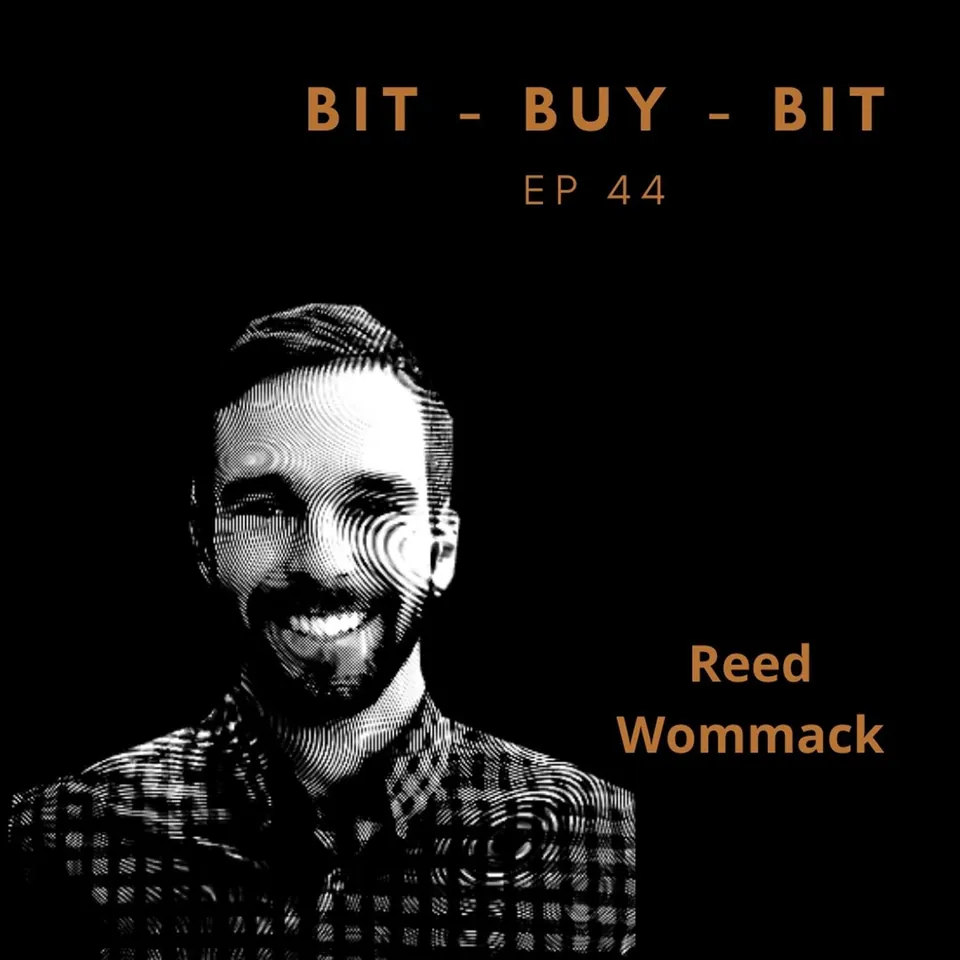
EP44 Bitcoin podcast with Reed Wommack
Discussed in this episode
Boost this Episode
Send sats directly to the creators. Value for Value.
Plus 1% to Podcast Index, 1% to Boost Bot.
Show Notes
Reed is the Head of Customer Support for Swan bitcoin and the Author of Bitcoin Buddha Newsletter.
In todays episode Reed and I talk about his rabbit hole journey, meditation, Swan and why DCA is such a good way to acquire bitcoin.
If you don't already follow Reed, do it now.
Twitter - @ReedWommack
Bitcoin Buddha Newsletter --http://eepurl.com/gMePyT
Buy bitcoin in the US -
https://www.swanbitcoin.com/reedwommack/
As always please feel free to reach out and ask me any questions.
Website -https://www.bit-buy-bit.com
Twitter -https://twitter.com/Maxbuybit
Email -bit-buy-bitpodcast@protonmail.com
Today you can exchange $1 for 9174 Sats (Sale ends soon.)
Thank you Coinfloor for sponsoring the show. If you haven't signed up already then click the link below for the best way to buy Bitcoin. coinfloor.co.uk/BITBUYBIT
(upbeat music) - Bitcoin is close to becoming worthless. (upbeat music) - Now what's the Bitcoin? - Bitcoin's like rat poison. - Yeah. - Oh. - The greatest scam in history. - Let's get it.
(upbeat music) - Bitcoin will go to fucking zero. (upbeat music) - All right, you ungovernable misfits. I'm your host, Max. Everybody knows that Bitcoin is useless, worthless, and doomed to fail.
But what if everyone's wrong? What if it's the system that is doomed to fail? Join me as I speak to some of the brightest people in the space, and slither to the deepest, darkest depths of the Bitcoin rabbit hole.
(upbeat music) - Welcome back to the show, Reed. It was only about 30 seconds ago that we were speaking, but for anyone who's listening to this now, I have just wasted Reed Womack's time.
He is the most patient man in Bitcoin, and we're just about to record again. Reed, can you just do an introduction for us, please, for the second time, and tell us what you're doing. - Absolutely, Max.
I don't think I'm the most patient man in Bitcoin, but I do work for Swan Bitcoin, and I run customer support for Swan Bitcoin, and Swan Bitcoin is a USB exchange. That's the easiest and safest way for you to start building a position in Bitcoin, and start accumulating Bitcoin.
So we do automatic polls from your bank account, automatic conversions to Bitcoin, and we'll automatically send you Bitcoin. And I run customer support, so anytime you have an issue, anytime my customers have an issue, they contact me, and I try and help them figure it out, or if they have a question about Bitcoin,
I spend a lot of my time answering questions about Bitcoin, too. - That's cool. So what sort of questions do you normally get if you've got somebody, you know, we said on the last recording already, but you were saying to me you had, you know, mainly people who are already involved in Bitcoin, or the sort of older generation
who are more used to just like slowly trickling their money into something they don't want to just do like one big buy. So what are the questions that you're getting from people? Like what is it that you're helping people generally with on a day-to-day basis?
- Good, good question. So as background to start with, we started the company and really catered towards hardcore users who all want the DCA. And as the company's grown, we've now made it more and more and more beginner-friendly and are now starting to see a lot more people who have never even heard of Bitcoin
or heard of exchanges who are now hearing about us and coming to us as their first point of reference within Bitcoin, which is great because like in our opinion, we're gonna do a very good job educating people about what exactly Bitcoin is and the potential for Bitcoin.
So now we're getting a lot of questions like, you know, what wallets are? How can I be more private with my Bitcoin? Where is my Bitcoin stored? What is a Bitcoin? These sorts of beginner questions or, you know, the privacy questions are intermediate.
We're now getting more and more of those questions in support, which is really validating and fun for me to answer 'cause I get the sense that we're starting to onboard new users into Bitcoin.
- That's awesome. Yeah, that's really cool. And I love the approach that one have, you know, I think that the education part of it is so key and the fact that you're getting involved with that is brilliant, the fact that you're Bitcoin only and that you have DCA is just the perfect mix.
And, you know, my sponsor that I have here in the UK, coin floor UK, have a similar approach. And see, anything I feel comfortable with when new people are coming into Bitcoin is that, you know, now for anyone who's in America, I'll be sending them over to you guys because you're doing a similar thing.
And for anyone in the UK, it's coin floor because I know that when I send them there, they can't make a mistake. And they're doing things in the best possible way. And I think that's what catches so many people out because you go to these shitcoin casinos and people get distracted and there's lots of things
that are flashy and looking like they could be the next big thing or sort of teaching you basically to invest poorly and what you're doing, they can't do that. And they have the support, it sounds like, to ask the questions that need to be asked and to make sure that they feel comfortable doing it.
So I'm really happy to be discussing this and I'll definitely be sending people over to Swan. - Yeah, yeah, absolutely. Thank you for referring people to us. Also, also know that we get a lot of customers who are reaching out to us from the UK, wondering whether we're working in the UK and I always refer those customers to coin floor.
'Cause I know that they're Bitcoin only business. And again, as you mentioned, they're not going to get distracted by random alt coins that are really pumping dump schemes and they're not going to get distracted by gambling.
- Yeah. - Really love what Obie's doing at coin floor. - Yeah, he's awesome and I was so happy to have them get involved and reach out and help sponsor the podcast. And it just, it helps me so much because like I said to you before, it's just allowed me to buy a new microphone and it's allowing me to just make this show
better slowly over time and reach more people. And that's what it's all about. And it's great just to have a company where you can believe in them because that's the last thing you want from a sponsor is to be sending people over to a company where you don't really believe in what they're doing or you don't really trust them.
And I could never really do something like that. So no, I'm very happy and yeah, Obie's fantastic. - It's cool that there are more and more Bitcoin only companies coming online as the industry grows.
There are more and more Bitcoin companies that can sponsor podcasts like this. And I think a few years ago, you know, most podcasts, any sponsorship that they had were just exchanged that also sold shit coins.
And now we're bringing enough Bitcoin, pure Bitcoin only companies get enough traction that they can start sponsoring educational material. Yeah, that gives me a lot of hope and it's a cool direction that the industry's going.
- Yeah, I really like it. And I think we're just gonna see more and more of it because after speaking to you, I can tell that, you know, you are a Bitcoin are through and through and this really matters to you.
This is something you care deeply about. And it seems that there are more and more people like that. And that after a while, once you've been in this industry and you've seen all the other scams and bullshit, you do get to this point where you're just like, this is the only thing that matters.
And as far as I can see it, it's the only thing that's gonna matter for a long time or ever. And just having that piece and knowing that you're on the right path and you're setting people on the right path.
And I can't see that these shit coin casinos last long term. And I think the people who move into Bitcoin only first, they're gonna have that respect for a lot longer. And I'm sure these casinos make a lot more money and that, you know, it's easy to just scam people out of their money.
But, you know, I think if you really care about this space, you wanna be here for five years, 10 years, 20 years. And the approach that's being taken by you guys is exactly that. It's, you know, it seems like you wanna be here for the long run.
- Yeah, yeah. Wanna be here for 40 years, at least 40 years. And that's the timeline and timescales that we're looking at and thinking about and trying to build a brand for and trying to build educational materials for and build a reputation for really.
I personally look at shit coin casinos and a lot of crypto exchanges. It's a very different business model from what we're doing. And we're almost not even competing or in the same industry.
And, you know, naturally we're gonna try and draw users who are using BitMax or using Binance. We're gonna try and draw those users to really start DCing just into Bitcoin. But like the ethos of the company, the vision of the company is very different.
And hopefully over time, you know, over multiple years as people recognize the importance of just Bitcoin and feeling Bitcoin only. Now, our reputational grow significantly and people will respect the fact that we haven't sold out to scams or we haven't tried to manipulate our customers
into buying something that isn't a good long-term investment. - That's brilliant. And what made you sort of come into this space? Were you already in finance or were you, you know, anything to do with this sort of industry or doing something completely different?
- Not at all. I actually, so I went to Dartmouth College in New Hampshire and graduating out of there, most of my friends went to finance. So most of them went to Wall Street and either worked for consulting companies in Boston or New York or worked for investment banks or, you know, boutique investment banks.
And so even back then in 2014, I had the sense that finance was like a little corrupt, that there was something not quite right about the world of finance, but I had all these incredible art people.
Many of them had studied engineering or computer science, you know, skills that could transfer really well to other industries who were getting sucked into Wall Street, you know, to create trading algos or to build relationships for various funds, fund managers.
Yeah, I had saw so many friends go into finance and couldn't put my finger on why it was so icky until much more recently when I've got into Bitcoin, but had a sense that it was really, something was rotten in the state of Wall Street.
And so I tried to get sort of as far away from that as possible and spent essentially four or five years, four years in very remote locations, either teaching in small private schools in the town of 900 or actually leading expeditions out into the woods for anywhere between a week to 50 days at a time.
And so I tried to get as far as I could from Wall Street, even though all my friends were working there. So it was funny in that stage of my life to share stories with them because they would talk about going to see, you know, saving up money to go see a Broadway show or something and I would, on the phone with them,
I would talk about like washing an orca whale breach.
- So we're just living very different lives. But then in the summer of 2018, I inherited some money and I was trying to figure out how to deploy it and how to sort of make it grow over time.
And that sort of started me looking actually at the stock market. You know, I'm sort of too young for bonds. So I was trying to figure out a way that I could allocate this in companies. And that sort of started the beginning of me trying to explain and or try to figure out and figuring out why exactly Wall Street was so,
was so icky and corrupt. And sort of through that fall, realized that the Fed was just at the base of all of the asset prices. And so their decisions dramatically affected asset prices. And at that point in time, they had tried to start rolling off their balance sheet.
And I was smart enough to realize that we would get a bit of a correction as a result of that. So fortunately, it was actually out of the market that fall. But sort of got into Bitcoin a little bit that fall and winter and then really got into it that winter when the Fed started, you know, Bitcoin bottomed.
Bitcoin was bottoming. The Fed started turning on the liquidity again. Stock markets started going up. And I was sort of early, I think, to the Robinhood Day trading trend that is now sweeping the world, where I recognized exactly what was happening with the Fed pumping liquidity and that kind of pump asset prices.
And so I started leverage day trading. And as I was leverage day trading that winter, I was also simultaneously reading about Bitcoin. And like I recognized that this system was so broken, but I was playing the game.
And then essentially at some point that spring just recognized that I was taking so much risk, that I finally come around to see all the ways in which Bitcoin wasn't risky and was reducing the individual's risk.
That you no longer had to trust the Fed or your custodian or, yeah, really those two things are sort of the major risks in the stock market. It's like, what's the Fed gonna do? And also like my custodian who says they have these stocks, do they actually have these stocks?
Recognize that I was taking too much risk there and sort of went all into Bitcoin that spring and got sucked deep down the rabbit hole that spring, started writing a newsletter that the following fall to try and get my friends and family on board.
And that newsletter sort of built and built into, I was writing it every day. So it built into a big catalog of writing that I had that I was able to share with Swan and Brady, head of education at Swan, like my writing and hired me.
So that's sort of the transition, my brief transition from trying to get it far away from the world as finance as possible and experimenting with leverage trading of stocks and then eventually realizing that I'm much more conservative and only want to hold my whole value in things that I have much more control over.
So now I'm pretty much all in Bitcoin. - That's an interesting story, you know, coming in from that perspective and being wanting to be as far away from Wall Street as possible because you smell a wrap, but you know, like I think most people in this industry, it takes some time to really wrap your head around
what it is that feels so wrong about it and then why you sort of know it's corrupt and you know it's rigged, but you don't quite know how you've gone to get as far away from that, you know, into the wilderness and then somehow you're actually now drawn back in, but now you're doing battle with Wall Street
because I kind of see this as like anyone who's involved in this, we're knocking on their door. It might be a little bit of time until that really happens, but essentially that is what we're doing.
So maybe you were always destined to do battle with Wall Street. - I think that that battle analogies is compelling and it is prominent within some Bitcoiners doing battle with Wall Street.
For me in particular, I actually don't, I don't think that Wall Street is really the enemy. I've like come sort of full circle and realized like all my friends working on Wall Street we're actually providing an enormous amount of value.
They're just providing that value in a broken system. And it's not really that Wall Street is wrecking the world or Wall Street is sucking people's value up and Wall Street is unfair. It's just that the government has sort of gotten so large that it's screwed up incentives.
So now people have the incentives to invest their money through Wall Street and Wall Street can help them essentially protect their savings from inflation by creating all of these strange investment products.
So Wall Street, it really is doing a good deed and they were doing a good deed. And now we just have a better solution to protect savings from inflation rather than creating these esoteric investment vehicles that Wall Street is able to get a piece of.
- Well, it's kind of one of those things where you need to have some assets to not get left behind. And you have the inflation of assets and therefore it's okay if you're on the bowel or you've got to put on the ladder.
But for a lot of people who haven't got any assets and they don't really understand that their money is getting less and less valuable over time and they don't really know how they're storing it.
One thing that I find is really beautiful about Bitcoin is that you don't really have to understand that much more than this thing gets more scarce over time. And as long as things go in the direction that they're going at the moment and this industry gets better and stronger and the security continues to get better
and the usability gets better and all of these things continue on the path they are. People don't really have to do too much. And I think that's quite nice because for a lot of people when they're working their other job and then they have to think about investments on top of it, it's just really, really stressful
and you have to put a lot of trust into other people and trust that they know what they're doing and trust that what they're doing is in your best interest. - Absolutely. Yeah, and I mean, that's one of the main reasons that Corey and Jan started up Swan Bitcoin, where I work is we wanted to make it really easy for people to save money
in the best savings vehicle that exists and not have to put an enormous amount of trust into another institution. So at least for us, we make it really easy for people to buy Bitcoin and then immediately and automatically withdraw it so that they don't have to store it with any one other themselves.
So that's one of the things that we do best of all compared to, there are a lot of other really, really great companies in the space. A lot of great Bitcoin only companies in the space, but really emphasizing this self-ownership of Bitcoin and we're drawing it from us so that our users are custody in their Bitcoin, not us.
It's something that we thrive at. - That's so important. So how do you do that? Do you have a sort of, is it every time they're on a recurring buy that's being sent directly to their cold storage or do people do it in sort of bundles to reduce the fees or what's the sort of setup for that?
- You can set it up how you wish. So you can either set it up so it's every single recurring buy or you can set it up so you'll wait until you hit maybe 0.1 Bitcoin. So like $1,000 of Bitcoin before you withdraw.
And you can choose that scale for yourself. - I think that makes sense because otherwise if people are doing smaller amounts and they're getting hit with the fees, it's not always that, you know, there's a lot of you obviously you want to be self-custodying unless they're sending things over lightning or do you have that as an option?
Do you have sort of lightning payments and that kind of stuff as an option or? - We don't for withdrawals, normal withdrawals. We're looking into it for something called our swan force payouts.
So our referral payouts, actually anyone in the world can sign up and get a custom URL. And if you get Americans to sign up through your custom URL, you can earn 25% of all the fees that swan earns from that referral.
- That's cool. - And those payouts, we're looking at doing those over lightning, but the rest of them are on base chain. - Yeah, that's a nice setup. It can't be stressed enough how important that is that people take control of their Bitcoin.
You know, it's something that it's kind of hard for people to wrap their head around and we're so used to having to trust banks and institutions to look after our things and it can be a little bit scary, but I assume that's why you have your swan education.
- Yeah, yeah, and that's another thing. I think we do pretty well is we have a series of podcasts and we've just started doing weekly ANAs, ask me anything with Brady and I, where we get a lot of really good questions in the YouTube chats about Bitcoin in general.
So we got that just starting out. We have swan Signal Live, which is a weekly show that brings sort of the best and brightest of Bitcoin together, Brady hosts that. And that does a really good job of teaching people about Bitcoin.
And then we also just have a blog and newsletters and we're always sort of creating content, trying to share with our users, trying to educate more about what Bitcoin is and how to take care of their Bitcoin.
- Yeah, that's great. It's so key and it does take time. You know, we were saying previously, you have to kind of be quite an obsessive personality to really fall down the rabbit hole and really care deeply about this stuff.
But I imagine there are also people who are just like, well, you know what, this is something that makes sense to me. I like that it's scarce and I like that it's kind of a hedge against everything else that's going on.
And maybe they're not sort of ideologically attached to it, but they're thinking, well, this is just a smart and wise thing to do and they're the people that really, that education is gonna help over time.
So I think that's brilliant that you're doing it. - Yeah, we're seeing a lot of those types of people come on board with Swan, a lot of people who, you know, it's their first time ever buying Bitcoin or that they, you know, just heard about us through Swan Signal Live and maybe have owned a little bit of Bitcoin before,
but don't really understand it. And we're onboarding them and teaching them a little bit more about Bitcoin as a savings technology rather than this speculative trading vehicle. - Yeah, that's great.
And with your role and what you're doing, it sounds like it's kind of, you know, you're gonna involve with a podcast, you're gonna involved in the education, but is it also a case of people are emailing or you're having to pick up the phone and go through things with them as well?
Like how far does your role go with that kind of stuff? - Absolutely, yeah. Most, you know, probably 40% at this point is through a CMS system sort of through Zendesk, people just writing in emails essentially to us.
Now I do a fair amount though, another 50% probably through Twitter or Reddit or LinkedIn, sort of more informal channels. And then 10% now is sort of starting to be phone call. So we now have a phone line.
I'm able to just talk to people. And that in particular is really helpful for a lot of our older users. It can be pretty, pretty anxiety inducing to try and if you don't know anything about Bitcoin and you know that it's stored sort of digitally in the ether to go to this website, sign up
and not really know that there's a human behind the website. - Yeah. - And so it's really nice and really helpful for us to take phone calls from people who are concerned about whether you know, our company even exists.
- Also, we also have legitimate questions about what Bitcoin is and what we do. But that's been really, really rewarding that we started doing more of the last two weeks is a lot more phone calls.
- Yeah, that's great. And you were saying to me earlier about your previous work and going out to the wilderness and you were saying about your meditation and things. And I really wanted to just dig a little bit deeper onto that because it's something that absolutely fascinates me and I know I should do myself and I know
it's incredibly helpful. Is that something that has helped you through this transition and learning about Bitcoin and dealing with newcomers and everything that goes along with it? Is it something that's been a good tool to have at your disposal?
- Absolutely. I'm bullish on meditation for sure. - You're stacking meditation. - Stacking meditation every day, exactly. As background that before I got into Bitcoin that was sort of my last really intense obsession and it had gotten so intense that I was actually thinking of joining a monastery.
I went on both silent meditation retreats and even after deciding not to join the monastery I was still meditating 2018 fall about three or four hours a day and then reading books the rest of the time and going on quiet walks alone.
I went really, really deeply into meditation a few years ago and coming out of that, two of the benefits I think that have bled over, shall we say, into Bitcoin. There are many benefits of meditation, happier, more balanced, but two of them are better ability to concentrate and focus really intensely on one thing for long periods of time,
which is helpful when you're trying to learn about this very strange new technology and you're trying to learn about the history of money. You've got to study up, you've got to read a lot.
- It's a steep learning curve, isn't it? - Yeah, so that meditation helped build that focus, but I think that the main thing it did was that it taught me to let go of preconceptions because in meditating, meditation you're always letting go of whatever story you're telling or whatever narrative
you are projecting onto your base experience. You're always just letting back go and trying to just experience your base experience rather than the story of your base experience. So letting go of the thoughts of a narrative and experiencing true reality, and that actually has a lot of parallels
to Bitcoin education where you have to let go of a lot of narratives that you don't quite realize you believe in until you really start looking at Bitcoin. Narratives around what the government is, narratives around greed and selfishness, narratives around capitalism, socialism, narratives around taxation and family,
like even narratives around what you should eat or gender narratives, these are things that start to question or let go of once you get deep down the Bitcoin rabbit hole. And that kind of letting go of narratives is very similar between meditation and learning about Bitcoin.
- Well, you just said there about letting go and accepting that maybe we had the wrong idea about things or maybe the things we were so sure of were actually wrong. And that's something for me personally, I haven't really meditated.
I've tried, I think that honestly, the most I've ever managed was 10 minutes and it was so hard. I was doing that, what was it called? Headspace, have you heard of that one? And I tried for weeks and weeks and weeks and made myself do it, but I think maybe I'm a bit ADD, but it was the hardest thing I've done
was trying to just switch off. I found it impossible, but I wish I'd have stuck with it because what I found learning about all this stuff and then once I got fairly deep into it all, I had to admit to myself that everything I thought I knew was wrong.
And that's quite like a scary realization. And I imagine that if you do have that ability to strip everything back and just take everything back to the most simple sort of just a breath and then build from there must have helped a hell of a lot.
It certainly does, that fear though, that you mentioned from the scariest of letting go of all the narratives that you believe is a very real obstacle both in Bitcoin journey and also in meditative journey.
It's very uncomfortable as you start learning more about Bitcoin to realize one that everything that your parents and or many of the things that your parents and friends and society tells you aren't true, very uncomfortable and somewhat alienating.
And that leaves you sort of baseless. It leaves you without some sort of anything to cling on to. So you got to let go of all those things and then at least in Bitcoin, you build up this other sort of narrative or worldview.
- Yeah, it is starting from nothing. It's literally just like pretty much everything you've been told is wrong or a lie and then it's accepting that and then building this new view of the world and trying to make sense of everything.
And it's almost like like a rebirth of just like, everything is just new and it is so confusing because you've got to dig into so many different things. It's not just finance. It's not like, oh, I'm just trying to work out, is this stock a good buy or is this property something that I should invest in?
Or it's not just that. There is so much that goes into this and it does, it flips your whole worldview upside down. So yeah, it sounds like you were sort of prepped and ready for it. - For sure, for sure.
I mean, that process of like going from trusting sort of traditional institutions, traditional narratives to no longer trusting them is very uncomfortable. And then in Bitcoin, again, you build up this different worldview.
A lot of people in the meditative journey, they have to go through the same exact process of letting go of these traditional narratives and then sometimes they build up other competing narratives but sometimes it's just being comfortable living in a narrative-less existence.
Like becoming comfortable living without things to hold onto, without really like an attachment to a story or an idea. And that process of going from, you know, like believing, you know, that you have this independent sense of self, believing that, yeah, really, really coming down to the independent sense of self
and then letting go of that and being okay, recognizing that you don't actually have any sort of clearly defined sense of who you are and that's fine. That process can be very, very disorienting for people as they get more into meditation because you just tell yourself these stories of who you are in your day-to-day life.
You know, I'm a father or I have this job or, you know, I'm like a white person. I'm six, two, I like, I'm a spear. Like all of these categories that you put yourself in, when you start looking more deeply at yourself and meditating more, you realize that those have no basis in reality, that they're just stories
and letting go of those can be a very disorienting experience. - Yeah, I can only imagine. - Just like letting go of the narratives you have around government and around the economy and around jobs, those sorts of narratives, letting go of those can be disoriented, disorienting.
I sort of think that actually the narratives around that you have to let go of in the meditative journey or even more profoundly disorienting, but it is similar, it is similar. - Yeah, well, I guess because what was certainly for me and I think for a lot of people, you always sort of know that the government's not really
doing things in your best interest and you kind of don't trust a lot of what's going on anyway. It's just that you can't explain it. You're not sure exactly how it is that they're screwing you over, but you're what you're talking about there where you're saying, you know, really stripping back
to taking away all these ideas of who you think you are or who other people have told you who you are or you've told yourself you are. Yeah, that does sound like that's something that would take a lot of time and a lot of effort and could be, like you say, disorientating, but I imagine once you've done it and you've got almost to that,
like you're saying, that sort of place of Zen and you can build from it, it must be an interesting way to view the world. I'm sure things seem very different from that point. - Well, I don't necessarily think that it's some end goal that I've achieved.
It's this ongoing process of just any time I recognize, like I'm falling into this box of a static box of who I think I am, just like constantly letting that go and getting rid of that. And so training yourself more and more to just let go of those stories that are wrong.
For me, at least, I'm not trying to build up a competing story. I'm just trying to actually let go of any story. - Have you got any tips for someone like me who finds five minutes of meditating, like, almost impossible?
Are there any sort of tricks or tips that you can give? - Yeah, I think that, well, your experience is totally normal that everyone, when they first try and start meditating, first, notices that their mind doesn't stop and then judges their mind for not stopping.
And the next step after you notice that your mind can't stop and that you judge your mind for not stopping, the next step really is to just forgive your mind for judging your mind, like-- - Okay.
- Recognize that you can't stop thinking and that's okay. So a photo of giving up a little bit, you don't have to chase after the pure experience of what you think you should be doing when you're meditating and you instead open yourself up to a little bit more compassion, a little bit more, a little bit more forgiveness
and all of what is actually happening. So it's okay if your mind is just running and running and running, you just accept that and are aware of that. And the more you accept and are aware of that, actually, the more your mind will quiet.
But the more you fight it and say, like, oh, I'm screwing this up, you know, like, you're just gonna think about it as these narratives. Like, narratives around like, I'm meditating wrong.
That's still a narrative that is, that's not true, you know? (laughing) - Is it a bad thing to meditate? 'Cause when I was listening to my, doing this app, he was saying, oh, you have to sit and, you know, sit there and keep your arms just side and, you know, whatever, all rest them on your lap, whatever.
I always found like, the only time that I could do it at all well was if I was just lying down flat on the floor on my back. Is that a bad thing? - No, do that. That works for you, do that.
- All right, I'm gonna give it a go. I want to be more Zen like you. I wanna be Zen enough that when I've recorded 40 minutes of a podcast and then the idiot podcaster, the computer locks itself down, shuts everything off and you lose everything for you just to be like, yeah, that's fine.
That's fine, I'm not gonna get annoyed. I'll just record another one. I'll just waste another hour of my life for this guy. (laughing) - No, I'm happy to talk to you. I'm happy to record another podcast that this one gets to leave it.
(laughing) - No, no, no, don't tempt fate, don't tempt fate. (laughing) - On the note about lying or sitting, especially when you're first getting into meditating, just take whatever position feels most comfortable for you.
And that could be standing for some people even. A lot of people it's sitting in chairs and some people it's lying down. - Okay. - And aside from if you're only going for a few minutes, like lying down is totally reasonable.
As you get, like, if you get super serious about meditating, you'll eventually likely find that when you lie down, you'll drift off to sleep. (laughing) - Yeah. - Whereas when you sit, it could actually be a more enjoyable, a more peaceful experience where you maintain awareness.
But I still meditate lying down sometimes too. - Okay. Yeah, it sort of seemed like they might go hand in hand in some ways because I don't know if you've had a similar experience, but for me, since I've fallen down the rabbit hole and got involved with this stuff, I dropped all my other work.
It's all I can think about. My mind is constantly running, constantly thinking about what's possible. And it can be quite a tiring way to live because there's almost, there's no switch off.
It will be in my dreams. It's from every second I wake. Do you find that that's similar with you, that it's just always there at the front of your mind, Bitcoin? - Yeah. - Like you're like, you're possessed.
- Yeah, exactly. - Yeah, I can't stop thinking about it and also not really trying to stop thinking about it. I think a lot of people expect, and I'm not an advanced meditator by any means, but a lot of people expect that if they meditate, then they'll be able to go through life
without thinking or without having their brain go off in all these directions. And that's not really true. You also don't even really want that. You need to be able to think in order for your body to survive.
(laughing) You need to be able to try them. And you need to be able to remember your social security number and your license plate number. These are things that your brain is very good. And it's also, though, important to occasionally give your brain a rest.
And that's sort of what I look at meditating as now. It's not me trying to pursue any higher state of enlightenment or really self-improve. It's really just a way to rest back in base awareness and touch back to that side of me, which is, yeah, it's a beautiful place
that you can go in yourself when you just sort of sit and let thoughts filter through you for a while, but eventually they sort of stop coming and you can just sit with yourself in the silence.
(laughing) - Do you have a sort of finish doing a medication meditation and come up with new ideas or like heady thoughts that maybe you hadn't before? Does it ever take your thoughts to different places than a normal state, if that makes sense?
- Yeah, yeah, I think so. It certainly produces me after math or sometimes while I'm meditating, you come up with some different ideas that have a slightly different flavor from your normal everyday life.
That doesn't, you know, initially when I started meditating, I thought that any time I had a thought while meditating or when I felt deep in meditation and a thought came up that that thought was somehow more profound as a result.
(laughing) Which is not always or even really true. (laughing) You can follow them all. You can be in very, very profound states and think some incredibly moronic thoughts. (laughing)
So I don't necessarily give the thoughts that arise anymore undue attention as a result of the meditative state that I am in. - And what's your craziest thought within this space and within Bitcoin?
Like, do you have any sort of, not price 'cause that's boring, but do you have any sort of predictions about the way that things are gonna play out or any predictions about, you know, what's coming next?
Or do you think deeply about the future? - Yeah, yeah. I've thought about this a bit this week as there've been a lot of narratives around, not just this week, but in the last four months, people predicting what exactly hyperbiconization will look like or how Bitcoin will fix various societal problems.
And this week in particular, I've thought more and more about how hyperbiconization or Bitcoinization and Bitcoin's effects aren't gonna be on the societal level. It's gonna be on the individual level.
And maybe you can cast and tell stories of aggregate individual decisions into these societal patterns, but ultimately it's not really society or culture that's changing 'cause that doesn't, you know, so according to Austrian economics, that doesn't really exist.
Like you can't really analyze culture or consciousness at the collective level. You analyze it much more at the individual level. And that's the place that I've seen, or that I've seen Bitcoin change people the most.
And it's the place that I think will continue to change people the most. So as much as it's fun and exciting, and I still do this a fair bit to think about, you know, all the ways that Bitcoin will improve traffic or taxation or the environment.
Like, you know, these areas that Bitcoin will touch, as much as it's fun to postulate and theorize about how Bitcoin will fix those, really it's just going to sort of fix individuals and individuals' time preference.
And I sort of, more and more, these last two weeks have just come back to ways in which it's fixing my life and helping me be a better person. And then the people around me that are exposed to it, how it's helping them be better people.
And that, even though it's not as fun and exciting as sort of like drawing these grand conclusions about how Bitcoin will fix XYZ societal level problem, that will ultimately be the way that it does fix those problems.
Or it will provide people forward, you know, caring less actually about fixing societal level problems and caring more about fixing their life, their neighbor's life, and their kid's life.
And we'll just care less about these societal level problems. I think then we are now. - Yeah, I think that's a really good point because if you can fix yourself, and you know, this is sort of a big theme I see within people who are involved in Bitcoin is, they do start to take care of themselves a little bit more
to think about the future a bit more, to think about family, about their time preference. And you know, like you're saying, if you can just focus on yourself and those around you, just your family and yourself, you are gonna make the world a better place and that all these grand ideas that people have about,
oh, I'm gonna save the planet and you know, I'm gonna, whatever it is, these grand ideas, they haven't got their own house in order most of the time. And those things are never gonna change.
You have to start with a man in the mirror. And I think you're absolutely right that it will change enough individuals that eventually that might change society. - Yeah, certainly, certainly.
I guess another way of looking at the societal level issues is that unless you're dealing with it on the ground, you're really just sort of projecting this story out into the world that isn't necessarily true.
You're telling yourself the story of something that's wrong in the world, but you aren't really day-to-day experiencing it. And I think more and more, I think as a result of fiat culture, more and more people have gotten sucked into that of telling these stories of issues in the world that don't really affect them on the day-to-day life
and then feeling like they need to somehow fix these abstract issues where I think both Bitcoin and meditation teach you to come back to your own life and let go of these narratives of what's wrong with the world and just sort of try and make your day-to-day experience and the people around you day-to-day experience
the best you can make it. - Yeah, and it does sort of spread, doesn't it? I mean, I always think that if you can get your own mind and body in order and you can sort of create the best life for your family possible and have great relationships with those that you care about, that then spreads because a lot of this desperate
to change things and this kind of idea that almost, it's almost arrogant to think that you can make these massive changes, but if you can look after yourself and your family, then they will hopefully do the same for others and it does sort of spread out that way and you create a good environment of your family to be in,
they're gonna be less anxious, they're gonna generally be better people and I kind of see it like that, it's just little changes and maybe this takes a long time to play out, maybe it's multi-generational and nothing can just be fixed quickly and kind of Bitcoin does teach you that because you do have to learn to be patient,
you said to me before about coming in sort of early 2018 and pretty much basically you've just seen bear markets and you have to have conviction, you have to be willing to wait for things and I think that's something that's missing in society is people are not willing to wait for things
and that's part of the reason they're drawn to Hulk coins and all of these other ideas because Bitcoin's very much like look, these are things that won't change, there are certain things that we're working on but it's gonna take time and if you want something done properly, it's gonna take time and it's a very different mindset I think.
- Yeah, yeah, very, very different mindset and that's why I sort of talked earlier about how altcoins and altcoin casinos and what we do at Swann are sort of two different industries because one is really high time preference, like trying to make money quickly and the other one is looking at things in the long term
and trying to sort of build slowly, slowly build value for the long term. I don't think that high time preference behavior is gonna go away anytime in the next five, 10, 30 years. I still expect that to pull on people, that people will still want to be able to make money immediately with leveraged trading of stocks
or leveraged trading Bitcoin, leveraged using altcoins or DeFi or whatever, whatever the like high time preference scam of the year is. - That would contain, I think just more and more people will trickle into Bitcoin DCA, trickle into understanding the long term path.
Like our customer base at Swann, but also the people interested in long term thinking that will slowly grow with time. I'm excited for that to happen. - Yeah, slow and steady wins the race.
- Yeah. - Do you get fairly involved with the technical side of things with what you're doing at Swann? Or do you sort of geek out with this stuff and get involved? You know, do you get involved with building nodes and messing around with the new tech and get excited about these projects?
Or are you sort of too busy with everything else that you're doing? - Good question. So as background, I'm not a coder. I tried to get into coding when I was getting into Bitcoin initially, but it didn't make my heart sing.
I still actually, as customer service, I am the interface between our developers and our customers. And so I have to understand what's going on behind the scenes in order to communicate that to our customers.
And so in plain English, I keep up with the technical developments, not the code per se, but like what the code is actually doing and the logic behind the code I keep up with. Yeah, I find all that side, all that side of things just so interesting.
But a similar thing, I've tried messing around with code. Like I've messed around and done a couple of courses and I did Justin Moon's work and I've done a few and I've played around with it.
But same thing, like it just, it doesn't really excite me to sit in front of a computer for that amount of time. And I just don't think I'm particularly good at it. But I do find it interesting and I like to tinker with things.
So I'm always more drawn to like the hardware side of things. And you know, once you get to a point where you sort of, you're like, okay, like I understand why this thing is going to become more valuable.
I understand why this can bring freedom. And then it's like, okay, well, how can I really get my hands on what's cutting edge? And always find it's a difficult balancing act between like what I aspire to be able to do, especially with privacy and that kind of stuff.
And then my level of competency and they're quite far apart. - Yeah, I'm very much glad we got tinkerers like you, especially on the hardware side. I'm sort of such a conservative, actually getting into Bitcoin has made me incredibly conservative that I don't want to take big risks
with tinkering with new, like the latest thing to come out. Like I prefer sort of more tried and true methods and prefer having a lot of people aggregate opinions on things before I like slowly move into it.
So I'm glad you were tinkering with setting up the latest node or setting up more lightning channels or trying non-studio lightning because I'm very conservative to do that sort of stuff and prefer, still do that, but make sure it's the features and the products that have been around for a few years and have been battle tested.
- Yeah, I mean, that's definitely wise, especially with the census pressures as they are. - Yeah, I can't lose any stats by having a lightning channel closed down, no way.
- That's always a worry in the back of your head, isn't it? It's just like with all this stuff, like when you have the conviction and you're not thinking about, okay, what's the current price now is actually, these things you just don't want to let out of your hand.
And yeah, again, it's a balancing act of playing with the new tech and not being too reckless. - Absolutely, yeah, yeah. - All right, really, well listen, it's been amazing talking to you and I apologize once again for wasting your time before.
I don't know what happened there, but thank you for being so patient. And it's been great. We've had a really interesting conversation. I've loved hearing about what you've done in the past and I've loved hearing and learning about the meditation and I will try and do some of it and take your advice and do it lying down
'cause I thought that was wrong and I was worrying about the fact that thoughts are going into my head and getting annoyed but that's been some words of wisdom and yeah, it's been a great conversation.
And like I said before, I love what you guys are doing. It's absolutely brilliant and I'll be sending people your way, anyone who's in the US. But is there anything that we haven't covered that you wanted to go through or anything that I've missed?
- No, I don't think so. You haven't wasted my time. I really enjoyed our first podcast that we recorded that we'll never see the world. - I know. (laughs) - I really enjoyed that as well.
- Yeah. - Yeah. - And otherwise, people can reach me at Reed Womack. So on Twitter people can reach me at slash readwomack-r-e-e-d-w-o-m-m-a-c-k. And also email me at read@swannbitcoin.com.
And if you wanna start DCANG and you're an American, if you sign up at swannbitcoin.com/readwomack, you get $10 a free Bitcoin drop into your account. So. - Well, there we are. Excellent.
That's great. Now that's brilliant. And I'll link all of that in the show notes as well. And anything that you want linking in there, just let me know before we go live with this and I'll put it in there.
And yeah, I've really enjoyed both podcasts. They've been fantastic. It's been great chatting to you. And I'd love to have you on again in the future. And I'm sure we'll be chatting on Twitter.
Thank you for speaking to Snao Toshi because as you know, I got locked out of my Twitter and he had to organize this interview. So it's been a little bit hectic, but we got there in the end.
- Absolutely, absolutely. Thank you so much for having me on. - Cheers then, Reed. We'll speak again soon.
Machine transcript; expect the odd mishearing. Click a passage to play from there.



