
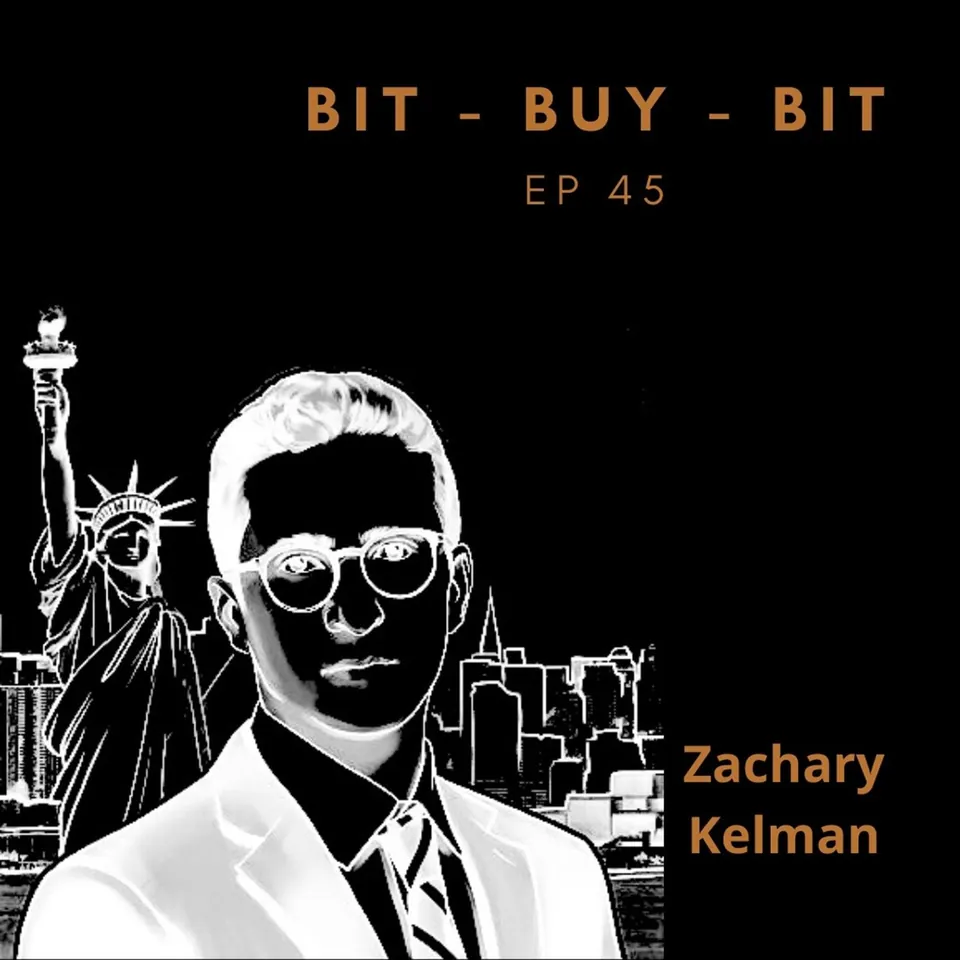
EP45 Bitcoin podcast with Zachary Kelman
Discussed in this episode
Boost this Episode
Send sats directly to the creators. Value for Value.
Plus 1% to Podcast Index, 1% to Boost Bot.
Show Notes
Zachary is a managing partner at Kelman law. We discus his journey down the bitcoin rabbit hole, his views on our current system and the future he sees for Bitcoin.
I loved this discussion and was fascinated to hear things from a different perspective. I also found it reassuring to know Zachary is there to help if Bitcoiners are wronged.
If you don't already follow Zachary, do it now.
Twitter - @ZKelman
Website - https://kelman.law
As always please feel free to reach out and ask me any questions.
Website -https://www.bit-buy-bit.com
Twitter - @BitBuyBitPod
Email -bit-buy-bitpodcast@protonmail.com
Today you can exchange $1 for 9546 Sats (Sale ends soon.)
Thank you Coinfloor for sponsoring the show. If you haven't signed up already then click the link below for the best way to buy Bitcoin. coinfloor.co.uk/BITBUYBIT
Bitcoin is close to becoming worthless.
Now what's the Bitcoin? Bitcoin's like rat poison. Oh. The greatest scam in history. Let's get it. Bitcoin will go to fucking zero.
All right, you ungovernable misfits. I'm your host, Max. Everybody knows the Bitcoin is useless, worthless, and doomed to fail. But what if everyone's wrong? What if it's the system that is doomed to fail?
Join me as I speak to some of the brightest people in the space and slither to the deepest, darkest depths of the Bitcoin rabbit hole. Welcome back to Bit by Bit Everyone. Today's guest is Zachary Kellman from Kellman Law, and although he's a little bit of a different type of guest
to what I'd usually have on, I really love this conversation. And to be honest with you, he shattered my expectations of quite how well I'd get on with a lawyer and how much we'd have in common.
He is a proper Bitcoiner, and he's there to defend you if anyone wrongs you in this space. Apologies in advance for the poor sound quality on my side of the recording, and thank you very much to Coin Floor, my sponsors for supporting me and allowing me now to buy a new mic.
So as of next episode, the sound quality will be much, much better. Thanks again, and enjoy the episode.
Welcome to the show, Zachary. It's wonderful to have you on. Anyone who hasn't already heard of you will know what it is you're doing in this space. Can you just give us a little bit of an introduction and talk about Kellman Law and your experience with Bitcoin and cryptocurrencies?
Yes, thank you, Max. Happy to be here, big fan of the show. Yeah, I'm a general partner of Kellman Law. We're a boutique law firm focusing on crypto. We do a lot of litigation work in the U.S.
based in New York. But, yeah, we've been in this space for a long time, and interestingly, my brother and I, who's also my co-founder, Daniel Kellman, who might have heard of him. He was very involved in the whole half.
Mount Gox Civil Rehab claims situation. Pretty famous in the crypto space for that. We've been in this space since very early. We kind of came in as people interested in crypto as opposed to lawyers because when we got in, there wasn't really wasn't a legal focus at all.
And we've kind of watched it evolve since then. My background originally was I worked in banking. I was in a compliance person and working Stanley and credit Suisse. And I saw correspondent banking and how that functioned as a kind of global settlement system.
I wasn't a big fan of how it worked, to be honest with you. I thought in a lot of ways it was, it kind of privileged certain countries over other ones. It was very expensive to move money around in the developed world.
It's essentially a system where you have clearing houses in New York and every other bank kind of moves around that system on the periphery. The closer you are to it, the less fees you pay.
And so Bitcoin to me seemed like an alternative that could disrupt that system and allow people to settle without it. I first worked for a crypto startup in the Caribbean that was focused on financial inclusion, helping them work with the government to get approval.
And then I went to Asia and worked in the Philippines at a larger one with the kind of bigger footprint for a million users in the developed world in a country that had I think 15% bank penetration rate.
And they had over a million users, which was significant. So I saw the kind of way that the crypto can actually lead to financial inclusion, particularly Bitcoin. And since then, while we were focused on litigation the whole time, but since the end of that, it was like 2017, I've been pretty much focused primarily on the law practice.
You know, we do, like I said, we do contract litigation, anything, any kind of battle in which someone's been wrong in the space that has a crypto focus. But we also work pretty closely with other countries who've drafted some laws for different jurisdictions, crypto-friendly laws, and we also have our pulse
on which countries are attractive for crypto, which countries would be best to kind of incorporate, operate in and build a structure through. So that's more or less our practice. But yeah, primarily US-based litigation from focusing on crypto.
Virtually all of our clients are crypto clients. Okay. And so when you were working with organ Stanley, was that when you came across Bitcoin for the first time? Or was it working there that was making you think, well, actually, I want to see if there's sort of another option
you're talking about, this sort of everything going through New York and that maybe it didn't seem like it was the best way for everyone the way it was set up. Was it something that pushed you towards finding Bitcoin or how did that happen?
Yeah. Well, my brother found out about it first, and so he started pitching it to me. And this was while I was at these institutions. And so, you know, I got it from an economic standpoint, that it's scarce to be factored and everything else.
And, you know, digital gold and so forth. Those things made sense to me. But I was working in correspondent banking at the time. And so I did, I got that concept of, oh, it's censorship-free money that can be transferred internationally and can be competitive.
You know, I don't think that the world financial system was designed with some kind of sinister plot to harm the developing world. But if you look at just the raw fees, how much it costs to move money around, the laws and regulations around money laundering have resulted in making it very difficult to enter the banking system.
And, you know, to a large extent, this is to stop money laundering and stop criminals. And to that extent, it's very good. But it's also inherently political. I mean, if you look at sanctions alone, you know, you sanction a country, you're effectively saying that everybody in the country is a criminal, functionally speaking,
and that working with them makes you learn. And that, you know, just from the system, obviously that's not literally what the sanctions laws say, but functionally it does that. And working with them makes you a criminal.
And so you're out of the system. And so, you know, you have that on one end. And then you have banks that have actual criminals that they have to shut down and ponzi schemes and things like that.
On the other hand, and most of it is somewhere in the middle. The decision-making doesn't happen on kind of, you don't have morally self-righteous bankers stopping bad guys. You kind of have political decisions where you have to decide what the impact of the bank's reputation would be and things like that.
And this really started to accelerate after the financial crisis. It didn't accelerate on bankers for issues with the financial system. It accelerated on banks that had engaged in sanctions violations and forms of money laundering in the sense of violating their internal policies.
And it was for huge amounts of money. I mean, just think about one of these sanctions. They just, you see, I believe that fined $3.5 billion. And just to get a sense of that, you could build a compliance department, you know, with, we'll say like 10 compliance officers making 100 grand a year.
And it would be 350 years before you'd pay that off. So from a compliance standpoint for that bank, it makes a lot of sense for them to build out their compliance function. And the main mechanism through which this kind of big global de-risking, by which I mean poor, small countries or countries that are deemed to be high risk
by NGOs like FADF losing their banking in the people in the country. Not being able to have bank accounts is really accelerated during that period. I mean, there's certain countries that have lost, that have one or two banks left, that people pay money to even get into the bank and have to stay in line to get access to the bank.
The banks behave in a monopolistic way when there's less of them. So we've seen that accelerate. And so I was working in the bank during this time period, this is, you know, about 10 years ago.
So I saw the bank change in, there were worse sanctions. And when I got hired, it was getting more intense. We were reviewing, you know, this wasn't working, same way. It was a different client.
But yeah, we were reviewing different correspondent banking relationships they had around the world, deciding whether they're too high to risk or low risk. And through that period, I got a sense of, okay, so what's really happening in these places is a consequence of it.
They're the places and the places are actually potentially the people in the country are being harmed. And the calculus that goes into it is, is this country high risk? Yes or no. And then how much money is this client, is this correspondent relationship worth to us?
And so if it's a relatively small country in the developing world, it doesn't have a lot of money. And the international community deems it to be high risk. They're going to shut that account down for the most part, in which case, it's harmful to the people there.
And, you know, I think in many ways, we haven't quite seen it happen yet, but Bitcoin and crypto can act as a counterweight to that. You know, de-risking is a nightmare. And some countries have been almost completely de-risking of beliefs.
It was almost completely de-risk. They might have one correspondent banking relationship left. And a lot of the people there just use Mexico for banking. But it can be a nightmare, and so having an old set of alternative rails for money and for banking is useful to people.
So that was kind of the dream that got me interested in working in that field specifically at that point in the developing world and financial inclusion and whatnot. But yeah, since then, and really throughout most of that period, we've been focused on US-based litigation and, you know, we've redoubled our efforts.
I wish I had some big cases to point to you, but we don't. Our big cases end up getting settled before they go to court. So we haven't had one yet, but we might have one coming up. So we'll see.
So your brother's talking to you about this stuff. You're sort of working and living in a completely different world. And what happens then? Are you immediately like, "Wow, this stuff makes sense to me."
You can see how this could change the world and allow finance of people who just cut off from it because of race school, you know, like you're saying that that country doesn't have that money.
They're not big enough clients for whatever reason or sanctions. Did you immediately dive down the rabbit hole and become obsessed with it? So did it take a little bit of time where you were just sort of trying to work out, you know, "Is this a dream or is this something that can actually work?"
Because I think for most people, when they come across this stuff, it's like, "Yeah, it seems like such a huge and crazy idea that it takes either a couple of touches with it or it takes someone who's quite an obsessive personality to really take the time to understand this."
Because it's pretty complex and pretty different. Yeah, I think my initial reaction was to think pretty civically that this is going to get -- they're going to make this illegal. This cannot be -- because I worked in the course by the banking world and I understood that it was a threat to it immediately.
So it just -- I became interested in it, but I assumed it would get shut down. I did not assume that it would continue to operate, you know, and last as long as it has and grow like it had.
I'm still kind of in shock of it. I still remember when Bitcoin hit $1,000 since it was late 2016, and it was just -- I couldn't believe that that had happened or was allowed to happen in some way, which is, I guess, maybe it's like a slave mentality or something, but that was how I saw it at first.
And it took me a while to see that it had the potential it has, you know, in many ways the trajectory of Bitcoin circa 2015, 2016 was more positive in certain ways than it's become since then with all the bubbles and markets and price-focused discussions and institutions getting involved and whatnot, you know.
But all of those things are good in the long run. These are all necessary steps to have a world where, you know, crypto is really integrated. I don't -- I'm not someone that thinks we're going to have a world that's a crypto run world.
It's -- I think we'll still have fiat currencies in countries and, you know, independent financial systems and forex trading and all that. I'm just thinking that if the world continues on the current trajectory, the Bretton Woods US dollar system -- I don't know when it will -- I don't want to say it's going to fail,
but it'll start to noticeably decline. There'll be tipping points and whatnot. I'm not sure when that's going to happen, and again, this is just my personal projections. But, yeah, I think that's going to happen, and it'll act as a kind of a balance against it much the way that gold acted prior to Bretton Woods.
And there's pros and cons of that. I'm not someone that thinks it's going to be a, you know, utopia. I think there's some serious issues with that, a lot of deflationary problems in the financial system and whatnot.
But, yeah, I think that's where we're headed now. We were talking before, obviously, we started recording, and you were saying about the current system and we were basically saying, "Oh, we don't actually know how long this can last the way that it is."
And eventually, all fiat currencies do fail. And if you just, you know, take a bit of a larger view and you look outside of, you know, the last 1,800 years, you can see that actually the system that's been created is almost in some ways going back to what we had before.
And that really what we have now is kind of a big experiment where we just kick the can down the road. And we've been kicking it for a while now. And, you know, at some point, this does have to end.
If you were to guess and put a timeline on that, you know, you're saying that you don't think that's just going to be, it's not like a bit of a bit of a connotation. There's nothing else.
But where do you think this goes? Do you just see Bitcoin sucking up more and more value and becoming a store of value for more people? Well, how should you say it playing out? Well, okay, it depends.
But yeah, overall, I definitely think that function will happen unless there's some serious issues with Bitcoin, quantum computers blowing it up or, you know, community getting together and banning it.
But yeah, like I was saying before the call, I think you have really two paths. One is the world continues to be multilateral, like it has been during the Bretton Woods era of post World War II.
And we have countries kind of agreeing applying pressure on others to slow the progress of Bitcoin and crypto. Look at the travel rule, which FADF passed and being passed a lot of other countries, an example of that, which for those who don't know, it requires these crypto business service businesses like exchanges and mobile wallets
ATM machines, money transfer services of every kind to list that to have in some way a manner of communicating the names and identities of the people who hold assets who are on either side of a transaction between each other.
You know, that didn't exist beforehand, but that's what banks have been required to do since the late 90s. And to an extent before then, but it was codified in the 90s. So, yeah, if that happens, if we keep going down that path, and I don't think to me, the travel rule is not the end of the road.
There's going to be more of these things coming down the pipe, especially if these does get implemented. And it does appear to be and it does appear that the exchanges are also, regardless of which home jurisdiction they have.
Looking to follow it, I think we might see a weaker case for it. We'll see more institutions getting access to it. We might see a world in which newly minted coins and coins that you can show the provenance of and show that it has always been owned by quote unquote the good people, then, you know, they'll be valuable.
And the coins that have been on crypto exchanges that allowed dark coins or have some shady provenance you can't prove might not be accepted.
And so it's one of those issues. It's like the classic censorship issue that, you know, if you create a rule that sensors everybody who did something wrong, and you have enough people that can say to themselves, well, I didn't do anything wrong.
Then the people that are not in that group will, it'll be too easy to continue to use the systems that you've been using if you're in the group that says they didn't do anything wrong. And you'll can, you'll effectively censor out the people that the ones running the system want to push out.
So to me that's, that's the fear, that's the worst case scenario. Now the other scenario is, and it does seem that we're headed more along this path of a kind of increased national sovereignty perspective and different kind of the rise of nationalism you might want to say.
So countries that are more interested in their own nationalistic interest as opposed to a multilateral global interest, they're not as likely to listen to the advice of multilateral organizations.
We're likely to focus on internal politics populism, figure out ways to build power bases within your country. And when I say this, people think, "Oh, you're talking about Trump, you're talking about Bolsonaro."
I'm talking about Erdogan, Putin, Xi, you know, we, you know, Khomeini and Iran. Most of the world is like this increasingly so. I mean, we have this notion of this Fukuyama-ish world of the 90s where everyone was a democracy.
That never really was true, but there was peak democracy maybe at that period. But to me, it's about source of power and legitimacy.
If the source of your power is voters in your country and the legitimacy is you as the leader as opposed to NGOs and groups internationally that are giving you that power, that's overall the direction we're headed in.
And in that world, I see certainly the rise of Bitcoin and the current.
The current world financial system is based around the dollar and this kind of current configuration. So if that trend continues, you'll end up having to have Bitcoin and gold and other types of deflationary assets as the settlement tool as a way of measuring currencies.
Right now you have the whole world buying into the dollar as the measurement tool. But if that happens, if the world goes, continues to go in that direction, there will need to be a new measurement tool.
So it's going to be a breaking point because the dollar is better for some countries and other countries. And so at some point, if your country is not benefited by it, you'll stop. There's pressure from the other countries that is better for to continue the pressure to accept it.
The dollar will continue to be a very useful, valuable currency. And obviously we still have the petri dollar, which is dollar enforced or dollar only trading in global oil markets. So it's still an important settlement tool will continue to be an important settlement tool.
But you can see as reflected in the price of Bitcoin over time, I think it'll go up because it will be an increasingly used settlement tool in that world. So yeah, to me, I hate to give a non answer, but that's the answer.
I think it depends on general trajectory of the world. And if you believe in a more populist nationalist direction, you'll see more bifurcation and eventually the interests of the people in those countries and the interests in those countries.
You're not just like the voter, but the economic and financial interests that are divergent from a national order will eventually end up putting that order in check. I think what you said there makes a lot of sense.
And what I would say though is, you know, you're talking about two different options or two different sort of parts of the world can take. And the first option where you're talking about more regulation, sort of tying people's hands and trying to have like blacklisted and whitelisted coins and all that kind of stuff.
I can completely see that world happening and I can completely see why some of these countries and some of these regulators will try and do it. My question with it is, can they, because as far as I can see it, some of the brightest minds on the planet are working on ways to make that job impossible.
And the developments that I'm seeing as sort of hinting to me that actually they might want to have these whitelisted coins and they're actually not going to be as valuable because then everything is trackable and kept within these sort of gates and it's then very
similar to the old system and, and to me what Bitcoin is about is that people can be self sovereign and that they aren't trapped and that they aren't controlled and, you know, what would you prefer a coin base whitelisted coin that's been verified and tracked and everyone knows everything
about it or do you want something that's freshly minted. It's not even a question. What's your view on that is that me just being a dreamer and spending too much time with developers or do you have a similar view or can't you say.
No, I don't think that's, I don't think that's wrong. I mean, I look, I definitely left that point out, which is, you know, on the one hand, the regulators and, you know, an NGO world is going to want this place where all the coins are tracked and they're going to value the newly minted coins.
And it's true, the people who are not in that world and don't want everything tracked will also value the newly minted coins, the weird way the only real thesis here is buy into the mining companies because new minted coins, or I think you know you'll see physical Bitcoin
and things go up and value as well. But yeah, I don't think that's wrong and it depends. I mean, I should say I'm worried. I'd like to see that world. I'd like to see, you know, but I don't see people doing it the right way with the DEXs and kind of decentralized platform.
You know, it's hard because what you really need are a lot of people with a hacker mentality who are very talented, who have resources and are willing and aren't hungry for lots and lots of money to put this together and make a lot and be willing to put themselves at risk.
You know, I'm not sure there's enough of that being done in the right way to make that happen. But I will say if in fact it were possible to build enough DEXs that were cross platform and user friendly and didn't have a central point of control and were managed by a community in some way or another.
That would, that might be a death knell for this kind of global order. And I think the regulators and groups know that I've talked to a lot of, you know, NGO type people in those organizations and whatnot and policymakers and they're concerned about that.
They were very concerned about the DEXs and the possibility of that, you know, disrupting this but the counterpoint is, it's, it's, it's about the money, you know, I remember about a year ago.
And then that that CZ did and he would asked, what are you going to do about US regulation, what are you going to do about the travel rule and all these different things.
And he more or less said no full steam ahead we're not, we're not a US company and so forth. And then a few months later he did the finance.us and spun off all the US people and do it and bought a US company.
Now, you know, do I know what happened now I wasn't in the meetings I don't know what took place but my thinking is he got some carrots and sticks he avoided getting swatted by the sticks and he ate the carrots and the result is we have finance.us.
You know, the finance didn't exist a few years ago, it started. It did this thing that the system didn't like and now it's doing what the system wants it to do and obviously it's, it's, it's not going to go away that that's kind of the leverage is okay you can continue to exist and your current form which itself is,
is a bit of a systemic threat. But you have to play by these rules now and so it is and so even even bit next recently introduced to KYC last week.
So yeah we're, we're seeing whatever pressure would ever exist out there which again these are meetings and things that we're not, we're not in the meetings, but you can look at the consequences and draw conclusions if you'd like.
And that's, I think that's the reasonable conclusion is they've gotten enough success and they're worried about the risk it's a there must be some pressure that exists. I mean unless you believe that they think users want it, which case I don't know to say I tend to think user friction is bad and users would prefer not to have that.
I mean there is a sound there to be to be totally fair.
If you have KYC and you know who your users are and some fraud or something or you get that lose access to your token there's some utility to having that so it's not purely a bad thing from a business standpoint but I tend to think when I see more and more of that more of those directions
coming from acquiescing to pressure as opposed to independent business decision. Yeah I would think like you said for the most part it's going to be that it's going to be pressure.
What my hope is you know I understand as well that these businesses have to do, they have to jump through certain hoops and my sponsor coin floor UK, they have to jump through certain hoops they might, you know, I'm not going to speak for them but might not agree with some of the things
that they have to do and maybe a lot of these companies would prefer not to have KYC and all these things but I think that the tools at people's disposal after the fact even if they don't have the access to fresh emitted coins and they don't have the
technical capabilities right now, the tools that are being developed are getting more and more easy and more and more slick so that even someone as stupid as me and with no technical background can use it with ease and things like coin swap that Chris Belch is working on
all these different things I am starting to believe that actually they will try and they will fail, it's going to be a little bit of a battle that is going to be interesting to watch play out unless the second option happens like you're talking
about these countries are going to try and do what's best for them and then again the incentive system of Bitcoin is built in such a way that you will have some of these countries that are going to compete and it is going to be in their best interest to make things more comfortable
and usable for these companies so is that something you're seeing happen already or is that something that maybe is a little bit further down the line?
Well I'd say for the most part it's for the double one but you do make a good point which is that the nationalism thing cuts both ways and so you do have some countries where certainly in certain countries interest to not have crypto because it's not necessarily good for their own national currency
So if you look at a case like Iran, Iran is sanctioned and it's not allowed to be part of the international financial system in that way so they've done things to encourage mining and trying to get more people to mine Bitcoin in that country
But at the same time they've outlawed exchanges and trading and all these other things so they're trying to get more Bitcoin but they don't want to allow financial freedom to go along with it and you saw a similar thing with Venezuela where they jumped around on this
They wanted mining, they wanted more Bitcoin but then they didn't want people to trade, you know, and they did their large petro dollar thing that centralized coins, yeah and in many ways I think you could look at CBDCs as that, you know, if you look at China they have their own national currency
and they have their kind of international renminbi and they're willing to go fast and loose with the renminbi, not the same with their own national currency which they're more concerned about, so you have a dual currency model there so, you know, I think we'll see a lot more experimentation
I can't even predict, you know, what that's going to look like, you'll see many different countries trying to deal with the new environment, if in fact the dollars gets weaker and weaker, I mean, I have to say if but to me I agree it seems like it's inevitable
as a matter of when, I don't know when that is, but we will, I think we're already seeing moves in that we've seen moves in that direction, to me the big crack in the system was maybe like 2012 or so, which is what led to the current bubble, because, you know, that the fed was trying to flatten the yield curve
because people were not trusting long-term US debt and the same way 30-year bonds were not the way that they had before, so they ended up buying up a lot of corporate debt as a result and corporations were able to issue a lot of corporate debt for very cheap and then buy up their own stock
and we've seen a big run-up in stock since then, and, you know, again, I'm not reinventing the wheel here, this is a somewhat controversial view, but a lot of investors, Carl Icahn, people like that agree with this as their view as well, and that's led to a big stock bubble, equities bubble, but to me that was a big, you know,
the fact that there was a, almost, you know, there was a lack of faith in long-term US ability to repay debts
that was something that the fed couldn't get around easily and had to do to something which led to a lot of wealth inequality, people don't realize how much wealth inequality that resulted in in the past decade, people are lamenting wealth inequality
and for the most part they're looking at policy choices, tax decisions, things like that, but a lot of it is this kind of dollar decline in the way that the fed has to deal with that to try to keep it going, that their only mechanisms have a byproduct, which is wealth inequality, I don't think it's a conspiracy,
this is just the consequences to keep the balls in the air, so, yeah, I don't know how, I think that will happen inevitably over time, so, and then many different countries will try different approaches and how to deal with it for themselves, but I think it's the same thing with Wall Street right now,
you look at how a lot of Wall Street firms are trying to get a little bit of Bitcoin, they're trying to hedge into it, and it's a game, it's like a prisoner's dilemma problem, it's probably against their collective interest to do that, but on an individual basis, it's worth doing that.
It's kind of like what led to the last financial crisis in some ways, big banks were not giving other banks money to hold them over, and so ultimately it led to this cascading crisis where everything was revealed as a big house of cards in the financial system, so, yeah, I don't know, I think we're headed for a rocky road,
I'm just not quite sure how it's going to play out, but
there's just this pressure to buy Bitcoin as a hedge on, and it's like a self-fulfilling prophecy in gold as well, but I think because Bitcoin's just such a superior settlement tool to gold, and it's so much less centralized, it's a better hedge, so I think that's where we are at this moment,
we're going to continue to see that kind of prisoner's dilemma situation where enough people and organizations that are benefited by the current system will want to hedge into it and will kind of create the rope to hang themselves with, so to speak.
Definitely, and even just keeping some of it as part of your balance sheet, having something that isn't being inflated away and something is a bit of a hedge could be done by more and more companies, and just on a sort of individual basis as well, like, you know, I'm seeing in England,
I'm seeing a whole generation where the majority of them can't buy property, they're not really invested in the stock market, they're living sort of month to month, most of them have got the new iPhone and they got the loan on their car and they're spending money on, you know, all these bits and pieces
that they never actually have any savings, and they're getting further and further behind constantly because they have no assets and they're not benefiting from this inflation, and a lot of them are sort of going towards the idea of, like, socialism
and these sort of tendencies because they believe that if they remove the money from some of the more wealthy people that it will come to them, but actually, it's a systemic issue, and to my mind, people who can invest just a small amount in Bitcoin, it's such a massive asymmetric bet
and when you've got negative interest rates and they can't get into the stock market and the property market, they can buy a small fraction of Bitcoin every week or every month or every day, and by dollar cost averaging in, the pressure that that will put
the buy pressure that that will have, if just a small percentage of those people work this out, to me that's how I look at this thing is like, it's the obvious choice once you understand it, and I think enough people are annoyed enough and mistrusting enough
of what they currently have, that they'll be open to the idea of something different. Yeah, 100%, and I think, again, I don't think it's a sinister feature of the system, and I think a lot of people, it's hard to understand the world financial system, most people
don't, it's a very, very, very complex thing, but I say if you put on CNBC or one of those networks, yeah, most of the people are telling a very particular line, but you have all the people that understand that world on those networks and there are people that disagree, it's not just
Peter Schiff, it's a lot of people, and that was who it was last time, you know, we can talk about his bitcoin queues as well, which I guess he gets no air time on the show, I've had enough of him, you can go and fill his pockets with gold and he's just
saying, yeah, 100%, but anyway, the point is that you have a lot of people on these networks, they're the few people that understand it and they'll say these things, they get the wealth inequality, what the source of it is, they know it, you know, there have been
a lot of people, just the point is that most people don't understand that, they point to tax policies in history, they point to corporate government handouts and corporate corporations working together or politicians being bought out and those kinds of things and not saying those
that the source of the wealth inequality is the financial, it's mostly the Fed trying to paper over the financial system, that's leading to self-interested behavior by corporations, public and trade companies, typically by issuing bonds, buying back their stock, you have disproportionate ownership
of the stock market in the hands of a few and that lifts that boat at the expense of all the other boats, that's kind of a mechanistically what's been happening, at least over the past decade or so.
Sorry, if I was just going to say, like you said, I can be a little bit conspiracy-theorist and I can have these kind of ideas and I can get these dark ideas, but I think you are right for the most part, this isn't something that's just planned out and that they
thought, wow, this is how we're going to do it, I just think that over time, there is an incentive for these companies to buy back stock and there isn't an incentive for things to work the way they work because it's just people acting in their best interest
and to be honest with you, I'd probably do the same if I was in that position because you're going to do what's best for your company or what's best for you, that's kind of how humans work and it's nice to know that there is a system that has incentives
that can work for, everyone's can do what's best for them, but actually the rules can't be changed, the rules are the same for everybody and I think that's kind of the key to this is like, no matter how powerful you are, you can't change those rules and you go in willingly
and it's simple, once you understand like it's a hard-capped asset, you understand the basic rules of it, it's not as complex as the current financial system which a very, very, very small percentage of people understand and know how to navigate and everyone else or most people just
don't do so well, so I genuinely believe that more people can understand this other system and then it will benefit more people and I think it's perfect, nothing's perfect but I do believe it's much better and that's why it's interesting to hear from you
sort of how these two worlds can merge and what you think is going to happen in terms of like do you see some sort of niche businesses that are going to bridge these worlds where, you know, maybe now you've got people who are obsessive about this stuff like me and spend all that time
learning and playing around with it and using it but most people aren't going to do that, they're going to be businesses that are going to come in and link these two worlds and make it more easy for more people to use this stuff and do it safely and benefit from what we're probably going to see in this next bullet
Yeah, I'm not that optimistic about that happening in the near term, I tend to think it's going to be more investor focused and you know I think that as you raised the point before, younger people being left out of the system it's a big issue
you know it's not like I said I think there's a prisoner's dilemma thing going on with the financial world where they're getting more and more of a piece of it, and that means that the financial world's owning more and more of crypto, you know, writ large they're getting a more higher percentage of it
and you know in a nutshell the way the financial system works is banks can borrow more or less unlimited money at the Fed's interest rate at your union's central bank, the ECB central bank rate and those are very low and so that money goes to other wealthy groups because they have high credit ratings
and they have bank accounts and they take out loans and so that system is still relied upon by all the economies of the world in different ways so that system churning out money and buying more Bitcoin before Bitcoin becomes this inevitable
you know kind of global reserve currency, that whole process will certainly cause a big distribution of the crypto space into the legacy financial world, you know, as long as you can still print, as long as you can take a loan out buy it, you know and so forth,
unless something happens very suddenly that crashes the whole kind of legacy world, and everyone suddenly needs to start using Bitcoin to buy cereal, you know, which I don't think that's going to happen.
Then yeah, you'll see more of that kind of wealth inequality. And we actually saw a bit of a microcosm of that in the 2017 bubble, because if you do polling of Gen Z versus millennials on crypto, the sense you get are that millennials think, okay, crypto is cool, I want to get a piece of that.
And Gen Z thinks this is something that's, they're more nihilistic about it and they don't think that it's possible I think Bitcoin happened. I was too young and now it's over.
So that's, that's a real thing and it's a bit of like kind of a futurist take but you know, in 20 years Bitcoin, you know, many people start looking at this, whatever change happens in this optimistic way we're looking at it, they'll look at it as.
Oh, yeah, you know, that was something that happened for people in the past in the same way that we might look at. Oh, yeah, no, it'd be great to own a house. But that was from my parents and grandparents, you know.
Yeah, well, it's kind of, you know, it's been talked about as a wealth transfer. And what we are seeing is, you know, the difference between, say, you know, my parents generation and my generation.
Sort of, you know, late 20s, early 30s, the amount of value, the amount of money that they would have compared to what it's like now is, it's like seven X difference. It's a completely different world and that has to find some equilibrium.
And I'm looking out there and I'm thinking, well, property markets all time high stop market all time hard. They can't get their hands on these things like, how is, how is what's going to happen? How is this going to normalize?
And how are we going to get to a world where people today can live like the generation before? And I can't see anything else other than Bitcoin doing that.
And like you're saying, we, that these different generations have different views on things when we are in a digital world. And if I speak to people 20 to 30 to 40, maybe they'll be more open to Bitcoin and my parents generation of people like that.
It would be bad by the government, never going to happen. And that's like a flat out, not going to happen. So they're not going to jump on board.
But I, you know, I'm not convinced that it's going to lead to more wealth redistribution. You know, I think it might lead to the opposite direction. I mean, I hope you're right. I think certainly it is a wealth transfer.
But, you know, think of it this way, you know, the, if, if, if legacy financial systems and people that have, you know, dollars and euros and pounds and whatnot at, you know, I don't want to say money, but have those assets.
And the world changes in the direction of Bitcoin people are sort of lose faith in them. That interim period of losing faith will result in the people that are currently holding a lot of the well, getting more and more of the Bitcoin.
Basically, it's great for the early adopters of Bitcoin, but that's not a huge group of people. And I think if you look at what happened in 2017, it's not, it's not a uncorruptible group of people either. It's, you know, definitely isn't.
I bet you have dealt with some characters doing what you're doing and, and seen some things that I don't know whether you can talk about, but I bet you've seen some crazy stuff going on in 2017.
Yeah. Well, I'll say this. I did work in Southeast Asia then, and I did a lot of work in compliance and regulatory work with governments. And the one thing I noticed was there is just a massive proliferation of Ponzi schemes.
We know about BitConnect and we know about one coin, you know, there's some big ones, but there's tons and tons and tons of small ones. They're using the, the kind of lack of, you know, mass economic literacy to say, Hey, I have this new coin. You're going to get rich.
Here's my coin address and the Bitcoins. I'll convert them back into your special new coins and give them to you. And yeah, it's a plague and it'll never, in my view, it's like there's, you know, you look at the history of regulation in the past hundred years or so.
You have two kind of main thrusts. One is, Hey, there's bad guys and criminals. We need to track them and stop them. Another one is, Hey, there's frauds and scams. We can't let people start operations or launch businesses that are designed to be scams.
And those are two features of decentralized crypto economies that they are there. You'll never get rid of them, the extent to which you get rid of them and the extent to which you've lost that and become centralized.
So that's the real tension here. It's the same with the travel rule and all these issues we're talking about. You know, I think the world will strike a balance in some way. And we're seeing that with, you know, exchanges acquired KYC and a number of other things.
And also the SEC's, you know, kind of cracked down on different scammy projects with the exception of telegram. Most about the SEC's crackdown have been really bad scams because that's how you win federal lawsuits as you go after the really scammy ones and it's a no brainer.
And I'm sure there's a couple in there that aren't as bad. You know, I don't want to paint them all with that brush. Some of the ones they've gone after are egregious. You know, there was a one guy who claimed he had partnerships with McDonald's and the Catholic Church and everything else and selling it's called T bars, I believe.
So yeah, they go after the scammy ones. But the point is that as a space, people need to start saying, look, it's a trade off. There's going to be money laundering. There's going to be scammers. And that's going to happen. And, you know, as a community, we should talk about it and say it's bad and condemn it and pointed out and
deal with it as it comes, but it's a it will always be a policy justification to to get rid of decentralization. And there has to be an allowable level of that, you know, it's not going to go away.
Like on some level, you can I don't want to say it's a good thing because in no way is getting scanned a good thing and in no way is, you know, is allowing massive criminal rings to move money around the world.
And there's no doubt that those are both things that happen in this space. But that's going to happen with the with the freedom that comes with these networks. And you have to accept some level of it. And, you know, it's like a return to vigilance in that respect. That kind of just comes with the territory.
And I do feel like as a space we've kind of seeded those points. We said, okay, yeah, we know you're right. We can't have this. We can't have that. And, no, again, I feel weird making this case, but because I, you know, like I said, I condemn all of it.
And it's all bad. And, you know, you won't find anybody who hates scammers more than I do. I hate scammers. And that's why a lot of what we do at the law firm is go after people that are defrauding people and scanning people. And, you know, we wish we could do more of that. Sometimes it's not cost effective to do that.
But those are the things that I care the most about stopping those people. But that being said, on a systemic level.
If you're encouraging decentralized blockchains and cryptocurrencies and the proliferation of them in use of them, you're also encouraging, you know, scanning and some level of money laundering in doing that and I don't think it's possible to get rid of it all.
And to be fair, there's a massive amount of it that goes on in the banking world too. It's not as if it's purely in a crypto thing, right? So, and I don't know how it works in the volume level.
Yeah. Yeah, I mean, I agree with you. And I do, I hate scams as well. But I also accept that they are going to happen. And like you said, it all goes on in the traditional system and the money laundering and all of that.
I mean, money laundering generally is done at dollars. And most of the nasty things that go on in the world settled in dollars and a very, very, very, very tiny fraction of it is done in Bitcoin.
And doing it in Bitcoin isn't as good as doing it in dollars. It just isn't. People who argue that they can argue all they want, but, you know, it's going to happen regardless. And it would be nice to say people from getting scammed.
But I think a lot of that just has to come from education and scammers are always going to scam. They're always going to do it in bad people are always going to do bad things and they're just going to use whatever is the best tool to do what they're going to do anyway.
And, you know, I do kind of see it as a little bit of natural selection and if people are going to do stupid things, they are going to get burned.
And it's why I focus so much on, you know, this is a Bitcoin only show. It's the only thing that I talk about. I will try and get people to be responsible and do things in a way that is the safest for them because it's so confusing that it's so easy.
It's the perfect place for scammers to be because no one really understands this stuff and you can throw a load of buzzwords and bags and blah, blah, blah, and the newest coin and people fall for it because they have the best marketing.
And that is why I just stick to Bitcoin and just say that this thing is pretty solid. There's loads of good education. Just try and do what's safest for people.
Well, I would say one interesting point, though, is if you're only interested in Bitcoin succeeding, I do think the strongest case is a mass adoption in the institutional world, institutionalized KYC, everything, you know, and so forth.
If you're just interested in the price of Bitcoin going up, you want institutions to adopt it. You want companies that sell and trade in it to make it themselves just like the banks.
They can massive KYC that will lead to more adoption. You're making it safer and safer. It's like, it's like in a big city, you know, Bitcoin is like, you know, New York circa 1975.
The best thing for if you're a property holder in New York, if you're a Bitcoin holder is get someone into crack some heads, enforce all the rules and laws, turn it into a nice safe place and you can get all the, you know, the prostitutes and, you know, and sex.
Whatever movie theaters and whatnot, out of Times Square and replace it with Disney and all that. Yeah, but you lose a lot of liberty and freedom in the process, but you end up with a much higher Bitcoin price and much more widely accepted.
You know, but again, I'm not saying that's a bad thing. That's probably a good thing. I think to me, the main issue, let's plug the first hole first, which is we have a global financial system where we measure everything and other currencies as opposed to something that's actually stable and deflationary.
You know, again, I get the nuance on that. I understand that that view is something that is anathema to economic history, monetary history for the most part. I mean, historians and institutional members. It's not something that's most, it's not something that people in those institutions would agree with.
If you look at the causes of the Great Depression and how the Bretton Woods system and markets have performed in the past hundred years or so, you know, it doesn't seem like it's failing in that respect.
But I think we've seen, I mean, I think you and I are releasing the same page. We've seen the end, that system is dying, you know, and so if you can replace it with Bitcoin, it does get sanitized.
That's all for the better, I suppose. But yeah, I think to me, it's also a question of the kind of systems, decentralized crypto systems writ large, whether it's a DEX or, you know, new currencies that come out or new interesting applications that exist.
You know, we'll Bitcoin succeed and then shut the door behind them and, you know, destroy the drop of the bridge on the way I back or will those will those things also pass through as well.
It's going to be interesting to see, you know, I have no investment in any other coins. I don't really have that much interest in anything at the moment, because I don't see a huge amount of value in several of them. I could obviously be wrong.
I do think there will be other things that will be useful. Maybe blockchain will be useful for something else. I don't really know. I just, I currently see that a lot of it is just snake oil and maybe through a lot of what's out there, there will be the old diamond and there will be something useful.
But I think really for me, just I'm taking the approach that on this show, I will talk to people and tell people and advise people what I would advise my friends and family and all I advise my friends and family is look, you want some exposure to something.
Just have a little bit of exposure to Bitcoin and learn as much as you can. And to me, it's the, it's the only project that really I can, I can believe in and understand at this point in time.
And that doesn't mean there are, there won't be things in the future and that there won't be other applications, but I don't know. I kind of, I look out at this D5 stuff that's going on and to me, it kind of just looks like the last ICO bubble. I can see a lot of people getting burned.
I have friends texting me about, oh, yield farming and buy this token and it's gone up 25x today and I'm getting this, you know, I'm just, I'm just like, it just sounds like nonsense to me.
It's like our current system on steroids with rabies. It just sounds horrible. You know, I don't understand it. Yeah, I think a lot of these what they've done is, and I don't want to, I don't want to go too deep into it, but I'll just say in a broad sense, I think what's happened is the flaws in the 2017 projects.
A lot of the recent projects, they've just hid the flaws a little bit better. They've pushed them into some second order token or something else. So it's not as visible to people in the sense that's the new innovation.
But you know, I will say this, I think a lot of what you're seeing is just a regulatory arbitrage. You can make these images of tokens and trade them and you don't need to go through all the red tape.
And frankly, I think one thing people don't realize is a lot of the best traders in the world work for big banks and, you know, organizations that don't allow them to do their own prop trading.
So, you know, they can, they can break the law, I guess, and I assume that they do and do this type of trading on the side.
I don't know, but actually I'm not sure if it's covered under every bank's regulations at this point, whether they're employees can do that. But yeah, I mean, you can, you can actually trade in these assets on these exchanges, the carbon copies of them or what have you so.
Yeah, there's some utility in it, but I don't know, at the end of the day, a lot of it is just gambling. And that was one of the biggest insights I had dealing with a lot of the Ponzi schemers and people like that is I talked to a lot of people who were harmed by them.
And the thing I realized was whether it was someone who's a sophisticated investor who was in on it, or whether it was someone who was just this poor family that got screwed by it.
I was surprised because I always found the same thing virtually all of them knew say that they knew it was a scam the whole time, but they thought they'd get out before everybody else did.
You know, these rules exist. It's a, and it's the same reason why gambling is regulated, you know, like these are all things. There's tragedies that are prevented by these regulations from existing.
It's not a, it's not a one sided obvious choice like an anarchist would say, you know, it's, they're both good.
But you know, the point is that which one's better or worse it's a, it's a, you know, it's, yeah, I think you need a balance but overall, it's an either or and I think the problem is that the way that the debate's been framed is crypto allows for
criminality and money laundering, and it does. And you'll never get it to zero. You can't, you can't accept that. It will be at zero. You can't accept the argument that okay until it gets to zero. This is a bad thing that we all need to regulate and centralize
and in order to get the closer you get the zero, the only way to really get there is by making it further centralized and pushing the space into something where half the network is mapped out and half isn't and the dark parts are not allowed and, you know, you end up creating
a decentralized form of censorship in that sense, which is enforced at all these pressure points. And that's what I'm really concerned about with the kind of regulatory direction. So that's why I'd say it's important to accepting the fact that it's
going to have a bit of messiness. Yeah, and when you, you know, we're talking about, oh, it's similar to gambling, that the issue that I have with some of these tokens and the five things and all the stuff that's going on and what happened in
the industry, my issue with it is when you walk into a casino or you go to bed on horses or whatever, you know that the odds are not weighted in your favor is very rare for someone not to understand that you go in and you go and play
that's not weighted in your favor. You know, this is gambling. But with a lot of these projects that I see in a lot of the way that it's sold to people, I feel is disingenuous. Like, I feel like they are purposefully making it sound and use complex words to guide people down a path that is basically
my eyes, a lot of bullshit. And that upsets me because a lot of these people who are coming in, they're using a lot of the buzzwords and a lot of the things that say Bitcoin can do. And then they're just marketing it in a different way and telling lies about what it's roadmap is and what it's going to be able to do.
And they don't deliver on that. And so to me that's worse than gambling. To me that is literally just selling some other dream and then lying about it. So I don't have an issue with regulators stamping down on these sort of people and like one coin and that kind of stuff.
Oh yeah, you know, I do have a bit more of an anarchist view on the world. But I'm also realistic and I know that we don't live in that world. So if we're going to have regulations, they should be stopping that kind of behavior because a lot of these people are sort of almost on the right
path like they've almost found something that would be I think a good investment and would be very useful for a lot of people and they just veer off and they buy some shit coin and it does it makes me sad to sit.
Yeah, I know I basically agree with all that. And again I think the SEC mostly has gone after really bad scams that they should have gone after. My only point is that I worked in the developing world and those controls aren't put in place
in many places in the world they don't have the resources or ability to regulate that. And it's a global world. So you'll have Russian and British scammers in Indonesia who are scamming people in Vietnam, right?
But because of the nature of crypto being funds that you can send not through a central intermediary, that in and of itself makes it harder to scan. If all these things have to be done through the legacy banking world, you'd have asset
freezing, you'd have all these normal legal mechanisms to get the money back and stop it from happening and would disincentivly doing it. But in the same way that crypto locker and hacking are encouraged by the tool of Bitcoin, these types of scams are too.
So I'm just saying it's going to be with us till the bloody end. It's always been with us in some ways. You know, I don't want to pontificate on it too deeply. But yeah, there's, I think, a lot of aspects of society and culture probably started as scams and turned into something that's not a scam.
You know, history is written by the victor so we don't know it, but I think that's probably true. That's a very good point. Yeah, and those one coin things and these kind of stuff. I mean, I had somewhere that.
Am I right in saying it was like six billion that was taken in that scam or am I completely off? Right. I think it's in the billion range. I don't have the number in front of me, but I remember. Yeah, I think it's up there.
I seem to remember hearing something like that. And I remember at the time the market cap of Bitcoin was like at the time, I think it was like 90 billion or something like that. And I was thinking that is crazy that this like really obvious Ponzi scheme has taken that much money and all those people have had that money taken from them.
A large percentage of what was the Bitcoin market cap and like that is just madness that the amount of money that people are scamming up people is it's absolutely sick. I heard a conversation with one of the ladies who was scammed a Scottish lady who was scammed and lost all her family's money and everything, everything into this thing.
It was just horrible to hit absolutely horrible to hit it to me. Look, the way I see it playing out is something like this. I mean, markets are an educational tool as well. So people are learning scam. A lot of the scams like denta coin should say their scheme, but you know, a lot of the tokens that are thought of as scams.
Okay, it's a scam. Fuck it. I don't at this point. It's a scam coin and maybe they thought they could actually build a dental network around it. I don't know. But the point is that the markets, most people have learned that that scam doesn't work anymore.
If you know, if someone came up with Cairo coin of all the chiropractors in the world saying they've been accepted, I don't think it would blow up the same way denta coin did. Sorry to take on denta coin.
No, no, I saw them shilling one of the London and it's one of the first one I went to denta coin and I was in dentistry before this I ran dental. And I remember going there was like, I was trying to listen to that blurb and I was just thinking, the fuck are you talking about?
What is this? It is just obviously bullshit. But yeah. Sorry, not the point, but we're not sorry. Exactly. But yeah, but the point is that denta coin couldn't happen again in this market. People learn that it's a scam.
And, you know, Defy is working and a yam was a scam. I think we can agree on that if that was dead. Two weeks ago, it was a great coin that was not a scam right now it is. But the point is that people are learning. Yeah, at the same time, scammers are getting better and more creative.
But I think over time we'll end up with a very congealed group of people. We'll call them Marx and they can't help themselves. It's like with the gambling thing, you know, they're gambling.
You know, Dick casinos have a set group of people that are their core users that are addicted to gambling and it's sad. But you either live in a society where you make gambling illegal and no one's allowed to do it and you have police and people that enforce that rule.
Or one where it is and the people that have become gambling addicts don't become gambling addicts. Maybe they become, you know, a beanie baby collectors or something. Maybe they collect UEO cars. I don't know.
You know, that's that's the trade off. Right. And so I, you know, at the end of the day, we're always going to keep some percentage of people that fall for that. It's the it's the adrenaline rush. It's the, you know, and look, here's the thing, right.
Yeah, it's fun. People, if you look at a successful Ponzi scheme, you know, the first thing you do is they let people win. They actually do. They're these big Bitcoin doubleers thing a few years ago that we saw all the time where they'd say, give me Bitcoin, I'll double it.
People would give it to them. They didn't even know how they doubled it. It's just that they heard like five or six other people actually doubled it. They got the money back and that testimony, you know, led to more and more of it so they'd keep doubling it or whatever.
They'd not quite double it. And then suddenly they just disappear. So I don't think that's, I think it's, it's just a feature of the fact that the asset can be transferred and there's no intermediary.
And you'll just get more scamming. There is, you know, like a scamming for, I'm selling you my PS4. Here send me the Bitcoin first. I'll mail it to you. You know, that's the oldest trick in the book.
You know, it's the modern day equivalent of, hey, I'm going to, you know, you want to bag a weed. I'll go for you to go buy it. Just give me the money. And then you just go away. Right. And you can't do that with banking. You can only do that with Bitcoin.
I suppose you could do it with bank, but again, it's too high of a risk. It's too traceable. There's a central party who holds them. It's self responsible for preventing it. So there's charge facts. It's not final. I mean, yeah, Bitcoin's perfect for that kind of stuff. And, you know, that's what we were using.
And we saw with this Twitter hacks and all this kind of stuff, they're not asking for anything else. They're asking for Bitcoin. And I can only see that continuing. But the thing is that not a lot of these people are very sophisticated.
Like we've seen already the Twitter hack. They've already been caught. And a lot of these people aren't very sophisticated, but I do see that it's kind of over time. They're going to work out to use this stuff.
And yeah, it's going to keep the regulators busy. You know, you're talking about litigation and all this kind of stuff. Are you working with individuals as well? Like when something might happen to an individual, can they reach out and contact you?
Are you all working with businesses? We do work with individuals. Actually, Max, we're at one, one hour, five minutes and 48 seconds. Can I leave for like one second? I'll be right back. Yeah, of course. Okay. Can you like cut it? Oh, you're right back. Yeah, yeah, yeah. Let's go.
Hey, Max, sorry about that. I'm back. No problem. Sorry. It's me. Yeah. Rapid sing on this usual. No, I didn't use the bathroom. But yeah, you were you were asking whether or not we know we represent individuals a lot, you know, at our firm. We, you know, we don't just represent we represent individuals more than businesses, I would say.
It's just a matter of how someone was wrong. I mean, you have to find a toward or a contract dispute. A lot of the time it's founder issues. A lot of the time it's someone who worked for the firm.
Um, was some some type of entitlement that's not being honored. Um, a lot of the time it's, it's an investor or the company versus an investor. Um, sometimes it's a.
Sometimes it's a hack or, you know, someone that got hacked or scanned by someone else that's hiding it or, you know, it's a lot of, it's a lot of complex issues that happen in crypto that don't happen in other spaces.
If you don't live in it, you don't understand it. It's a steep learning curve. I mean, think of it this way. Most lawyers who are good. What being a lawyer, you get better at it as you get older. It's a skill.
Um, and experience. There's a lot of different skill sets you gain in it. Um, but learning about crypto is something that happens when you're young. You can't really start learning about it when you're in your 40s and 50s. It's harder to.
It just doesn't interface with your life in the same way. It becomes like an intellectual curiosity more than like a practical, you know, lifestyle choice.
And if you know, if you understand on a impractical theoretical level, it doesn't, it's not as helpful to look at the case back patterns of your clients and what's going on in the world and kind of troubleshoot with them.
So, yeah, I wish, I wish I had a better pitch to tell people how we can help them, but it's, uh, it's, it's every client's kind of different. You know, the point is that if you're, if you are not getting what you're entitled to in different ways, whether you're, you know, an investor that didn't get paid or whether you're
running a project, being taken advantage of, you know, or you were hacked or things are stolen or you have an issue that crypto is at the center of, we help with that, typically. And you'd be surprised.
You'd be surprised. They really run the gamut. You know, so basically, you're there to protect people who have already been wronged and see if you can help them, but also do kind of do preventative work for, you know, let's just say I had an idea and
just to start a company within Bitcoin and, and I said to you, look, I don't know anything about law or anything about how all this works, but I want to make sure that I don't end up in a prison cell or with a massive load of problems.
Could you give me some advice and is that something that you do for people? Yeah, we do. I mean, a lot of the time, well, the problem, that's what I mentioned before, is that I think most people are interested in what will get so many clients, most of them are just interested in how to make a quick buck.
And it's hard to give them advice, but for people that are really serious and want to build something and improve the space and they, you know, they have some, some concerns about how to do it the way that that will be protected.
And, you know, there's things you can do to protect yourself and things that you can't risk that you can't get around. I think when you go to a big law firm, what they're going to do is, you know, pay, they'll charge you a lot of money to put a memo together.
And the memo will tell you 90% things you already knew, that'll be very long, and then there'll be 10% of things you weren't totally sure about and might be useful.
And then you won't get any real protection. They'll just say, if you do this, if you do that, here's the risk, that's the risk, you know, blah, blah, blah, because there's no clear answers to any of this stuff.
You can't engage in the space without some level of risk. It is what it is. Right. So, I can't, I can, you know, I'm doing more advisory work. I'm interested in the project. I want to see it succeed.
I can help them figure out how to make less risky decisions and smarter decisions. And we, like I mentioned, given our kind of international focus and the fact that we work with different jurisdictions and laws and whatnot, we have a good sense of how you would set it up.
It's not our, you know, and we do do that, but it's, and we don't do it for free, but to me it's more, I don't say it's a favor, but it's something that we do. And then advisory level out of, but it's, but we're interested in more as a litigation.
It's more fun to be honest with you. That's why we do it. Yeah, you know, it's a, it's a battle, you know, you're, you're taking, you're battling for your client. It's, it's fun. It's interesting.
You know, and you're, you're at the end of the day, you're bringing value to the clients that way. And I just feel as a lawyer, the transactional work, you know, you know, you know, you're adding value, but it's like being a goalkeeper, you know, you're just blocking shots.
In fact, nobody even in the difference is known even sees you block the shot so they don't know if you're good or not.
I mean, you're just kind of putting them in a situation where all the things that bad it could happen don't happen and it always kind of ends, especially unless people are, you know, fully aware of it, they just, it's put it this way.
Imagine you took someone who's never watched a football game soccer to, to imagine, you know, the goal is really good. Could they understand that the goalie is good? Not really.
But then they get scored on, say, okay, you're bad, but we've never been scored on. But anyway, the analogy still holds. So I don't find that work is satisfying. I mean, we do do it.
You know, we've done it a bunch of times, but we're primarily looking for litigation where people would have had disputes and issues in crypto, you know, where you take an advantage of it or you owed crypto by someone that hasn't given it to you.
Did you get ripped off or hurt in some way by in by crypto business or by another person? You know, did you have an agreement that was breached? It doesn't even matter if it was written was it or something that you had agreed on had expectations that were dashed? I mean, were you wrong? That's kind of it. You feel you were wrong.
And, you know, if that happened, we'll talk to you and figure out, you know, we're not going to charge you. We'll talk to you and figure out what happened. What are your options laid out for you.
Most of the time it'll be us not working with you, but try to just hear you where you when are your options and what's your best option. And sometimes it will be a good match. And that's how our business works.
Most of the time it's turning people away. We're not a we're not a factory, you know, we're looking for good cases and good clients that have good claim and, you know, and that that need help and, you know, that we actually can can help.
And we've done a lot of that. And, you know, the issue I'd mentioned before is we always end up getting them to settle. You know, we always end up getting a settlement and working it out. And that's how most cases are dealt with anyway. So we don't have any big high profile cases that you would you could point to.
But, you know, I think that might be happening soon, but we don't have that at this stage. It must be a pretty amazing feeling to I'm sure that some people come to you to scroll and just not knowing what to do or which way to turn and helping them must be quite an amazing feeling.
I mean, what is that? Oh, yeah. It's it is an amazing feeling. It is because, you know, you have to jump through a lot of hoops to be in the position that we're in. You have to go to law school, you have to get past the bar, you have to learn about the court system, you have to learn how to put together all the legal documents.
You have to have done it a bunch of times that you see how how it plays out, how it doesn't, you know, and it's like I said before the legal profession is one of experience you get better.
Being a great lawyer is not something you start off with. You have great potential because you have a strategic mind and you're smart and these other things, but you get wily and better at it as you get older and have more experience with it.
You know, thankfully my brother and I have both been, you know, because we've jumped out the gate with this have a lot of experience at a high level, despite being in our 30s. So, you know, I think we're more experienced than average in that respect.
But yeah, being able to do that, when you actually are able to use these tools that currently exist in our legal system to leverage this for people is an amazing feeling.
And that's why we do it. We've never had a client that we didn't feel was in the right. We've never had a situation where we were doing something we didn't feel was, you know, been a result in something positive for the world.
One way or the other, which is, you know, it's a bit of luck, perhaps, but yeah, it feels terrific when you actually bring it home. And yeah, we've definitely improved lives for people, for sure.
People that were, I can't get in detail, but I can say there was one case we had where somebody was owed a lot of money. They're being taken advantage of the person that took advantage of them was running a scam operation.
And we had enough leverage to ultimately force them to settle to avoid, you know, more pain and suffering. And they got a significant payout and got to a bond with their life. This is a very sweet, wonderful person we had as a client who I don't think was would have really been able to defend themselves.
Otherwise, they didn't know the system well and they were prepared to make a decision which would have more or less given away all their leverage. And, you know, now they're happy and live in a good life. And, you know, they're able to move on and to bigger and better things.
So those are great stories when you do that. It feels great. The legal profession, you know, in adversarial legal systems like the US and Britain still has that where you can actually fight and win. You're like, you know, it's like the olden days, a little bit where you get hired to for a
trial by combat, except it's litigation work. It's not actual combat, but as close as we have to that in modern content. Combat of the minds. Yeah, that's awesome. And that's, that's really nice to hear that you're helping people and that you're able to do that.
I love when I hear these kind of stories within this space because there's a lot of dark things that go on and there's, you know, there's a lot of sad stories, but it's good to know that you're there to, you know, if anyone needs to turn to somebody and if anyone listening to this has been scammed or wronged or
just have problems, then yeah, definitely check out Kalman law and what would they do. I'm hoping nobody listening to this has had any problems, but just say they did. What would be the procedure?
You just email us at info@calman.law. Go to www.calman.law. You can always @ me at Twitter and message me. It's @ccalman. Yeah, that's basically it. And I don't know if you want to put that in on the
chat, but yeah, I'll put all the links in the show notes and, you know, we'll speak off there as well and make sure that I've got all the correct links and everything because it's an important service. And like I said, I hope no one has had any issues.
But if they have, it's good to know that they can have someone who covers their back and if any scammers are listening to this now and thinking about scamming me. Think again, because my friends.
As if you didn't have a choice before you could. Yeah. All right. Awesome. Well, Zachary, is there anything that we haven't covered that you wanted to? We've had a, you know, a rambled on and we've had a wide wrenching conversation that's been really awesome speaking to you and the opportunity. But is there anything I've missed?
No, I mean, I just, it's a privilege to be on here. And, you know, I love the show. And so, no, I think we covered everything I wanted to talk about.
And just my main thesis, I think we just have to accept a little bit of messiness in the crypto space. You know, that's kind of, that's my basic ethos in trying to get out to people these days.
Perfect. All right, Zachary, it's always been great speaking to you. If you ever find yourself in London, we'll have to grab a drink and, you know, if any developments happen or anything you want to chat to in the future, I'd always love to have you back. It's been great.
Awesome. Anytime. Bye.
Machine transcript; expect the odd mishearing. Click a passage to play from there.



