
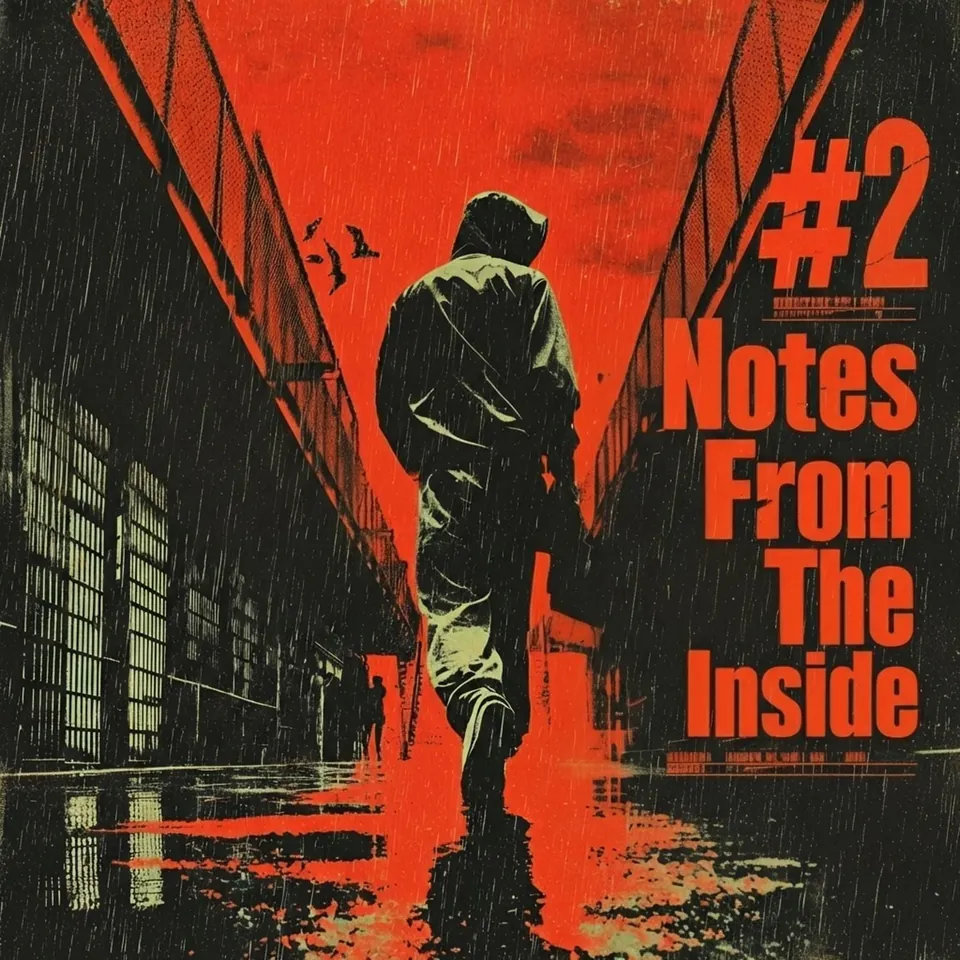
Letter #2: Notes From The Inside
Discussed in this episode
Boost this Episode
Send sats directly to the creators. Value for Value.
Show Notes
In these episodes, Max and John read Keonne’s recent letters written from FPC Morgantown. The aim in sharing this is simple: amplify Keonne’s story, support him and Bill, and ensure help reaches their families. If his voice isn’t your thing, the full text is linked in the show notes—please read, listen, and share. Consider sending a letter, a book via an approved retailer, or some sats. Your support matters, and together we can keep their stories alive and make a tangible difference.
LINK TO THE LETTER AT THE RAGE
Write to Keonne:
Keonne Rodriguez
11404-511
FPC Morgantown
FEDERAL PRISON CAMP
P.O. BOX 1000
MORGANTOWN, WV 26507
Mailing Guidelines:
Please note: You can only send letters (no more than 3 pages long). No packages or other items are allowed. Books, magazines, and newspapers must be sent directly from the publisher or an online retailer like Amazon. All letters must include a full return address and sender name to be delivered.
HELP GET SAMOURAI A PARDON
- SIGN THE PETITION ----> https://www.change.org/p/stand-up-for-freedom-pardon-the-innocent-coders-jailed-for-building-privacy-tools
- DONATE TO THE FAMILIES w/ USD ----> https://www.givesendgo.com/billandkeonne
- DONATE TO THE FAMILIES w/ BTC ----> https://pay.zaprite.com/pl_JpxtkLv95T
- SUPPORT ON SOCIAL MEDIA ---> https://billandkeonne.org/
Alright, John here, welcome back. And a big thank you to Max for reading, and to all the ungovernable misfits who donated to letter one, notes from the inside. Together, we raised
500,000 sets, and 100% of that will be going directly to Keon and Bill's wives. As you know, the ungovernable misfits cared deeply about our diversity, equity, and inclusion principles,
fostering fair treatment, full participation, and a genuine sense of belonging for everyone in our community. Even dyslexic retards with a reading age of five, like Max. That said, I'll be reading this one myself, and I hope you enjoy it. Please remember to donate
generously and sign the petition. Letter number two, notes from the inside. In his second letter from prison, samurai wallet developer Keon Rodriguez breaks down how a lack of access drives the need
for alternative markets to develop. Hello, reader. The shadow economy of FPC Morgantown runs on pouches of mackerel. Yes, the fish. Much like any fiat or precious metal standard, there is no intrinsic value to the currency, to the mackerel. You might be a smartass thinking to
yourself that surely you can eat the mackerel if you wanted. And there is some amount of protein that some prison economist has a model for deriving intrinsic value based on caloric density and
protein richness. But alas, no. Most of the mackerel in circulation is so old that eating it would most certainly result in a visit to the medical station, or worse, a nasty case of the runs.
Trust me when I say the last place you want to have the runs is in a communal toilet block that 100 other guys make use of as well. So no, the mackerel, also known as max, are certainly not
for eating. But why mackerel? Why not chicken, salmon, tuna, or like other prisons? Stamps. Stamps seem like a more logical choice. They have multiple face value denominations. They are a form of government tender. They have some value on the outside. They are hard to counter
fit. They do not go rancid after time. And in the words of the gentleman I met in the laundry room last night, dog on things smell like pussy. They go on rotten. Before we can get into the reason for the mac standard at FPC Morgantown, let us examine more deeply the gray market forces at play
by first understanding what the white market looks like. Each prisoner has two ways to earn dollars while incarcerated. A friend or family member on the outside can add money to your books.
This means they deposit a sum of money into your prisoner trust fund account held by the BOP on your behalf. The other way is by earning the dollars through your prison job. Each person in a federal prison must have a job. The pay for these jobs range from 20 cents to $1 an hour.
So needless to say, if you are relying on your prison job solely to earn money while inside, there is going to need to be some creativity on your part. What is money actually used for
anyway? Where does one spend the money they earn or that friends and family send? Every week there is a designated day that you are allowed to shop at the commissary. You fill out a sheet like you would have found in an old mail order catalog. You mark what item you want and then
quantity you want. You then wait in line for over an hour while commissary employees gather the items to be distributed. You can buy all sorts of items to make your stay in prison more comfortable.
Your sentence goes much smoother with limited creature comforts on your side. For example, you can buy what prisoners call grays, which is a gray sweatshirt and gray sweat pants so that during off hours you can remove your stiff, uncomfortable uniform. You can change into something
more comfortable. They sell comfortable sneakers so that during recreation time you can wear something other than your heavy and mighty uncomfortable prison-issued work boots. The commissary also sells shelf stable food items and snacks. Of course, the most important shelf stable item they sell
are pouches of mackerel. One pouch goes for one dollar and forty cents. They used to be a dollar, but that is inflation for you. There are several other factors of the white market prison economy
to be aware of. These factors really drive the gray market in a prison. The first is each prisoner has a spending limit imposed on them of $360 per month. It isn't too difficult to hit that limit.
A tablet for watching rented movies cost $148. A pair of sneakers, $70. A pair of more comfortable work boots, $100. A pouch of chicken, $4. You have to be quite strategic about what you buy and when
in order to make sure you do not run over your allocated spending amount too early in the month. The second factor is the artificial limits placed on certain items. For example, you can only buy
up to ten pouches of tuna, or only one notebook at a time, or only $20.78 stamps, or $10 stamps. Understanding these factors of artificial limits, inflated prices, and suppressed wages,
we can begin to discover why a gray market exists in every single prison institution globally. There exists two primary needs to prisoners participating in the economy. The ability to
overcome the artificial limits imposed by the administration and the ability to earn more than is possible by their prison jobs alone. Quite frankly, it is the same needs and motivations that were readily apparent and well-studied by economists during the reign of the Soviet Union.
It is the same factors and motivations that ensure a thriving black and gray market in communist Cuba today. Whenever these types of limits and restrictions are imposed within the otherwise
free and unencumbered market, by top-down administrators, market participants find a workaround. That is why the black/gray market is the largest market on earth. It has nothing to do with criminality
and everything to do with honest actors being pushed out of the permissioned system. For the guys who don't have help on the outside, they need to make money on the inside to supplement the
pittance they will earn from their prison job. As such, people run various hustles. Some guys will do your laundry for you. Running what essentially amounts to a wash/dry and fold service
with pickup and delivery. This usually runs for one Mac for garment with some sort of volume discount for large orders. Some guys are chefs and will prepare hot food to sell right from their
cell, like some sort of food stall in a third world bazaar. You can often smell the, frankly, delicious scents radiating from the chef's makeshift kitchen. By the way, there is a sort of symbiotic relationship with the chef and the laundry man. The chef hoards the iron for use in cooking,
thereby limiting availability to iron your own clothes. The laundry man has the only other iron, so if you want pressed clothing, you must engage his services. The chef will often have runners that take the hot prepared food from cell to cell, collecting packets of mackerel
as payment, a sort of prison equivalent of uber eats. I am sure they get some commission for this job they perform. Of course, some guys operate on the wrong side of the law and sell contraband
items, such as cell phones, cigarettes, and vapes. Though I haven't seen this personally yet, I have heard of it within the prison. Apparently, the COS have heard about it, too. As I have experienced two shakedowns, we all are required to leave our living area while a pair of COS
search ourselves and everywhere else in the room, including air vents and lighting fixtures. When sports games are on the TV, there will be bookmakers and gamblers trying out their luck at a mackerel windfall. Just like on the outside, people will do what they have to do
to make a buck or a macke. For the guys who do have help on the outside and money flowing onto their books, they have slightly different motivations. Some just want to be able to purchase
more than the artificial limits allow for. Some are required by their sentence to pay fines or restitution, and if they place too much money on their books, the amount they will be required to
repay each month will increase. So it makes financial sense for them to keep their books light on cash and handle only mackerel. Sort of like the way on the outside, a businessman will
keep their taxable income as low as possible, think Jeff Bezos famously being paid a salary of $1. And some just want to corner the Keebler Chocolate Cookie Market, a very popular item, by the way,
and become the go-to market maker for that product. Whatever the motivations or desires, humans make rational decisions in their own economic self-interest. Being institutionalized
in a prison will not change that. In fact, it will amplify it. Successful Hustler will accrue a large amount of "max" while in prison. What do they do with it? You may be wondering how they
convert some of that to real money. Like every other economy, there are currency converters/money changes, and in a prison filled with highly educated, white-collar criminals, it appears to be a pretty
sophisticated operation. I really haven't participated in the hustle and bustle. I have only been here long enough to shop at Commissary once, and I was able to buy everything I needed without breaking the spending limits or item limits. So, while I do not know exactly how this part works,
I have some inkling of an understanding. From what I gather, converting max to dollars works by the buyer of the max, getting an associate on the outside to send the seller of the max
USD via cash app, or by depositing money onto their books directly using something like Western Union. Like all economies, there is some degree of barter that occurs in the prison system.
Some guys refuse to bother with max, and instead will trade with higher value chicken, or soda, or flaming hot Cheetos. It all depends on who you are dealing with and what they want.
Everything is always open to negotiation. However, barter soon becomes ineffective at scale, and currency must be utilized. Much like all economies, what is used as currency is generally
worthless, be it paper, metal, or pucker shells. But there is a sort of shared acceptance or delusion that the thing we choose represents some sort of value that we all can agree on.
An FEC Morgantown that is pouches of mackerel, and they are worth roughly one dollar. As we close this letter, let us return to our original question. Why max? Why not stamps? The
short answer is, I don't know. I have theories, but I am not certain. My best theory so far is, one. Most people don't actually want to eat the mackerel, so they stay in circulation longer than something desirable like chicken, which more people want to eat.
Two. There appears to be no limit on how many mackerel pouches you can buy from the commissary. From what I gather, stamps are always limited. In fact, most things are, but not mackerel pouches.
I think these two observations are what led my forefather prisoners to found an entire shadow economy based on the mackerel standard. As I write this, it is December 26th, the day after Christmas, my eighth night as a prisoner. It hasn't taken long to start seeing the way things really work,
the way the real economy functions, the way humans will adapt to any situation we find ourselves in. Just like on the outside, there are winners and losers, moguls and paupers, blue collar and
white collar. But unlike the outside, there is a shared camaraderie between the classes and strata of prisoner. And us versus them undertone, prisoner versus cop. Merry Christmas, everyone. I wish I was there to celebrate with my family and with you.
Keon Rodriguez. Write to Keon. Keon Rodriguez. 1-1-4-0-4-5-1-1
FPC Morgantown. Federal Prison Camp. P.O. Box. 1-0-0-0 Morgantown. W.V. 26-5-0-7. Mailing Guidelines. Please note, you can only send letters. No more than three pages long.
No packages or other items are allowed. Books, magazines and newspapers must be sent directly from the publisher or an online retailer like Amazon. All letters must include a full return
address and sender name to be delivered. Please share these letters far and wide to help raise awareness of the injustice these two fine gentlemen and their families are facing. We'll be reading letter three in the next few days, so cast your vote. Boost special. If you'd like Max to read the
next one or John, if you'd prefer I take it, and please boost generously. 100% of the sets will be donated directly to the cause. Catch you on the next one. Stay ungovernable.
Machine transcript; expect the odd mishearing. Click a passage to play from there.



