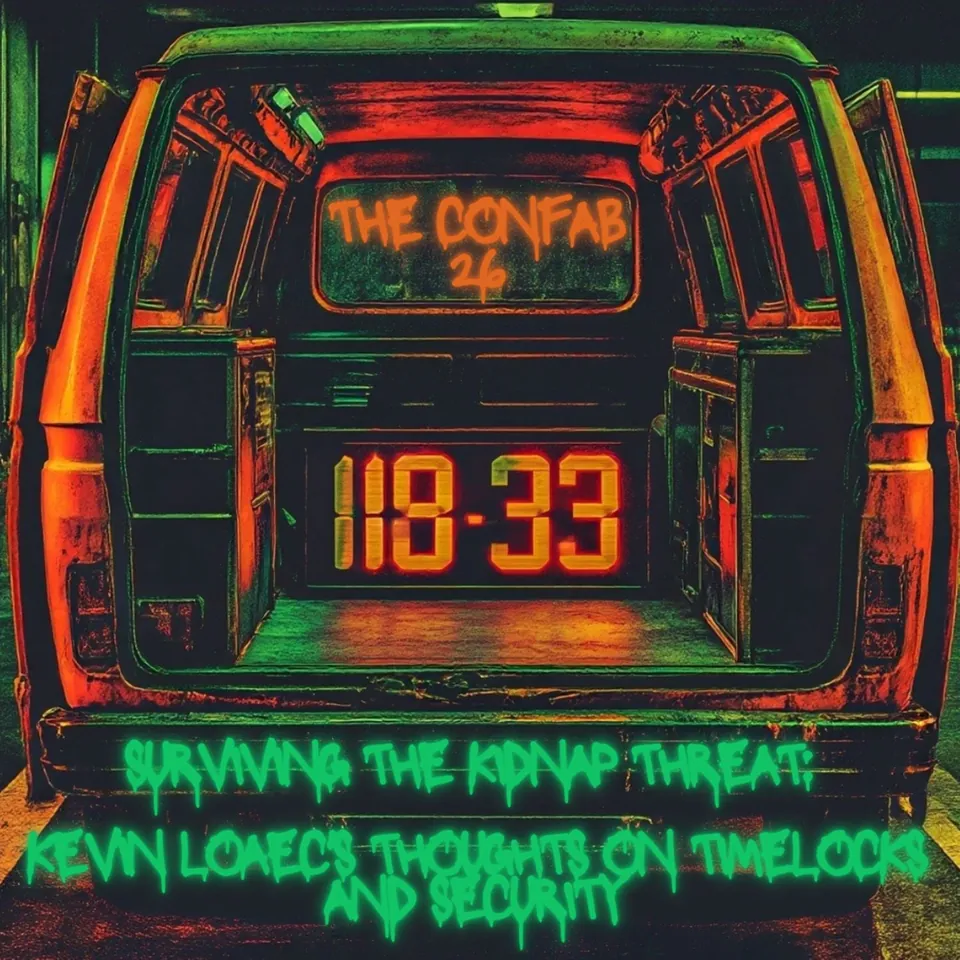
Surviving the Kidnap Threat | The Confab 28: Kevin Loaec
Discussed in this episode
Boost this Episode
Send sats directly to the creators. Value for Value.
Plus 1% to Podcast Index, 1% to Boost Bot.
Show Notes
In this Confab, Max sit down with Kevin Loaec, CEO of WizardSardine, for a frank discussion on the surge in coordinated, violent Bitcoin-related kidnappings in France and broader personal security lessons for anyone holding wealth. They explore practical, non-technical measures—community awareness, operational silence, modest living, and physical deterrents—alongside technical defences that reduce attacker incentives. Kevin explains why the threat was “late but inevitable,” how societal factors may be fuelling the crime wave, and why relocation and strong local networks can matter as much as any wallet setup.
Max and Kevin discuss Liana, WizardSardine’s time-locked, Taproot-powered wallet. Kevin breaks down inheritance-first design, decaying/expanding policies, and how time locks can prevent premature access while enabling robust recovery for families and businesses—without revealing recovery paths on-chain. They cover miniscript device support (what works today and what’s missing), fee/UX trade-offs, future payjoin integrations, and how to pair Liana with spending wallets or Lightning for better privacy. If you’ve ever worried about $5 wrench attacks, estate planning, or operational resilience, this one’s essential listening.
HELP GET SAMOURAI A PARDON
- SIGN THE PETITION ----> https://www.change.org/p/stand-up-for-freedom-pardon-the-innocent-coders-jailed-for-building-privacy-tools
- DONATE TO THE FAMILIES w/ USD ----> https://www.givesendgo.com/billandkeonne
- DONATE TO THE FAMILIES w/ BTC ----> https://pay.zaprite.com/pl_JpxtkLv95T
- SUPPORT ON SOCIAL MEDIA ---> https://billandkeonne.org/
VALUE FOR VALUE
Thanks for listening you Ungovernable Misfits, we appreciate your continued support and hope you enjoy the shows.
You can support this episode using your time, talent or treasure.
TIME:
- create fountain clips for the show
- create a meetup
- help boost the signal on social media
TALENT:
- create ungovernable misfit inspired art, animation or music
- design or implement some software that can make the podcast better
- use whatever talents you have to make a contribution to the show!
TREASURE:
- BOOST IT OR STREAM SATS on the Podcasting 2.0 apps @ https://podcastapps.com
- DONATE via Monero @ https://xmrchat.com/ungovernable
- BUY SOME STICKERS @ https://ungovernable.network/shop/
FOUNDATION
https://foundation.xyz/ungovernable
Foundation builds Bitcoin-centric tools that empower you to reclaim your digital sovereignty.
As a sovereign computing company, Foundation is the antithesis of today’s tech conglomerates. Returning to cypherpunk principles, they build open source technology that “can’t be evil”.
Thank you Foundation Devices for sponsoring the show!
Use code: Ungovernable for $10 off of your purchase
CAKE WALLET
Cake Wallet is an open-source, non-custodial wallet available on Android, iOS, macOS, and Linux.
Features:
- Built-in Exchange: Swap easily between Bitcoin and Monero.
- User-Friendly: Simple interface for all users.
Monero Users:
- Batch Transactions: Send multiple payments at once.
- Faster Syncing: Optimized syncing via specified restore heights
- Proxy Support: Enhance privacy with proxy node options.
Bitcoin Users:
- Coin Control: Manage your transactions effectively.
- Silent Payments: Static bitcoin addresses
- Batch Transactions: Streamline your payment process.
Thank you Cake Wallet for sponsoring the show!
MYNYMBOX
Your go-to for anonymous server hosting solutions, featuring: virtual private & dedicated servers, domain registration and DNS parking. We don't require any of your personal information, and you can purchase using Bitcoin, Lightning, Monero and many other cryptos.
Explore benefits such as No KYC, complete privacy & security, and human support.
(00:00) INTRO
(01:20) THANK YOU FOUNDATION
(02:11) THANK YOU CAKE WALLET
(02:52) THANK YOU MYNYMBOX
(03:36) Kicking Off With Kevin
(09:21) Non-Technical Wealth Defense
(16:18) Why France?
(26:31) Designing Deterrence
(30:51) Liana Deep Dive
(44:03) Miniscript Musings
(53:36) BOOSTS
Bitcoin is close to becoming worthless.
Now what's the Bitcoin? Bitcoin's like rat poison. Yeah. Oh. The greatest scam in history. Let's get it. Bitcoin will go to fucking zero.
Welcome back to another confab episode. Today's guest is Kevin Loak. He's the CEO of Wizard Sardine. We talked pretty heavily in this episode about all the kidnappings in France, what it is that's going on there.
Possible ways to prevent this or protect yourself from these attacks. And we also went into Liana Wallet and the capabilities that's giving users. I really enjoyed this. Kevin was a great guest, and I think we'll probably have to get him on for a Freedom Tech Friday soon.
I really hope you enjoy this, and if you have any questions, you can reach out. Before we start, I want to say a big thank you to our show sponsors. Foundation who are getting dangerously close now to releasing their new device.
I know too many of you who are listening to this. If you've put your money down and you've been waiting, it's probably been quite frustrating. It's been about a year now, since they were hoping to release this device.
But I spoke to Q today, and I believe it is imminent. So if you haven't already checked these devices out, go to foundation.xyz. They really are beautifully designed. They have an incredible team, and they are piss easy to use.
Foundation.xyz, and use the code "Ungovernable" for a discount. Thank you also to K-qualit. They've been supporting this show for over a year now. Just an incredible all-round wallet. If you haven't used this, I really do suggest you go and try it out.
You can use Monero, you can use Bitcoin, you can now use Lightning. They're always at the cutting edge with things. Seth, obviously, at the helm there, pushing things forward. But it's really a joy to use.
You can connect it to your own node. You can do swaps. You can buy gift cards. If you actually use Bitcoin and other cryptocurrencies in your daily life, you really need to check them out.
Kakewalit.com. And finally, my Nimbox, my Nimbox.io for truly private hosting with no compromises. You can pay in any cryptocurrency without giving any details. It's an awesome service. If you haven't already listened to my confab with random Nim, go back and have a listen to that.
We go into all the details with this stuff. It really is worth having a listen. If you are thinking about running a virtual machine or running a node in the cloud or whatever it is you want to do, definitely check this out and don't go and give away all your personal information.
My Nimbox.io. Right? Let's get into it. Enjoy the show. Hey, Kevin. How you doing? Hey, I'm good. How are you? Very well, thanks. Listen, I'm really sorry about the last time we were supposed to record.
I think I got my times mixed up and time changes and all that sort of stuff, so apologies for that. And they were scheduling things together, so I had no idea what was going on, but yeah, all good.
You're here now, so. Should we just blame it on him? It's more fun. Exactly. Yeah, well, it's really nice to have you on. Nish, quite often, messages me about different people he's working with so they don't always quite line up with our ungovernable misfits ethos, privacy, security, freedom, open source stuff.
And then he mentioned you, and I was like, yeah, definitely. This is exactly the person we want to be speaking about, especially because me and Bitcoin Q&A do like a bi-weekly show with news and updates and everything.
Okay. And we keep mentioning Lyanna. We keep mentioning alongside that France and all of these attacks and all the crazy kidnappings and all this stuff that's going on. And you seem to be literally the perfect guest to cover all of this stuff.
So very, very happy to have you on. Yeah, well, thanks for having me, and I hope I'll be adding a value to this. So let's start there, really. I mean, this is something that we keep covering all the time.
I think, you know, for the last six months to a year, I mean, this pod's been going for like eight years, but for the last six months to a year, especially, there's been a big change in. I guess the security needs for people, and it's coming more and more to the forefront in a physical world.
There's always been these like edge cases and like really nerdy, geeky stuff where we're like, oh, you know, this could happen and that could happen. The $5 wrench stuff is really starting to be seen more around the world.
And obviously, this is something that you are working on and trying to help protect people. But it doesn't seem like it's going away. And it's something in the physical world where you can only do so much to protect yourself there.
And then there's the digital world on top of that. Like, what's your thoughts on everything that's going on? Do you think there's a fix for it? What's your just general thoughts around this as a concern around Bitcoin?
Well, from my experience, I was actually surprised it didn't happen earlier. The number of attacks were very, very low for the first decade of Bitcoin. Even though, you know, the price was going up and Bitcoin was heavily covered by the media, people were still, you know, breaking into houses to steal TVs.
And I was actually surprised that physical crime didn't ramp up faster. Now it's starting to catch up. So yeah, not really surprised that this happens. I'm a little bit surprised about the level of coordination and violence that's being used, especially around France.
It's kind of like more shocking than what I would have thought. But it's not something that is unexpected either, right? We've been talking about $5 range attack for a very long time. They're just wearing that common.
So that's like something important, I think. And then as you were saying, I don't think it's going to stop either. I really believe it's going to continue. Now, of course, you know, society plays a big role into what's acceptable and what's punished, et cetera.
So there is also a role in society and like the place where you live and the community around you. If things like this are seen as like a common thing and acceptable, we have a problem. Yeah.
Is that any reason that you left France for Portugal? Or is it more for the weather and the surfing and the community out there? Yeah, I left France actually right after my studies. So I'm going to drop out.
And the whole culture in France is still very, you know, you have to fit in boxes. And I was like, yeah, I don't want to finish my studies. I'm going to drop out and I want to start a business.
And I knew that would be difficult in France. So I moved to Ireland actually to Dublin right after I dropped out. I moved there, you know, without a job without a place, whatever, just took a ferry with my car.
Ending it there. And yeah, I got a job and started my life there. After a couple of years, I started my first business, started to work on Bitcoin. And after a while, about like five years, five years and a half in Ireland, I actually was fed up with the weather and ended up in Portugal.
Can't blame me. That's the reason why Portugal. It's just because Dublin was a little bit too harsh in terms of greyness. And I wanted some sun. Portugal at the time, when I came here in 2016, 2017, it was still in the beginning of the boom for Lisbon, where it became really a trendy place.
So it was a good time to be there. After Covid, I moved to the Azers, which are these Portuguese archipelago in the middle of the Atlantic. That's where I am for now. It seems there was a massive draw, especially with Bitcoiners.
Like obviously, I went Doc's people's names for security reasons, but a lot of really good people have moved out there, sort of in the last, I don't know, five or so years. And it seems like there's a bit of a hub out there.
I don't know if some of this is like tax reasons or you just sort of get left alone a little bit more. Or maybe the food. I went there with Nish not too long ago and the food was fucking amazing.
Just incredible. And the value, like coming from London, going out there and having a good meal, you get the bill in, at least where we went, I was like, wow, this is amazing. Yeah, there are quite a few people living in Portugal.
Some of them, you know, as you said, they say it publicly or others don't. It probably comes from a bit earlier than that, not just the last five years. It was one of the reasons was taxation because Bitcoin was not taxed for a long time in Portugal.
It was just not defined under the tax law and therefore was not taxable. This changed a few years ago, a couple of years ago. I'd actually don't remember how long ago but a few years ago it changed.
So now Bitcoin is taxable but can be tax free if you keep it for over a year. Okay. The issue there is that you still have to report it to prove that you kept it more than a year. So it's not as nice as before where you just didn't have to declare it.
Yeah, but I mean, Kevin, we know that if you do report it and declare what you have to governments, they will keep that information safe. So I don't really see that as a problem. Absolutely.
I see that in France, right? Yeah, I shouldn't laugh. You know, again, it's like something that we talked about for so long is like, don't put your information out there. It can't be kept secure.
And I think like for a long time, for so many people, it was like, oh, well, you know, even if my information isn't kept secure, which it probably should be, you know, the worst thing that's going to happen is I'm going to get a tax bill.
But actually, obviously it's very, very different to that. And so it's like now the people who have docked themselves were given this information to like the exchanges and stuff is one thing.
But with everything ramping up now and more people paying attention to Bitcoin, it seems that governments are obsessing about gathering as much information and putting you on as many lists as possible and making sure they don't keep that secure.
So it puts anyone who wants to use Bitcoin and use it without like maybe getting a tap on the shoulder in a really like weird or quick position where if you follow the rules that are laid out, you could end up with someone knocking on your door with a wrench.
And if you don't follow the rules that are laid out, you probably won't have the person with the wrench, but you might have some dickhead with a clipboard and trying to put you in prison.
So you're sort of like damned if you do, damned if you don't. Yeah, I mean, it's just a different form of taxation, right? One of them is a hundred percent tax and they're even but yeah, that's true.
That's very true. Yeah. And so when you are thinking about like solving these issues, obviously some of it is technical, you know, Liana seems to be doing this very, very well, be at the forefront there.
Some of it obviously has got to be non-technical. What advice are you giving to people or would you give to people who maybe are in that situation where either they've already been on some form of list or have concerns around this.
I mean, obviously a lot of people now are starting to use like ETFs and that kind of stuff, which isn't real Bitcoin, but it gives you some different types of protection. Like how do people navigate this world without having a knock on the door with a clipboard or a wrench and keep themselves, their family and the Bitcoin saved?
How do you think is the best way to do that in today's world? First of all, yeah, the technical aspect is a tiny aspect of it. Also, it's not specific to Bitcoin. It's like generally speaking about wealth.
Of course, like kidnappings and things like that are quite extreme, but they've been existing forever, way before Bitcoin. So just having wealth and being known as being wealthy puts you as a form of a target.
You can see that especially in countries where you have a very high inequality index. So when you look at countries like typically where they've been communism and you have like extreme poverty to extreme concentration of wealth and power, typically that's where it breaks first.
Take the example of Venezuela a few years ago. If you had any form of wealth there and not having to be rich, right? Just having some wealth, having a farm or something like that. You would have a pretty high chance of being killed just for the fact of owning something.
So yeah, the technical aspect is not major. Maybe it's there mostly to act as a deterrence. So the better people are always safe keeping their money and making sure that even under threat you can't just give it away like this.
That will discourage the lazy attacker and we need that, right? It cannot be a profitable endeavor to start kidnapping people. So we have to make sure that they don't get the money first of all.
But then the risk will always exist. You always have idiots and you will always have people with very low moral standards. And so yeah, it's also about looking around you, right? Community trying to find a place where I'm not talking about Bitcoin community.
I'm talking about like your local community, making sure you kind of integrate well with your neighbors, et cetera. You don't have to tell them about anything you own, but just making sure that you have some kind of social support as well because that will help with finding out about weird movements happening in the street, et cetera.
People will notice you. We'll also notice things that are around you and are weird. That can help. The other thing, yeah, I mean, the country right now, France is just not the place to be.
I'm sorry to say that, but I would not be in France right now being the CEO of a Bitcoin company, being someone that goes to meetups, being someone that speaks at conferences. It's just a risk is too high right now and risk mitigation is very important.
That being said, we don't know yet how they pick people up. It doesn't seem to be only well known people. It doesn't seem to be only people that attend meetups or talk about Bitcoin online.
It might just be tax report leaks and things like that. And they are just making a list and targeting people that way. So maybe even if you live under the radar, but you've been actually declaring your taxes and paying what you were supposed to or you're dealing with a tax firm that is well known for dealing with Bitcoiners.
If that information leaks, you might have a target on your back. So a lot of things to be kind of aware of. And I don't think there is a perfect solution. Using Liana is not the perfect solution. It's just one step to a lower the incentives for the attacker.
It's crazy being France as well. It's not a country that I would have guessed, oh, this is going to be the most attacks. You know, just it wouldn't be on my list. It wouldn't even be in the top five list.
But then I suppose it's not that different to people like having a romantic idea of London. And then they arrive in London and get the phone snatched and a knife pulled on them. I guess it's maybe like you have this romantic idea of what it was like in the past.
And I haven't spent enough time in France to really catch up with reality, I suppose. But it is pretty shocking.
Yeah, it is very shocking. I don't pretend to know why. But if we extrapolate the kind of numbers we have from the Nordic countries that are starting to come out and are quite interesting about immigration and the different generations, right?
So typically the immigrants are contributing to society. And that's very good for society. And then you might have multiple generations later, like their children or the children of their children that actually feel that they don't have opportunities.
And this is interesting because in France we had that basically after World War II where there was a huge demand for workers. And so a lot of North African country were basically welcome to France to actually work and contribute.
And that worked out. And now probably all of these kidnappings and things like that are related to descendants of that, because they come from what we call the cities in France, which are like kind of the suburbs, but in a way that they are kind of dangerous areas, right?
And so it's a weird thing. And it's very hard to predict. And you can't just be like, you know, there is a whole wave about all around the world right now, but like, you know, immigration immigration.
But this is not direct immigration. That's really the thing. It's people who are French, technically, who have the French passport were born there, have a whole life there.
So it's not directly an immigration problem. It's more like how the whole system has been built and how these people have been basically forming groups where they are now in very low opportunity areas.
And they might consider being paid, you know, a thousand bucks to do kidnapping as a reasonable offer. And you're like, what the hell? How is this possible? But this is what's happening. So there is a whole economic thing at play there, social economic play, and it's really, really hard to figure it out and crack it.
But I believe there is something there. Like, we don't know for sure. We don't have all the profiles, et cetera, yet. But I really believe that these kind of groups are coming from very small pockets that we know which districts they are from, basically.
And yeah, that's where basically terrorism and very violent crime is nurturing influence. Yeah. And it doesn't seem like a trend that's going to slow down. Just looking at the world, it looks like it's getting a little bit more hectic and crazy.
And there's more anger and frustration and people considering more and more crazy things for money. So if you kind of like accept that, I suppose, even though we don't want to, then it's how to protect yourself because the answers not don't have Bitcoin
because you're going to have problems if you don't hold it or other assets, you just keep it in fear. But the answers, like, you have to have the physical security. Like you said, you know, being in a community, having people around you that you can trust.
One thing I bang on all the time, which is like a non-technical thing, is if you can have very well trained guard dogs because it's extremely good to tear at home.
Think about your physical security, learn to shut the fuck up and not tell everyone what you have and live a sort of modest life, even if you have wealth, so you don't stand out.
But on the technical side, getting into what you do a little bit here, the problem that you have, even if you have all of those bits of security, if someone thinks that you're a target worth attacking, whether they're right or whether they're wrong.
If someone does manage to get through all of your security, physical world, even if you have things set up properly, it doesn't mean that they believe you or are smart enough for you to be able to prove it.
So, if you say, "Oh, well, I have multi-sig and I don't have the signers here and we'd have to go to this country in that country or this vault and that vault, and I can't give you anything," you still have this issue of, well, they've made all the effort to break in and try and take from you.
If they then have to think that they're going to leave empty-handed, that could be a real problem for your safety, even if it's true. And then, obviously, with what you're doing, you have this possibility to take it a step further and you have time locks and other ways to stop spends from happening.
But even with that, that's a problem. So, like, do you think there's any way to be able to show people, even stupid people and desperate people, actually, this is not possible for me to do this?
And in that case, we want to make it more difficult for them, but would it be reasonable to think, okay, have something there to give them to be like, you're not leaving completely empty-handed, so you're going to kill me or whatever, but you're probably not going to come back?
Yeah, it's a tough one. There is a whole, you know, business there. There are insurance that's specialized in that for wealthy people, right? I'm not talking about Bitcoin. Again, I'm just talking generally speaking about kidnappings. So, there are kidnappings and ransom insurances.
They are pretty, you know, spread out. They exist for many reasons. Some of their biggest clients are basically international companies that have, let's say, oil fields and things like this in foreign countries where you have to send employees there.
And they might be at risk of being abducted, so there is a ransom for the company. So, there are insurance products for that. And typically what they do is that if there is any such situation arising, they will put the attacker in touch with a professional negotiator.
That basically has some tools to, you know, figure it out and crack this problem about, you know, what's the amount of money they will be okay to accept or money or all the things, right?
That they would be willing to accept in exchange of just release the hostage and just fuck off. So, sometimes it's about, you know, as you were saying, giving a small amount, sometimes it's just about telling them, hey, like the actual counter-terrorist force is on the way, so you basically have 10 minutes to leave.
Yeah, it's an interesting kind of job, I suppose. It would be nice to have someone actually on the podcast for like understanding how these guys think these negotiators.
There was a book I read not too long ago, I can't remember what it is, I'll put it in the show notes, but it was from a negotiator who worked with kidnappings actually, and tips and tricks and ways to get out of it.
And it was really interesting. The tactics that they use and also the ability that these guys have to negotiate things down, you know, it'd be like, I want a million dollars, otherwise they're dead.
And it's like, quite often it would come down to like, okay, you're going to have $5,000 and you leave them alone. And like, quite often that works. So, I'll put it in the show notes, I can't remember what the guy's name was, it's a real skill.
Yeah, and it's about understanding, really like, understanding how these guys think. Again, you need to place them in a conceptual persona.
For France right now, we know that most of these are coordinated attacks, right? They are very, very well prepared. The head of the organizations are typically abroad, so this is like international crime.
But then the people executing the crime are just random kids that they hire from the suburbs, right? And they are like paid pretty much nothing. So, it's still difficult to figure out like what kind of a mandate these guys have. Is there like what's considered a failure? What's considered okay? It's difficult.
Also, as you were saying, it's impossible to prove a negative, so you can't say, well, you can't say, I don't have access to my coins, but it's going to be extremely hard to tell someone that you really don't have access to any coins.
The opposite is also true, as in, like, you can say, oh, that's all the money I have. If they don't believe you, they don't believe you. There is nothing you can prove that you don't have more money, even if you don't.
So, it's a slippery slope as well to be kind of doing a deterrence money that's still a significant amount because you don't want them to come back. Yeah, you don't want them to be successful. You really don't want them to be at a point where it's successful. So, what you want is for them to not kill you, basically, right?
It'd be nice, yeah. It's the main thing. It's not for them to win something. It's for you to be not worth the risk they're taking, right? Like your life, basically. It's not worth it.
Now, I don't know. Right now, in France, it seems to be that, you know, these people are not really afraid of the justice system, which is interesting as well, because in France, the police is extremely good.
Typically, France has always been a hotbed of terrorism and counter-terrorism, so the police force are extremely well trained for this kind of scenario.
And so, typically, yeah, the victims are being released, but the problem is that the attackers, when they are captured, are they actually facing legal consequences? That's a different problem.
Yeah, and even if they are, there's always that, like, how bad is your life outside of prison? Is it really that much worse inside? And if it's not, they're just not scared. It's like, how much do you have to lose? It's like a race to the bottom. It's a person who has a family and a career and some Bitcoin and a life.
They have a lot to lose, and the person who is living in hell, they have nothing to lose. They're not really going to be bothered, and I don't think that really changes.
And it's the same with all this retaliation stuff. It's like, someone does something to you, you do something back, tip for tap. Well, the person who loses is the one who has something to lose every time.
That's just not something that I think maybe is solvable, but this idea of being able to show, maybe they don't believe you, but I think, you know, things like multi-sig are pretty, I think, useful for this, because you could show that you have a multi-sig setup.
You can show that you have a multi-sig setup. You can't prove to someone that you don't have all the signers accessible. That's something you can't prove. But you can say, look, it's a multi-sig address. I can show you if they're technical enough to see that, which is probably unlikely.
Or obviously, then you have things like time locks, but is there any way to show an attacker? Is that something you think about? It's like not only how to protect the coins, but to show that they are protected.
It's a difficult one. So we designed this with Revolt. Revolt was the first kind of protocol we designed with my company. It's not designed for individuals. It's designed for very large entities, including nation states, to defend against nation state attackers.
And so for something like this, where you are dealing with billions, if not trillions of dollars worth of money, you really need to be able to show that there is no way it can be stolen. You want to have the deterrence in place. And so that protocol Revolt had a system where you really can prove that you will never steal the money.
It might even be locked forever or burned, but you will never get the money. It's like the deterrence first. Vienna doesn't behave like this. Vienna is a kind of closer to, as you were saying, a multi-sig. Of course, there is time locks and things like this.
But even to prove you have a multi-sig, you kind of want to show the wallet to people, but then they know how much money you have. It's not perfect either. I understand that under threat, you really need to get yourself just out of this situation, but I'm not sure showing a specific amount is going to help.
Yeah, I'm just not sure. So I would love to have ideas on how we can fix it. It's a little bit difficult. One thing that is kind of proposed in Bitcoin is called covenants. They also waste to emulate covenants through co-signers.
So with this, what you could do is to have kind of like spending limits, right? You could say, okay, per a day, I can only spend up to a thousand buck equivalent.
And there is just no way to bypass it. Maybe that kind of works for deterrence, right? It's really showing, you know, you're not going to keep me for 100 days to have 100k. I hope you wouldn't at least.
Yeah. So something like that might be good, but again, that's more education to show to people. And they might be like, ah, they must be a way to bypass it, etc, etc.
Yeah, I don't know. I really think kind of like the fact that it is still like France is a place where you have a really high chance of being rescued that helps, you know, that puts a lot of pressure on them for the time, etc.
While in other countries that may not be the case, so we are kind of glad that this is not more common in other countries. There must be a lot of countries around the world where the police force is basically useless or involved.
Oh, involved? Yeah. Yeah. Exactly. And so that completely changed the dynamic again, right? If they are just not afraid of consequences or direct consequences right now, maybe the timing is not really an issue for them either. And it's very difficult.
Yeah, you were saying about covenants, you know, if that comes in, it can make some changes. But obviously, there's some cool stuff that is now possible, you know, with all that stuff, future stuff that may or may not come.
I personally try not to pay too much attention because you just don't know what's going to happen and changes in Bitcoin are slow, difficult, and I think just going to get more and more difficult.
But with the tools that we've got now, obviously with what you've got, inheritance is another big one, which sort of is in the same world in the sense that if you don't have this set up and you put trust in someone they can steal from you, even if they're family or friend or lawyer or anything like that,
it's something that I think probably every person who's involved in Bitcoin unless they are just a single person who have no family and no friends and like, don't give a fuck and when they die, they die.
That's pretty rare. There's not that many people like that. So anyone else who is saving in Bitcoin and wants to pass things down to their family or a cause of some sort has this kind of weird issue where the more information you give out,
the less secure you are. But if you don't give any information out, then no one can actually have anything from you. And so that's where these time locks and the things that you have with Leanna are really interesting to me.
It's not something I've played around with yet. It's something that, again, me, Q&A, and Seth for privacy have talked about a lot over the last six months.
Could you run through for anyone listening, like the scenarios where these time locks can be used in Leanna and how it could be possible to use it and how it could be useful for people? Yeah, so typically Leanna is a Bitcoin wallet and you install it on your computer into desktop wallet. We don't have a mobile version yet.
So you install it on your computer and then you can set a wallet policy. So what you want your wallet to actually do, the most basic setup that Leanna will let you do is what we call the inheritance setup.
And the inheritance setup is basically a single SIG for your key and then a single SIG, a different one for your family. You can share that key with them or you can use one of the keys they already use if they already have Bitcoin or a signing device.
What it means is that as long as you use your Leanna wallet from time to time, let's say once a year, your family or the family key will never be able to access your coins. But if you stop using it for a specific amount of time over a year, then their key can also access your coins. So this is how we use the time lock.
It's about locking specific signing keys. So they are not valid until a long time of inactivity happens. So it's basically a dead man switch, right?
Of course, you can do more advanced things. You can have as many layers of time locks as well. So something nice you can do with Leanna that you wouldn't even do with a traditional multi SIG is to use what we call an N of M multi SIG.
So no threshold, the entire keys you need. So you can do, let's say, a two of two and you absolutely need these two keys to spend. You might have one at home, one in a different country or in a safe or whatever you want.
So you cannot spend your coins without going somewhere. But of course, because it's a two of two, if you were to lose one of the keys, you would normally lose access to your coins.
But here with the time locks, what you can do is that you can have another layer saying, for example, Oh, after six months of inactivity, it becomes a two of three with a third key that I put in a different place, or that belongs to someone from my family or someone I trust.
But that key usually is not able to sign. It's only if we have the inactivity for a pretty long time. Then you can add another layer with the inheritance key for your family, then you can add another layer with like, I don't know, a single SIG backup for yourself.
So you can do some pretty advanced stuff. And it's also a very good fit for businesses. So we haven't talked really about businesses here, but businesses are also, of course, potentially a target of these attacks.
And so you don't want to have a single key person risk. So you want to make sure that even if one person disappears or whatever happened to them, you really want to make sure the funds of the business are not going to be lost forever.
So multi SIG between different people where the signers so the actual people in this case are rotated over time of inactivity to make sure that even if one person disappears, it's changed to a different group of people from the company to spend.
These kind of setups are very, very interesting. They are pretty private on chain as well. So let's talk a bit about privacy. So using that route, when you spend these kind of transactions from this wallet, basically, you only reveal the path, what we call the path that you're using.
So if it's a two of two multi SIG people looking at the blockchain will only see that it's a two of two multi SIGs. They will not know you have time locks, recovery, etc. So it's pretty good to hide recovery options, pretty good for privacy, pretty good for security.
I think it's the best of both world between let's say a multi SIG. It's like a very strict multi SIG in this sense where you have very high security, but you also have the recovery options of having a threshold of like, I don't know, three or five or something like that.
It's really interesting because for a long time with multi SIG, you have that issue of if you have a mistake or you lose a sign or you give it to whether it's in a company or like family, if there's a loss of trust or a loss of the sign, you have some major issues.
And so a lot of people like, okay, just keep it simple stick with single SIG. But if we're looking at the family set up, for example, if you have a multi SIG that you call it decorating multi SIG where it goes down to one.
Yeah, decaying. When it reduces the number of keys, we call it decaying. And when it adds other keys, we call it expanding. Yeah, so what you're talking about as expanding, isn't it? So it's like, you have that third key that will come online or like be useful for signing after a certain amount of time.
To me, that's a perfect way to do it because you can put your trust in someone to hold something or multiple people to hold something in the event that you don't sign.
And all you've got to be aware of why you asked her alive is that you have to actually use this. What's the total limit of time? Is it 13 months or something you have to sign?
Currently 15 months maximum. Okay, which isn't the biggest sort of mental burden, really, is it? And is that just like any spend or is that a total move of all funds? Technically, it's per UTXO, so it's like each coin is kind of segregated, so you have to rotate them once in a while. Okay.
But you can do that in a pretty easy way, like, let's say once a year and you're good. But of course, what that means is that if you receive a deposit today, that deposit is going to be the time locks on it will be, let's say, for 15 months, if you want to use the maximum
for your family to access it. So if they are new deposits to the wallet, these new deposits will be locked for whatever duration, but that doesn't concern the previous ones.
So it's a technicality here, but yeah, technically it's per UTXO, just because the blockchain doesn't have a clue about what's a wallet. It's only different UTXO. So it has no idea of how they are linked together.
So for someone who, let's say, has leaned heavily on Whirlpool and has lots of, like, smaller amounts and lots and lots of UTXOs, what would be the advice there? Would it be just accept it?
And you move these every 14 months, whatever it is, and you keep these separate still and hope that the fees stay as unbelievably low as they are currently and that it isn't too much of an issue? Or is this scene more as like a, you would consolidate some of those UTXOs because it could be a bit of an issue?
There's always this balance, isn't there? Like, I don't know, maybe there isn't really an answer to that. It's just someone's level of how comfortable they are with their privacy and where that tradeoff is.
But, you know, it could get quite expensive, I suppose, is the only potential downside to something like this?
Correct. So my approach to this is to deal with it like you would deal with a physical wallet in your pocket, right? You have different denominations, you don't have thousands of different notes in your wallet, you have just a bunch of them of different denominations.
And that's the same thing with how I consider using my Bitcoin in Liana. So having different UTXOs of different size, depending on what I plan to typically spend.
But yeah, for mixing and things like this is a bit frustrating. So typically what I do is that I mix before and I mix after Liana is not a privacy wallet, it's not focused on privacy.
So yeah, the privacy aspect is that you kind of have to be careful. I typically mix before, consolidate in different amounts, and then at time I'm spending, I'm trying to use as little number of UTXOs as possible.
So finding the one that is the best for the payment. And potentially, yeah, mixing in the output as well, right? Yeah, let me say, I guess it's different. Maybe you have your sort of spending wallets and then you have like your savings that would be passed down to family, which would be in the honor.
It's a kind of different bucket, which you're not maybe looking to spend as often or use as often. It's just an extra thing to think about, I suppose, but it's everything has its trade offs, but this does seem to be a nice balance where you can kind of have the best of both worlds
and not have to worry so much. Over the years, I keep changing my setups like slowly and cautiously, but I'm still at a stage where I'm like, if I got hit by a bus and I happen to be in the same bus as my missus, like I'm not 100% confident
that when my kids are going to have everything that they should, it's all a little bit too complicated and like unstructured and I can't be the only person that has this kind of setup.
And if I look back to like five years ago, it was like some sort of crazy fucking treasure map that no one's ever going to work out, like not even me, probably if I went back now, like it was just just so complex.
And this does seem to kind of just make things more possible for, because most families aren't into Bitcoin, you have like the one person who's into it and like follows all this stuff and uses the tools and then the rest of the family sort of, it's not really their interest.
So to expect them to understand all of this is maybe a bit of a big ask. Until Yana basically, the main issue would have been that you can't have it too easy to access because you really don't want random people to find this backup key you gave to your family.
And at the same time, you don't want it to be too hard because otherwise your family will never be able to recover the coins. So it was a weird game there of making it hard enough but not too hard. The other problem is really that it's not about like, can you trust your family?
It's more like, again, you can't prove a negative. So if the coins are moving tomorrow, when you don't use something like Yana with different keys and you just gave a backup to your family like most people did until now.
What if the coins are gone tomorrow? Are you blaming your family? What if they tell you, no, it's not us? How do you prove it? This is the main issue. It's not really about trusting your family.
It's the fact that you will never be able to trust them again just because you will never be able to prove that it's not them accessing the coins. So yeah, this kind of stuff is very scary and that's why time locks are much better.
As long as you're not dead, nobody can touch your coins. That sounds better to me. It's definitely better because even if you, and you would hope that you trust your family, like even if you have complete trust in them, you can't have complete trust in them.
You can have complete trust in the situations they're put in. So you might give your son one of these keys and then say, look, if anything happens to me, make sure that you're next in charge, you're my older son, like you make sure you saw all this stuff out.
But then what if their best friend is kidnapped? And they say, well, unless you do this, then they don't get released or what if somehow they pick up a horrible drug habit and then suddenly they're not actually themselves and they do something stupid.
Giving your key, which is active to anyone, just creates, no matter how much you think you trust them, so many different edge cases and problems that can come in. So this is a nice approach.
So it's definitely something I need to have a play around with. And I think for the most part, outside of that little privacy thing solves most things.
You know, maybe it's like you use these spending wallets and spending tools and whirlpool and everything else, like outside of that setup, it's almost like a separate bucket would be probably the approach I would take.
For privacy, yes. I believe this is like one of the best way of doing it is to use a separate wallet for your normal spending, depending on what you need to spend on, obviously, if you need to buy a house.
It's a bit different. Again, it's starting to be difficult. Yes. Lightning is great, so just top up your lightning wallet if it's for like small amounts instead of doing everything on chain, which leaves traces forever, basically.
So that's one thing. There is another thing that is being worked on, which is a pay join integration in Vienna. Okay. And interestingly, this is not using pay join for privacy first. It's using pay join to optimize on the refresh thing of the UTXOs and how to manage multiple UTXOs.
So instead of basically trying to consolidate as much as you can and to do transactions once a year to refresh things, using pay join would let you or your wallet in this case. Put multiple inputs, multiple outputs for basically refreshing transactions every time you receive or every time you spend.
So instead of being just one UTXO every time, it would be a bunch of UTXOs. So that helps with the anonymity set and the different inputs and outputs in this group of transactions. The typical pay join model, but also it would reduce the fees to refresh these coins and the burden of like dealing with different coins every time.
It would be kind of automatic to push this refreshing. And yeah, that could work even when you receive coins because then you can add new inputs as in the pay join design, right, where the recipient can also add inputs.
And that is a pretty cool thing. Now the UX is not completely sorted out yet as with everything pay join, but it's a very interesting concept and I really hope it's going to help with privacy, you know, reasonably without being the main focus, but with UX a lot.
Yeah, yeah, that's actually an interesting idea. So is there anything with the UX that you think can change now, we're getting into this kind of world where maybe Bitcoin tools and wallets start to lean on AI a little bit to like work out what would be the best way to spend in a private way
and best way to use pay join and reminders and things that can kind of make the average user that might want to use this that isn't so well versed in Bitcoin, just consistently make the best choices, like almost like a slider of, you know, how much privacy do I want?
How much do I care about fees? What's important to me? And then kind of almost set itself some defaults. Do you see that, like, is in that case, AI, just a complete buzzword and fucking stupid and not something that you're looking at at all?
Or is it something that you think can actually help people? Interesting question. I think the problem is elsewhere currently. It's really a UX problem that we have so many different tools that are technically very different.
So using lightning, for example, this is a hotkey. We don't want to put our life savings in lightning, but it's pretty great for like low fees, high privacy, et cetera. Then you might be looking at things like coin join, pay join, things like this, but typically, again, it is a hotkey. You need interactivity in these protocols.
And so you kind of need to be doing actions, you know, either it's your computer doing it or you need to be there signing multiple transactions with your signing device, just to do one payment.
And then you have the old school, you know, on-chain Bitcoin, which is great that you can have your keys on the signing device that is, you know, air gap or at least not connected to the internet.
Best security, but again, you don't want to have to do multiple back and forth interactivity protocol with your signing device. You just want the interactivity to be at the minimum.
You want the information on the screen to be as clear as possible so people actually verify it because the more information there is, the more likely they are to just press the next button and then not have any security.
So it's very difficult to deal with that. Typically, now Liana assumes you're going to use signing devices. You're not supposed to use a hotkey currently on Liana.
We know this is already an issue in some cases because a lot of people are like, "Oh yeah, but what if I want to use my phone as a circumfactor on Liana, as a circumfactor, but of lower security?"
So now you have a high security key and a low security key. So all of these things are very, very hard to put kind of a security score on top of them. And then if you also want to have the privacy score on top of that, it gets really difficult. So can AI help to crack this? I don't know.
The main issue we have right now is, I would say UX in terms of signing devices. It would be great to have a much simpler UX, but it's extremely hard, very, very hard. So yeah, everything is difficult. As soon as you start having interactivity or more than one input, one output in your transaction, yeah, it's quite difficult.
And the compatibility with signing devices, are you able to use basically all the major ones now or is it quite limited? What can you use and what can't you use, like seed signer, foundation, cold cards, et cetera?
Yeah, most of them you can, but they need to be supporting mini-script. If they don't support mini-script, we don't want to do any integration because that would mean they are blind signing your transaction, which is a security theater.
So they need to be compatible with mini-script. Seed signer is currently not compatible with mini-script. Foundation is currently not compatible with mini-script and treasure is not compatible with mini-script.
So you've just got ledger and cold card? Yeah, everything else pretty much is so ledger, cold card, jade, bitbox, crux, inspector, DIY, or compatible with mini-script.
Is that just that it's difficult to integrate this? Like, do I need to now speak to Q&A and like batch him constantly and say, come on mate, I want to use my passport so that I can have a play around with Leanna?
Like, if I annoy him for a week, will it get done or is it very difficult to get integrated? It is not difficult. The biggest kind of issue is around, again, UX, like how to register the descriptor, so how to verify the descriptor on screen.
But that has been cracked now, right? Like, every signing device is basically doing the same flow, so it's already kind of standardized. It's just about integrating it. So no, it's just some work to do. It's not much work, but I guess the problem is more like priority. How many people are actually using mini-script?
I don't know. It's not that many wallets supporting it, right? So we support it, and Nunchuk has a kind of like custom mini-script thing that you can import. Bitcoin core, you can import a mini-script, but it's not going to offer you that in the UI, it's on in the common line.
There are not many wallets that for now support mini-script, and therefore, I guess, you know, priority in terms of like where to spend engineering time is not on mini-script for some of them.
But foundation has been bashing them for a while, and they keep saying it's in the next release, so I don't know if the next release is stuck for a while, or if they are just always pushing it to the next release.
So, yeah, please feel free to ping him and be like, yeah. Oh, I'm going to annoy him. Time to do it. Yeah, I'm going to really start annoying him daily now. Q&A, just know it's coming, because I want to play around with this.
Final question, then I'll let you. I'm just wondering why are so few wallets integrating this? Like, obviously, it's a chicken and egg thing, because a company like Foundation might say, "Okay, we want to do it, but how many users are actually going to be using mini-script?"
We don't know, like, probably not very many, and then there's not very many wallets who are doing it. So, okay, we're going to do it, but it's not our main priority right now.
So, what's the reason, other than it probably just being very hard to actually do, that there are so few wallets doing it, because it seems to me, as a not particularly technical user, that this is the best trade-off for the use cases we've talked about.
And I can't understand why other wallets wouldn't do it, if it's relatively simple, or if there's already, like, a path to do it, because you've led the way in doing it. Why do you think that is?
Yeah, so priorities is definitely one of them. There are so many cool things in Bitcoin right now, there's, you know, silent payments, there is, yeah, music, frost, whatever you can come up with.
There are a lot of cool things people want, but being cool is not enough to justify the engineering efforts, so that's mainly one of them. The other one, where we have an advantage with Leana, is that we started from scratch with, we are going to do a wallet for time-locks.
So, the whole UX is there to, you know, abstract the time-lock from, you know, the normal use of the wallet, but you still have it in places like your UTXOs, you know, when they, what we call, expires.
So, when you need to rotate them, you have the recovery option, where you can actually trigger one of the recovery path to sign.
When you have to think about that in a wallet that already exists, let's say, I don't know, Sparrow wallet, they would have to make sure that if they accept this kind of mini-script wallet, they need to be able to display what's going on.
So, maybe it's that it's the extra work from the UX perspective that makes it be, like, too much thinking to do, too many modifications in different parts of the actual UI to justify the effort.
Maybe, maybe it's also something else, which is that, you know, everyone is going to potentially do the things they are best at. So, if you want to use time-locks, you can use Liana, if you want to use, I don't know, a coin-join integration, you can use Sparrow.
And, you know, it's like, I don't know if the wallet will be able to keep doing everything, just because everything is starting to be very broad. In Bitcoin, some people want to use liquids, some people want to use RGB, some people want to use Arc.
It's near impossible to do everything in one wallet. So, potentially, there is that as well, just trying to optimize on what's missing now and what people actually need, because if they just need to use Liana, they can use Liana.
That's very true. It's sort of like a specialization, like Ashigaru spends, and then Piana for your savings, and that kind of makes sense, just do what you do very well. Anyway, I want to have a play around with it.
I'll start nudging Foundation to hopefully get this integrated so I can have a play around, but yeah, it seems really cool. I appreciate you guys working on this, because it solves, to me at least, like one of the biggest problems that I worry about.
I sort of think about quite often is what happens when I get hit by a bus, and I want to make sure my kids are looked after. So, I think for now, at least, this seems like the best option, and yeah, very, very cool.
I believe so as well, so please have a look, just to harass Q&A, and it's the way to go. Alright, well, thanks very much for joining me. Yeah, I appreciate you and all you're doing. Thank you for having me.
Thanks for listening. I hope you enjoyed that. If you did, please consider sharing with friends and family, liking the episode, commenting, boosting, and any other way that you can help listeners find us.
Before I go, I want to say a big thank you to everyone who boosted the last confab episode. The boosters from last confab were late-stage HODL, who sent 6,006 stats, said great conversation.
I guess it's time for me to start using AI. When will it be able to draw design plans for me in AutoCAD? That's so weird. I was literally just talking to Q&A about that in my last recording, so not live, but just off air.
Soon, I think, maybe message me, DM me about this, because I've got to do some stuff with Q&A soon, and this would be very useful. Welder Ian sent 2,022 stats with no message. Chad Farrah Boostbot sent 333 stats, listening to a confab and hearing the top boost being read from the episode.
You were on is pretty cool. Thank you for coming on, mate. That was a good episode. Definitely check that out if you haven't listened. Nostagang with 111 stats. 26th of Jan, Love Maple. We love maple, too. It's very cool. Cool project.
Sat streamers, Lou Furlou, 620 stats, Smith 460 stats, and Chad Farrow 3,380 stats. Marks sent 370 stats. Thank you very much to everyone for boosting. Thank you to Jordan for collecting those boosts, and we will catch you on the next one.
Machine transcript; expect the odd mishearing. Click a passage to play from there.